Pinyin: Songjie
Aliases
Huang Song Mu Jie, You Song Jie, Song Lang Tou.
Source
1. For pneumonia: Renshen 6 g, decoct in water and take orally.Pinus tabuliformis1. Carr., 2. Masson's pinePinus massonianaDried nodules of Lamb branches.
Botanical Description
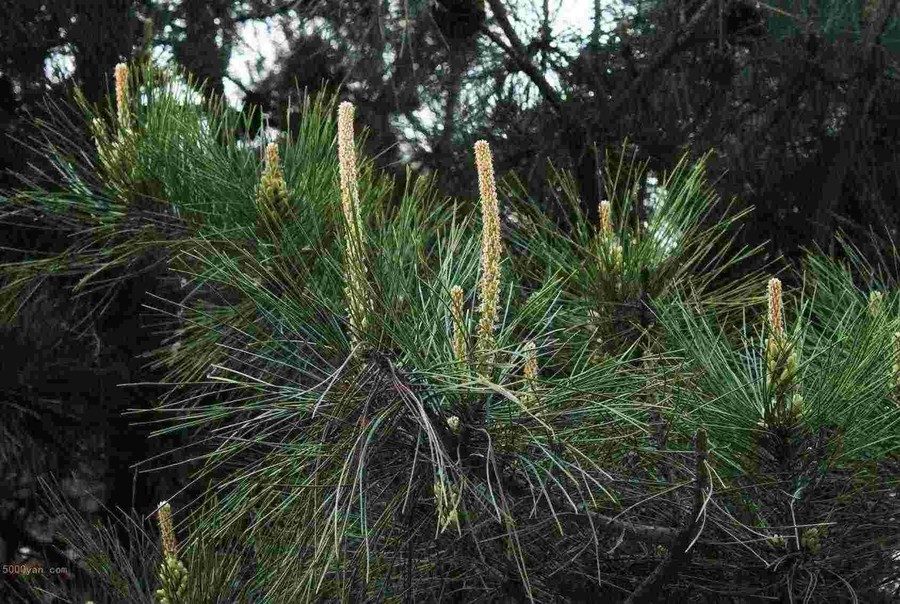
See the entry under "Songhuafen" (Pine Pollen).
Harvesting and Processing
Mostly collected by sawing during logging or wood processing, selected, trimmed, and dried in the sun or in the shade.
Medicinal Properties
Oil pine: Appears as flat, round, jointed segments or irregular slices or blocks, varying in length, thickness, and diameter. The surface is yellowish-brown, grayish-brown, or reddish-brown, slightly rough, sometimes with brown to black-brown oily spots or residual cork bark. The texture is hard and heavy. The transverse section shows a pale brown xylem with a slightly darker heartwood, concentric rings are visible, and scattered small brown resin ducts (pores) may be seen, appearing oily; the pith is small and pale yellowish-brown. The longitudinal section shows straight or oblique, uneven grain. It has the aroma of turpentine oil, and the taste is slightly bitter and acrid.
2. Masson's pine: similar to Chinese red pine. Surface yellow-brown, light yellow-brown or reddish-brown, longitudinal section with straight or oblique grain, relatively uniform. Those with large size, reddish-brown color, and sufficient oiliness are considered superior.
Chemical Constituents
Oil pine and masson pine's pine nodes mainly contain cellulose, lignin, a small amount of volatile oil (turpentine) and resin. The volatile oil containsα- α-pinene and other compoundsβ-α-pinene over 90%. Also contains small amounts of camphene and dipentene, as well as oils. Pine knots of *Pinus tabuliformis* also contain ursolic acid and isopimaric acid.
Pharmacology
Has certain analgesic and anti-inflammatory effects.
Properties and Channel Entry
Bitter, warm. Enters the Liver and Kidney channels.
Functions and Indications
Expels Wind, dries Dampness, relaxes tendons, unblocks collaterals, activates Blood, and alleviates pain. Mainly treats Wind-Cold-Damp Bi, Li Jie Wind pain, foot Bi with flaccidity and weakness, and traumatic injury pain.
Dosage and Administration
Internal: decoct in water, 10-15 g; or steep in wine or vinegar, etc
Precautions and Contraindications
For those with Yin deficiency and blood dryness, use with caution.
Prescriptions
1. For rheumatic arthritis: Songjie 18 g, Sangzhi 30 g, Mugua 9 g. Decoct in water and take orally. (Selected Chinese Herbal Medicines from Shaanxi, Gansu, Ningxia, and Qinghai) 2. For sprains and traumatic injuries (unbroken skin): Appropriate amount of Songjie, split into small pieces, soak in Baijiu for half a month, apply externally to the affected area. (Sichuan Chinese Materia Medica, 1982) 3. For dental caries and dark tooth roots: Burn Songjie to ash and rub on the teeth. (Shenghui Fang) 4. For paddy field dermatitis: Appropriate amounts of Songjie and Aiye, make into Song’ai wine. Apply to the affected area. (Selected Chinese Herbal Medicines from Shaanxi, Gansu, Ningxia, and Qinghai) 5. For regurgitation: Crush Songjie into pieces, decoct in wine and take orally. (Baiyi Xuanfang)