Pinyin: Jixueteng
Aliases
Xuefengteng, Zigengteng, Daxueteng, Guoganglong
Source
Internal use: decoct 3-10 g.patholobus suberectusDunn's dried vine stem.
Botanical Description
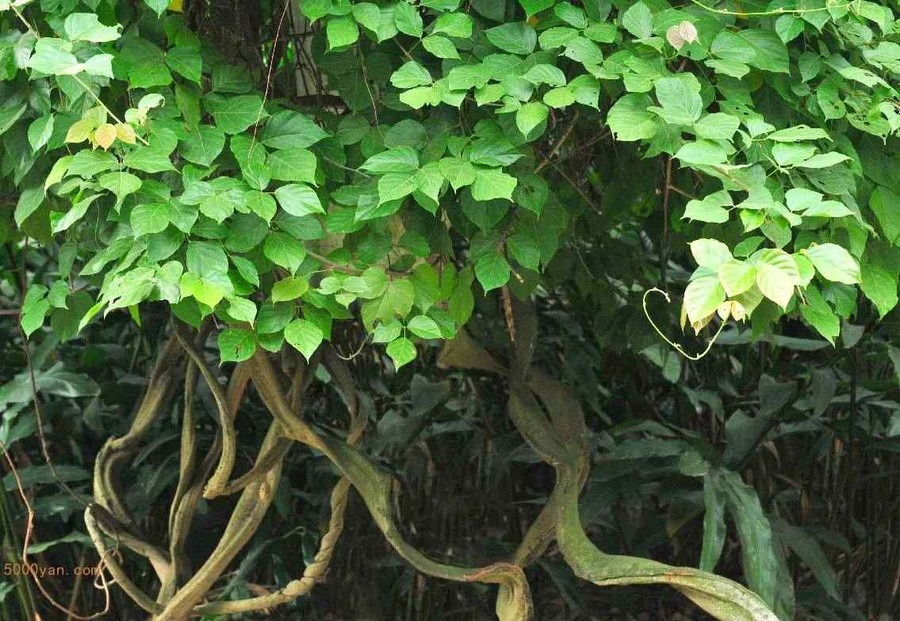
Woody vine, up to several tens of meters long. When the old stem is cut, several eccentric rings can be seen, and chicken blood-like juice exudes from the rings. Trifoliate compound leaves alternate; terminal leaflet broadly elliptical, 12-20 cm long, 7-15 cm wide, apex acute, base rounded or nearly cordate, sparsely covered with short stiff hairs on the upper surface, with yellow short beard hairs between veins on the lower surface; lateral leaflets with oblique base, petiolule about 6 mm long; stipels needle-like. Panicle axillary, large, with many dense flowers, rachis and pedicels covered with yellow pubescence; flower about 10 mm long; calyx fleshy, tubular, 5-toothed, the upper 2 teeth connate, both sides with yellow pubescence; corolla white, fleshy, standard suborbicular, clawed, wings and keel about 7 mm long, with claw and auricle; stamens 10, diadelphous, 5 large and 5 small anthers; ovary with white stiff hairs. Legume ligulate, 8-10 cm long, with yellow pubescence; seed 1, at the apex of the legume. Flowering period June to July, fruiting period August to December.
Habitat and Distribution
It grows in mountain valleys, forests, streamsides, and thickets, and is distributed in Fujian, Guangdong, Guangxi, and Yunnan.
Harvesting and Processing
Harvested in autumn and winter, remove branches and leaves, slice, and sun-dry.
Medicinal Properties
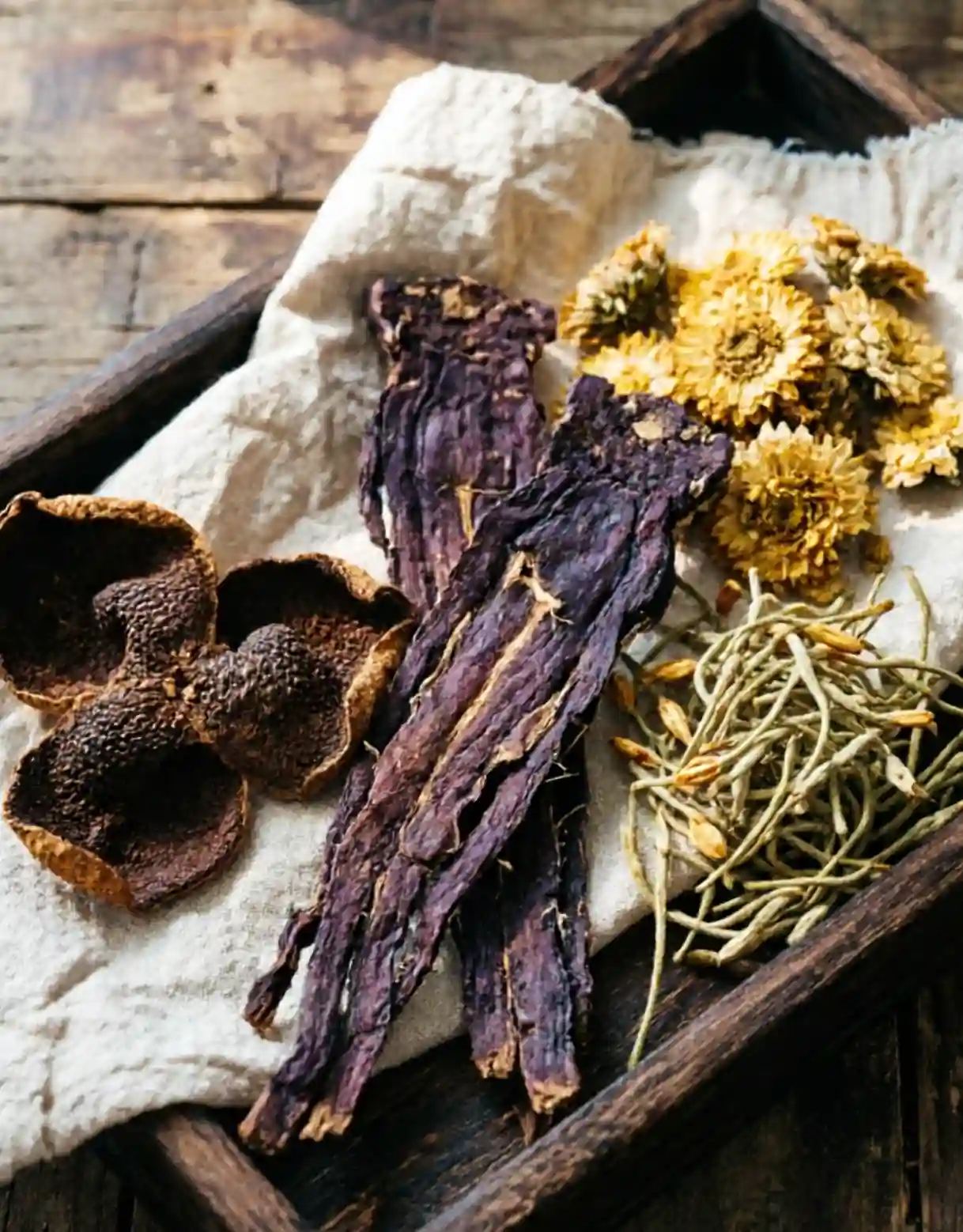
This product consists of oval, oblong, or irregular oblique slices, 0.3-1 cm thick. The cork bark is gray-brown, occasionally with gray-white patches, and the areas where the cork bark has exfoliated appear red-brown. The texture is hard. On the cut surface, the xylem is red-brown or brown with numerous vessel pores; the phloem contains resinous secretions that are red-brown to black-brown, arranged alternately with the xylem to form several concentric oval rings or eccentric semicircular rings; the pith is displaced to one side. Odor: faint; Taste: astringent.
Chemical Constituents
Contains epifriedelanol, daucosterol, ononin, epicatechin, and aloe-emodin among its constituents.
Pharmacology
Has vasodilatory, antiplatelet aggregation, and promotes phosphorus metabolism effects.
Properties and Channel Entry
Bitter, sweet, and warm. Enters the Liver and Kidney channels.
Functions and Indications
Activates Blood and tonifies Blood, regulates menstruation and alleviates pain, relaxes tendons and activates collaterals. Used for irregular menstruation, dysmenorrhea, amenorrhea, Wind-Damp Bi pain, numbness and paralysis, and sallow complexion due to Blood deficiency.
Dosage and Administration
Oral administration: decoct 10-15 g, large doses up to 3-30 g; or steep in wine.
Prescriptions
1. For rheumatic pain: Spatholobus suberectus 15 g, Semiliquidambar cathayensis 15 g, Angelica sinensis 15 g, Achyranthes bidentata 9 g, Viscum liquidambaricola 15 g, Piper kadsura 15 g, Litsea cubeba 15 g. Decoct in water for oral administration. (Spatholobus suberectus Decoction from Clinical Application of Chinese Materia Medica) 2. For vascular sclerosis and lumbodorsal neuralgia in the elderly: Spatholobus suberectus 20 g, Eucommia ulmoides 15 g, Acanthopanax gracilistylus 10 g, Rehmannia glutinosa 15 g. Decoct in 500 ml water down to 200 ml, remove residue, and take in 3 divided doses daily. (Modern Practical Chinese Materia Medica) 3. For lumbago and leukorrhea: Spatholobus suberectus 30 g, Rosa laevigata root, Moghania philippinensis, Parabarium huaitingii, Eclipta prostrata 15 g each, add Codonopsis pilosula 15 g if necessary. 1 dose daily, decoct in water twice for oral administration. (National Compilation of Chinese Herbal Medicine) 4. For amenorrhea: Spatholobus suberectus and Cudrania cochinchinensis 30 g each. Decoct in water for oral administration, 1 dose daily. (Selected Explanations of Anti-aging Chinese Herbal Medicine) 5. For aplastic anemia: Spatholobus suberectus 60-120 g, eggs 2-4 pieces, red dates 10 pieces. Add 8 bowls of water, decoct down to about half a bowl (remove eggshells after eggs are cooked and add back to decoction). Take both the eggs and the decoction together, 1 dose daily. (National Compilation of Chinese Herbal Medicine)