Pinyin: Daxueteng
Aliases
Hongteng, Dahuoxue, Shanhongteng, Huoxueteng
Source
Plant source: Lardizabalaceae family plant *Sargentodoxa cuneata* (Oliv.) Rehd. et Wils.Sargentodoxa cuneataDried vine stem of (Oliv.) Rehd. et Wils.
Botanical Description
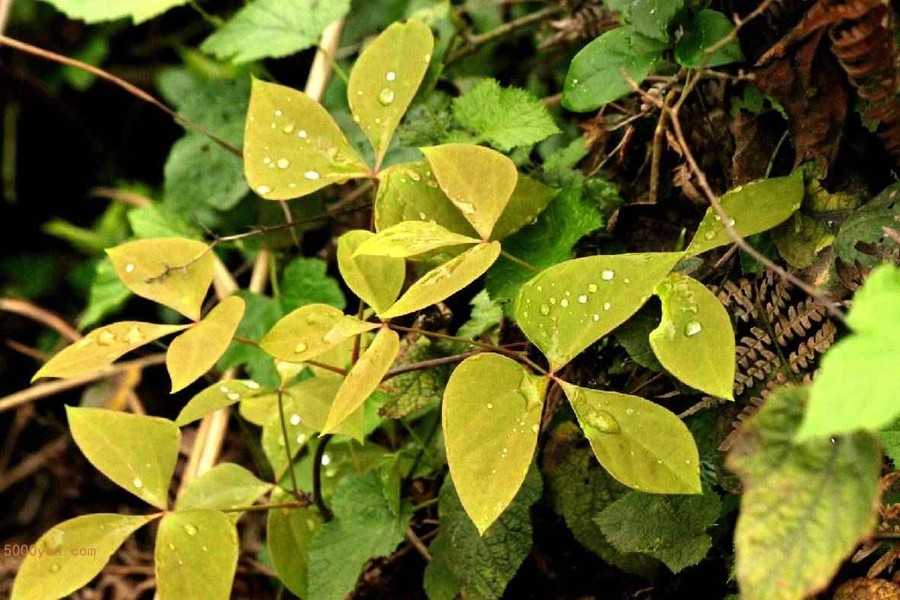
Deciduous woody vine, up to 10 m long. Stem cylindrical, brown and twisted, exuding red sap when cut. Leaves trifoliate, alternate, with long petioles; terminal leaflet obovate, 7-12 cm long, 3-7 cm wide; lateral leaflets larger, obliquely ovate, apex acute, base asymmetrical. Flowers unisexual, dioecious; racemes arising from axils of previous year's leaves, up to 12 cm long, pendulous; sepals 6; petals 6, yellow; male flowers with 6 stamens opposite petals; female flowers with 6 staminodes. Carpels numerous, free, spirally arranged, each with 1 ovule. Berry fleshy, with pedicels, many borne on a globose receptacle. Seeds ovoid, black, glossy. Flowering March to May, fruiting August to October.
Habitat and Distribution
Growing in deep mountain sparse forests, large mountain ravines and fertile soil shrublands. Distributed in Central South China and Shaanxi, Jiangsu, Anhui, Zhejiang, Jiangxi, Fujian, Sichuan, Guizhou, Yunnan and other regions.
Harvesting and Processing
Harvested in autumn and winter, remove lateral branches, cut into segments, and dry.
Medicinal Properties
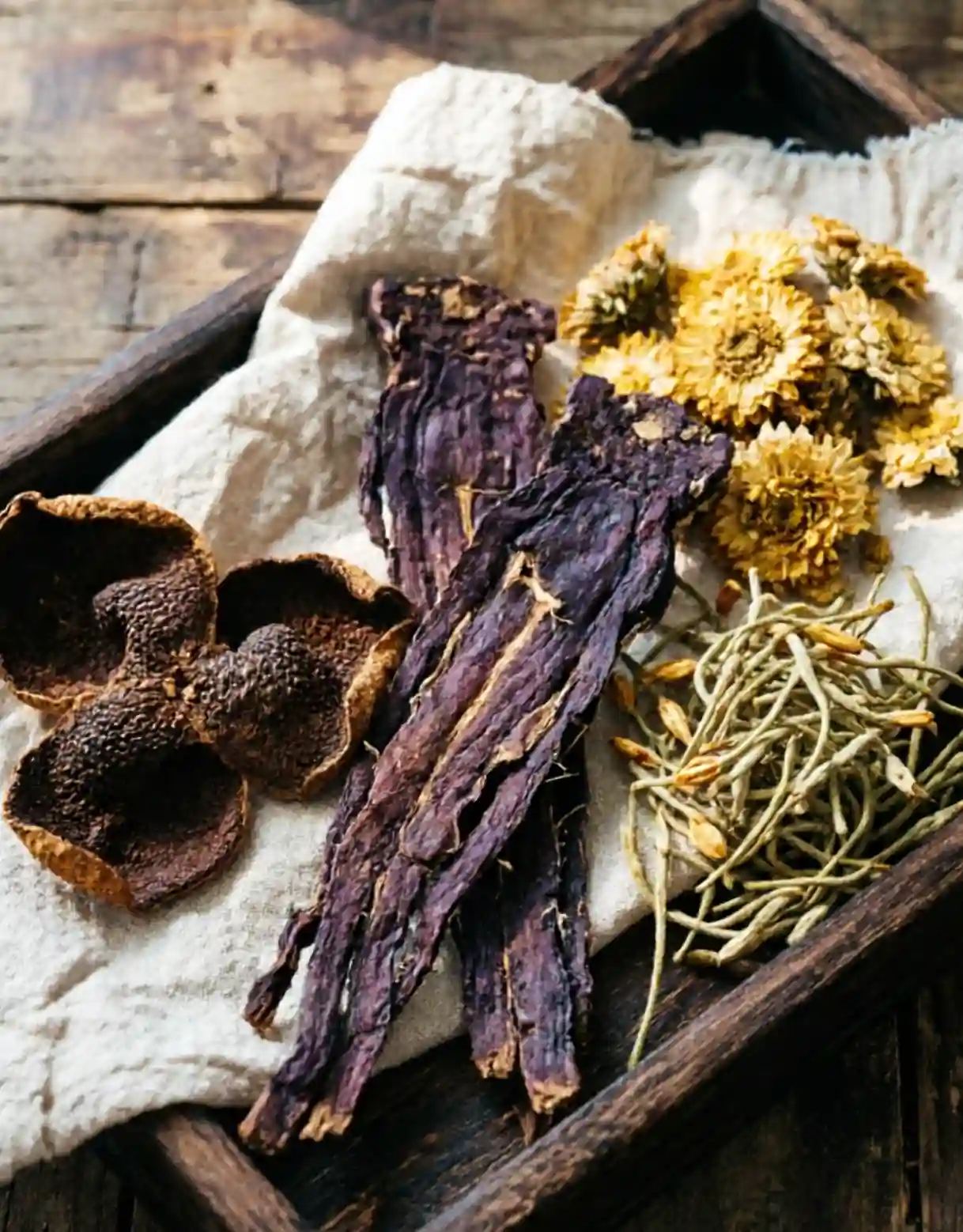
This product is cylindrical in shape, slightly curved, 30-60 cm long, 1-3 cm in diameter. The surface is grayish-brown, rough, with the outer bark often peeling off in scales, revealing a dark reddish-brown color beneath; some specimens show enlarged nodes and slightly sunken branch or leaf scars. The texture is hard; the bark in cross-section is reddish-brown, with several areas embedded inward into the xylem; the xylem is yellowish-white, containing numerous fine porous vessels, with rays arranged radially. Odor: faint; Taste: slightly astringent.
Chemical Constituents
Contains emodin, physcion,β- Sitosterol, stearic acid, salidroside, liriodendrin, tannins, and other constituents.
Pharmacology
Has antibacterial effects.
Properties and Channel Entry
Bitter, neutral. Enters the Large Intestine and Liver channels.
Functions and Indications
Clears Heat, resolves toxicity, invigorates Blood, dispels Wind, and alleviates pain
Dosage and Administration
Internal: decoct 9-15 g in water; or boil in wine or steep in wine. External: appropriate amount, mash and apply to the affected area.
Functions and Indications
Caution should be exercised in pregnant women.
Prescriptions
① Treat dysmenorrhea: Sargentodoxa cuneata, Leonurus japonicus, and Agrimonia pilosa, 9-15 g each. Decoct in water for oral administration. (Zhejiang Flora of Medicinal Plants) ② Treat metrorrhagia: Sargentodoxa cuneata, Agrimonia pilosa, and Imperata cylindrica, 15 g each. Decoct in water for oral administration. (Hunan Materia Medica) ③ Treat traumatic injury: Sargentodoxa cuneata and Drynaria fortunei, appropriate amounts. Pound together and apply to the injured area. (Hunan Rural Commonly Used Chinese Herbal Medicine Manual) ④ Treat rheumatic lower back and leg pain: Sargentodoxa cuneata and Achyranthes bidentata, 9 g each; Citri Reticulatae Pericarpium Viride, Seseli buchtormense, and Polygonum cillinerve, 6 g each. Decoct in water for oral administration. (Shaanxi Chinese Herbal Medicine) ⑤ Treat gastroenteritis with abdominal pain: Sargentodoxa cuneata, 9-15 g. Decoct in water for oral administration. (Zhejiang Folk Commonly Used Chinese Herbal Medicine)