Pinyin: Chuanmutong
Source
This product is the plant Clematis armandii in the family Ranunculaceae.Clematis armandiiFranch.Internal use: decoct the dried vine stem.
Botanical Description
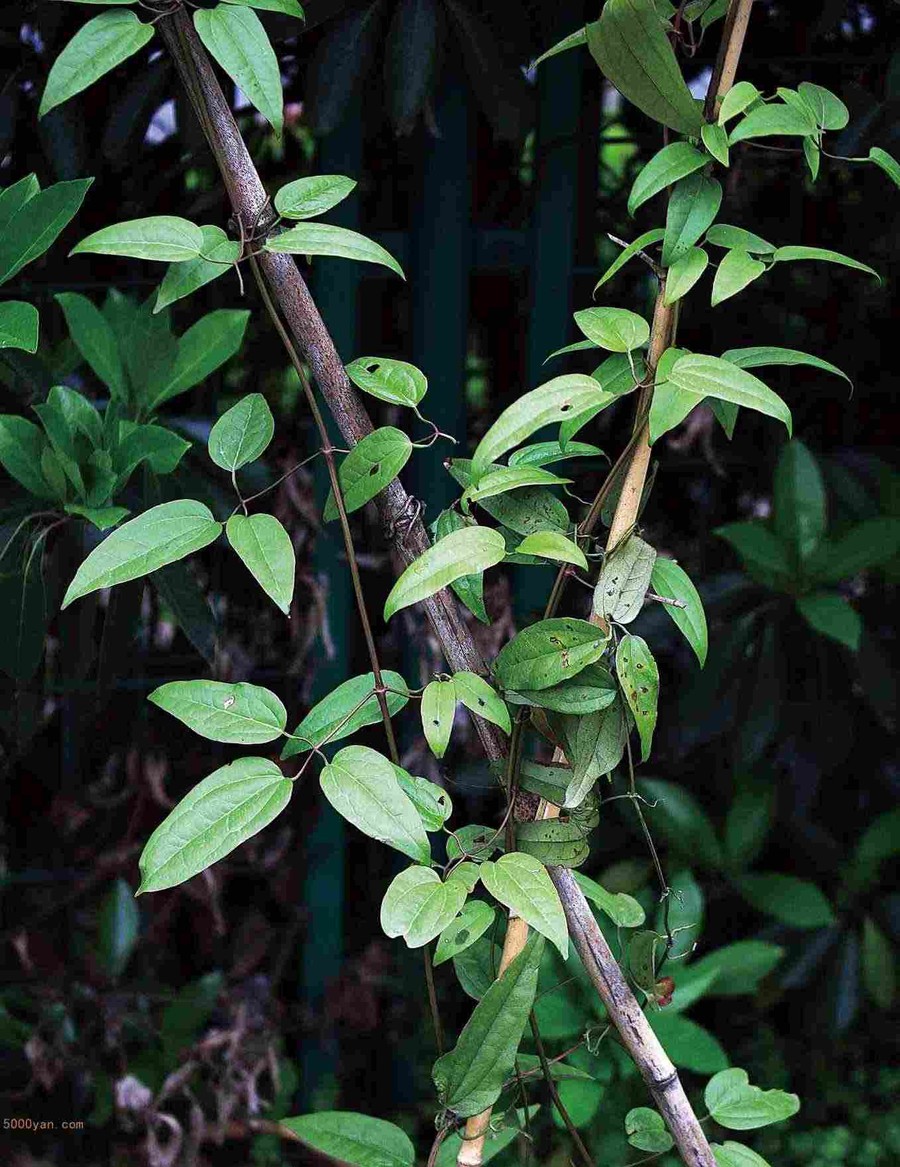
Woody vine, up to 6 m tall. Stem cylindrical, with longitudinal striations, branchlets angled. Leaves trifoliolate; leaflets leathery, ovate-lanceolate, oblong-ovate to ovate, 4-12 cm long, 2-5 cm wide, apex acuminate, base rounded, cordate or broadly cuneate, margin entire, glabrous on both surfaces. Cyme or paniculate cyme, axillary or terminal, usually longer than or nearly equal to leaves; bracts at base of inflorescence nearly oblong, often 3-lobed, upper bracts gradually smaller, lanceolate to subulate; sepals 4-5, spreading, white, oblong or long-elliptic, highly variable in size, outer margin densely pubescent with short hairs, stamens glabrous. Achenes compressed, ovoid to ellipsoid, 4-7 mm long, sparsely pubescent, persistent style up to 5 cm long, with long white hairs. Flowering March to April, fruiting April to July.
Habitat and Distribution
It grows on hillsides, valleys, roadsides in thickets, forest edges, or beside ditches. Distributed in eastern Tibet, Yunnan, Guizhou, Sichuan, southern Gansu and Shaanxi, Hubei, Hunan, Guangdong, Guangxi, southwestern Fujian, and other regions.
Harvesting and Processing
Harvested in spring and autumn, remove the rough outer bark, dry in the sun, or slice thinly while fresh and dry in the sun.
Medicinal Properties
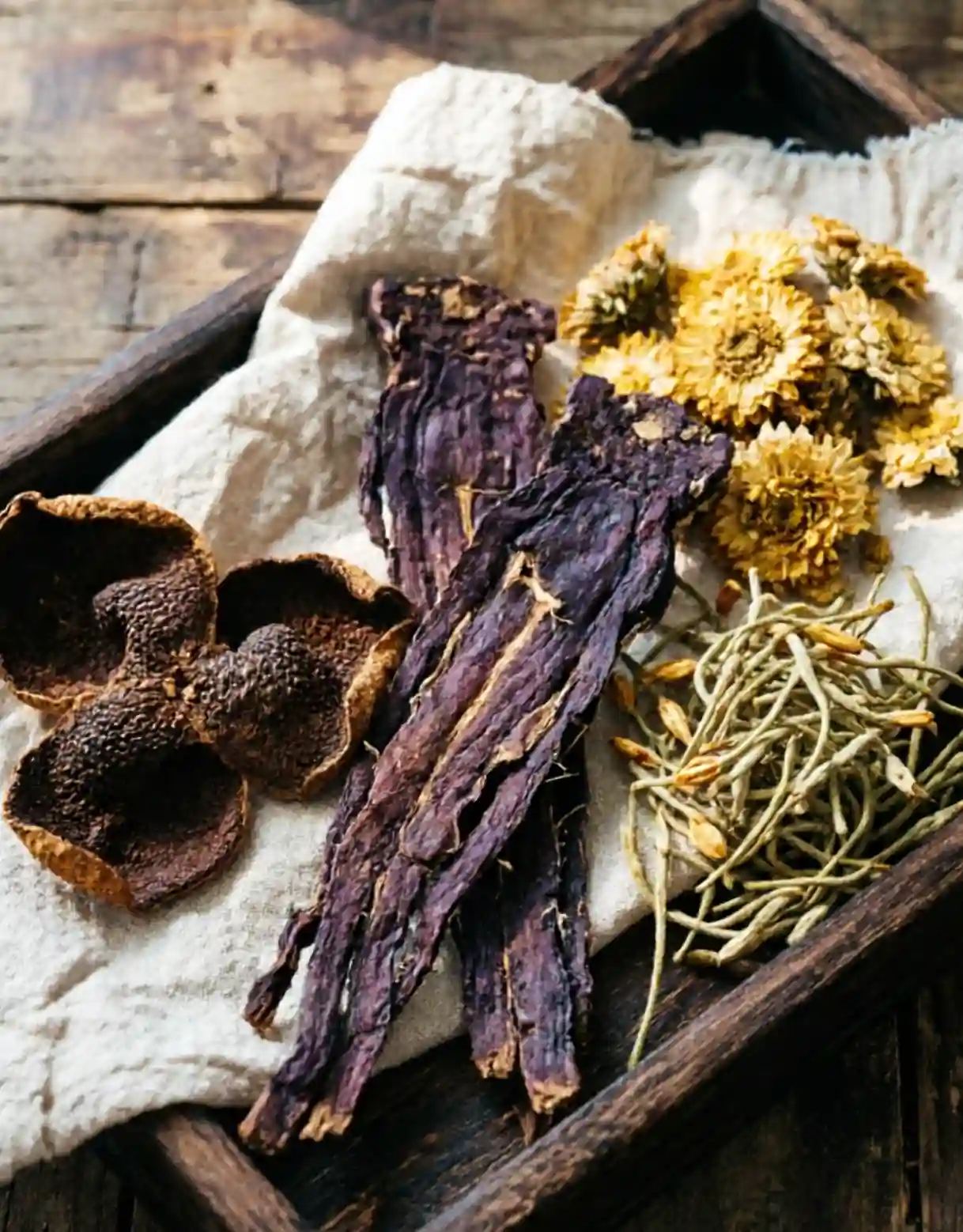
This product is long cylindrical, slightly twisted, 50-100 cm long, 2-3.5 cm in diameter. The surface is yellowish-brown or yellowish-brown, with longitudinal grooves and ridges; nodes are often enlarged, with leaf scars and lateral branch scars. The remaining bark is easily torn. The texture is hard and difficult to break. Slices are 2-4 mm thick, with irregular edges, the remaining bark is yellowish-brown, the xylem is light yellowish-brown or light yellow, with yellowish-white radial striations and fissures, which are filled with vessel pores; the pith is relatively small, off-white or yellowish-brown, occasionally with cavities. Odor: faint; Taste: bland.
Studies have shown that Codonopsis pilosula exhibits a variety of pharmacological effects
It has a significant diuretic effect.
Properties and Channel Entry
Bitter, cold. Enters the Heart, Small Intestine, and Bladder channels.
Functions and Indications
Diuresis to relieve stranguria, clears the Heart and eliminates vexation, unblocks the menses and promotes lactation. Used for edema, stranguria syndrome, vexation with red urine, oral ulcers, amenorrhea with scant lactation, and Damp-Heat impediment pain.
Dosage and Administration
Oral: decoction, 3-6 g.
Precautions and Contraindications
Contraindicated in cases of weak Qi with fluid injury, seminal emission with enuresis, excessive urination, and during pregnancy.