Pinyin: Mahuang
Aliases
Gougu, Beigan.
Source
Family Ephedraceae, plant Ephedra sinicaEphedra sinicaStapf or Ephedra equisetina Bge.Ephedra equisetinaDried herbaceous stem of Bge.
Botanical Description
1. For Ephedra (Cao Mahuang), see the entry under "Mahuang Root" (Mahuanggen).
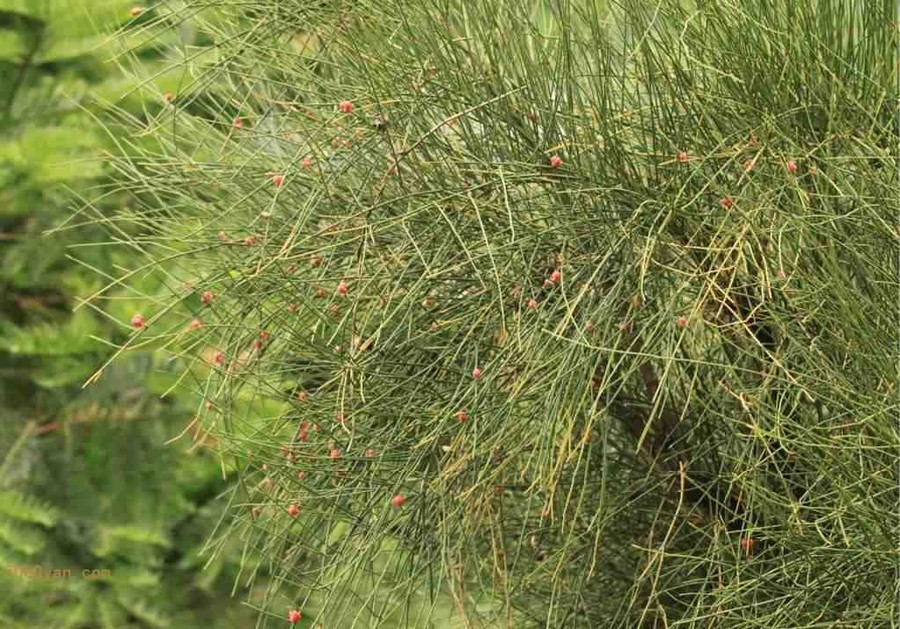
2. Ephedra equisetina: An erect small shrub, 70-100 cm tall. The woody stem is thick and long, erect, with a basal diameter of 1-1.5 cm; branchlets are slender and cylindrical, with many opposite or whorled branches and relatively short internodes. They are usually 1.5-2.5 cm long and 1-1.5 mm in diameter, with inconspicuous fine and shallow longitudinal grooves, covered with white powder, appearing blue-green or gray-green; scale leaves are membranous and sheath-like, with the lower about 2/3 fused, often brown, with the upper part 2-lobed, lobes bluntly triangular, 1.5-2 mm long. Male cones are solitary or 3-4 clustered at the nodes, sessile or with short stalks; female cones are solitary, often paired at the nodes, sessile, with bracts becoming fleshy, red, berry-like, oblong-ovoid or ovoid at maturity. Seeds are usually 1, narrowly oblong-ovoid, 5-7 mm long, 2-3 mm in diameter, often with distinct longitudinal striations. Flowering period is June to July; seed maturity period is August to September.
Habitat and Distribution
Ephedra equisetina grows in arid deserts, gravelly ridges, mountaintops, or grasslands. Distributed in North China, western Shaanxi, Gansu, Xinjiang, and other regions.
Harvesting and Processing
Harvest the green herbaceous stems in autumn and dry them in the sun.
Medicinal Properties
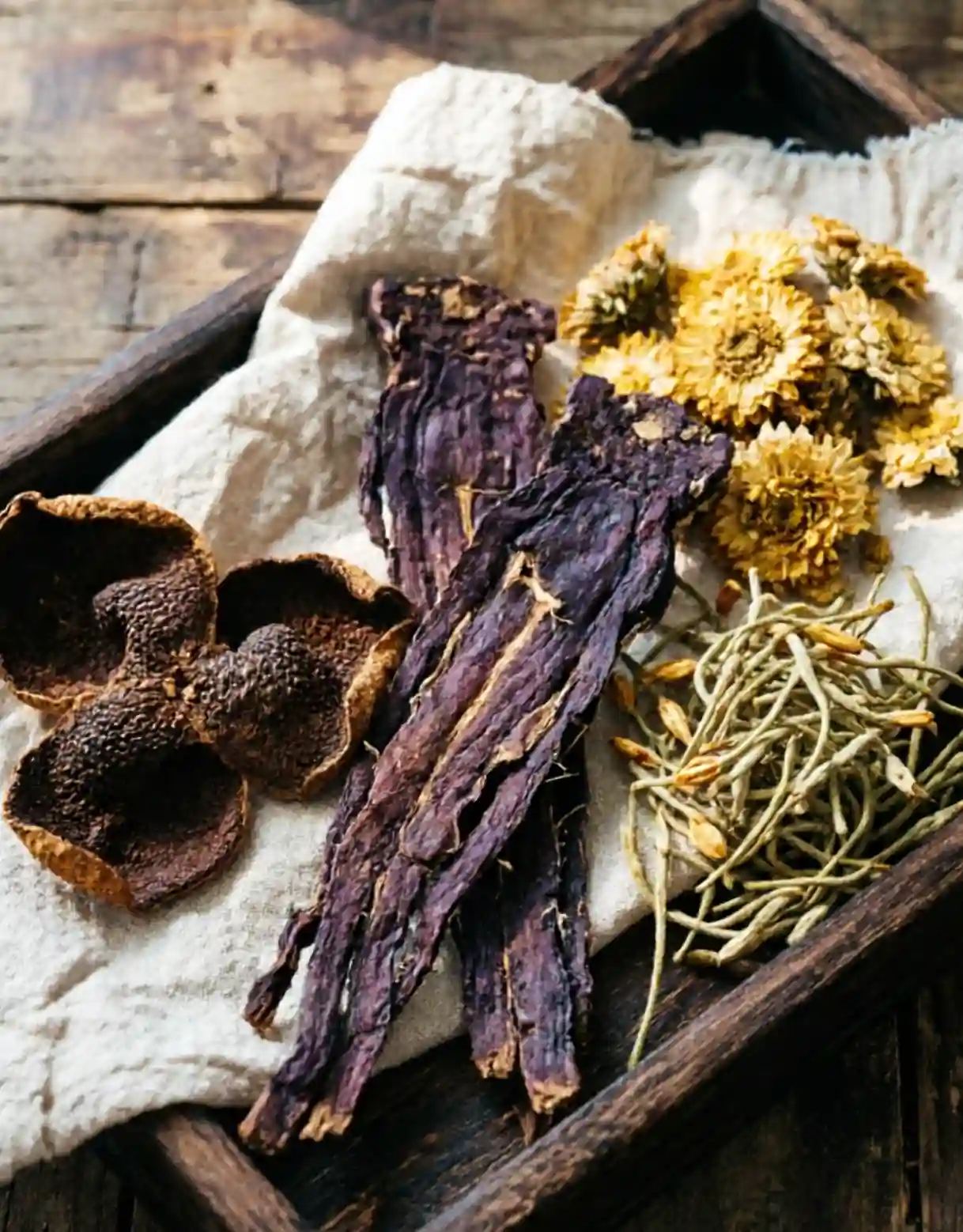
1. Cao Mahuang: It is slender cylindrical, with few branches, diameter 1-2 mm. Some have a small amount of brown woody stem. The surface is pale green to yellow-green, with fine longitudinal ridges, and feels slightly rough to the touch. The nodes are distinct, with internodes 2-6 cm long. At the nodes, there are membranous scale leaves, 3-4 mm long; the lobes are 2 (rarely 3), sharply triangular, with grayish-white tips that are recurved, and the base is united into a tube, reddish-brown. It is light in weight, brittle, easily broken, the fracture is somewhat fibrous, with a greenish-yellow periphery and a reddish-brown, nearly rounded pith. Odor: faintly aromatic; Taste: astringent, slightly bitter.
2. Ephedra intermedia: Many branches, diameter 1.5-3 mm, rough to the touch. Membranous scale leaves at nodes 2-3 mm long, with 3 (rarely 2) lobes, apex sharply pointed. Pith of the stem cross-section triangular-round in shape. 3. Ephedra equisetina: More numerous branches, diameter 1-1.5 mm, not rough to the touch. Internodes 1.5-3 cm long. Membranous scale leaves 1-2 mm long; with 2 (rarely 3) lobes, upper part short triangular, grayish-white, apex mostly not recurved, base brownish-red to brownish-black.
Chemical Constituents
This product contains levo-ephedrine, pseudoephedrine, levo-norephedrine, ephedroxane, and other components.
Pharmacology
On the cardiovascular system, it exhibits adrenergic nerve-like effects; its blood pressure-elevating effect can induce rapid tolerance. On the respiratory system, it has antiasthmatic, antitussive, and expectorant effects. It increases sweat gland secretion. It has a significant diuretic effect. It has antiallergic and certain anti-inflammatory effects. It has antipyretic effects and varying degrees of antimicrobial effects. It stimulates the central nervous system and affects neuromuscular transmission. It has a cholagogic effect, can lower blood urea nitrogen and raise serum cholesterol. It stimulates the radial muscle of the iris, causing pupil dilation; it can also stimulate the isolated uterus, while in normal women it reduces uterine activity. Ephedrine generally inhibits gastrointestinal secretion. It can raise blood sugar, but the effect is weak and inconsistent.
Properties and Channel Entry
Acrid, slightly bitter, warm. Enters the Lung and Urinary Bladder channels.
Functions and Indications
Dispels sweating, disperses Cold, diffuses the Lungs, calms wheezing, and promotes urination to reduce edema. Used for Wind-Cold common cold, chest fullness, wheezing and cough, and Wind-Edema with facial swelling. Honey-fried Mahuang moistens the Lungs and stops cough, mostly used when the exterior pattern has been resolved but wheezing and cough remain.
Dosage and Administration
Oral: decoct in water, 1.5-10 g; or made into pills or powder. External use: appropriate amount, grind into powder for nasal drops or apply topically. Raw use has stronger diaphoretic effect, used for inducing sweating and promoting diuresis; honey-fried use has weaker diaphoretic effect and also moistens the Lungs, mostly used for relieving cough and asthma.
Precautions and Contraindications
For deficiency with spontaneous sweating, night sweats, and deficiency-type dyspnea: contraindicated.
Prescriptions
1. For fluid retention internally, rising to disturb the heart with palpitations under the heart: Banxia (Pinellia ternata) and Mahuang (Ephedra sinica), equal parts. Grind into powder, mix with refined honey to form pills the size of small beans. Take 2 pills with water, three times daily. (from Jingui Yaolüe, Banxia Mahuang Wan). 2. For excessive sleepiness and fondness for sleeping: Mahuang and Baizhu (Atractylodes macrocephala) each 1.5 g, Gancao (Glycyrrhiza uralensis) 0.9 g. Grind into powder, take one fangcunbi (approx. 1-2 g) with water, three times daily. (from Zhouhou Fang). 3. For internal and external eye obstructions: Mahuang 30 g, Danggui (Angelica sinensis) body 3 g. The two ingredients, coarsely ground and stir-fried until black, add a little Shexiang (Moschus) and Ruxiang (Boswellia carterii), grind together into a fine powder. (from Lanshi Micang). 4. For unilateral eye pain and head wind: Mahuang (burned to ash) 15 g, Penxiao (sodium sulfate) 7.5 g, a little Shexiang and Bingpian (borneol), grind into fine powder. (from Puji Fang, Ru Sheng San). 5. For wandering phlegm and all yin-type deep-rooted boils, with diffuse swelling without a head, flat, sunken, and pale white: Mahuang 1.5 g, Shudi (Rehmannia glutinosa preparata) 30 g, Baijiezi (Sinapis alba) 6 g (stir-fried and ground), Paojiangtan (charred ginger) 1.5 g, Gancao 3 g, Rougui (Cinnamomum cassia) 3 g, Lujiaojiao (deer antler glue) 9 g. Decoct in water and take orally. (from Waike Quansheng Ji, Yanghe Tang). 6. For externally contracted cold not relieved, with water qi below the heart, retching, fever with cough, or thirst, or diarrhea, or choking sensation, or urinary difficulty with lower abdominal fullness, or wheezing: Mahuang (remove nodes), Shaoyao (Paeonia lactiflora), Xixin (Asarum sieboldii), Ganjiang (Zingiber officinale), Gancao (honey-fried), Guizhi (Cinnamomum cassia, remove bark) each 60 g, Wuweizi (Schisandra chinensis) half sheng, Banxia (washed) half sheng. The eight ingredients, with one dou of water, first boil Mahuang, reduce by two sheng, skim off the foam, add the other ingredients, boil to obtain three sheng, strain, take one sheng warm. (from Shanghan Lun, Xiao Qinglong Tang). 7. For common cold with wind pathogen, stuffy nose with heavy voice, unable to speak; or wind-cold injury with headache, dizziness, limb spasms, cough with copious phlegm, chest oppression and shortness of breath: Mahuang (without removing nodes), Xingren (Prunus armeniaca, without removing skin and tip), Gancao (raw) each equal parts. Coarsely grind, each dose 15 g, with one and a half cups of water and five slices of Shengjiang (Zingiber officinale); decoct together to one cup, strain. Take orally, cover with clothing and bedding to sleep, induce slight sweating as the measure. (from Jufang, San'ao Tang). 8. For cough and wheezing with upward qi, and a sound like a water frog in the throat: Shegan (Belamcanda chinensis) 13 pieces, Mahuang 120 g, Shengjiang 120 g, Xixin, Ziwan (Aster tataricus), Kuandonghua (Tussilago farfara) each 90 g, Wuweizi half sheng, Dazao (Ziziphus jujuba) 7 pieces, Banxia (large, washed) 8 pieces. The nine ingredients, with one dou and two sheng of water, first boil Mahuang for two boils, skim off the foam, add the other ingredients, boil to obtain three sheng, take warm in three divided doses. (from Jingui Yaolüe, Shegan Mahuang Tang).