Pinyin: Tanxiang
Aliases
Zhan Tan, Bai Tan, Tan Xiang Mu, Zhen Tan
Source
Sandalwood plant from the Santalaceae family.Santalum albumL. tree trunk dried heartwood.
Botanical Description
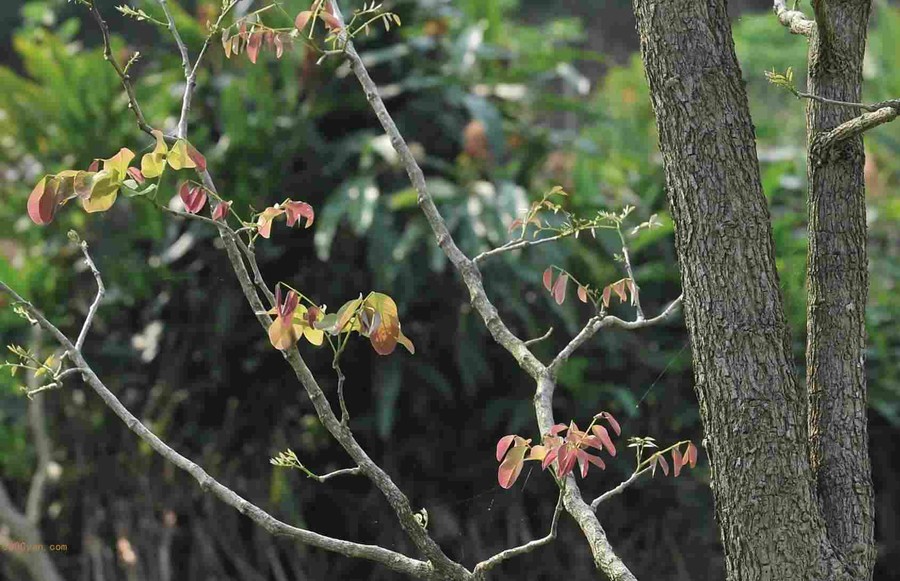
An evergreen small tree, about 10 m tall. Branches with stripes, numerous lenticels and semicircular leaf scars; branchlets slender, internodes slightly enlarged. Leaves elliptic-ovate, membranous, 4-8 cm long, 2-4 cm wide, apex acute, base cuneate or broadly cuneate, somewhat decurrent, margin undulate, slightly revolute, abaxially with white powder, midrib prominent on the abaxial surface, lateral veins about 10 pairs; petiole slender, 1-1.5 cm long. Thyrse inflorescences axillary or terminal, 2.5-4 cm long; bracts 2, subulate-lanceolate, 2.5-3 mm long, caducous; peduncle 2-5 cm long; pedicel 2-4 mm long; flowers 4-4.5 mm long, 5.6 mm in diameter; perianth tube campanulate, about 2 mm long, pale green; perianth 4-lobed, lobes ovate-triangular, initially greenish-yellow, later dark brownish-red; stamens 4, exserted; disk lobes ovate, about 1 mm long; style 3 mm long, dark red, stigma shallowly 3-4-lobed. Drupe 1-1.2 cm long, 1 cm in diameter, exocarp fleshy and juicy, mature deep purplish-red to purplish-black, apex slightly flat, persistent style base somewhat raised. Endocarp with 3-4 longitudinal ribs. Flowering period May to June, fruiting period July to September.
Habitat and Distribution
Wild or cultivated. Distributed in Australia, Indonesia, and South Asia. Introduced and cultivated in Taiwan, Guangdong, Hainan, and Yunnan in China.
Harvesting and Processing
Harvested 30-40 years after planting in the original habitat, sawn into sections. The pale sapwood is discarded, and the heartwood is dried for medicinal use.
Medicinal Properties
This product is cylindrical in shape, some slightly curved, 50-100 cm long, 10-20 cm in diameter, with a pale grayish-yellow surface that is smooth and fine, sometimes showing longitudinal cracks and knife-cut marks. The transverse section is brown with visible oily traces; when split longitudinally, the texture is straight. The texture is firm and not easily broken. Odor: fragrant; Taste: slightly bitter. The aroma is intense when burned.
Chemical Constituents
Internal use: decoct 3-10 g, large dose 10-30 g.α- Santalol,β- Santalol, santene,α- Santalene,β- Santalene, pterocarpene aldehyde, and other components.
Pharmacology
It has a relatively strong antibacterial effect.
Properties and Channel Entry
Acrid, warm. Enters the Spleen, Stomach, Heart, and Lung channels.
Functions and Indications
Promotes the flow of Qi and warms the Middle Jiao, opens the Stomach and alleviates pain
Dosage and Administration
Oral: decoct in water, 1.5-3 g, added later; or made into pills or powder. External: apply appropriate amount of ground juice.
Precautions and Contraindications
Contraindicated for patterns of Yin deficiency with exuberant Fire.
Prescriptions
1. For cold pain in the heart and abdomen: White Sandalwood (Tanxiang) 9 g (ground to a very fine powder), dried Ginger (Ganjiang) 15 g. Infuse in boiling water and take. (Ben Cao Hui Yan) 2. For Qi syncope: Cardamom (Baikoukou), Clove (Dingxiang), Sandalwood (Tanxiang), and Costus Root (Muxiang) each 9 g, Agastache (Huoxiang) and licorice (Gancao, honey-fried) each 24 g, Amomum Fruit (Sharen) 12 g. Grind the above into powder. Take 6 g per dose with a little salt, dissolve in boiling water and take. (Dan Xi Xin Fa, Tiao Qi San) 3. For cold-type cholera: White Sandalwood (Baitanxiang), Agastache Stem (Huoxiang Geng), Costus Root (Muxiang), and Cinnamon (Rougui) each 4.5 g. Grind into a very fine powder. Take 3 g per dose with 15 g of fried Ginger (Ganjiang), infuse in boiling water and take. (Ben Cao Hui Yan) 4. For dysphagia with inability to swallow food: White Sandalwood (Baitanxiang) 4.5 g, Poria (Fuling) and Tangerine Peel (Juhong) each 6 g. Grind all into a very fine powder and take with Renshen (Ginseng) decoction. (Ben Cao Hui Yan) 5. For neurogenic gastrointestinal disorders, vomiting and diarrhea, chest tightness and abdominal pain: Sandalwood (Tanxiang) fine powder 10 g, Agarwood (Chenxiang) fine powder 3 g, licorice (Gancao) fine powder 5 g, Acorus Root (Shichangpu, ground to powder) 10 g. Mix well and store tightly in a sealed bottle. Take 1 g three times daily, before meals, with warm water. (Xian Dai Shi Yong Zhong Yao)