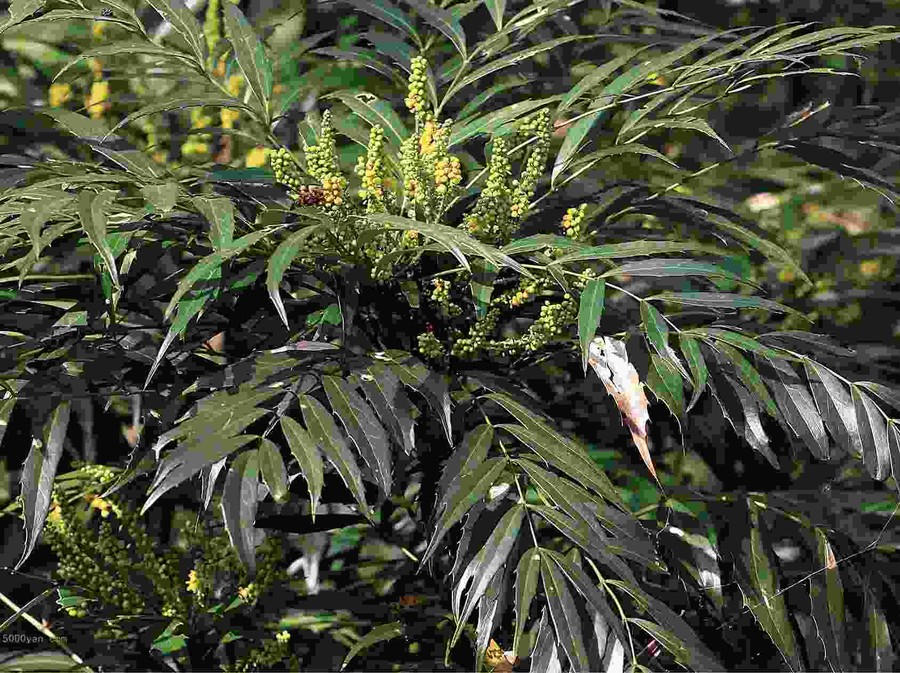
Pinyin: Gonglaomu
Aliases
Tuhuangbai (Mahonia fortunei), Shidagonglao (Mahonia bealei), Laoshuchi (Ilex cornuta), Tuhuangqin (Scutellaria amoena), Yangjiao Huanglian (Coptis omeiensis).
Source
Berberidaceae plant *Mahonia bealei* (Fort.) Carr.Mahoniabealei(Fort.) Carr. or narrowleaf MahoniaMahonia fortuneiDried stem of (Lindl.) Fedde.
Botanical Description
1. Kuo Ye Shi Da Gong Lao: see entry under "Shi Da Gong Lao."
2. Mahonia fortunei: Evergreen shrub, 1-2 m tall. Stem erect, bark gray, much branched. Leaves alternate; odd-pinnately compound; petiole base swollen; leaf leathery, leaflets 5-13, narrowly lanceolate to lanceolate, 6-12 cm long, 0.7-1.5 cm wide, apex long-acuminate with sharp spines, base cuneate, margin with 6-13 spine-tipped serrations on each side, upper surface dark green, glossy, veins indistinct, lower surface yellow-green; veins 3 from base. Racemes from axils of bud scales at branch tips, 3-6 cm long, pedicel base with involucre, bracts ovate-triangular; sepals 9, petaloid; petals 6, yellow, oblong, entire; stamens 6, filaments linear, anthers dehiscing by valves; ovary ovoid, style absent, stigma capitate. Berry ovoid, blue-black when ripe, covered with white powder. Flowering July-August, fruiting August-October.
Habitat and Distribution
Slenderleaf Mahonia grows in thickets on hillsides, along roadsides, and is also cultivated in gardens. It is distributed in Jiangsu, Zhejiang, Jiangxi, Fujian, Hubei, Hunan, Guangdong, and other regions.
Harvesting and Processing
Harvested year-round, cut into pieces or slices, and dried.
Medicinal Properties
This product consists of irregular pieces, varying in size. The outer surface is grayish-yellow to brownish-brown, with distinct longitudinal grooves and fine transverse cracks; some pieces have a relatively smooth, glossy outer surface or remnants of leaf bases. The texture is hard; the cut surface shows a thin, brownish-brown bark and a yellow wood, with several concentric rings and tightly arranged radial striations; the pith is darker in color. Odor: faint; Taste: bitter.
Chemical Constituents
Contains berberine hydrochloride, palmatine hydrochloride, oxyacanthine, jatrorrhizine, berberine, berbamine, tetrandrine, and magnoflorine, among other components.
Pharmacology
1. A 25% water decoction of the root of *Mahonia bealei* (Fort.) Carr. showed mild inhibitory effects on *Staphylococcus aureus*, *Escherichia coli*, and *Pseudomonas aeruginosa* in vitro.
2. Three alkaloid salts extracted from Mahonia fortunei can promote spontaneous movement of isolated intestinal segments at low concentrations, while at high concentrations they may cause increased tension and motor inhibition.
Properties and Channel Entry
Bitter, cold. Enters the Liver, Stomach, and Large Intestine channels.
Functions and Indications
Clears Heat and dries Dampness, drains Fire and resolves toxicity
Dosage and Administration
Oral: Decoct in water, 5-10 g. External: Apply an appropriate amount, wash with decoction; or grind into powder and mix for application.
Precautions and Contraindications
Contraindicated for those with a constitution of deficiency-cold.
Prescriptions
1. For enteritis and dysentery: Mahonia fortunei 15 g, Rhodomyrtus tomentosa root 30 g, pomegranate leaf (or Pteris multifida) 15 g. Decoct in water and take orally. (Zhejiang Medicinal Plant Flora) 2. For hemorrhoids: Mahonia fortunei 15 g, pig trotters 2 pieces. Boil until cooked, remove the residue, and eat the pig trotters. (Hunan Materia Medica) 3. For red, swollen, and painful eyes: Mahonia fortunei 15 g, Wild Chrysanthemum 15 g. Decoct in water and take orally. (Jiangxi Herbal Manual) 4. For toothache due to fire: Mahonia fortunei 60 g. Decoct in water and frequently rinse the mouth. (Hunan Materia Medica)