Pinyin: Xiheliu
Aliases
Chengliu, Heliu, Chunliu, Chichengliu, Shanchengliu
Source
Tamarix chinensis Lour., a plant of the family Tamaricaceae.Tamarix chinensisThe dried tender branches and leaves of Lour.
Botanical Description
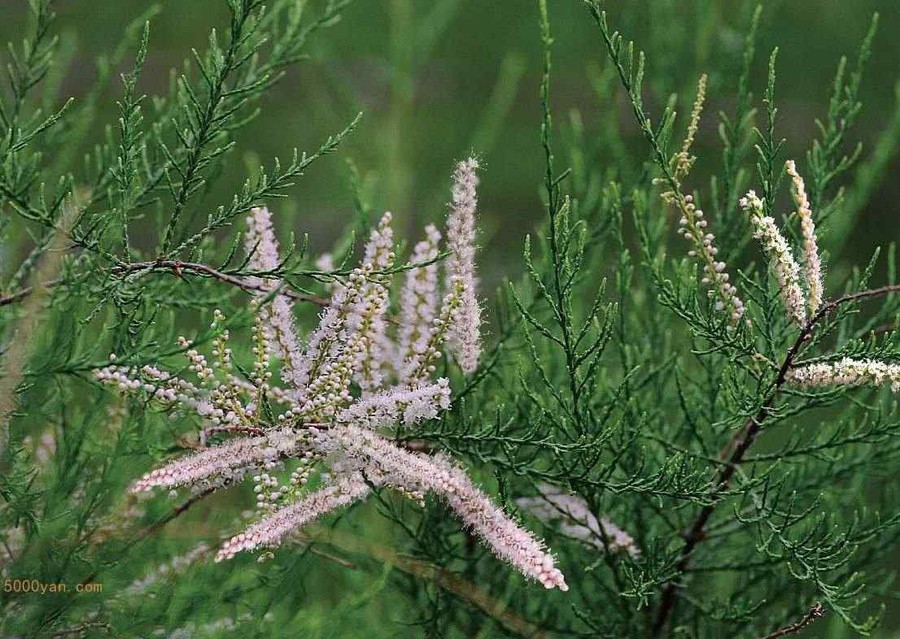
Shrub or small tree, 3-6 m tall. Young branches slender, spreading and pendulous, reddish-purple or dark purple. Leaves scale-like, subulate or ovate-lanceolate, 1-3 mm long, half-adnate, with a keeled ridge on the abaxial surface. Flowers 2-3 times per year; in spring, lateral racemes on previous year's branchlets, flowers slightly larger and sparse; in summer and autumn, terminal racemes forming large terminal panicles at the tips of current year's young branches, often pendulous, flowers slightly smaller and densely arranged; each flower with 1 linear-subulate green bracteole; flowers pentamerous, pink; sepals ovate; petals elliptic-obovate, about 2 mm long; stamens inserted between lobes of the disc, longer than petals; ovary conical-bottle-shaped, style 3, clavate. Capsule about 3.5 mm long, 3-valved. Flowering April to September, fruiting June to October.
Habitat and Distribution
It thrives in river alluvial areas, seashores, beaches, moist saline-alkali soils, and sandy wastelands. Wild in Liaoning, Hebei, Shandong, Jiangsu, Anhui, Henan, and other areas; cultivated in regions from eastern to southwestern China.
Harvesting and Processing
Harvest in summer when the flowers have not yet opened, and dry in the shade.
Medicinal Properties
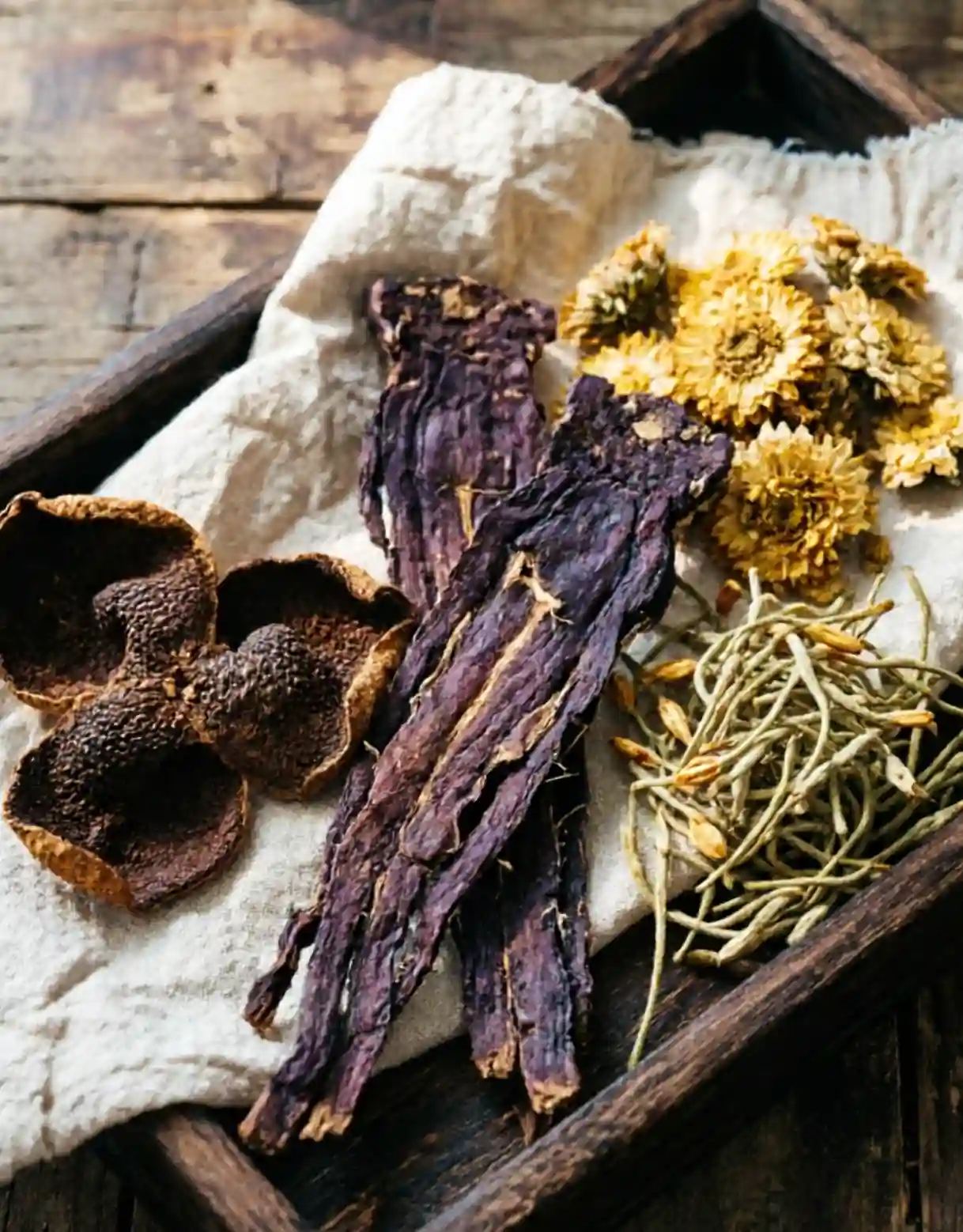
The stems and branches are slender, cylindrical, 0.5-1.5 mm in diameter. The surface is grayish-green, with numerous alternate, scale-like leaflets. The texture is brittle and easily broken. Slightly thicker branches have a reddish-brown surface, with leaves often fallen off, leaving raised leaf bases; the fracture surface is yellowish-white with a central pith. Odor: faint; Taste: bland.
Chemical Constituents
Contains tamariscinone, tamarixinol, tamarixol, kaempferol-4′-methyl ether, quercetin-3′,4′-dimethyl ether, salicin, and other constituents.
Pharmacology
It has an inhibitory effect on the respiratory system; has a hepatoprotective effect; inhibits bacterial growth, and also has antipyretic effects.
Properties and Channel Entry
Sweet, pungent, neutral. Enters the Lung, Stomach, and Heart channels.
Functions and Indications
Induces sweating to promote eruption of measles, expels Wind and eliminates Dampness. Used for incomplete measles eruption and Wind-Damp Bi pain (rheumatic arthralgia).
Dosage and Administration
Internal: decoct in water, 10-15 g; or taken as powder. External: appropriate amount, decoct for washing.
Precautions and Contraindications
Forbidden for patients with measles that have already erupted and those with general debility and excessive sweating.
Prescriptions
1. For colds, fever, and headache: Xiheliu (Tamarix chinensis) and Bohe (Mentha haplocalyx) 9 g each, Jingjie (Schizonepeta tenuifolia) 6 g, Lüdouyi (mung bean coat) 9 g, Shengjiang (Zingiber officinale) 3 g; decoct in water and take orally. (Qingdao Chinese Herbal Medicine Handbook) 2. For rheumatic pain: Xiheliu (Tamarix chinensis), Huzhanggen (Polygonum cuspidatum root), and Jixueteng (Spatholobus suberectus) 30 g each; decoct in water and take orally. (Zhejiang Medicinal Flora) 3. For malaria: Decoct Xiheliu (Tamarix chinensis) in water, leave it exposed outdoors overnight, then drink it several times before dawn. The malaria will resolve on its own. (Weisheng Yijian Fang) 4. For alcohol-related disorders: Xiheliu (Tamarix chinensis), in an unspecified amount, dried in the sun and ground into a fine powder. Take 3 g each time, mixed with wine. (Lü Chan Yan Ben Cao)