Pinyin: Dinggongteng
Aliases
Baogongteng, Malaza teng, Banyulie
Source
1. For rheumatism: Dinggongteng 9 g, Duhuo 6 g, stir-fry with wine and decoct in water, take orally.Erycibe obtusifoliaDried rattan stem of Benth.
Botanical Description
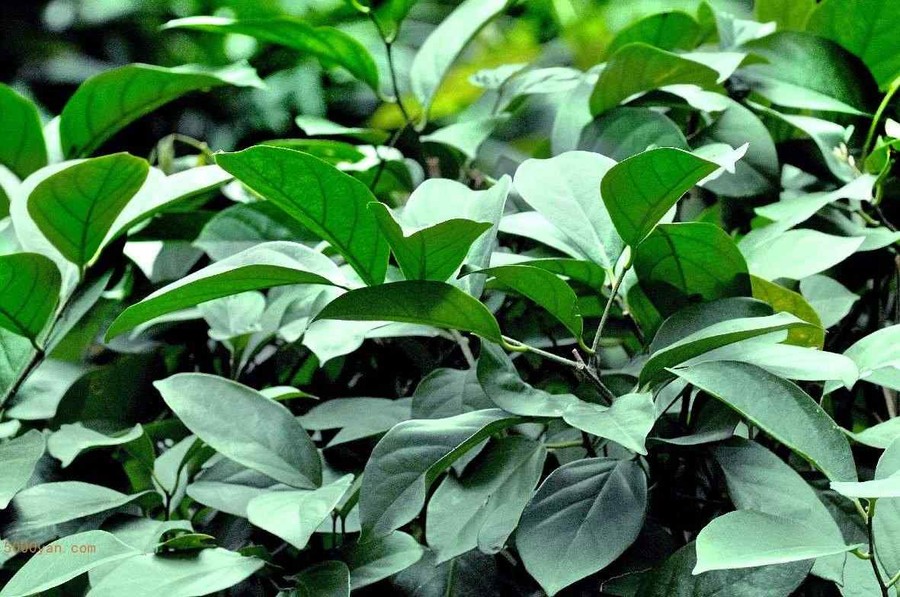
Woody vine, approximately 12 m long. Branchlets yellow-brown after drying, distinctly angular, glabrous. Leaves simple, alternate; petiole 0.8-1.2 cm long, glabrous; leaf blade leathery, elliptic or obovate-oblong, 6.5-9 cm long, 2.5-4 cm wide, apex obtuse or rounded, base gradually narrowed to cuneate, both surfaces glabrous; lateral veins 4-5 pairs, anastomosing and ascending within the margin. Cymes axillary and terminal, those axillary with few to many flowers, those terminal arranged in racemes, inflorescence axis and pedicels with pale brown pubescence; calyx spherical, sepals 5, suborbicular, with pale brown pubescence and ciliate margin; corolla white, 5-lobed, lobes oblong, entire or shallowly undulate; stamens 5, unequal, anthers gradually acuminate at apex, scales present between filaments; ovary cylindrical, stigma conical, appressed to the ovary. Berry ovoid-ellipsoid, about 1.4 cm long. Seed 1. Flowering period June to August.
Habitat and Distribution
Born in valley dense forests or sparse forests at an altitude of 250-1200 m, climbing on trees. Distributed in Guangdong, Guangxi, and Yunnan.
Harvesting and Processing
It can be harvested year-round, cut into segments or slices, and dried in the sun.
Medicinal Properties
This product consists of obliquely cut segments or slices, diameter 1-10 cm. Outer bark is grayish-yellow, grayish-brown, or light brownish-brown, slightly rough, with shallow grooves, irregular longitudinal cracks or fissures, and punctate or wart-like lenticels that are yellowish-white; older cork bark exfoliates in thin flakes. Texture is hard, relatively fibrous, difficult to break; cut surface is elliptical, yellowish-brown or light yellowish-brown, with abnormal vascular bundles arranged in flower-like or block-like patterns, and xylem vessels appearing as punctate dots. Odor: faint; Taste: bland.
Chemical Constituents
This product contains the chemical components erythroside A, erythroside B, erythroside C, scopoletin, scopolin, and trace amounts of caffeic acid and chlorogenic acid.
Pharmacology
It has anti-inflammatory, miotic, and intraocular pressure-lowering effects; it promotes both cellular and humoral immunity; and it improves cardiac function.
Properties and Channel Entry
Acrid, warm; slightly toxic. Enters the Liver, Spleen, and Stomach channels.
Functions and Indications
Expels Wind and eliminates Dampness, reduces swelling and alleviates pain. Used for Wind-Damp Bi pain (rheumatic arthralgia), hemiplegia, and traumatic swelling and pain from falls and contusions.
Dosage and Administration
Internal use: decoction, 3-6 g; or steep in wine. External use: appropriate amount, steep in wine for external application.
Precautions and Contraindications
This product is toxic and has a strong diaphoretic effect; use with caution in debilitated individuals and contraindicated in pregnant women.