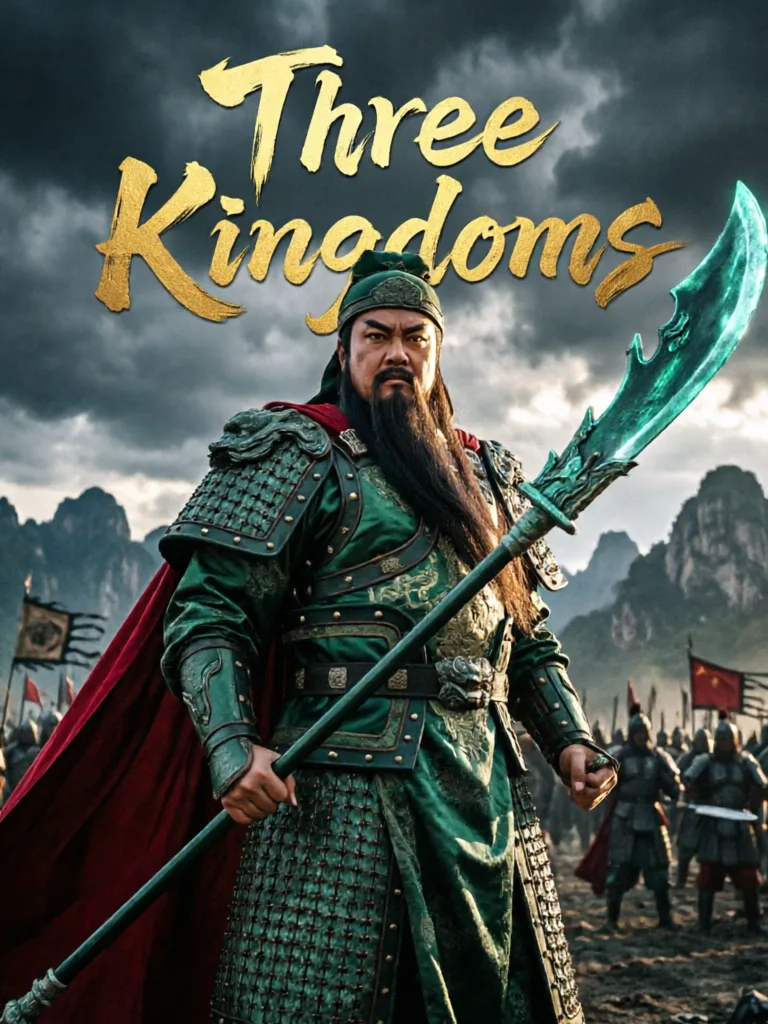
After his victory at Guandu, Cao Cao reorganized his forces and began a steady pursuit of the retreating Yuan Shao. Yuan Shao, wearing only a simple headscarf and single robe, fled with barely eight hundred cavalry to the northern bank of Liyang. There, General Jiang Yiqu emerged from his camp to receive his defeated master. Yuan Shao recounted the disaster that had befallen him, and Jiang Yiqu immediately set about rallying the scattered survivors. When the lost soldiers heard their lord still lived, they gathered like ants to a honey trail. The army's spirit revived, and they discussed returning to their capital of Jizhou.
As they marched, they made camp one night in a desolate mountain range. Lying in his tent, Yuan Shao heard distant weeping. He stole out to investigate and found his defeated soldiers huddled together, mourning brothers lost, comrades fallen, and families abandoned. They beat their chests and wept bitterly, crying out: "If only our lord had heeded Tian Feng's counsel, how could we have suffered such calamity!" Great remorse seized Yuan Shao. "I ignored Tian Feng's advice," he muttered to himself, "and now my army is shattered and my generals dead. How can I face him again?" The next morning, as he rode forth, Feng Ji arrived with reinforcements. "I did not listen to Tian Feng," Yuan Shao confessed to Feng Ji, "and this defeat is the result. I am ashamed to see him." Feng Ji, ever the sycophant, seized the opportunity to slander his rival. "Tian Feng," he whispered, "when he heard of your defeat from his prison cell, he clapped his hands and laughed, saying, 'Exactly as I predicted!'" Yuan Shao's face twisted with rage. "How dare that petty scholar mock me! I will have him killed!" He immediately dispatched an envoy with a sword to the prison in Jizhou to execute Tian Feng.
Meanwhile, Tian Feng sat in his cell. One day, the jailer came to him and said: "Congratulations, Master Tian! I bring you joyful news!" "What joy could there be for me?" Tian Feng asked with a faint smile. "General Yuan has returned in defeat," the jailer explained, "and surely he will now value your wise counsel." Tian Feng laughed bitterly. "I am a dead man," he said. "Why do you say that when everyone else celebrates?" the jailer asked in confusion. "General Yuan appears generous but is inwardly suspicious," Tian Feng explained. "He does not value loyalty. If he had won, his pride might have allowed him to spare me. But now that he has lost, his shame will demand my death." The jailer did not believe him, but soon the envoy arrived with the general's sword and the execution order. Only then did the jailer understand. "I knew this day would come," Tian Feng said calmly. The jailer wept, but Tian Feng remained composed. "A true man born into this world who serves an unworthy lord is a fool," he declared. "Today I die—what is there to regret?" With that, he drew the blade across his own throat in his prison cell. Thus perished Tian Feng, a man of wisdom and integrity. Of him,
history records a verse: "Yesterday, Ju Shou was lost on the battlefield; today, Tian Feng perishes in his cell. The pillars of the north are broken one by one—how could Yuan Shao's house long stand?" All who heard of Tian Feng's death sighed in sorrow.
Yuan Shao returned to Jizhou, his mind in turmoil. He could not attend to state affairs. His wife, Lady Liu, urged him to settle the succession. Yuan Shao had three sons: his eldest, Yuan Tan, styled Xiansi, governed Qing Province; his second, Yuan Xi, styled Xianyi, governed You Province; and his third, Yuan Shang, styled Xianfu, was born of Lady Liu. Yuan Shang was handsome and robust, and Yuan Shao doted on him, keeping him always at his side. Since the defeat at Guandu, Lady Liu had pressed for Yuan Shang to be named heir. Yuan Shao consulted his four chief advisors: Shen Pei and Feng Ji, who supported Yuan Shang, and Xin Ping and Guo Tu, who supported Yuan Tan. Each spoke for his own master. "External threats still loom," Yuan Shao told them, "and internal matters must be settled quickly. I wish to name my successor. My eldest son, Yuan Tan, is violent and fond of killing. My second, Yuan Xi, is too weak and indecisive. My third, Yuan Shang, has the bearing of a hero—he honors the worthy and respects the learned. I wish to make him my heir. What say you?" Guo Tu objected: "Of the three sons, Yuan Tan is the eldest and governs an important province. To depose the elder in favor of the younger is to sow the seeds of chaos. Our military strength is already shaken, and the enemy presses at our borders. How can we add father-and-son, brother-against-brother conflict to our troubles? My lord, focus on repelling the enemy—leave the matter of succession for another day." Yuan Shao hesitated, unable to decide.
Suddenly, reports arrived that Yuan Xi was approaching with 60,000 troops from You Province, Yuan Tan with 50,000 from Qing Province, and their cousin Gao Gan with another 50,000 from Bing Province. All converged on Jizhou to aid their lord. Yuan Shao's spirits lifted. He reorganized his army and prepared to face Cao Cao once more. Meanwhile, Cao Cao led his victorious forces to the banks of the Yellow River. Local elders, their hair and beards white with age, came bearing food and wine to welcome him. Cao Cao invited them into his tent, offered them seats, and asked the eldest: "How many years have you seen, venerable sir?" "Nearly a hundred," the old man replied. "I apologize if my soldiers have disturbed your village," Cao Cao said. The elder replied: "During the reign of Emperor Huan, a yellow star appeared in the skies above the regions of Chu and Song. A man named Yin Kui from Liaodong, skilled in reading the heavens, was staying here that night. He told us: 'This yellow star in the heavens shines directly upon this land. Fifty years from now, a true man will arise from the region between Liang and Pei.' By our reckoning, exactly fifty years have passed. Yuan Shao taxed the people heavily, and all resent him. But you, Chancellor, have raised an army of righteousness to comfort the people and punish the tyrant. Your victory at Guandu, shattering Yuan Shao's million-strong army, fulfills Yin Kui's prophecy. The people can now hope for peace." Cao Cao smiled modestly. "How dare I accept such praise?" He gave the elders wine, food, and silk, then sent them on their way. He issued a strict order to his army: "Any soldier who kills a villager's dog or chicken shall be punished as if he had killed a man!" The people were awed and grateful, and Cao Cao was secretly pleased.
Word soon came that Yuan Shao had gathered the forces of four provinces, totaling two to three hundred thousand men, and had encamped at Cangting. Cao Cao advanced and set up his own camp. The next day, the two armies faced each other in battle formation. Cao Cao rode out with his generals; Yuan Shao emerged with his three sons, his nephew, and his civil and military officers. "Yuan Benchu," Cao Cao called out, "your plans have failed and your strength is exhausted. Why do you not surrender? Wait until the blade is at your neck, and it will be too late!" Yuan Shao roared in fury and turned to his generals. "Who dares to challenge him?" Yuan Shang, eager to show his prowess before his father, brandished a pair of swords and charged onto the field, his horse galloping back and forth. "Who is that?" Cao Cao asked. "Yuan Shao's third son, Yuan Shang," someone replied. Before the words had died, a general named Shi Huan, a subordinate of Xu Huang, galloped out to meet him. The two clashed, but after barely three exchanges, Yuan Shang feigned defeat and fled at an angle. Shi Huan pursued. Yuan Shang nocked an arrow, twisted in his saddle, and shot backward, striking Shi Huan squarely in his left eye. The general fell dead from his horse. Seeing his son victorious, Yuan Shao raised his whip as a signal. The massive Yuan army surged forward, and a chaotic melee erupted. Both sides withdrew only when their gongs sounded the retreat.
Back at his camp, Cao Cao gathered his advisors to devise a plan to break Yuan Shao. Cheng Yu proposed a stratagem: the Ten-Sided Ambush. He urged Cao Cao to retreat to the riverbank and conceal ten units in ambush. "Lure Yuan Shao to pursue us to the river," Cheng Yu explained. "With our backs to the water and no retreat, our men will fight to the death. That is how we will defeat him." Cao Cao approved. He divided his forces into two wings of five units each. On the left: Xiahou Dun, Zhang Liao, Li Dian, Yue Jin, and Xiahou Yuan. On the right: Cao Hong, Zhang He, Xu Huang, Yu Jin, and Gao Lan. Xu Chu commanded the center as vanguard. The next day, the ten ambush units advanced first and took their positions. At midnight, Cao Cao ordered Xu Chu to lead a feigned attack on Yuan Shao's camp. The five camps of Yuan Shao's army all roused and counterattacked. Xu Chu turned and fled. Yuan Shao led the pursuit, the war cries never ceasing. By dawn, they had driven Cao Cao's forces to the riverbank. With no escape route left, Cao Cao shouted: "There is no way forward! Will you not fight to the death?" His soldiers turned and charged with desperate fury. Xu Chu, riding at the front, cut down over a dozen enemy officers. Yuan Shao's army fell into chaos. As they tried to retreat, Cao Cao's forces struck from behind. A drum roll thundered—from the left, Xiahou Yuan; from the right, Gao Lan—both burst forth and attacked.
Yuan Shao gathered his three sons and his nephew and fought desperately to cut a bloody path. But before they had gone ten li, Yue Jin from the left and Yu Jin from the right struck again. The field was carpeted with corpses, and blood flowed like rivers. Within a few more li, Li Dian from the left and Xu Huang from the right intercepted them once more. Father and sons, their courage shattered, fled into their old camp. They ordered the army to cook food, but as they were about to eat, Zhang Liao from the left and Zhang He from the right stormed the camp. Yuan Shao scrambled onto his horse and fled toward Cangting. His men and horses were exhausted, but just as they sought to rest, Cao Cao's main army bore down on them. Yuan Shao fled for his life. As he rode, Cao Hong from the right and Xiahou Dun from the left blocked his path. "Fight to the death," Yuan Shao screamed, "or we are captured!" They broke through the encirclement with desperate effort. Yuan Xi and Gao Gan were both wounded by arrows. Their army was nearly annihilated. Yuan Shao embraced his three sons and wept bitterly, then collapsed unconscious. When they revived him, he coughed up blood without stopping. "I have fought in dozens of campaigns," he lamented, "but never have I been reduced to such a state! Heaven itself abandons me! Return each of you to your province, and swear to fight Cao Cao to the bitter end!" He ordered Xin Ping and Guo Tu to go with Yuan Tan to Qing Province and prepare defenses against Cao Cao's invasion. Yuan Xi was to return to You Province, and Gao Gan to Bing Province, each to gather men and horses for future use. Yuan Shao himself took Yuan Shang into Jizhou to recover from his illness, placing Yuan Shang, Shen Pei, and Feng Ji in temporary command of military affairs.
After his great victory at Cangting, Cao Cao richly rewarded his army and sent spies to assess the situation in Jizhou. They reported: "Yuan Shao lies ill in bed. Yuan Shang and Shen Pei guard the city. Yuan Tan, Yuan Xi, and Gao Gan have all returned to their provinces." His officers urged Cao Cao to attack immediately. "Jizhou has vast grain stores," Cao Cao replied, "and Shen Pei is a cunning strategist. It cannot be taken quickly. The crops are still in the fields, and I do not wish to harm the people's livelihood. We will wait until the autumn harvest, then take the city." As they debated, a letter arrived from Xun Yu in Xuchang: "Liu Bei has gathered tens of thousands of troops in Runan from Liu Pi and Gong Du. Hearing that you have marched north to Hebei, he has left Liu Pi to guard Runan and is leading his own army to attack Xuchang while your back is turned. Return at once to defend the capital!" Cao Cao was alarmed. He left Cao Hong to hold the river crossing with a show of force while he himself led the main army south to Runan to confront Liu Bei.
Liu Bei, with Guan Yu, Zhang Fei, Zhao Yun, and their forces, was marching to attack Xuchang. Near Mount Rang, they encountered Cao Cao's army advancing toward them. Liu Bei made camp at the foot of the mountain, dividing his forces into three units: Guan Yu held the southeast corner, Zhang Fei the southwest corner, while Liu Bei and Zhao Yun established the main camp in the south. When Cao Cao's army arrived, Liu Bei emerged with drums and war cries. Cao Cao formed his battle line and called Liu Bei forward. "I treated you as an honored guest," Cao Cao shouted, pointing his whip at Liu Bei. "How can you betray my kindness?" "You claim the title of Han Chancellor," Liu Bei retorted, "but in truth you are a traitor to the state! I am a scion of the Han imperial house, bearing the emperor's secret decree to punish rebels!" He then recited the contents of the secret edict from the emperor's belt from memory. Cao Cao burned with rage and ordered Xu Chu to attack. From behind Liu Bei, Zhao Yun galloped out with his spear. The two generals clashed for thirty rounds without either gaining the upper hand. Suddenly, a great cry erupted—from the southeast corner, Guan Yu burst forth with his troops; from the southwest, Zhang Fei charged as well. All three forces struck simultaneously. Cao Cao's army, exhausted from their long march, could not hold and fled in defeat. Liu Bei returned to camp victorious.
The next day, Liu Bei sent Zhao Yun to challenge the enemy. But Cao Cao's army did not emerge for ten days. Liu Bei sent Zhang Fei to challenge them, but still they would not come out. Growing suspicious, Liu Bei received a report that Gong Du, who was bringing grain supplies, had been surrounded by Cao Cao's forces. He immediately sent Zhang Fei to rescue him. Then came word that Xiahou Dun had taken a circuitous route to attack Runan from the rear. "If that is true," Liu Bei exclaimed in alarm, "I am caught between two enemies with nowhere to go!" He hastily dispatched Guan Yu to defend Runan. Both armies departed. Within a day, a horseman reported that Xiahou Dun had already broken into Runan, Liu Pi had abandoned the city and fled, and Guan Yu was now surrounded. Liu Bei was horrified. Another messenger arrived to say that Zhang Fei, sent to rescue Gong Du, was also surrounded. Liu Bei wanted to retreat but feared an attack from Cao Cao's main force. Then came word that Xu Chu was challenging him at the camp gate. Liu Bei dared not engage. He waited until dawn, fed his soldiers well, and ordered the infantry to march first, followed by the cavalry, while leaving the camp fires burning and the night watches sounding as if the camp were still occupied. Liu Bei and his men had traveled only a few li when they rounded a hill and saw torches blazing everywhere. From the hilltop, a voice shouted: "Do not let Liu Bei escape! The Chancellor himself awaits you here!" Panic-stricken, Liu Bei looked for an escape route. "Do not worry, my lord," Zhao Yun said. "Follow me." Zhao Yun raised his spear and charged, cutting a path. Liu Bei drew his twin swords and followed. As they fought, Xu Chu caught up and engaged Zhao Yun in a fierce duel. Then Yu Jin and Li Dian arrived. Seeing the danger, Liu Bei fled across the wild countryside. When the shouts behind him faded, he found himself alone on a narrow mountain path, his horse his only companion.
As dawn broke, a band of troops suddenly emerged from the side. Liu Bei was terrified, but recognized Liu Pi leading a thousand or so battered cavalry, escorting Liu Bei's family. Sun Qian, Jian Yong, and Mi Fang were also there. "Xiahou Dun's army was too fierce," they explained, "so we abandoned the city. Cao's troops pursued us, but thankfully Guan Yu held them off long enough for us to escape." "Where is Guan Yu now?" Liu Bei asked. "Keep moving, General," Liu Pi urged. "We will sort things out later." They traveled a few more li when a drum roll sounded and a troop of men blocked their path. At their head was Zhang He, who bellowed: "Liu Bei, dismount and surrender!" Liu Bei tried to retreat, but on a hilltop, a red banner waved, and another force emerged from a valley. Their commander was Gao Lan. Caught between two enemies, Liu Bei looked up to heaven and cried: "Why does Heaven put me through such torment? If this is my fate, I would rather die!" He drew his sword to cut his own throat, but Liu Pi stopped him. "Let me fight to the death and open a path for you," Liu Pi said. He charged at Gao Lan, but after barely three exchanges, Gao Lan cut him down with a single stroke of his blade.
Liu Bei was about to fight for his own life when Gao Lan's rear ranks suddenly fell into chaos. A general burst through the enemy line, his spear flashing—Gao Lan tumbled from his horse. It was Zhao Yun! Liu Bei's heart leaped with joy. Zhao Yun spurred his horse, spear raised, scattering the rear ranks, then charged forward to engage Zhang He alone. They fought for thirty rounds before Zhang He turned his horse and fled. Zhao Yun pressed the pursuit, but Zhang He's men held a narrow mountain pass, and the road was too tight for Zhao Yun to break through. As he struggled to force his way, Guan Yu, Guan Ping, and Zhou Cang arrived with three hundred troops. Together, they attacked from both sides and drove Zhang He back. They escaped through the pass and fortified a hilltop position. Liu Bei sent Guan Yu to find Zhang Fei. It turned out that Zhang Fei had gone to rescue Gong Du, but Gong Du had already been killed by Xiahou Yuan. Zhang Fei had fought fiercely and driven Xiahou Yuan back, pursuing him until Yue Jin surrounded him. Guan Yu, encountering fleeing soldiers on the road, followed their trail, defeated Yue Jin, and reunited with Zhang Fei. They both returned to Liu Bei.
Word came that Cao Cao's main army was approaching. Liu Bei ordered Sun Qian to escort the women and children ahead while he, Guan Yu, Zhang Fei, and Zhao Yun covered the rear, fighting as they retreated. Seeing that Liu Bei had escaped too far, Cao Cao called off the pursuit. Liu Bei's defeated army numbered less than a thousand. They fled in misery until they reached a river. Asking the locals, they learned it was the Han River. Liu Bei set up a temporary camp. The local people, recognizing Liu Bei, offered sheep and wine. The officers gathered on the sandy shore to drink. Liu Bei sighed deeply. "All of you have the talent to be king's ministers," he said, "but misfortune has bound you to follow me. My fate is wretched, and I have dragged you all down with me. Today, I have not even a patch of ground to stand on. I fear I will only continue to harm your prospects. Why do you not abandon me and seek a worthy lord, so that you may achieve fame and honor?" His officers covered their faces and wept. "Brother, you speak wrongly," Guan Yu said. "In the past, Gao Zu contended with Xiang Yu for the realm and was defeated many times. Yet he won the decisive battle at Mount Jiuli and founded four hundred years of imperial glory. Victory and defeat are common in war—do not lose heart!" Sun Qian added: "Success and failure have their seasons. Do not despair. We are not far from Jing Province. Liu Biao, styled Jingsheng, rules nine commanderies with strong armies and abundant grain. Moreover, he is also a scion of the Han imperial house. Why not seek refuge with him?" "I fear he will not welcome me," Liu Bei said. "I will go ahead and speak with him," Sun Qian offered. "I will persuade him to come out and welcome you." Liu Bei was overjoyed and sent Sun Qian to Jing Province that very night.
Sun Qian arrived at the provincial capital and was received by Liu Biao. After the formal greetings, Liu Biao asked: "You serve Liu Xuande—why have you come here?" "Lord Liu is a hero under Heaven," Sun Qian replied. "Though his forces are few and his generals few, his ambition is to restore the Han dynasty. Liu Pi and Gong Du of Runan had no prior connection to him, yet they died for his cause. You, my lord, and Lord Liu are both descendants of the Han imperial house. Now, after a recent defeat, Lord Liu was considering seeking refuge with Sun Quan in Jiangdong. But I dared to advise him: do not turn away from kin to seek out strangers. General Liu of Jing Province honors the worthy and welcomes the learned—scholars flock to him like water flowing east. And you share the same clan! So Lord Liu sent me first to pay respects and seek your decision." Liu Biao was delighted. "Xuande is my younger brother," he said. "I have long wished to meet him but could not. If he is willing to honor me with his presence, it would be my greatest fortune!" Cai Mao stepped forward to object. "This is unwise," he said. "Liu Bei first served Lü Bu, then Cao Cao, and recently Yuan Shao—none of these relationships ended well. That shows his true character. If we accept him now, Cao Cao will surely attack us, and we will have brought war upon ourselves for nothing. Better to cut off Sun Qian's head and send it to Cao Cao—he will reward you richly." Sun Qian replied with stern dignity: "I am not a man who fears death. Lord Liu serves the state with utmost loyalty—he is no match for the likes of Cao Cao, Yuan Shao, or Lü Bu. His previous allegiances were forced upon him by circumstance. Now, hearing that you, General, are a descendant of Han and share his clan, he has traveled a thousand li to seek you out. How can you listen to slander and reject such a worthy man?" Liu Biao rebuked Cai Mao: "My decision is made. Say no more." Cai Mao left in shame and resentment. Liu Biao sent Sun Qian back to report the good news and then personally rode thirty li outside the city to welcome Liu Bei. When Liu Bei arrived, he performed the formal courtesies with utmost respect. Liu Biao received him with great warmth. Liu Bei introduced Guan Yu, Zhang Fei, and the others, and Liu Biao led them all into the city, assigning them residences.
When Cao Cao learned that Liu Bei had taken refuge with Liu Biao in Jing Province, he wanted to attack immediately. Cheng Yu advised against it: "Yuan Shao is still alive. If we attack Jing Province now and Yuan Shao rises from the north, the outcome is uncertain. Better to return to Xuchang, rest our troops, and conserve our strength. When spring comes, we can first destroy Yuan Shao, then take Jing Province. Both north and south will fall in one stroke." Cao Cao agreed and led his army back to Xuchang.
In the first month of the seventh year of the Jian'an era, Cao Cao again discussed launching a campaign. He first sent Xiahou Dun and Man Chong to guard Runan against Liu Biao, left Cao Ren and Xun Yu to defend Xuchang, and personally led the main army to take up position at Guandu. Meanwhile, Yuan Shao, who had been coughing blood since the previous year's illness, was now somewhat recovered. He discussed attacking Xuchang. Shen Pei advised caution: "After the defeats at Guandu and Cangting, our army's spirit is not yet restored. We should dig deep moats and build high walls to give our soldiers and people time to recover." As they debated, news arrived that Cao Cao had advanced to Guandu and was marching on Jizhou. "If we wait until the enemy is at our gates," Yuan Shao said, "it will be too late to resist. I will lead the army myself to meet him." Yuan Shang objected: "Father, your illness has not fully healed. You cannot undertake such a campaign. Let me lead the army to face the enemy." Yuan Shao agreed and sent word to Yuan Tan in Qing Province, Yuan Xi in You Province, and Gao Gan in Bing Province to join forces and break Cao Cao with a four-pronged attack.
Truly, no sooner had the war drums sounded at Runan than the battle horns echoed from Hebei. Whether they would succeed or fail, the next chapter will reveal.