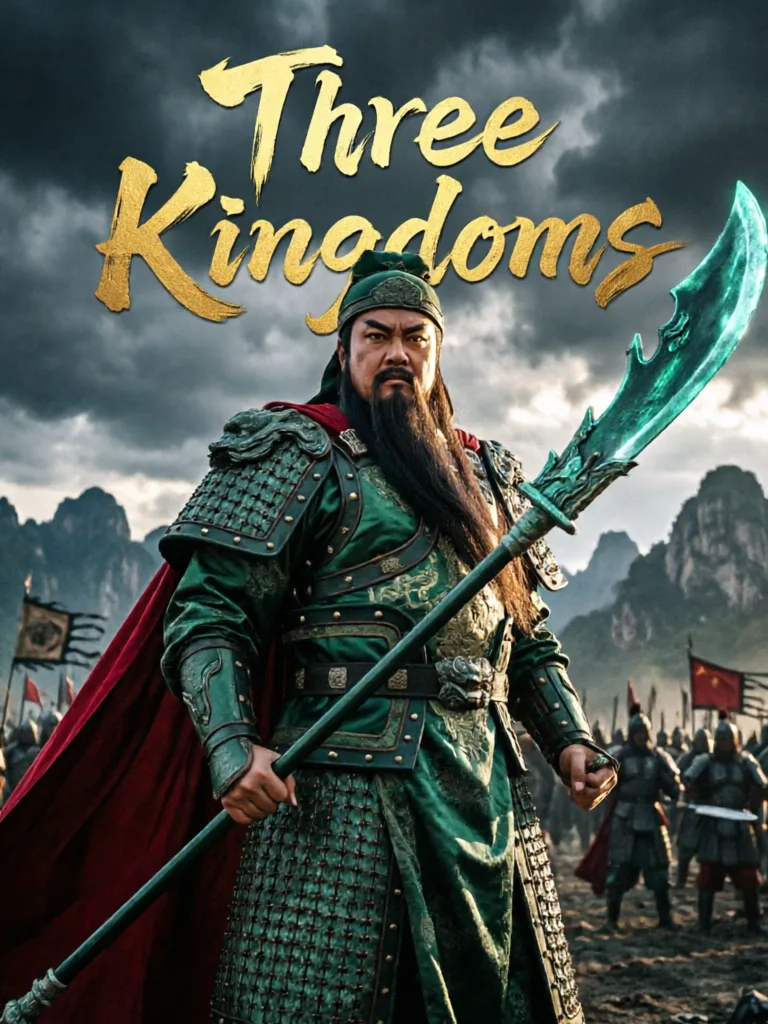
After two failed attempts to visit Kongming, Liu Bei resolved to try a third time. Guan Yu objected: “Brother, you have personally called upon him twice—surely this exceeds the bounds of propriety. This Zhuge Liang likely has a hollow reputation without real learning, which is why he hides and dares not meet you. Why are you so taken with this man?” Liu Bei replied: “Not so. In ancient times, Duke Huan of Qi sought an audience with a hermit of the eastern suburbs and only succeeded after five attempts. How much more should I persist when seeking a true sage?” Zhang Fei scoffed: “Brother, you are mistaken. This village rustic is hardly a great sage. This time, you need not go. If he refuses to come, I’ll simply tie him up with a hemp rope and drag him here!” Liu Bei scolded him: “Have you not heard how King Wen of Zhou sought out Jiang Ziya? Even a king showed such reverence for talent. How dare you be so rude? This time, you will stay behind. I will go only with Yunchang.” Zhang Fei protested: “If both elder brothers are going, how can I, the youngest, lag behind?” Liu Bei warned: “If you come, you must not be discourteous.” Zhang Fei agreed.
The three of them mounted their horses and, accompanied by attendants, set out for Longzhong. When they were still half a li from the cottage, Liu Bei dismounted and proceeded on foot. There they encountered Zhuge Jun. Liu Bei quickly bowed and asked: “Is your elder brother at home?” Jun replied: “He returned only last evening. You may see him today, General.” With that, he walked away without another word. Liu Bei exclaimed: “How fortunate! Today I shall finally meet the master!” Zhang Fei grumbled: “What insolence! He might have led us to the cottage at least. Why did he just wander off?” Liu Bei said: “Each has his own affairs. We cannot force him.”
Arriving at the gate of the thatched cottage, they knocked. A boy opened the door and asked their business. Liu Bei said: “Please trouble the immortal lad to announce that Liu Bei has come especially to pay his respects to the master.” The boy replied: “The master is at home today, but he is sleeping in the hall and has not yet awakened.” Liu Bei said: “In that case, do not announce us.” He instructed Guan Yu and Zhang Fei to wait outside the gate while he himself entered softly. He saw the master lying on a mat in the main hall, face up, fast asleep. Liu Bei stood with folded hands at the foot of the steps. A long while passed, but the master did not stir. Guan Yu and Zhang Fei waited outside for some time, and when they heard nothing, they entered to find Liu Bei still standing there. Zhang Fei was furious and said to Yunchang: “How arrogant this master is! My elder brother stands waiting at the foot of the steps, yet he lies there sleeping, pretending not to hear! Let me set fire to the back of the cottage and see if he rises or not!” Yunchang repeatedly restrained him. Liu Bei ordered the two of them to wait outside again. He looked toward the hall and saw the master turn over as if to get up, but then turn his face back to the wall and fall asleep again. The boy was about to announce them, but Liu Bei said: “Do not disturb him.” He stood there for another full two hours. Finally, Kongming awoke and recited a verse:
Of this, a poet of the time recorded: “Who first awakens from the great dream? I alone know the pattern of my life. In the thatched hall, spring slumber is sweet; beyond the window, the sun lingers lazily in the sky.”
Having finished his verse, Kongming turned over and asked the boy: “Are there any vulgar guests?” The boy replied: “Imperial Uncle Liu has been here, waiting for a long time.” Kongming rose and said: “Why did you not inform me earlier? Allow me to change my clothes.” He retired to the inner chamber. After another long pause, he emerged properly dressed and went out to greet them.
Liu Bei saw that Kongming was eight feet tall, with a face as fair as jade. He wore a silk headband and a crane-feather cloak, giving him an ethereal, almost immortal bearing. Liu Bei knelt and bowed: “I am a humble descendant of the Han house, an ignorant man from Zhuo Commandery. I have long heard of your great name, which rings in my ears like thunder. I came twice before but could not see you. I left my name on your desk—I wonder if you saw it?” Kongming replied: “I am but a rustic from Nanyang, lazy by nature. I am deeply ashamed that you have troubled yourself to come so often.” When the formalities were complete, they took their seats as guest and host, and the boy served tea. After tea, Kongming said: “From your letter, I could see your deep concern for the state and the people. But I fear that I, young and shallow in learning, am unworthy of your inquiries.” Liu Bei said: “The words of Sima Decao and Xu Yuanzhi cannot be empty praise. I beg you, sir, not to despise my ignorance but to grant me your guidance.” Kongming replied: “Decao and Yuanzhi are noble scholars of the age. I am but a farmer. How dare I speak of the affairs of the realm? They have overpraised me. Why do you, General, abandon fine jade to seek out a common stone?” Liu Bei said: “A man of true talent should not waste his life in obscurity among the forests and streams. I beg you, sir, to think of the suffering people of the realm and to enlighten my foolishness.” Kongming smiled and said: “May I ask what your ambition is, General?” Liu Bei dismissed the others, drew his mat closer, and said: “The Han house is crumbling; treacherous ministers have usurped the mandate. Though I know my own weakness, I wish to uphold righteousness in the realm. But my wisdom is shallow, and I have achieved nothing. Only you, sir, can open my eyes and save me from my plight. That would be my greatest fortune.”
Kongming said: “Since Dong Zhuo’s rebellion, heroes have risen across the land. Cao Cao’s strength was less than Yuan Shao’s, yet he defeated him—not only through the timing of Heaven but also through human strategy. Now Cao Cao commands a million men and holds the Emperor hostage to command the warlords. You cannot contend with him directly. Sun Quan holds Jiangdong, a land his family has ruled for three generations. The terrain is defensible, and the people are loyal. You may use him as an ally, but you cannot seek to conquer him. Jing Province lies north of the Han and Mian Rivers, with access to the wealth of the southern seas. It connects to Wu and Kuaiji in the east and to Ba and Shu in the west. This is a land where warriors contend, but only a true master can hold it. It seems Heaven has granted it to you, General. Are you interested? Yi Province is a rugged stronghold with a thousand li of fertile land—a land of natural abundance. The founder of the Han dynasty used it to build his empire. Now Liu Zhang rules it, but he is weak and foolish. Though the people are prosperous and the state wealthy, he does not care for them. Wise men there long for a wise ruler. You, General, are of imperial lineage, known throughout the realm for your honor and righteousness. You gather heroes and thirst for talent.
If you can take both Jing and Yi Provinces, hold their natural defenses, make peace with the western tribes to the west and the southern tribes to the south, ally with Sun Quan externally, and govern wisely internally—then, when the time is ripe, send a senior general with the army of Jing Province to strike at Wan and Luoyang, while you yourself lead the forces of Yi Province out through the Qin Mountains. Will the people not welcome you with baskets of food and jugs of drink? If you do this, your great enterprise can succeed, and the Han house can be restored. This is my plan for you, General. Consider it carefully.” When he finished, he ordered the boy to bring a scroll and hang it on the wall. Pointing to it, he said to Liu Bei: “This is a map of the fifty-four prefectures of western Sichuan. If you wish to build a hegemon’s realm, let Cao Cao occupy the advantage of Heaven’s timing in the north, and let Sun Quan occupy the advantage of terrain in the south. You, General, must occupy the advantage of human harmony. First take Jing Province as your base, then take western Sichuan to establish your foundation. This will create a tripod’s balance among the three powers. Only then can you plan to seize the Central Plains.” Hearing this, Liu Bei rose from his mat, folded his hands, and bowed: “Your words have opened my eyes, dispelling the clouds so that I see the clear sky. But Liu Biao of Jing Province and Liu Zhang of Yi Province are both of the imperial clan. How can I bear to take their lands?” Kongming replied: “I have observed the stars. Liu Biao will not live long.
Liu Zhang is not a man to build a kingdom. In time, both will fall to you.” Liu Bei bowed low in gratitude. Indeed, this single discourse—Kongming, before he had even left his thatched cottage, already knew the division of the realm into three—was something no one in ten thousand generations could match. A poet of later times praised him:
History records a verse: “The Imperial Uncle of Yu Province lamented his lonely plight; how fortunate that in Nanyang dwelt the Sleeping Dragon! When asked where the future tripod’s legs would stand, the master smiled and pointed to the map.”
Liu Bei bowed and pleaded: “Though my name is slight and my virtue meager, I beg you, sir, not to despise my humble station but to come forth from the mountain and aid me. I will listen humbly to your wise instructions.” Kongming replied: “I have long delighted in farming and am too lazy to involve myself in worldly affairs. I cannot accept your command.” Liu Bei wept and said: “If you do not come forth, Master, what will become of the people?” As he spoke, tears soaked his sleeves and the lapels of his robe. Kongming, seeing his sincerity, said: “Since you, General, will not abandon me, I am willing to serve you like a dog or a horse.” Liu Bei was overjoyed. He summoned Guan Yu and Zhang Fei inside, and they presented gifts of gold and silk. Kongming firmly refused them. Liu Bei said: “This is not a proper gift for a great sage, but only a token of my sincerity.” Only then did Kongming accept. That night, Liu Bei and his companions stayed at the cottage.
The next day, Zhuge Jun returned. Kongming instructed him: “I have received the grace of Imperial Uncle Liu’s three visits and cannot refuse to go forth. You must farm here and not let the fields go to waste. When my work is done, I will return to seclusion.” A poet of later times lamented:
A poet wrote: “Before he rose, he thought of retreat; when his work was done, he remembered the words he spoke. But because the First Lord was so earnest, his star fell in the autumn wind at Wuzhang Plains.”
There was also an ancient poem that told the tale: “The High Ancestor wielded a sword white as snow and shed the white serpent’s blood at Mangdang Mountain. He conquered Qin, destroyed Chu, and entered Xianyang—a dynasty that nearly ended two hundred years later. Then Guangwu restored the Han in Luoyang, but it passed to Huan and Ling, and the empire shattered again. Emperor Xian moved the capital to Xuchang, and heroes swarmed across the land. Cao Cao seized power with Heaven’s timing; the Sun clan of Jiangdong opened their great enterprise. The orphaned Liu Bei wandered the realm, alone at Xinye, grieving for the people’s suffering. The Sleeping Dragon of Nanyang harbored great ambition; within his breast, he divided the armies into orthodox and unorthodox. Because of Xu Shu’s parting words, three visits to the thatched cottage won his heart. The master was then twenty-seven; he packed his zither and books and left the fields. First he took Jing Province, then Sichuan—a masterful plan that mended the broken heavens. His tongue stirred wind and thunder; his mind shifted stars and constellations. Like a dragon and a tiger, he secured the realm—his name immortal through ten thousand ages!”
Liu Bei, his two brothers, and Kongming took their leave of Zhuge Jun and returned together to Xinye. Liu Bei treated Kongming as his teacher. They ate at the same table and slept on the same mat, discussing the affairs of the realm day and night. Kongming said: “Cao Cao has built Xuanwu Lake in Ji Province to train his navy. He must have designs on the south of the Yangtze. You should send someone secretly across the river to scout the situation.” Liu Bei agreed and dispatched a man to the Jiangdong region.
Now, after Sun Ce’s death, Sun Quan held Jiangdong, inheriting his father and brother’s legacy. He welcomed worthy men widely, opening a guesthouse in Wu and Kuaiji, and appointed Gu Yong and Zhang Hong to receive guests from all directions. Over the years, men recommended one another. Among those who came were Kan Ze of Kuaiji, styled Derun; Yan Jun of Pengcheng, styled Mancai; Xue Zong of Pei County, styled Jingwen; Cheng Bing of Ruyang, styled Deshu; Zhu Huan of Wu Commandery, styled Xiumu; Lu Ji, styled Gongji; Zhang Wen of Wu, styled Huishu; Luo Tong of Wushang, styled Gongxu; and Wu Can of Wucheng, styled Kongxiu. These men all came to Jiangdong, and Sun Quan treated them with great respect. He also gained several fine generals: Lü Meng of Runan, styled Ziming; Lu Xun of Wu Commandery, styled Boyan; Xu Sheng of Langya, styled Wenxiang; Pan Zhang of Dong Commandery, styled WenGui; and Ding Feng of Lujiang, styled Chengyuan. With these civil and military officials assisting him, Jiangdong was said to have gathered the finest talent.
In the seventh year of the Jian’an era (202 AD), after Cao Cao defeated Yuan Shao, he sent an envoy to Jiangdong, ordering Sun Quan to send his son to the court as a hostage. Sun Quan hesitated, unsure of the decision. Lady Wu, his mother, summoned Zhou Yu, Zhang Zhao, and others for a council. Zhang Zhao said: “Cao Cao wants us to send a son to court—this is his method of controlling the warlords. If we refuse, he may raise an army against Jiangdong, and we would be in grave danger.” Zhou Yu said: “You, General, have inherited the legacy of your father and brother, command the forces of six commanderies, with well-trained troops and ample supplies. Your officers are ready to die for you. Why should you be pressured into sending a hostage? Once a hostage is sent, you will be forced into an alliance with the Cao clan. When he summons you, you must go—and thus you will be controlled by another. It is better not to send one. Observe the situation slowly and devise a better strategy to counter him.” Lady Wu said: “Gongjin speaks wisely.” Sun Quan followed this advice, thanked the envoy, and did not send his son. From that time, Cao Cao harbored intentions to invade Jiangdong. But the north was not yet pacified, and he had no time for a southern campaign.
In the eleventh month of the eighth year of Jian’an (203 AD), Sun Quan led an army to attack Huang Zu, clashing on the Yangtze River. Huang Zu’s forces were defeated. Sun Quan’s general Ling Cao charged ahead in a light boat, breaking into Xiakou, but was shot dead by an arrow from Gan Ning, a general under Huang Zu. Ling Cao’s son, Ling Tong, then only fifteen, fought fiercely to retrieve his father’s body and returned. Seeing that the wind was unfavorable, Sun Quan withdrew his forces back to eastern Wu.
Sun Quan’s younger brother, Sun Yi, was the Grand Administrator of Danyang. Yi was violent by nature and fond of drink; when drunk, he often flogged his soldiers. The Danyang commander Gui Lan and the commandery deputy Dai Yuan had long harbored thoughts of killing him. They conspired with Yi’s attendant, Bian Hong, and plotted the murder. At that time, all the generals and county magistrates had gathered in Danyang, and Yi hosted a banquet. Yi’s wife, Lady Xu, was beautiful and wise, skilled in interpreting the Book of Changes. That day, she cast a hexagram that foretold great disaster. She urged Yi not to attend the gathering. Yi ignored her and went to the feast. When the banquet ended at nightfall, Bian Hong followed Yi outside, drew his blade, and cut him down. Gui Lan and Dai Yuan then blamed the murder on Bian Hong and executed him in the marketplace. The two of them then seized Yi’s wealth, concubines, and servants. Gui Lan, seeing Lady Xu’s beauty, said to her: “I have avenged your husband. You must submit to me. If you refuse, you will die.” Lady Xu replied: “My husband has only just died. I cannot bear to take another so soon. Wait until the last day of the month, when I have held a memorial service and set aside my mourning clothes. Then we can marry.” Gui Lan agreed.
Lady Xu secretly summoned two of Sun Yi’s trusted former officers, Sun Gao and Fu Ying, to her chamber. Weeping, she told them: “When my husband was alive, he often spoke of your loyalty and honor. Now the traitors Gui Lan and Dai Yuan have murdered him, blamed it on Bian Hong, and divided all our property and servants. Gui Lan also wants to force me into marriage. I have pretended to agree to calm him. You two must send a messenger posthaste to report this to the Marquis of Wu. Meanwhile, I will devise a secret plan to kill these two villains and avenge this disgrace. I will be grateful to you even in death.” She bowed to them again. Sun Gao and Fu Ying wept and said: “We have always been grateful for the kindness of our late lord. The only reason we did not die in the attack was that we were waiting for a chance to take revenge. We will do whatever you command.” They secretly dispatched a trusted messenger to report to Sun Quan.
On the last day of the month, Lady Xu first hid Sun Gao and Fu Ying behind the curtains of a secret chamber. Then she set up a memorial altar in the main hall. After the ceremony, she removed her mourning clothes, bathed and perfumed herself, put on heavy makeup and fine garments, and laughed and talked as if nothing were wrong. When Gui Lan heard this, he was delighted. That night, Lady Xu sent a maidservant to invite Gui Lan to the residence, where a feast was laid out in the hall. When Gui Lan was thoroughly drunk, Lady Xu invited him into the secret chamber. Overjoyed, Gui Lan followed her in, reeling from drink. Lady Xu cried out: “Where are Generals Sun and Fu?” The two men leaped out from behind the curtains, blades drawn. Before Gui Lan could react, Fu Ying cut him down with a single stroke, and Sun Gao finished him with another. Lady Xu then sent another invitation to Dai Yuan. When he entered the residence and reached the hall, Sun Gao and Fu Ying killed him as well. They then sent men to slaughter the families of the two traitors and their remaining followers. Lady Xu donned her mourning clothes again, placed the heads of Gui Lan and Dai Yuan on the altar, and offered them in sacrifice before Sun Yi’s spirit tablet. Not long after, Sun Quan himself arrived in Danyang with his army. Seeing that Lady Xu had already killed the two traitors, he appointed Sun Gao and Fu Ying as Commandants of the Camp Gate, ordered them to guard Danyang, and took Lady Xu back to his household to be cared for in her old age. All the people of Jiangdong praised Lady Xu’s virtue. A poet of later times praised her:
A poet wrote: “Talent and integrity combined—rare in this world—crushed the treacherous in a single blow. Petty officials follow rebels; loyal men die—but none could match the woman of eastern Wu.”
Meanwhile, the various mountain bandits in Jiangdong were all pacified. On the Yangtze River, there were over seven thousand warships. Sun Quan appointed Zhou Yu as Grand Commander-in-Chief, in overall command of Jiangdong’s land and naval forces. In the winter of the twelfth year of Jian’an (207 AD), Sun Quan’s mother, Lady Wu, fell gravely ill. She summoned Zhou Yu and Zhang Zhao to her bedside and said: “I was born in Wu. I lost my parents young and moved to Yuezhong with my brother Wu Jing. Later, I married into the Sun clan and bore four sons. When my eldest, Ce, was born, I dreamed of the moon entering my bosom. When my second, Quan, was born, I dreamed of the sun entering my bosom. The diviner said that a dream of the sun or moon entering the bosom foretold a child of great nobility. Unhappily, Ce died young. Now I entrust the foundation of Jiangdong to Quan. I hope you will support him with one heart. Then I will be immortal even in death.” She then instructed Sun Quan: “Serve Zibu and Gongjin with the rites due to a teacher and a father. Do not be negligent. My younger sister married your father along with me, so she is also your mother. After I die, treat her as you would treat me. Your younger sister, too, must be cared for and married to a worthy husband.” With these words, she died. Sun Quan wept bitterly and prepared a proper funeral and burial, as was fitting.
The following spring, Sun Quan discussed launching an attack on Huang Zu. Zhang Zhao said: “We are still in mourning and have not completed a full year. We cannot move the army.” Zhou Yu argued: “To avenge a wrong, why wait a full year?” Sun Quan hesitated. Just then, the Colonel of the North, Lü Meng, came to see him and reported: “I was guarding the Longqiu waterway when suddenly Gan Ning, a general under Huang Zu, came to surrender. I questioned him closely. His name is Gan Ning, styled Xingba, a native of Linjiang in Ba Commandery. He is well-read in history, strong and bold, and fond of knight-errantry. He once gathered fugitives and roamed the rivers and lakes, wearing a copper bell at his waist so that people would flee at the sound. He used brocade from western Sichuan for his sails, and people called him the ‘Brocade Pirate.’ Later, he repented of his past, reformed his ways, and led his men to join Liu Biao. Seeing that Liu Biao could not achieve anything, he wanted to come to eastern Wu, but Huang Zu detained him at Xiakou. When eastern Wu attacked Huang Zu before, Gan Ning saved Huang Zu and brought him back to Xiakou. But Huang Zu treated him poorly. The commander Su Fei repeatedly recommended Gan Ning to Huang Zu, but Huang Zu said, ‘Gan Ning is a river pirate—how can he be given high office?’ Gan Ning therefore bore a grudge. Su Fei understood this. He invited Gan Ning to his home and said: ‘I have recommended you many times, but our lord will not employ you. Time passes swiftly; life is short. You should make your own plans far away. I will recommend you as the magistrate of Zhu County, and you can decide your own course.’ Thus, Gan Ning was able to leave Xiakou. He wanted to join Jiangdong but feared that we would resent him for saving Huang Zu and killing Ling Cao. I told him that our lord thirsts for talent and does not hold grudges—after all, each man serves his own master. Why should we resent him? He happily led his men across the river to see you. I await your decision.”
Sun Quan was overjoyed and said: “If I can win Xingba, Huang Zu’s defeat is certain.” He ordered Lü Meng to bring Gan Ning in for an audience. After the formal bows, Sun Quan said: “Xingba, your coming here fills my heart with joy. How could I possibly hold a grudge? Do not doubt me. Tell me your plan for defeating Huang Zu.” Gan Ning said: “The Han dynasty is in peril. Cao Cao will surely usurp the throne. The land of southern Jing is a prize that Cao Cao will inevitably contest. Liu Biao lacks foresight, and his sons are foolish and incompetent—they cannot preserve the legacy. You, Illustrious Lord, should act quickly. If you delay, Cao Cao will take it first. Your best move now is to attack Huang Zu. He is old and senile, obsessed with profit. He oppresses his officials and people, and they all resent him. His war machines are neglected, and his army has no discipline. If you attack him, his defeat is certain. Once you break Huang Zu’s army, drive westward, seize the Chu Pass, and plan for Ba and Shu—your hegemon’s realm can be established.” Sun Quan said: “These are words of gold and jade!” He appointed Zhou Yu as Grand Commander-in-Chief of all land and naval forces, Lü Meng as Vanguard Commander, Dong Xi and Gan Ning as deputy generals, and led a great army of 100,000 men himself to attack Huang Zu.
Spies reported this to Jiangxia. Huang Zu hastily gathered his officers for a council. He appointed Su Fei as senior general, with Chen Jiu and Deng Long as vanguard commanders, and mobilized the entire Jiangxia army to meet the enemy. Chen Jiu and Deng Long each led a squadron of covered assault ships to block the mouth of the Mian River. On each ship, they set up over a thousand strong bows and crossbows, and tied the ships together with heavy ropes across the water. When the eastern Wu fleet arrived, the drums sounded on the assault ships, and a hail of arrows and bolts flew out. The Wu forces dared not advance and fell back several li.
Gan Ning said to Dong Xi: “We have come this far. We must press forward.” They selected over a hundred small boats, each carrying fifty elite soldiers—twenty to row and thirty armored men with steel blades, ignoring the arrows and stones. They drove straight to the side of the assault ships, cut the heavy ropes, and the ships drifted sideways. Gan Ning leaped onto one of the assault ships and cut down Deng Long. Chen Jiu abandoned his ship and fled. Lü Meng saw this, jumped into a small boat, took the oar himself, and rowed directly into the enemy fleet, setting the ships on fire. Chen Jiu tried to escape to shore, but Lü Meng pursued him relentlessly, caught up, and cut him down with a single stroke to the chest. By the time Su Fei led his troops to the shore to reinforce, the eastern Wu generals had all landed together, an irresistible tide. Huang Zu’s army was utterly routed. Su Fei fled across the wilds, only to encounter the eastern Wu general Pan Zhang. The two met on horseback, and after only a few exchanges, Pan Zhang captured him alive and brought him in chains to Sun Quan’s ship. Sun Quan ordered his men to put Su Fei in a cage cart, to be executed together with Huang Zu when he was captured alive. He then drove the three armies forward, attacking Xiakou day and night without pause. Truly:
And so it was that because Huang Zu refused to employ the Brocade Pirate, the enemy broke through his chained ships.
Whether Huang Zu would prevail or be defeated remains to be seen. The next chapter will reveal the outcome.