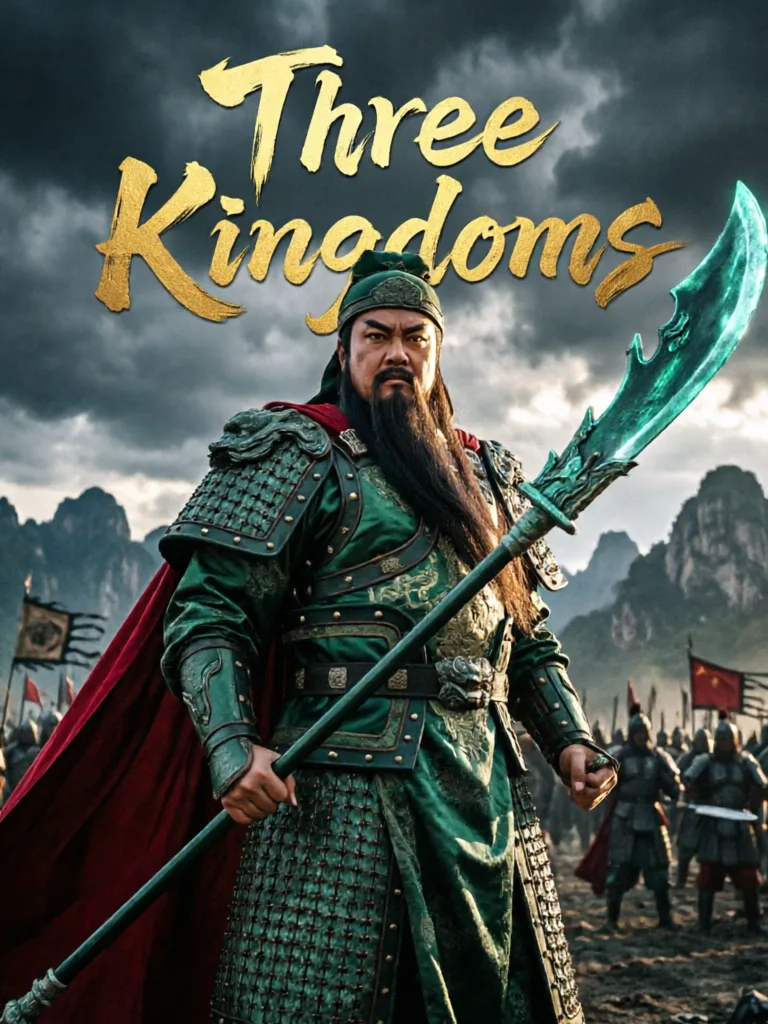
As Jiang Wei, burning with fury, saw Wei Yan stamp out the lamp, he drew his sword to slay him. Kongming stopped him, saying, "This is my fate to die, not Wenchang's fault." Jiang Wei sheathed his sword. Kongming coughed up several mouthfuls of blood and collapsed onto his bed. He said to Wei Yan, "Sima Yi has guessed that I am ill, which is why he sent men to probe our weakness. You must go out at once to confront the enemy." Wei Yan accepted the order, left the tent, mounted his horse, and led his troops charging out of the camp. When Xiahou Ba saw Wei Yan, he hastily withdrew his forces. Wei Yan pursued him for over twenty li before returning. Kongming ordered Wei Yan to return to his own camp and hold the defense.
Jiang Wei entered the tent and went directly to Kongming's bedside to ask after his health. Kongming said, "I had intended to exhaust my loyalty and strength to restore the Central Plains and revive the Han Dynasty. But Heaven's will is otherwise; I shall die at any moment. All that I have learned in my life, I have written down in twenty-four chapters, totaling one hundred and four thousand one hundred and twelve characters. Within these are methods concerning the Eight Essentials, the Seven Cautions, the Six Fears, and the Five Dreads. I have surveyed all the generals, and none are fit to receive this knowledge, except you alone. You may inherit my books. Do not treat them lightly!" Jiang Wei wept, bowed, and accepted them. Kongming continued, "I have a method for the 'repeating crossbow' that I have never used. The arrows are eight inches long, and one crossbow can fire ten arrows at once. I have drawn up complete diagrams for it. You may build and use them according to these plans." Jiang Wei bowed and accepted these as well. Kongming added, "There is no need to worry excessively about the various routes into Shu. But the land of Yinping—you must be especially careful there. Though the terrain is treacherous, it will eventually be lost." He then summoned Ma Dai into the tent, whispered a secret plan into his ear, and instructed him, "After I die, you must carry out this plan." Ma Dai accepted the plan and left.
Shortly after, Yang Yi entered. Kongming called him to his bedside and handed him a silk pouch, saying in a low voice, "After I die, Wei Yan will surely rebel. When he does, and you face him in battle, open this pouch. Then you will find the man who will behead Wei Yan." Having given all his orders, Kongming fell into a faint. He did not revive until evening, and that very night he sent a memorial to the Later Ruler. The Later Ruler was greatly alarmed upon receiving it and immediately ordered the Imperial Secretary Li Fu to travel day and night to the army camp to inquire after the Chancellor's health and to ask about the affairs to come. Li Fu accepted the command and hurried to the Wuzhang Plains. He entered Kongming's presence, conveyed the Later Ruler's wishes, and asked after his health. Kongming wept and said, "It is my misfortune to die midway, wasting the nation's great affairs and wronging all under Heaven. After I am gone, you all must loyally assist our lord. Do not alter the established laws of the state, and do not lightly discard the men I have employed. My military strategies have all been taught to Jiang Wei; he will be able to carry on my will and serve the nation. My life is now measured in hours; I shall soon present a final memorial to the Son of Heaven." Li Fu received these words and hurriedly took his leave.
Kongming, forcing his ailing body, had his attendants help him into a small carriage and had them drive him out of the camp to survey the various units. Feeling the autumn wind cutting through him to the bone, he let out a long sigh. "Never again will I take the field to punish the rebels! O vast and distant Heavens, why have you brought me to this end?" He sighed for a long time. Returning to his tent, his illness grew more critical. He summoned Yang Yi and instructed him, "Wang Ping, Liao Hua, Zhang Ni, Zhang Yi, and Wu Yi are all men of loyalty and righteousness. They have long experience in battle and have borne much toil and hardship. They are worthy of being entrusted with important tasks. After I die, let all matters be handled according to the old methods. Withdraw the army slowly; do not be hasty. You are deeply versed in strategy, so I need not give you many instructions. Jiang Boyue is both wise and brave enough to command the rearguard." Yang Yi wept, bowed, and accepted the orders. Kongming then called for his writing implements and, from his sickbed, personally wrote a final memorial to the Later Ruler. The memorial read, in summary:
"I humbly understand that life and death are fixed by fate, and that one cannot escape the ordained course. Since death is near, I wish to offer my utmost loyalty. Your servant Liang is by nature dull and foolish, yet he has lived in difficult times. He has borne the tally and held the seal, taking sole charge of the state's balance. He raised an army for northern expeditions, but did not achieve success. Who could have foreseen that illness would enter the vital organs, leaving my life hanging by a thread, and that I would not be able to complete my service to Your Majesty, leaving behind an endless regret? I humbly beg Your Majesty: clear your heart and reduce your desires, restrain yourself and love the people. Be filial to the former emperor, spread benevolence and grace throughout the realm. Promote the worthy and hidden, and advance the good and able. Drive out the treacherous and evil, so as to strengthen the customs of the people.
"Your servant's family in Chengdu has eight hundred mulberry trees and fifteen acres of poor land. The food and clothing of my children and younger brothers are more than sufficient. As for your servant, while serving in the field, I have made no other arrangements. My personal food and clothing have all come from the government. I have not engaged in any private enterprise to increase my wealth by even a single inch. On the day of your servant's death, I will not allow there to be any surplus silk in my home or any excess wealth outside it, so as to fail Your Majesty."
Having finished writing, Kongming again instructed Yang Yi, "After my death, do not announce the funeral. Build a large shrine and place my body inside it in a seated position. Put seven grains of rice in my mouth and place a bright lamp beneath my feet. Let the army remain peaceful and orderly as usual—do not raise any cries of mourning. Thus the general's star will not fall. My spirit will rise up to guard it. When Sima Yi sees that the star has not fallen, he will be alarmed and uncertain. Let our army have the rear camp withdraw first, and then one camp after another, slowly retreat. If Sima Yi comes in pursuit, you must form up the battle lines, turn the flags, and beat the drums. When he approaches, take the wooden image I carved earlier, place it on the carriage, and drive it out before the army. Have all the officers and men, great and small, line up on left and right. When he sees it, he will surely flee in terror." Yang Yi acknowledged each instruction.
That night, Kongming had his attendants help him outside. He looked up at the Northern Dipper and pointed to a single star. "That is my general's star," he said. The others looked and saw that it was dim and seemed about to fall. Kongming pointed his sword at it and began to chant a spell. When the spell was finished, he hurried back into the tent, where he lost consciousness. As the generals were in a panic, the Imperial Secretary Li Fu suddenly arrived again. Seeing Kongming unconscious and unable to speak, he wept loudly, "I have ruined the nation's great affairs!" In a moment, Kongming revived. He opened his eyes and looked around, seeing Li Fu standing by his bed. Kongming said, "I already know why you have returned." Li Fu apologized, "I was sent by the Son of Heaven to ask, after the Chancellor has passed away, who can be entrusted with the great affairs of state. Earlier, in my haste, I neglected to ask, so I have returned." Kongming said, "After I die, the man who can handle the great affairs is Jiang Gongyan. He is suitable." Li Fu asked, "After Gongyan, who can succeed him?" Kongming replied, "Fei Wenwei can succeed him." Li Fu asked again, "After Wenwei, who will succeed him?" Kongming did not answer. The generals drew near and saw that he had passed away. It was the twenty-third day of the eighth month of the twelfth year of the Jianxing reign period. He was fifty-four years old.
A poet of the time, Du Fu, lamented:
Of him, history records that a long star fell before the camp last night, bringing the news that this great man had toppled that morning. No more would his commands be heard from the tiger-skin tent; only his brilliant name would be recorded in the halls of fame. He left behind three thousand disciples at his gate, but the ten thousand troops within his breast were wasted. In the clear daylight, beneath the green shade, there is no longer any sound of elegant song.
The poet Bai Juyi also wrote a verse:
Of this master, it is said that he hid his brilliance and lay in the mountain forest until the sage ruler sought him out with three visits. When the fish reached Nanyang, it found water; when the dragon soared to the Heavenly River, it brought rain. Having been entrusted with the orphan, he exhausted all the rites of devotion; to repay the state, he poured out his loyal heart. The memorials from the two campaigns remain, and a single glance at them makes one's tears soak the collar.
Earlier, Liao Li, the Colonel of the Changshui Garrison in Shu, had considered himself talented and famous enough to be Kongming's deputy. Dissatisfied with his idle post, he had been constantly resentful and full of complaints. Kongming had stripped him of his rank, made him a commoner, and exiled him to Wenshan. When Liao Li heard of Kongming's death, he wept and said, "I will end my days as a tribesman!" When Li Yan heard the news, he also wept bitterly and died of illness. For Li Yan had always hoped that Kongming would recall him, allowing him to make amends for his past mistakes; but after Kongming's death, he knew no one else would employ him. Later, the poet Yuan Zhen wrote a eulogy for Kongming:
Of this man, it is said that he quelled chaos and supported the imperiled lord, receiving the orphan's trust with utmost devotion. His talent surpassed that of Guan Zhong and Yue Yi; his brilliant strategies excelled those of Sunzi and Wu Qi. His awe-inspiring "Memorial on the Northern Expedition" and his magnificent "Eightfold Formation" stand as monuments. Such was his perfect virtue that all ages, ancient and modern, must sigh in admiration.
That night, Heaven was sad and the earth was mournful; the moon's light was extinguished. Kongming passed away. Jiang Wei and Yang Yi, following Kongming's final instructions, dared not raise a cry of mourning. They encoffined him according to the prescribed rites, placed him in the shrine, and had three hundred trusted soldiers guard it. They then sent out secret orders for Wei Yan to command the rearguard, and the various camps began to withdraw one by one.
Meanwhile, Sima Yi was observing the heavens that night when he saw a great star, red in color with pointed rays of light, stream from the northeast to the southwest, falling into the Shu camp. It rose and fell three times, with a faint sound. Sima Yi was overjoyed and exclaimed, "Kongming is dead!" He immediately ordered his main army to give chase. But just as he reached the camp gate, he hesitated. "Kongming is skilled in the arts of the Six Ding and Six Jia spirits. Seeing that I have not come out to fight for so long, he is using this trick of feigning death to lure me out. If I pursue now, I will surely fall into his trap." So he reined in his horse and returned to camp, staying put. He merely sent Xiahou Ba with a few dozen riders to scout the Wuzhang Plains and the surrounding hills for information.
In his own camp, Wei Yan had a dream that night. He dreamed that two horns had suddenly grown from his head. When he woke, he was greatly troubled. The next day, the Army Commander Zhao Zhi arrived. Wei Yan invited him in and asked, "I have long known that you are deeply versed in the principles of the Book of Changes. Last night I dreamed that two horns grew from my head. I do not know whether this portends good or ill. I beg you to decide the matter for me." Zhao Zhi thought for a long time, then replied, "This is an omen of great good fortune. The unicorn has horns on its head, and the azure dragon has horns on its head. This is a sign of transformation and soaring." Wei Yan was overjoyed. "If it comes true as you say, you will be richly rewarded!" Zhao Zhi took his leave. He had not gone more than a few li when he met the Imperial Secretary Fei Yi. Fei Yi asked where he had come from. Zhao Zhi said, "I have just come from Wei Wenchang's camp. Wenchang dreamed of horns growing on his head and asked me to divine the meaning. This is by no means a good omen, but I was afraid that telling him the truth would offend him, so I interpreted it as the unicorn and the azure dragon." Fei Yi asked, "How do you know it is not a good omen?" Zhao Zhi replied, "The character for 'horn' is formed by the character for 'knife' placed on top of 'use.' When a knife is placed on the head, the ill fortune is extreme!" Fei Yi said, "Do not let this leak out." Zhao Zhi departed.
Fei Yi went to Wei Yan's camp and, after dismissing the attendants, said to him, "Last night, at the third watch, the Chancellor passed away. On his deathbed, he repeatedly instructed that you, General, are to command the rearguard to hold off Sima Yi, and that the army is to withdraw slowly, without announcing his death. Here is the military tally. You may now raise the troops." Wei Yan asked, "Who will handle the Chancellor's great affairs?" Fei Yi replied, "The Chancellor has entrusted all his affairs to Yang Yi. His secret military methods have all been taught to Jiang Boyue. This tally is issued by Yang Yi." Wei Yan said, "Though the Chancellor is dead, I am still here. Yang Yi is merely a Chief Clerk. How can he be fit for such a great responsibility? He should merely escort the coffin back to Shu for burial. I will personally lead the main army to attack Sima Yi and ensure our victory. How can the nation's great affairs be abandoned because of one man's death?" Fei Yi said, "The Chancellor's final order was to retreat for now. You must not disobey." Wei Yan said angrily, "If the Chancellor had followed my plan when he was alive, we would have taken Chang'an long ago! I now hold the rank of General of the Vanguard, General of the Western Expedition, and Marquis of Nanzheng. How can I be willing to guard the rearguard for a Chief Clerk?" Fei Yi said, "What you say is reasonable, General. But you must not act rashly, lest you give the enemy cause for ridicule. Let me go and see Yang Yi and explain the situation to him. I will try to persuade him to yield command of the army to you.
What do you think?" Wei Yan agreed to this.
Fei Yi took his leave and hurried to the main camp to see Yang Yi, to whom he reported everything Wei Yan had said. Yang Yi said, "On his deathbed, the Chancellor secretly instructed me that Wei Yan would surely rebel. Sending the tally to him was merely a test to gauge his intentions. Now his words have confirmed the Chancellor's prediction. I will have Boyue command the rearguard instead." So Yang Yi led the army, escorting the coffin, and departed first. He ordered Jiang Wei to command the rearguard, and according to Kongming's final instructions, they withdrew slowly. In his camp, Wei Yan, seeing that Fei Yi had not returned with a reply, grew suspicious. He sent Ma Dai with a dozen riders to scout for news. They returned and reported, "The rearguard is under the command of Jiang Wei, and the vanguard has mostly withdrawn into the valley." Wei Yan flew into a rage. "That little clerk dares to deceive me! I will kill him!" He turned to Ma Dai and asked, "Will you help me?" Ma Dai replied, "I too have long hated Yang Yi. I am willing to help you attack him." Wei Yan was overjoyed. He immediately struck camp and led his own troops southward.
When Xiahou Ba led his scouts to the Wuzhang Plains, he found no one there. He hurried back to report to Sima Yi, "The Shu army has completely withdrawn." Sima Yi stamped his foot. "Kongming is truly dead! We must pursue them at once!" Xiahou Ba said, "Commander, do not pursue rashly. Send a deputy general first." Sima Yi replied, "This time, I must go myself." He then led his troops and his two sons in a charge toward the Wuzhang Plains. Shouting and waving their flags, they burst into the Shu camp—and found it completely empty. Sima Yi said to his sons, "Hurry and urge the main army forward. I will lead the vanguard." So Sima Shi and Sima Zhao urged the army on from behind, while Sima Yi himself led the charge. Reaching the foot of the hills, he saw the Shu army not far ahead and spurred his horse in hot pursuit. Suddenly, a cannon boomed from behind the hills, followed by a thunderous roar of battle cries. The Shu troops turned their flags and beat their drums. From amidst the trees, a great banner emerged, bearing the inscription: "Zhuge Liang, Chancellor of the Han Dynasty and Marquis of Wuxiang." Sima Yi's face turned pale with terror. He stared intently and saw, surrounded by dozens of senior officers, a four-wheeled carriage. Seated upright in the carriage was Kongming, wearing his silk headdress and feather fan, his crane-feather cloak and black sash. Sima Yi cried out in terror, "Kongming is still alive! I have rashly entered a trap!" He immediately wheeled his horse around and fled. Behind him, Jiang Wei shouted, "Rebel general, do not flee! You have fallen for my Chancellor's plan!" The Wei soldiers, their souls scattered and their spirits broken, threw away their armor and helmets, abandoned their spears and halberds, and fled for their lives, trampling each other to death in countless numbers. Sima Yi fled for over fifty li. Two Wei generals caught up with him from behind and grabbed his horse's bridle, calling out, "Commander, do not be alarmed!" Sima Yi felt his head with his hand and asked, "Do I still have a head?" The two generals replied, "Commander, do not be afraid. The Shu army is far away." Sima Yi panted for a long time before his expression calmed. Opening his eyes, he saw that it was Xiahou Ba and Xiahou Hui. He slowly gathered his reins and, with the two generals, found a small path to return to his camp. He then sent his officers to scout in all directions.
Two days later, villagers came running to report, "When the Shu army withdrew into the valley, the sound of their mourning shook the earth. White banners were raised throughout the camp. Kongming is truly dead. Only Jiang Wei remained with a thousand men to guard the rearguard. The Kongming on the carriage the other day was a wooden image." Sima Yi sighed and said, "I could predict his actions in life, but I could not predict his actions in death!" And so a saying spread through Shu: "The dead Zhuge Liang put the living Sima Yi to flight." A later poet wrote a verse in lament:
Of this event, it is said that a long star fell from the celestial pole at midnight, yet even in flight, men doubted that Kongming had perished. To this day, people outside the pass still laugh coldly, asking whether his head was still on his shoulders!
When Sima Yi was certain that the news of Kongming's death was true, he again led his troops in pursuit. Reaching the slope of Red Bank, he saw that the Shu army had already withdrawn far into the distance. He turned back and said to his officers, "Kongming is dead. We can all rest easy now!" He then ordered the army to return. Along the way, he saw the sites where Kongming had pitched his camps—the front, rear, left, and right were all arranged in perfect order. Sima Yi sighed, "This man was a genius unequaled in the world!" He then led his army back to Chang'an, assigned various generals to guard the strategic passes, and returned to Luoyang to report to the emperor.
Meanwhile, Yang Yi and Jiang Wei formed up their battle lines and slowly withdrew to the entrance of the Plank Road. There, they changed their clothes and announced the funeral, raising banners and wailing in mourning. The Shu soldiers all threw themselves to the ground and wept, some even weeping themselves to death. Just as the vanguard of the Shu army reached the entrance of the Plank Road, they suddenly saw a blaze of fire ahead, and the earth shook with battle cries. A body of troops blocked their path. The generals were greatly alarmed and urgently reported to Yang Yi. Truly:
They had already seen the Wei generals depart, but they did not know what force from Shu was now coming to meet them.
Who this army was, and what would happen next, must be revealed in the following chapter.