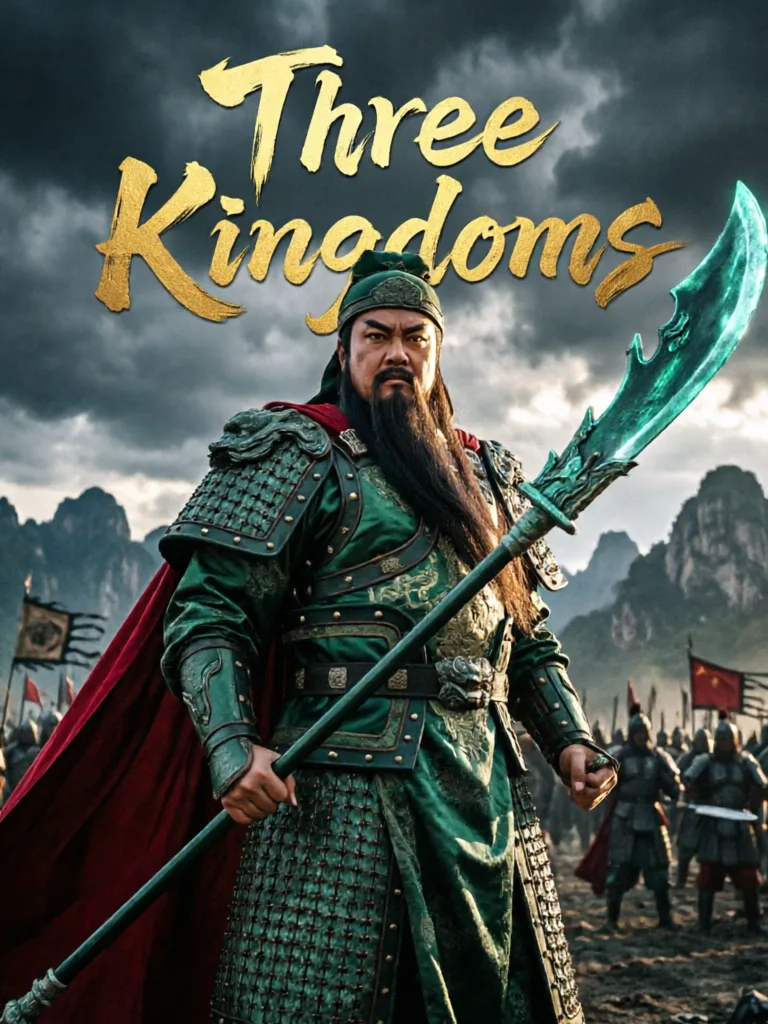
Yuan Shao was about to order Liu Bei’s execution when Xuande calmly addressed him: “My lord, would you heed only one side of a story and cast aside our former friendship? Since I was separated from my forces at Xuzhou, I have not known whether my sworn brother, Yunchang, lives or dies. There are many men in the realm with similar features—how can a red-faced, long-bearded man be conclusively identified as Guan? Why does my lord not investigate this more carefully?” Yuan Shao, a man of weak judgment, was swayed by Liu Bei’s words. He turned on Ju Shou, scolding him: “I nearly killed a good man by listening to your misguided counsel.” He then invited Liu Bei back to a seat of honor at his camp table to discuss avenging Yan Liang’s death. At that moment, a general stepped forward from the ranks, declaring: “Yan Liang was like a brother to me. Now that the traitor Cao has slain him, how can I not wash away this shame with blood?” Liu Bei studied the man: he was eight feet tall, with a face as stern as a mythical beast’s—this was the famed Hebei general, Wen Chou. Yuan Shao was overjoyed. “None but you can avenge Yan Liang. I will give you one hundred thousand troops. Cross the Yellow River and pursue that bandit Cao Cao to his death!” Ju Shou objected: “That cannot be. The better strategy is to hold our position at Yanzhou and divide our forces to guard Guandu. If we rashly cross the river and something goes wrong, none of our men will return.” Yuan Shao shouted in anger: “It is men like you who slow our army’s spirit and waste precious time, ruining great plans! Have you not heard that speed is the soul of warfare?” Ju Shou left the tent, sighing: “The lord’s ambition is swollen, and his subordinates crave only glory. O vast Yellow River, will I ever cross you again?” He then feigned illness and withdrew from all councils. Liu Bei said: “I have received great kindness from my lord, yet I have nothing to repay it with. I wish to accompany General Wen Chou on this campaign—first, to repay your grace, and second, to seek true news of Yunchang.” Yuan Shao was pleased and summoned Wen Chou to lead the vanguard with Liu Bei. Wen Chou replied: “Liu Xuande is a general of repeated defeats—he would bring ill fortune to our army. If my lord insists on sending him, I will give him thirty thousand troops to command the rear.” Thus, Wen Chou led seventy thousand men as the vanguard, while Liu Bei followed with thirty thousand in the rear.
Meanwhile, Cao Cao, seeing that Guan Yu had slain Yan Liang, admired him even more. He petitioned the Emperor to grant Guan Yu the title of Lord of Hanshou, had a seal cast, and presented it to Lord Guan. Suddenly, a report arrived that Yuan Shao had sent his great general Wen Chou across the Yellow River, and that he had already taken a position at Yanzhou. Cao Cao first ordered the local residents to be moved west of the river, then personally led his army to meet the enemy. He issued a strange command: the rear army was to become the vanguard, and the vanguard the rear; the supply wagons were to go first, with the soldiers following behind. Lü Qian asked: “Why place the supplies in front and the soldiers behind?” Cao Cao replied: “When supplies are in the rear, they are often plundered. By putting them forward, I prevent that.” Lü Qian pressed: “But what if the enemy seizes them?” Cao Cao answered: “When the enemy arrives, we will deal with it then.” Though puzzled, Lü Qian said nothing more. Cao Cao had the grain and equipment wagons move along the riverbank toward Yanzhou. Cao Cao himself was with the rear army when he heard shouts from the front. He sent men to investigate, and they reported: “The great Hebei general Wen Chou has arrived! Our troops have abandoned the supplies and scattered in all directions. The rear army is too far away—what are we to do?” Cao Cao pointed with his whip to a hill in the south. “We can take temporary shelter there.” The men and horses rushed to the earthen mound. Cao Cao ordered his soldiers to remove their armor and rest, letting their horses roam freely. Wen Chou’s forces approached.
The generals cried out: “The enemy is upon us! We must gather the horses and retreat to Baima at once!” Xun You urgently stopped them, saying: “This is the perfect bait to lure the enemy. Why would you retreat instead?” Cao Cao shot Xun You a quick glance and smiled. Xun You understood his intent and said no more. Wen Chou’s troops, seeing the abandoned grain wagons, rushed to seize them, then began chasing the horses. The soldiers broke formation, falling into disorder. At that moment, Cao Cao ordered his men to charge down from the hill and attack. Wen Chou’s army fell into chaos. Cao’s troops surrounded them. Wen Chou fought alone, but his own men trampled each other. Unable to stem the rout, he turned his horse and fled. From the hilltop, Cao Cao pointed and said: “Wen Chou is a famous general of Hebei. Who can capture him?” Zhang Liao and Xu Huang spurred their horses forward, shouting: “Wen Chou, do not flee!” Wen Chou looked back and saw the two generals closing in. He steadied his iron spear, nocked an arrow, and drew his bow, aiming directly at Zhang Liao. Xu Huang shouted a warning: “Do not loose that arrow!” Zhang Liao ducked just in time, but the arrow struck his helmet, tearing away its plume. Zhang Liao rallied and gave chase, but Wen Chou’s next arrow struck his horse in the face. The beast stumbled, and Zhang Liao fell to the ground. Wen Chou turned his mount and charged back. Xu Huang quickly raised his great axe and blocked his path. But then Wen Chou’s rear troops arrived in force. Xu Huang, realizing he could not prevail, turned his horse and fled. Wen Chou pursued them along the river.
Suddenly, a dozen horsemen appeared, their banners fluttering. At their head rode a general, gripping a sword and urging his horse forward at full speed. It was Guan Yunchang. He bellowed: “Traitor general, do not flee!” He engaged Wen Chou in combat. After barely three exchanges, Wen Chou lost heart and turned his horse to flee along the riverbank. But Guan Yu’s horse was faster. He caught up to Wen Chou and, with a single stroke of his blade to the back of the head, cut him down from his saddle. From the hilltop, Cao Cao saw Guan Yu kill Wen Chou and drove his army forward in a massive assault. Most of the Hebei troops plunged into the river, and the grain and horses were once again seized by Cao Cao’s forces.
Lord Guan led a few riders, charging east and west in the melee. Just then, Liu Xuande arrived with his thirty thousand rear troops. The scouts ahead reported back to Xuande: “This time, it was the red-faced, long-bearded man who killed Wen Chou.” Liu Bei urgently spurred his horse forward to see. Across the river, he glimpsed a cluster of horsemen moving like the wind, their banner bearing the words: “Lord Guan Yunchang of Hanshou.” Liu Bei silently thanked Heaven and Earth: “So my brother is indeed with Cao Cao!” He wanted to call out and meet him, but the mass of Cao’s army surged forward, forcing him to withdraw his troops.
Yuan Shao’s relief force arrived at Guandu and set up camp. Guo Tu and Shen Pei entered to see Yuan Shao and reported: “This time, it was that Guan who killed Wen Chou, and Liu Bei pretended to know nothing.” Yuan Shao flew into a rage, cursing: “That big-eared scoundrel! How dare he do this!” Shortly after, Liu Bei arrived, and Yuan Shao ordered him to be taken out and executed. Liu Bei asked: “What crime have I committed?” Yuan Shao replied: “You deliberately sent your brother to destroy another of my great generals—how can you claim innocence?” Liu Bei said: “Allow me one word before I die. Cao Cao has always been wary of me. Now that he knows I am with you, my lord, he fears I will aid your cause. Therefore, he sent Yunchang to kill your two generals, knowing you would be enraged. This is Cao Cao’s scheme to use your hand to kill me. I beg my lord to consider this.” Yuan Shao said: “Xuande’s words are true. You nearly caused me to commit an act that would harm the virtuous.” He dismissed his attendants and invited Liu Bei to sit with him in the tent. Liu Bei thanked him: “I am grateful for your lordship’s great mercy, but I have nothing to repay it with. I wish to send a trusted man with a secret letter to see Yunchang, so that he may learn of my whereabouts. He will surely come day or night to assist you, my lord, in destroying Cao Cao and avenging Yan Liang and Wen Chou. What do you think?” Yuan Shao was delighted. “If I can obtain Guan Yunchang, he is worth ten times Yan Liang and Wen Chou.” Liu Bei wrote a letter, but had no one to deliver it. Yuan Shao ordered his army to withdraw to Wuyang, establishing a chain of camps stretching for several miles, and remained inactive.
Cao Cao then ordered Xiahou Dun to hold the pass at Guandu, while he himself led the army back to Xuchang. He held a grand banquet for all his officials to celebrate Guan Yu’s achievements. He said to Lü Qian: “Earlier, when I placed the grain wagons in front, it was a ruse to lure the enemy. Only Xun Gongda understood my intent.” Everyone sighed in admiration. In the midst of the feasting, a report arrived: “The Yellow Turban rebels Liu Pi and Gong Du are causing great trouble in Runan. Cao Hong has suffered repeated defeats and begs for reinforcements.” Upon hearing this, Lord Guan stepped forward and said: “I am willing to exert my humble efforts to crush the rebels of Runan.” Cao Cao replied: “Lord Guan, you have already rendered great service and have not yet been properly rewarded. How can I trouble you with another campaign?” Lord Guan answered: “If I remain idle too long, I will surely fall ill. I wish to go once more.” Cao Cao admired his spirit and mustered fifty thousand troops, appointing Yu Jin and Yue Jin as his deputies. They were to march the next day. Xun Yu secretly said to Cao Cao: “Lord Guan has always harbored a desire to return to Liu Bei. If he learns of his whereabouts, he will surely leave. You should not send him on frequent campaigns.” Cao Cao replied: “After this campaign, I will not send him into battle again.”
As Lord Guan approached Runan with his army, he set up camp. That night, two spies were captured outside the camp. When Lord Guan examined them, he recognized one as Sun Qian. Lord Guan dismissed his attendants and asked Sun Qian: “Since we were scattered, I have heard nothing of your whereabouts. What brings you here?” Sun Qian replied: “After fleeing, I drifted to Runan and was fortunate enough to be taken in by Liu Pi. General, why are you now serving Cao Cao? Are Lady Gan and Lady Mi safe?” Lord Guan recounted everything that had happened. Sun Qian said: “I recently heard that Lord Xuande is with Yuan Shao and wished to go to him, but found no opportunity. Now, Liu Pi and Gong Du have pledged allegiance to Yuan Shao and are assisting him in attacking Cao Cao. By Heaven’s fortune, you have arrived. I was sent as a spy, guided by a soldier, to inform you. Tomorrow, Liu Pi and Gong Du will feign a defeat. You can then quickly take the two ladies and go to Yuan Shao’s camp to reunite with Lord Xuande.” Lord Guan said: “Since my elder brother is with Yuan Shao, I will go to him day or night. But I regret having killed two of Yuan Shao’s generals—I fear this may cause complications.” Sun Qian replied: “I will go ahead to scout the situation and then report back to you.” Lord Guan said: “I would gladly face ten thousand deaths to see my brother. I will return to Xuchang first and take my leave of Cao Cao.” That night, he secretly sent Sun Qian on his way.
The next day, Lord Guan led his troops out. Gong Du, fully armored, came forth to do battle. Lord Guan shouted: “Why have you rebelled against the court?” Gong Du retorted: “You are the one who betrayed your lord—how dare you accuse me?” Lord Guan asked: “How have I betrayed my lord?” Gong Du replied: “Liu Xuande is with Yuan Benchu, yet you serve Cao Cao. What do you call that?” Without another word, Lord Guan spurred his horse forward, brandishing his blade. Gong Du fled, and Lord Guan gave chase. Gong Du turned and said to Lord Guan: “Do not forget the kindness of your former lord. You should advance quickly. I will yield Runan to you.” Lord Guan understood. He drove his army forward in a fierce assault. Liu Pi and Gong Du feigned defeat and scattered in all directions. Lord Guan captured the towns, pacified the people, and led his army back to Xuchang. Cao Cao came out of the city to greet him and rewarded the soldiers.
After the banquet, Lord Guan returned home and bowed to the two ladies outside their chambers. Lady Gan asked: “Uncle, you have been on campaign in the west. Have you heard any news of the Imperial Uncle?” Lord Guan replied: “Not yet.” He withdrew. Inside the room, the two ladies wept bitterly. “We fear the Imperial Uncle is dead! Our brother-in-law is hiding the truth to spare us grief.” As they wept, an old soldier who had accompanied the army heard their cries. He said from outside the door: “Ladies, do not weep. Your master is now with Yuan Shao in Hebei.” The ladies asked: “How do you know this?” The soldier replied: “I followed General Guan on the campaign. Someone on the battlefield spoke of it.” The ladies urgently summoned Lord Guan and rebuked him: “The Imperial Uncle never wronged you. Now that you have received Cao Cao’s favor, you have forgotten your old loyalty. You do not tell us the truth—why?” Lord Guan bowed his head to the ground: “My elder brother is indeed in Hebei. I did not dare tell you, for fear of a leak. This matter must be planned carefully—it cannot be rushed.” Lady Gan said: “Uncle, you must act quickly.” Lord Guan withdrew, pondering how to leave. He could not sit still.
It turned out that Yu Jin had learned of Liu Bei’s presence in Hebei and reported it to Cao Cao. Cao Cao sent Zhang Liao to sound out Lord Guan’s intentions. Lord Guan was sitting in melancholy when Zhang Liao entered to congratulate him: “I heard that you learned of Xuande’s whereabouts on the battlefield. I have come to offer my congratulations.” Lord Guan replied: “Though my former lord is alive, I have not yet seen him. What is there to celebrate?” Zhang Liao said: “How does your relationship with Xuande compare to mine with you?” Lord Guan answered: “My bond with you is that of friends. With Xuande, I share the ties of friendship, brotherhood, and lord and vassal. How can they be compared?” Zhang Liao asked: “Now that Xuande is in Hebei, will you go to him?” Lord Guan replied: “How could I break the oath I swore before? Wenyuan, you must convey my intentions to the Chancellor.” Zhang Liao reported Lord Guan’s words to Cao Cao, who said: “I have my own plan to keep him here.”
As Lord Guan was deep in thought, he was told that an old friend had come to visit. When he invited the man in, he did not recognize him. Lord Guan asked: “Who are you, sir?” The man replied: “I am Chen Zhen of Nanyang, a subordinate of Yuan Shao.” Lord Guan was startled. He quickly dismissed his attendants and asked: “You must have a purpose in coming, sir.” Chen Zhen produced a letter and handed it to Lord Guan. Lord Guan looked at it—it was from Xuande. The letter read: “Since we swore brotherhood in the Peach Garden, we vowed to live and die together. Why have you now abandoned me halfway, severing our bond of grace and righteousness? If you seek fame and fortune, I offer you my head to complete your achievement. Words cannot express all I feel. I await your decision, even unto death.”
After reading the letter, Lord Guan wept bitterly. “It is not that I do not wish to find my brother, but I did not know where he was. How could I seek wealth and honor while betraying our old oath?” Chen Zhen said: “Xuande longs for you greatly. Since you do not wish to break your oath, you should go to him at once.” Lord Guan replied: “A man who lives between Heaven and Earth without finishing what he starts is not a true gentleman. I came here openly, and I must leave openly. I will write a letter now. Please deliver it to my elder brother first. Allow me to take my leave of Cao Cao before I bring the two ladies to meet him.” Chen Zhen asked: “What if Cao Cao does not permit it?” Lord Guan replied: “I would rather die than remain here any longer.” Chen Zhen said: “Write your reply quickly, so that Lord Liu will not be left in suspense.” Lord Guan wrote back: “I have heard that a righteous man does not betray his heart, and a loyal man does not fear death. Since childhood, I have read books and learned the rudiments of propriety and righteousness. Whenever I read of the sacrifices of Yang Jiao’ai and Zuo Botao, I cannot help but sigh and weep. Earlier, I defended Xiapi. With no grain within and no reinforcements without, I wished to die in battle, but I could not abandon the two ladies entrusted to me. So I temporarily endured this life, hoping for a future reunion. Recently, at Runan, I learned of my brother’s whereabouts. I will now take my leave of Lord Cao and return with the two ladies. If I harbor any disloyal thoughts, may the gods and men destroy me. I lay bare my heart and soul; words on paper cannot express it all. I look forward to the day I can pay my respects. With all due reverence, I await your understanding.”
Chen Zhen took the letter and departed.
Lord Guan went inside to inform the two ladies. He then went to the Chancellor’s residence to take his leave of Cao Cao. Cao Cao, knowing his intention, had the “Not Available” placard hung on his gate. Lord Guan returned in frustration. He ordered his old attendants to prepare the carriage and horses, ready to depart at any time. He instructed that all the gifts he had received from Cao Cao were to be left behind—nothing was to be taken. The next day, he went again to the Chancellor’s residence to bid farewell, but the placard was again on the gate. Lord Guan went several times in succession, but could not gain an audience. He then went to Zhang Liao’s home, hoping to speak with him, but Zhang Liao also feigned illness and refused to see him. Lord Guan thought: “This is Cao Cao’s way of saying he will not let me go. My resolve is fixed—how can I stay any longer?” He wrote a letter to Cao Cao, taking his leave. The letter read: “I served the Imperial Uncle from my youth, swearing to live and die with him. Heaven and Earth are my witnesses to this vow. When I lost Xiapi, the three conditions I proposed were graciously granted. Now that I have learned my former lord is in Yuan Shao’s camp, I recall our old oath—how can I break it? Though your new kindness is great, I cannot forget old loyalty. I write this letter to take my leave. I humbly ask for your understanding. Any remaining kindness I have not repaid, I hope to settle in the future.”
After sealing the letter, he sent a man to deliver it to the Chancellor’s residence. Meanwhile, he had all the gold and silver he had received counted and sealed in the treasury. He hung the seal of the Lord of Hanshou in the hall. He then invited the two ladies to mount the carriage. Lord Guan mounted Red Hare, grasped his Green Dragon Crescent Blade, and, leading his old attendants, escorted the carriage and baggage out through the north gate. The gatekeeper tried to stop him. Lord Guan glared, brandished his blade, and let out a thunderous shout. The gatekeepers all retreated. Once outside the gate, Lord Guan said to his followers: “You escort the carriage ahead. If anyone pursues us, I will deal with them myself. Do not alarm the two ladies.” The attendants pushed the carriage forward along the main road.
Meanwhile, Cao Cao was still discussing Lord Guan’s situation when an attendant reported that Lord Guan had delivered a letter. Cao Cao read it and was greatly shocked. “Yunchang has left!” Suddenly, a guard from the north gate rushed in to report: “Lord Guan has forced his way out of the gate. He has a carriage, horses, and some twenty attendants, all heading north.” Another man from Lord Guan’s residence arrived to report: “Lord Guan has sealed up all the gold and silver he was given. The ten beauties remain in their chambers. The seal of the Lord of Hanshou hangs in the hall. He took none of the attendants assigned by the Chancellor, only his original followers and his personal belongings. He left through the north gate.” Everyone was stunned. One general stepped forward and declared: “I will take three thousand iron cavalry and capture Guan alive, presenting him to the Chancellor!” All eyes turned to the speaker—it was General Cai Yang.
Truly, as the old saying goes: Just as he sought to escape the dragon’s lair, he faced three thousand wolves and tigers. Whether Cai Yang would pursue Lord Guan, and what would come of it, will be revealed in the next chapter.