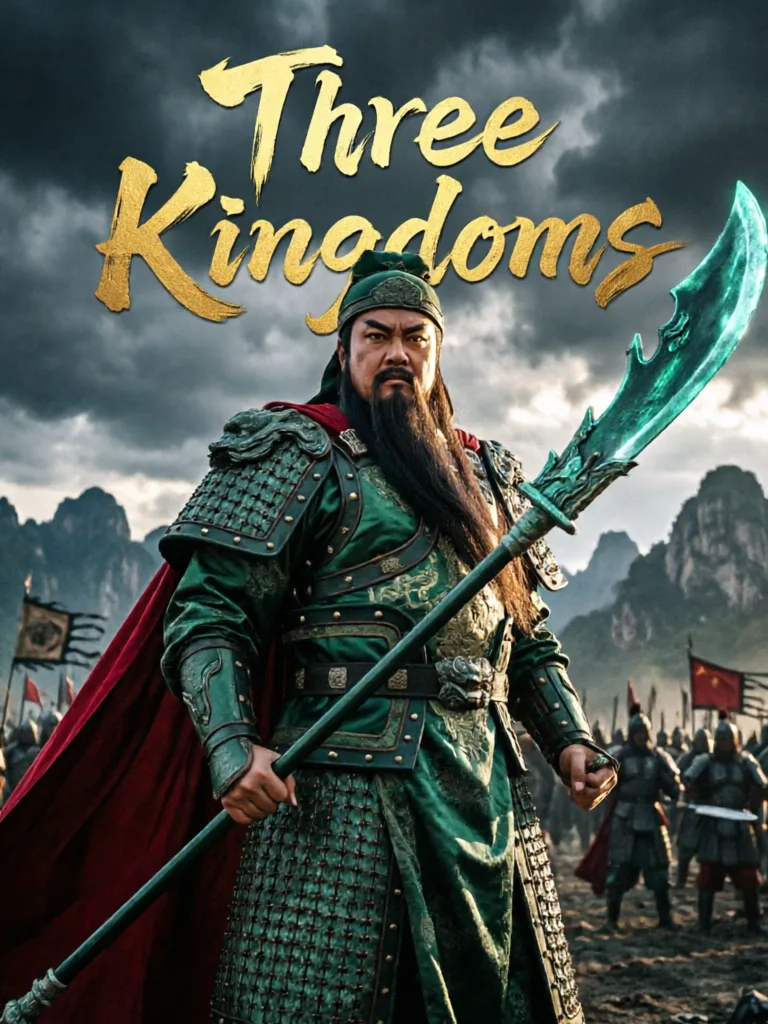
When Zhou Yu heard the words of Zhuge Jin, his resentment toward Zhuge Liang deepened, and he resolved in his heart to have the man murdered. The next day, he assembled his officers and troops, then went to take his leave of Sun Quan. Sun Quan said, "You go ahead, and I shall raise an army to follow shortly after." Zhou Yu took his leave and set out with Cheng Pu and Lu Su, and he invited Zhuge Liang to accompany them. Zhuge Liang accepted with cheerful readiness. Together they boarded the ships, hoisted the sails, and made their way steadily toward Xiakou. When they had come within fifty or sixty li of the Three Rivers Mouth, the ships anchored in orderly succession. Zhou Yu established his main camp at the center, while on the shore, fortifications were built at the foot of the western hills, with troops stationed all around. Zhuge Liang made his quarters in a single small boat.
After Zhou Yu had finished his deployments, he sent for Zhuge Liang to discuss matters. When Zhuge Liang arrived at the central command tent, they exchanged formal greetings, and Zhou Yu said, "In the past, when Cao Cao had fewer troops and Yuan Shao had more, Cao Cao still prevailed. This was because he followed Xu You's strategy and first cut off Yuan Shao's grain supplies at Wuchao. Now Cao Cao has 830,000 men, while we have only fifty or sixty thousand. How can we withstand him? We must first cut off his grain supplies before we can defeat him. I have learned that Cao Cao's army's provisions are all stored at Mount Jutie. You, sir, have long lived on the Han River and are familiar with the terrain. I would trouble you to go with Guan Yu, Zhang Fei, and Zhao Yun—and I will also provide a thousand men—to ride through the night to Mount Jutie and cut off Cao Cao's supply route. Each of us serves his own master, so I hope you will not refuse." Zhuge Liang thought to himself, "Since he could not persuade me to switch sides, he is now devising a scheme to harm me. If I refuse, he will certainly mock me. Better to agree and then think of another plan." So he accepted with apparent delight. Zhou Yu was greatly pleased. Zhuge Liang took his leave. Lu Su secretly asked Zhou Yu, "Why did you send Kongming to raid the grain supplies?" Zhou Yu replied, "I want to kill Kongming, but I fear the ridicule of others. So I am using Cao Cao's hand to do it, to remove a future threat." Hearing this, Lu Su went to see Zhuge Liang, to observe whether he suspected anything. He found Zhuge Liang showing no sign of difficulty, calmly preparing his men and horses for the mission. Lu Su could not bear it and tested him with a question: "Do you think this mission will succeed, sir?" Zhuge Liang smiled and said, "I am equally skilled in naval, infantry, cavalry, and chariot warfare. Why should I worry about not succeeding? Unlike you and Zhou Yu in Jiangdong, who each have only one specialty." Lu Su asked, "What do you mean by one specialty for Zhou Yu and me?" Zhuge Liang replied, "I have heard a children's rhyme in Jiangnan: 'For blocking roads and holding passes, rely on Zijing; for fighting on the river, there is Zhou Yu.' So you, sir, are only good at blocking roads and holding passes on land, while Zhou Yu is only fit for naval battles, not land warfare."
Lu Su reported these words to Zhou Yu. Zhou Yu was furious. "How dare he mock me for not being able to fight on land! I will not send him! I will lead ten thousand cavalry myself to Mount Jutie and cut off Cao Cao's grain supply!" Lu Su then repeated this to Zhuge Liang. Zhuge Liang laughed and said, "Zhou Yu ordered me to raid the grain only because he wanted Cao Cao to kill me. I teased him with a few words, and he could not tolerate it. At this critical moment, when we need men, I only hope that Lord Sun and Lord Liu will work together, and then success will be ours. If we scheme against each other, the great enterprise is lost. Cao Cao is full of tricks; he has always been skilled at cutting off others' grain lines. Do you think he would not guard his supplies heavily now? If Zhou Yu goes, he will surely be captured. For now, we should first decide the battle on the water, to blunt the northern army's edge, and then find another clever plan to break them. I hope you, Zijing, will convey my words to Zhou Yu." Lu Su then returned to Zhou Yu that very night and fully reported what Zhuge Liang had said. Zhou Yu shook his head and stamped his foot. "This man's insight is ten times greater than mine. If I do not remove him now, he will surely become a disaster for our kingdom!" Lu Su said, "At a time when we need men, I hope you will put the state first. Wait until after we have defeated Cao Cao, and then deal with him later." Zhou Yu accepted this reasoning.
Meanwhile, Liu Bei had ordered Liu Qi to guard Jiangxia, and he himself led his generals and troops toward Xiakou. From a distance, he saw the banners and spears faintly visible on the southern bank of the river, and he knew that the forces of Eastern Wu had already set out. So he moved all his troops from Jiangxia to Fan Pass and established a camp. Liu Bei gathered his men and said, "Zhuge Liang has been gone to Eastern Wu for a long time without any news. I do not know how matters stand. Who can go to find out the truth and report back?" Mi Zhu said, "I am willing to go." Liu Bei prepared gifts of sheep and wine and sent Mi Zhu to Eastern Wu, ostensibly to reward the troops but actually to learn the real situation. Mi Zhu took his orders, boarded a small boat, and sailed downstream directly to Zhou Yu's main camp. The guards reported his arrival to Zhou Yu, who summoned him in. Mi Zhu bowed twice, conveyed Liu Bei's respects, and presented the gifts. Zhou Yu accepted them and held a banquet for Mi Zhu. Mi Zhu said, "Zhuge Liang has been here for a long time. I wish to take him back with me." Zhou Yu replied, "Kongming is now working with me on the plan to defeat Cao Cao. How can he leave? I also wish to see Lord Liu Bei himself to discuss our strategy together. But I am in command of a great army and cannot leave for a moment. If Lord Liu would be willing to honor me with a visit, it would be a great comfort." Mi Zhu agreed, took his leave, and returned. Lu Su asked Zhou Yu, "Why do you want to see Liu Bei? What do you plan to discuss?" Zhou Yu said, "Liu Bei is a cunning hero of the age. He must be removed. I will use this opportunity to lure him here and kill him, to rid the state of a future threat." Lu Su repeatedly tried to dissuade him, but Zhou Yu would not listen. He secretly ordered, "When Liu Bei arrives, hide fifty armed men behind the wall tapestries. Watch for me to drop my cup as a signal, and then strike."
When Mi Zhu returned and reported to Liu Bei that Zhou Yu wished to meet with him for further discussion, Liu Bei immediately ordered a fast boat to be prepared and said he would go at once. Guan Yu advised against it, saying, "Zhou Yu is a man of many schemes, and we have no letter from Zhuge Liang. There may be treachery. You should not go lightly." Liu Bei replied, "I have allied with Eastern Wu to defeat Cao Cao. If Zhou Yu wants to see me and I do not go, it will seem like a breach of our alliance. If we begin to suspect each other, our plans will fail." Guan Yu said, "If you are determined to go, brother, I will go with you." Zhang Fei said, "I will go too." Liu Bei said, "Only Yunchang will accompany me. Yide and Zilong will guard the camp. Jian Yong will hold E County. I will return soon." Having given his orders, he boarded a small boat with Guan Yu and more than twenty followers, and they rowed swiftly toward Jiangdong. As Liu Bei observed the battle-ramming ships, the banners, the armor, and the orderly array of troops on the river, his heart was filled with joy. A soldier reported to Zhou Yu, "Lord Liu has arrived." Zhou Yu asked, "How many ships did he bring?" The soldier replied, "Only one boat, with about twenty followers." Zhou Yu laughed and said, "This man's fate is sealed!" He ordered the armed men to take their hidden positions, then went out of the camp to greet Liu Bei. Liu Bei, with Guan Yu and the twenty others, went straight to the central command tent. After exchanging greetings, Zhou Yu offered Liu Bei the seat of honor. Liu Bei said, "Your fame, General, has spread across the realm. I am a man of no talent. Why do you honor me with such courtesy?" So they took their seats as host and guest, and Zhou Yu held a banquet in Liu Bei's honor.
Now it happened that Zhuge Liang had come to the riverbank and heard that Liu Bei had come to meet the commander. He was greatly alarmed and hurried into the central camp to observe the situation. He saw murderous intent on Zhou Yu's face and noted the armed men densely hidden behind the wall tapestries. Zhuge Liang was terrified. "What can be done?" he thought. He looked at Liu Bei, who was chatting and laughing as if nothing were wrong. But then he saw the man standing behind Liu Bei, hand on his sword—it was Guan Yu. Zhuge Liang was overjoyed. "My lord is safe!" he said to himself. He did not enter the tent but turned back and went to wait by the river.
Zhou Yu and Liu Bei drank and feasted. After several rounds of wine, Zhou Yu rose to offer a toast. Suddenly, he caught sight of Guan Yu standing behind Liu Bei, hand on his sword. Startled, he asked who the man was. Liu Bei said, "He is my younger brother, Guan Yunchang." Zhou Yu was astonished. "Is this not the man who slew Yan Liang and Wen Chou?" he asked. Liu Bei replied, "It is." Zhou Yu was filled with shock, and cold sweat ran down his back. He poured a cup of wine and offered it to Guan Yu. Presently, Lu Su entered. Liu Bei said, "Where is Zhuge Liang? Please ask Zijing to invite him here for a meeting." Zhou Yu said, "Wait until we have defeated Cao Cao. There will be time enough to meet with Kongming then." Liu Bei dared not press the matter. Guan Yu shot a meaningful glance at Liu Bei, who understood and immediately rose to take his leave. "I will take my leave for now," he said. "When we have defeated the enemy and claimed our victory, I will come specially to offer my congratulations." Zhou Yu did not detain him and saw him out of the camp gate.
Liu Bei parted from Zhou Yu and went with Guan Yu and the others to the riverbank. There he found Zhuge Liang already waiting in the boat. Liu Bei was overjoyed. Zhuge Liang said, "My lord, do you know how great a danger you were in today?" Liu Bei was startled. "I do not," he said. Zhuge Liang said, "If it had not been for Yunchang, you would have fallen victim to Zhou Yu's plot." Only then did Liu Bei realize the truth. He invited Zhuge Liang to return with him to Fan Pass. Zhuge Liang said, "Although I am living in the tiger's mouth, I am as safe as Mount Tai. For now, my lord, you should prepare your ships and troops for use. On the twentieth day of the eleventh month, the day of Jiazi, you may order Zilong to bring a small boat to the southern shore to wait for me. Do not be late." Liu Bei asked what this meant. Zhuge Liang said, "When you see the southeast wind rise, you will know that I am returning." Liu Bei wanted to ask more, but Zhuge Liang urged him to set sail quickly. Then he himself turned back. Liu Bei, Guan Yu, and their followers set off. They had not gone more than a few li when they saw fifty or sixty ships coming down from upstream. At the prow of the lead ship stood a great general, his serpent spear held crosswise—it was Zhang Fei. Fearing that Liu Bei might come to harm and that Guan Yu alone might not be able to protect him, he had come to meet them. So the three brothers returned together to their camp. Of this, no more need be said.
After seeing Liu Bei off, Zhou Yu returned to his camp. Lu Su came in and asked, "You lured Liu Bei here. Why did you not strike?" Zhou Yu said, "Guan Yu is a tiger among men. He was with Liu Bei every moment. If I had made a move, he would have killed me." Lu Su was dumbfounded. Just then, a messenger arrived from Cao Cao bearing a letter. Zhou Yu summoned him in. The messenger presented the letter. On the envelope was written: "From the Grand Chancellor of Han, to be opened by Commander Zhou Yu." Zhou Yu flew into a rage. Without even opening it, he tore the letter to pieces, threw them on the ground, and ordered the messenger beheaded. Lu Su said, "When two states are at war, they do not kill the messenger." Zhou Yu said, "I will kill the messenger to show my might!" So the messenger was executed, and his head was given to his attendants to take back. Zhou Yu then ordered Gan Ning to lead the vanguard, Han Dang to command the left wing, and Jiang Qin to command the right. Zhou Yu himself led the main force in support. The next day, they were to prepare their meals at the fourth watch, set sail at the fifth, and advance with drums beating and war cries ringing.
When Cao Cao learned that Zhou Yu had torn up his letter and killed his messenger, he was furious. He ordered Cai Mao and Zhang Yun, the former Jing Province generals who had surrendered to him, to lead the front force, while Cao Cao himself commanded the rear. They urged their warships forward and soon arrived at the Three Rivers Mouth. Before long, they saw the ships of Eastern Wu covering the river. At the head of the Wu fleet, a great general stood at the prow of his ship and shouted, "I am Gan Ning! Who dares to fight me?" Cai Mao ordered his younger brother, Cai Xun, to advance. As the two ships drew near, Gan Ning drew his bow, nocked an arrow, and shot Cai Xun, who fell dead at the twang of the bowstring. Gan Ning drove his ship forward, and a volley of ten thousand arrows was unleashed. The Cao army could not withstand the assault. On the right, Jiang Qin; on the left, Han Dang—both charged straight into the midst of Cao Cao's fleet. Most of Cao Cao's troops were from Qing and Xu provinces and were not accustomed to naval warfare. On the great river, as the warships pitched and rolled, they could barely keep their footing. Gan Ning and the other two commanders sailed their ships back and forth across the water, striking at will. Zhou Yu urged more ships forward to join the attack. The number of Cao Cao's soldiers killed by arrows and cannon fire was beyond counting. The battle raged from the hour of the Snake (9-11 AM) to the hour of the Sheep (1-3 PM). Although Zhou Yu had gained the advantage, he feared that his smaller force might be overwhelmed by the enemy's larger numbers. So he ordered the gongs to be sounded to recall the ships.
Cao Cao's forces retreated in defeat. Cao Cao went ashore to his camp and reorganized his troops. He summoned Cai Mao and Zhang Yun and berated them, saying, "The army of Eastern Wu is smaller, yet we were defeated by them. This is because you did not exert yourselves!" Cai Mao replied, "The Jing Province navy has not been trained for a long time, and the troops from Qing and Xu are not used to naval warfare. That is why we were defeated. We should first establish a fortified naval camp, with the Qing and Xu troops in the center and the Jing Province troops on the outside. Train them every day until they are skilled, and then we can use them." Cao Cao said, "You are the commander of the navy. You may act on your own authority. Why do you need to report to me?" So Zhang Yun and Cai Mao went to train the navy. Along the river, they set up twenty-four water gates. Large ships were anchored on the outside to form a wall, while smaller ships were placed on the inside to allow movement between them. At night, lanterns were lit, and their glow turned the sky and the water red. The land camp stretched for over three hundred li, with smoke from campfires rising ceaselessly.
Zhou Yu returned to his camp victorious and rewarded his troops. He also sent a messenger to Sun Quan to report the victory. That night, Zhou Yu climbed a high place to observe the enemy. He saw a blaze of fire light up the western sky. His attendants said, "Those are the lights of the northern army's campfires." Zhou Yu was alarmed. The next day, he decided to go himself to reconnoiter Cao Cao's naval camp. He ordered a tower ship to be prepared, and with drums and musicians, and several strong warriors armed with powerful bows and crossbows, he sailed slowly forward. When he reached Cao Cao's camp, Zhou Yu ordered the anchor to be dropped, and the musicians on the tower ship began to play. Zhou Yu secretly observed the enemy's naval fortifications and was astonished. "This is a man who truly understands naval warfare!" he said to himself. He asked, "Who is the commander of the Cao navy?" His attendants replied, "Cai Mao and Zhang Yun." Zhou Yu thought, "These two men have long lived in Jiangdong and are well versed in naval combat. I must devise a plan to remove them first, and then I can break Cao Cao." As he was observing, a Cao soldier reported to Cao Cao that Zhou Yu was spying on their camp. Cao Cao ordered ships to be launched to capture him. When Zhou Yu saw the flags and signals moving in the enemy camp, he quickly ordered the anchor raised. His men rowed with all their might, and the tower ship sped away across the river like the wind. By the time Cao Cao's ships emerged, Zhou Yu's vessel was already more than ten li away, and they could not catch it. The pursuers returned and reported to Cao Cao.
Cao Cao asked his generals, "Yesterday we lost a battle and our edge was blunted. Today, Zhou Yu has deeply spied on our camp. What plan can we devise to defeat him?" Before he had finished speaking, a man stepped forward from the assembly and said, "I have been a close friend and schoolmate of Zhou Yu since childhood. I am willing to use my silver tongue to go to Jiangdong and persuade this man to surrender." Cao Cao was overjoyed. He looked at the speaker, who was a man from Jiujiang named Jiang Gan, styled Ziyi, currently serving as an adviser in Cao Cao's camp. Cao Cao asked, "Are you on good terms with Zhou Yu?" Jiang Gan said, "Rest assured, Chancellor. When I reach Jiangdong, I will surely succeed." Cao Cao asked, "What will you need to take with you?" Jiang Gan replied, "Just a young attendant to accompany me, and two servants to row the boat. Nothing else." Cao Cao was very pleased and prepared wine to see Jiang Gan off.
Jiang Gan, dressed in a simple linen robe and a coarse turban, took a small boat and went directly to Zhou Yu's camp. He sent a message: "An old friend, Jiang Gan, has come to visit." Zhou Yu was in his tent discussing affairs when he heard of Jiang Gan's arrival. He laughed and said to his generals, "A persuader has come!" He then whispered instructions into the ears of his generals, and they all departed to carry out his orders. Zhou Yu adjusted his robes and cap, and with several hundred attendants, all dressed in embroidered silk and flowered caps, he went out in a grand procession. Jiang Gan, followed by a young servant in blue, came striding in with an air of importance. Zhou Yu greeted him with a bow. Jiang Gan said, "How have you been since we last met, Gongjin?" Zhou Yu replied, "You have taken great trouble, Ziyi. You have crossed rivers and lakes to come here—are you not a persuader for Cao Cao?" Jiang Gan was taken aback. "I have been long parted from you, and I came only to talk of old times. Why do you suspect me of being a persuader?" Zhou Yu laughed and said, "Although I am not as perceptive as the legendary musician Shi Kuang, I can still catch the meaning when I hear a tune." Jiang Gan said, "If this is how you treat an old friend, then I will take my leave." Zhou Yu laughed again and took him by the arm. "I only feared you had come as a persuader for Cao Cao. Since you have no such intention, why leave so soon?" So they entered the tent together.
After exchanging formal greetings and taking their seats, Zhou Yu immediately ordered all the heroes of Jiangdong to be summoned to meet Ziyi. In a short time, civil officials and military officers, all in embroidered silk, and the captains and lieutenants of the camp, all in silver armor, entered in two rows. Zhou Yu had them all introduced, and then they took their seats on either side. A great feast was laid out, and the music of victory was played. Wine was passed around in turn. Zhou Yu said to the assembled officers, "This is my close friend and former schoolmate. Although he has come from north of the river, he is not a persuader for Cao Cao. Do not suspect him." He then unbuckled his sword and handed it to Taishi Ci, saying, "You may wear my sword and act as the wine steward. At today's feast, we shall speak only of friendship. If anyone mentions the military affairs of Cao Cao and Eastern Wu, let him be beheaded on the spot!" Taishi Ci accepted the order and sat down at the table, hand on his sword. Jiang Gan was stunned and dared not say much. Zhou Yu said, "Since I have taken command of the army, I have not drunk a single drop of wine. But today, seeing my old friend, and with no cause for suspicion, I will drink until I am drunk." With that, he laughed heartily and drank deeply. The cups and chopsticks flew back and forth among the guests.
When the wine had flowed freely and they were half drunk, Zhou Yu took Jiang Gan by the hand and led him out of the tent. The guards, fully armed and carrying spears and halberds, stood at attention. Zhou Yu asked, "Are my soldiers not fierce and strong?" Jiang Gan replied, "
Truly, they are like bears and tigers." Zhou Yu then led Jiang Gan to the rear of the tent, where they saw mountains of grain piled up. Zhou Yu asked, "Are my provisions not plentiful?" Jiang Gan said, "Elite troops and ample supplies—your reputation is well deserved." Zhou Yu pretended to be drunk and laughed loudly. "When Zhou Yu and Ziyi were studying together, I never dreamed that I would come to this!" Jiang Gan said, "With your great talent, my brother, this is not at all excessive." Zhou Yu took Jiang Gan's hand and said, "A man of true worth, when he meets a lord who understands him, is bound by the duty of ruler and subject on the outside, and by the affection of brothers on the inside. His words are heeded, his plans are followed, and he shares both fortune and misfortune. Even if Su Qin, Zhang Yi, Lu Jia, or Li Yiji were to rise again, with their tongues as sharp as swords and their eloquence flowing like a river, they could not move my heart!" With these words, he laughed again. Jiang Gan's face turned the color of ash.
Zhou Yu then led Jiang Gan back into the tent and continued the feast with the other generals. Pointing to them, he said, "These are all the heroes of Jiangdong. This gathering today should be called the Gathering of Heroes." They drank until evening, when lanterns and candles were lit. Zhou Yu himself rose and performed a sword dance, singing a song: "A man of valor in this life seeks to establish his name and achieve glory; achieving glory and fame brings comfort to a life well spent; comforted in life, I shall drink until I am drunk; drunk, I shall sing a wild and passionate song!"
When the song ended, the whole company burst into laughter. As the night grew deep, Jiang Gan excused himself, saying, "I can drink no more." Zhou Yu ordered the feast to be cleared, and the generals took their leave. Zhou Yu said, "It has been a long time since I have shared a bed with Ziyi. Tonight, let us sleep together." So, pretending to be deeply drunk, he led Jiang Gan into the tent to share his bed. Zhou Yu lay down fully clothed and soon began to snore, and he vomited messily. But Jiang Gan could not sleep. He lay with his head on the pillow, listening. When the drum in the camp sounded the second watch, he rose and saw that the lamp was still burning. He looked at Zhou Yu, whose snoring was like thunder. On the table in the tent, Jiang Gan saw a pile of documents. He got up and secretly examined them. They were all letters. Among them was one with the inscription: "Respectfully sealed by Cai Mao and Zhang Yun." Jiang Gan was shocked. He read it secretly. The letter said: "We surrendered to Cao Cao not for the sake of office or wealth, but because we were forced by circumstances. We have now lured the northern army into a trap within their own camp. As soon as we find an opportunity, we will take the head of the traitor Cao Cao and present it to you. Someone will be sent to report when the time comes. Do not suspect us. This is our preliminary report."
Jiang Gan thought to himself, "So Cai Mao and Zhang Yun are in league with Eastern Wu!" He secretly hid the letter in his clothing. He was about to examine the other letters when Zhou Yu turned over in bed. Jiang Gan quickly blew out the lamp and lay down. Zhou Yu mumbled in his sleep, "Ziyi... within a few days... I will show you Cao Cao's head!" Jiang Gan forced himself to reply. Zhou Yu mumbled again, "Ziyi... wait... I will show you Cao Cao's head..." When Jiang Gan asked him what he meant, Zhou Yu was already snoring again. Jiang Gan lay on the bed. Near the fourth watch, he heard someone enter the tent and call out, "Is the commander awake?" Zhou Yu, pretending to have just woken from a dream, asked the man, "Who is sleeping in my bed?" The man replied, "You invited Ziyi to share your bed, Commander. Have you forgotten?" Zhou Yu said with feigned regret, "I never drink to excess on ordinary days. Last night, I was drunk and may have said things I should not have. Did I say anything?" The man said, "Someone has come from north of the river." Zhou Yu hissed, "Lower your voice!" Then he called out, "Ziyi!" Jiang Gan pretended to be asleep. Zhou Yu crept out of the tent. Jiang Gan listened intently and heard someone outside say, "The two commanders, Zhang and Cai, say that they cannot strike yet..." The rest of the words were too low to hear clearly. After a while, Zhou Yu returned to the tent and called out again, "Ziyi!" Jiang Gan did not answer, but pretended to be asleep, his head covered by the blanket. Zhou Yu then took off his clothes and went to sleep.
Jiang Gan thought, "Zhou Yu is a meticulous man. When he wakes up and finds the letter missing, he will surely kill me." He waited until the fifth watch, then got up and called to Zhou Yu, but Zhou Yu was still asleep. Jiang Gan put on his turban, stole out of the tent, called his young servant, and went straight out of the camp gate. The guards asked, "Where are you going, sir?" Jiang Gan replied, "I fear I am disturbing the commander's business by staying here. I am taking my leave for now." The guards did not stop him. Jiang Gan boarded his boat and rowed swiftly back to see Cao Cao. Cao Cao asked, "How did your mission go, Ziyi?" Jiang Gan said, "Zhou Yu is a man of great refinement and lofty spirit. He cannot be moved by words." Cao Cao was angry. "You have failed again, and now you have been mocked!" Jiang Gan said, "Although I could not persuade Zhou Yu, I have learned something for you, Chancellor. Please dismiss your attendants."
Jiang Gan took out the letter and told Cao Cao everything that had happened. Cao Cao flew into a rage. "How dare these two traitors be so insolent!" He immediately summoned Cai Mao and Zhang Yun to his tent. Cao Cao said, "I want you two to advance and attack." Cai Mao replied, "The troops are not yet fully trained. We cannot advance rashly." Cao Cao shouted in fury, "If the troops were fully trained, my head would already be presented to Zhou Yu!" Cai Mao and Zhang Yun did not understand what he meant and stood there in terrified silence. Cao Cao ordered the guards to take them out and behead them. In a moment, their heads were presented before the tent. Only then did Cao Cao realize his mistake. "I have been tricked!" he said. A poet of later times lamented: "Cao Cao, that peerless villain, was momentarily outwitted by Zhou Yu's cunning. Cai Mao and Zhang Yun had betrayed their lord to save their own lives—who would have thought that this very day they would die by the sword?"
The other generals, seeing that Zhang Yun and Cai Mao had been executed, came to ask the reason. Although Cao Cao knew in his heart that he had fallen for a ruse, he would not admit his mistake. He said to the generals, "These two men were negligent in military discipline, so I had them executed." The generals all sighed in regret.
Cao Cao then selected Mao Jie and Yu Jin from among his officers to serve as commanders of the navy, replacing Cai Mao and Zhang Yun. Spies learned of this and reported it to Jiangdong. Zhou Yu was overjoyed. "The only men I feared were those two. Now that they have been removed, I have nothing to worry about!" Lu Su said, "With such skill in the art of war, Commander, why should we fear that Cao Cao will not be defeated?" Zhou Yu said, "I suspect that none of our generals have seen through this plan. But Zhuge Liang's insight surpasses mine, and I doubt this ruse can be hidden from him. Zijing, go and test him. See if he knows the truth, and then report back to me." And so it was that the successful ruse of sowing discord was to be used to test the observer from the sidelines. Whether Lu Su went to question Zhuge Liang, and what came of it, will be told in the next chapter.