That night, as Zhang Liao's arrow struck Huang Gai and sent him plunging into the river, Cao Cao was rescued and brought ashore. He found a horse and attempted to flee, but his army had already dissolved into chaos. Han Dang charged through smoke and flames to attack the water camp when suddenly a soldier reported: "A man on the stern of a boat is calling out your style name, General!" Han Dang listened carefully and heard a voice shouting: "Yigong! Save me!" "That is Huang Gongfu!" Han Dang exclaimed, and quickly ordered him rescued. He found Huang Gai wounded by an arrow, having bitten off the shaft while the arrowhead remained embedded in his flesh. Han Dang urgently stripped off his wet clothes, cut out the arrowhead with a knife, tore a banner to bind the wound, and removed his own battle robe to dress Huang Gai. He then sent him back to the main camp on another boat for treatment. Huang Gai, being an expert swimmer familiar with the river's currents, had managed to survive even after falling into the icy waters in full armor during the bitter cold. On that day, the entire river blazed with fire, and the cries of battle shook the earth. On the left, Han Dang and Jiang Qin's forces attacked from west of Red Cliffs; on the right, Zhou Tai and Chen Wu's forces struck from the east; and in the center, Zhou Yu, Cheng Pu, Xu Sheng, and Ding Feng arrived with the main fleet. Fire required soldiers to press the attack, and soldiers drew strength from the flames. Thus the great battle on the Three Rivers unfolded—the fierce clash at Red Cliffs. Cao Cao's men, struck by spears and arrows, burned to death or drowned, could not be counted.
A poet of the time lamented: "The struggle between Wei and Wu decided which would prevail, and the towering ships at Red Cliffs were swept clean. The first flames spread, lighting the sea of clouds, and Zhou Yu broke Cao Cao's power here." Another verse recorded: "The mountains were high, the moon small, the waters vast; one sighs, recalling the frantic struggles of bygone dynasties. The southern men had no heart to welcome the warlord of Wei; the eastern wind favored Zhou Yu's cause."
Let us leave the battle on the river and speak of Gan Ning. He ordered Cai Zhong to lead him deep into Cao Cao's camp, then struck Cai Zhong down from his horse with a single blow of his blade and set fire to the grass. Lü Meng, seeing flames rising from the central camp from afar, also ignited a dozen fires to support Gan Ning. Pan Zhang and Dong Xi set fires separately, shouting war cries, and drums thundered from all directions. Cao Cao, accompanied by Zhang Liao and a hundred cavalry, fled through a forest of flames. Ahead, every place was burning. As they rode, Mao Jie arrived with Wen Ping and a dozen horsemen. Cao Cao ordered his men to find a path. Zhang Liao pointed and said: "Only the Wulin region is open ground; we can flee there." Cao Cao galloped straight for Wulin. As he fled, a force caught up from behind, shouting: "Do not flee, traitor Cao!" In the firelight, Lü Meng's banner appeared. Cao Cao urged his horse forward, leaving Zhang Liao to hold the rear against Lü Meng. Then, ahead, torches blazed again, and an army emerged from the mountain valley, shouting: "Ling Tong is here!" Cao Cao's heart and liver nearly burst with terror. Suddenly, a unit arrived from the side, shouting: "Do not panic, Chancellor! Xu Huang is here!" They fought a chaotic battle and cut a path to flee north. Then they saw a troop of cavalry stationed on a hillside. Xu Huang went to inquire and found they were former subordinates of Yuan Shao—Ma Yan and Zhang Yi—leading three thousand northern soldiers encamped there. That night, seeing the sky ablaze, they had not dared to move and now happened to meet Cao Cao. Cao Cao ordered the two generals to lead a thousand men to clear the way, keeping the rest for his protection. With this fresh force, his heart calmed slightly. Ma Yan and Zhang Yi rode swiftly ahead. Within ten li, war cries rose, and a unit burst forth. At its head, a general shouted: "I am Gan Xingba of Eastern Wu!" Ma Yan was about to engage when Gan Ning cut him down with one stroke. Zhang Yi raised his spear to meet the attack, but Gan Ning roared, and before Zhang Yi could react, Gan Ning's blade struck him from his horse. A messenger reported this to Cao Cao. Cao Cao now hoped for reinforcements from Hefei, but Sun Quan, seeing the flames on the river from the Hefei road, knew his forces had won. He ordered Lu Xun to light signal fires. Taishi Ci saw this and joined forces with Lu Xun, charging forward. Cao Cao could only flee toward Yiling. On the road, he encountered Zhang He and ordered him to guard the rear.
Whipping his horse, Cao Cao rode until the fifth watch. Looking back, he saw the flames growing distant, and his heart finally steadied. He asked: "Where is this place?" His attendants replied: "This is west of Wulin, north of Yidu." Cao Cao saw the dense trees and rugged mountains and, from his horse, threw back his head and laughed loudly. The generals asked: "Why does the Chancellor laugh so heartily?" Cao Cao replied: "I laugh at no one else—only at Zhou Yu's lack of strategy and Zhuge Liang's poor planning. If I were commanding troops, I would have stationed an ambush here. What then?" Before he finished speaking, drums thundered from both sides, and flames blazed into the sky. Cao Cao was so startled he nearly fell from his horse. A unit charged out from the side, shouting: "I, Zhao Zilong, have been waiting here on the orders of the Military Strategist!" Cao Cao ordered Xu Huang and Zhang He to engage Zhao Yun together while he fled through the smoke and flames. Zhao Yun did not pursue but focused on seizing banners and supplies. Cao Cao escaped.
As dawn approached, black clouds covered the earth, and the southeastern wind still blew. Suddenly, a torrential rain poured down, soaking armor and clothing. Cao Cao and his soldiers marched on in the rain, all showing signs of hunger. Cao Cao ordered his men to plunder food from nearby villages and find fire-starting materials. Just as they were about to cook, another force caught up. Cao Cao was deeply alarmed. It turned out to be Li Dian and Xu Chu, who had escorted the strategists safely. Cao Cao was overjoyed and ordered the army to continue moving. He asked: "What place lies ahead?" Someone reported: "One road leads to South Yiling, the other to the mountain path of North Yiling." Cao Cao asked: "Which is the shortest route to Nan Commandery's Jiangling?" The soldiers replied: "Taking South Yiling through Gourd Pass is the most convenient." Cao Cao ordered the army to take South Yiling. When they reached Gourd Pass, the soldiers were so exhausted from hunger they could barely walk. Their horses were also fatigued, many collapsing on the road. Cao Cao ordered a temporary halt. Some had brought cooking pots on their horses; others had seized grain from villages. They found a dry spot by the mountain to set up camp and cook, cutting horse meat to roast. All stripped off their wet clothes to dry in the wind, and the horses were unsaddled and let loose to graze on grass roots. Cao Cao sat under a sparse grove of trees and laughed uproariously. The officers asked: "Earlier, the Chancellor laughed at Zhou Yu and Zhuge Liang, which brought out Zhao Zilong and cost us many men. Why do you laugh again now?" Cao Cao replied: "I laugh because Zhuge Liang and Zhou Yu are ultimately lacking in strategy. If I were commanding troops, I would have stationed an ambush here, waiting at ease for the weary. Even if we escaped with our lives, we would have suffered heavy losses. They did not think of this, so I laugh." As he spoke, shouts erupted from both the front and rear of the army. Cao Cao was greatly alarmed, abandoned his armor, and mounted his horse. Many soldiers could not even retrieve their horses. Flames and smoke gathered from all sides, and at the mountain pass, an army deployed. At its head was Zhang Yide of Yan, gripping his serpent spear and sitting astride his horse, roaring: "Where do you flee, traitor Cao!" The soldiers and generals, seeing Zhang Fei, were all terrified. Xu Chu, riding a horse without a saddle, charged to fight Zhang Fei. Zhang Liao and Xu Yang also galloped forward to join the attack. The two sides clashed in a chaotic melee. Cao Cao first turned his horse and fled; the generals each broke free. Zhang Fei pursued from behind. Cao Cao fled in a winding path, and as the pursuers gradually fell behind, he looked back to see that most of his generals were wounded.
As they marched, a soldier reported: "Ahead, there are two roads. Which one should the Chancellor take?" Cao Cao asked: "Which is shorter?" The soldier replied: "The main road is somewhat flat but fifty li longer. The small path leads to the Huarong Trail and is fifty li shorter, but the road is narrow, dangerous, and full of pits and gullies, making travel difficult." Cao Cao sent someone up the mountain to survey, and the scout reported back: "On the small path by the mountain, there are several columns of smoke; on the main road, there is no activity." Cao Cao ordered the vanguard to take the Huarong Trail. The generals asked: "Where there is smoke, there must be troops. Why do you choose this path?" Cao Cao replied: "Have you not read in the Art of War: 'Make a show of strength where you are weak, and weakness where you are strong'? Zhuge Liang is cunning, so he ordered smoke lit on the remote mountain path to make us afraid to take it, while he lays an ambush on the main road. I have calculated this; I will not fall for his trick!" The generals all said: "The Chancellor's foresight is beyond reach." So they led the army onto the Huarong Trail. By now, the men were collapsing from hunger and the horses exhausted. Those with scorched faces and burned heads leaned on each other to walk; those struck by arrows or spears struggled on. Their armor and clothing were soaked through, each piece incomplete; weapons and banners were scattered and disordered. Most had been so hastily driven from Yiling Road that they rode bareback horses, having abandoned saddles, bridles, and clothes. It was the depth of winter, and their suffering was beyond words.
Cao Cao saw the vanguard halt and asked why. The reply came: "Ahead, the mountain path is narrow. Because of this morning's rain, the ditches are filled with stagnant water, and the horses' hooves sink into the mud, making progress impossible." Cao Cao flew into a rage and shouted: "An army cuts paths through mountains and bridges across waters! How can muddy roads be an excuse!" He issued an order: let the old, weak, and wounded soldiers fall behind slowly, while the strong carry earth, bundle wood, and gather reeds to fill the road. They must move immediately; anyone who disobeys will be executed. The soldiers had no choice but to dismount and cut bamboo and wood from the roadside to fill the mountain pass. Fearing pursuit from the rear, Cao Cao ordered Zhang Liao, Xu Chu, and Xu Yang to lead a hundred cavalry with drawn swords, cutting down anyone who was too slow. By now, the troops were starving and exhausted; many collapsed. Cao Cao ordered his men to trample over them, and countless died. The sound of wailing filled the road. Cao Cao raged: "Life and death are fated! What is there to cry about? Anyone who cries again will be executed on the spot!" Of the original three divisions of men, one fell behind, one filled the ditches, and only one followed Cao Cao. After passing the treacherous terrain, the road became slightly flatter. Cao Cao looked back and saw only three hundred riders following, none with intact armor or robes. He urged them to hurry. The generals said: "The horses are exhausted; we must rest a little." Cao Cao replied: "We can rest when we reach Jing Province." They had not gone another few li when Cao Cao, on his horse, raised his whip and laughed again. The generals asked: "Why does the Chancellor laugh again?" Cao Cao said: "Everyone says Zhou Yu and Zhuge Liang are full of stratagems, but in my view, they are ultimately incompetent. If an army were stationed here, we would all be captured without a fight."
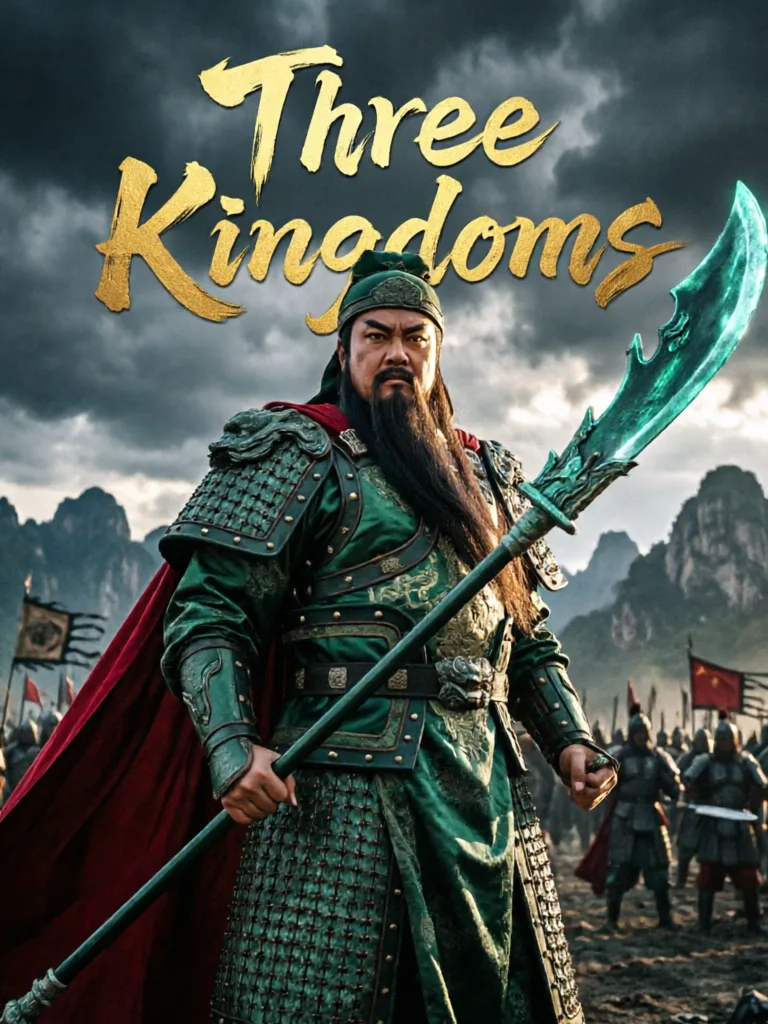
Before he finished speaking, a cannon boomed. Five hundred blade-wielding soldiers deployed on both sides. At their head was the great general Guan Yunchang, wielding the Green Dragon Crescent Blade and riding Red Hare, blocking the path. Cao Cao's soldiers, seeing this, lost all courage and stared at each other in terror. Cao Cao said: "Since we have come this far, we must fight to the death!" The generals replied: "Even if we are not afraid, our horses are exhausted. How can we fight?" Cheng Yu said: "I have long known that Yunchang is proud to those above him but merciful to those below; he bullies the strong but does not oppress the weak. He is clear in his favors and grievances, and renowned for his honor and righteousness. The Chancellor once showed him kindness. If you personally appeal to him now, we may escape this difficulty." Cao Cao followed this advice. He rode forward, bowed slightly, and said to Guan Yu: "General, have you been well since we parted?" Guan Yu also bowed slightly and replied: "I, Guan, have been waiting here for the Chancellor on the orders of the Military Strategist." Cao Cao said: "I am defeated and desperate, with no way out. I hope the General will remember our past bond." Guan Yu replied: "In the past, though I received great kindness from the Chancellor, I repaid it by slaying Yan Liang, killing Wen Chou, and lifting the siege at White Horse. Today, how can I allow personal favor to override public duty?" Cao Cao said: "Do you still recall when you passed through the five passes and killed the six generals? A true man values honor above all. You are deeply versed in the Spring and Autumn Annals. Do you not know the story of Duke Yu's son pursuing Zi Zhuo's son?" Guan Yu was a man as weighty as a mountain when it came to honor. He remembered all the kindness Cao Cao had shown him, and the events of the five passes, and how could he remain unmoved? He also saw Cao Cao's army, terrified and on the verge of tears, and his heart could not bear it. So he turned his horse's head and said to his troops: "Spread out to the sides." This was clearly a signal to let Cao Cao pass. Seeing Guan Yu turn his horse, Cao Cao and his generals charged through. By the time Guan Yu looked back, Cao Cao and his generals had already passed. Guan Yu gave a great shout, and his soldiers all dismounted, weeping and bowing to the ground. Guan Yu's heart grew even softer. As he hesitated, Zhang Liao galloped up. Seeing him, Guan Yu was moved by their old friendship. He let out a long sigh and let them all go.
A poet of the time recorded: "Cao Cao, defeated, fled to Huarong, meeting Guan Yu on the narrow path. Only because of past kindness and honor did he unlock the golden chains and let the dragon go free."
Having escaped the peril at Huarong, Cao Cao reached the valley mouth. Looking back, he counted only twenty-seven riders. By nightfall, they neared Nan Commandery. Torches blazed, and a cluster of horsemen blocked the road. Cao Cao gasped in terror: "My life is over!" But it was only a scouting party of Cao Ren's troops. Cao Cao's heart steadied. Cao Ren greeted him and said: "Though I knew of the defeat, I dared not go far and waited nearby to receive you." Cao Cao said: "I almost never saw you again!" He then led his men into Nan Commandery to rest. Zhang Liao arrived soon after and recounted Guan Yu's virtue. Cao Cao reviewed his officers and found many wounded. He ordered them all to rest. Cao Ren prepared wine to lift Cao Cao's spirits. All the strategists were present. Suddenly, Cao Cao threw back his head and wept bitterly. The strategists asked: "When the Chancellor fled from the tiger's den, you showed no fear. Now that you are in the city, with food for men and fodder for horses, and should be rallying the army for revenge, why do you weep instead?" Cao Cao replied: "I weep for Guo Fengxiao! If Fengxiao were still alive, he would never have allowed me to suffer such a great loss!" He beat his chest and cried: "Alas, Fengxiao! How I grieve for you, Fengxiao! How I mourn you, Fengxiao!" The other strategists fell silent, filled with shame.
The next day, Cao Cao summoned Cao Ren and said: "I will return to Xuchang for now to reorganize the army and come back for revenge. You must hold Nan Commandery. I leave a plan here, sealed and secret. Do not open it unless in an emergency; open it only when pressed. Follow its instructions, and Eastern Wu will not dare to look directly at Nan Commandery." Cao Ren asked: "Who will guard Hefei and Xiangyang?" Cao Cao replied: "Jing Province is entrusted to you. Xiangyang I have already assigned to Xiahou Dun. Hefei is the most critical point; I appoint Zhang Liao as commander, with Yue Jin and Li Dian as his deputies, to hold it. If anything urgent arises, report to me immediately." Having made these arrangements, Cao Cao mounted his horse and led his men back to Xuchang. All the civil and military officials who had surrendered in Jing Province were brought back to Xuchang for reassignment. Cao Ren himself sent Cao Hong to guard Yiling and Nan Commandery to guard against Zhou Yu.
Now, Guan Yunchang, having released Cao Cao, led his troops back. By this time, all the other units had returned to Xiakou with captured horses, weapons, and supplies. Only Guan Yu returned empty-handed, without a single man or horse, to see Liu Bei. Zhuge Liang was congratulating Liu Bei when Guan Yu was announced. Zhuge Liang quickly rose from his seat, took a cup of wine, and greeted him, saying: "I am delighted that the General has performed such a world-shaking deed, ridding the realm of a great scourge. I ought to have gone far to welcome you and offer congratulations!" Guan Yu remained silent. Zhuge Liang said: "Is the General displeased because we did not come far enough to greet you?" He turned to his attendants and asked: "Why did you not report his arrival earlier?" Guan Yu said: "I have come to beg for death." Zhuge Liang asked: "Did Cao Cao not take the Huarong Trail?" Guan Yu replied: "He did come that way. But I was incompetent and let him escape." Zhuge Liang asked: "What officers did you capture?" Guan Yu replied: "None." Zhuge Liang said: "This means Yunchang, recalling Cao Cao's past kindness, deliberately let him go. But since a written pledge exists, military law must be upheld." He then ordered the guards to take Guan Yu out and execute him. Truly: "He risked his life to repay a friend, earning eternal admiration for his honor." Whether Guan Yu lived or died, the next chapter will reveal.