As Kongming led his army forward to Mianyang, they passed by the tomb of Ma Chao. The Chancellor ordered Ma Chao’s younger brother, Ma Dai, to don mourning garments, and Zhuge Liang himself conducted a solemn sacrifice. After the ritual, he returned to his camp to discuss the advance. Suddenly, a scout galloped in with news: “The Wei ruler, Cao Rui, has sent his Imperial Son-in-Law, Xiahou Mao, to muster all the provincial armies of Guanzhong to oppose us.” Wei Yan stepped forward in the command tent to offer a plan. “Xiahou Mao is a pampered son of privilege,” Wei Yan said, “weak and without strategy. I request five thousand elite troops. I will take a route through Bao Valley, follow the Qinling Mountains eastward, pass through Ziwu Valley, and head north. In no more than ten days, I can reach Chang’an. When Xiahou Mao hears of my sudden approach, he will surely abandon the city and flee toward the storehouses at Hengmen. I will then attack from the east, while you, Chancellor, drive the main army through Xie Valley. If we do this, everything west of Xianyang can be taken in one stroke.” Zhuge Liang smiled. “This is not a perfect plan. You underestimate the Central Plains. If someone there advises them to set an ambush in the narrow mountain passes, not only would your five thousand men be lost, but our army’s morale would be severely damaged. I cannot use this plan.” Wei Yan pressed further. “If the Chancellor advances along the main road, the enemy will surely muster all the troops of Guanzhong to meet us on the way. The campaign will drag on for months. When will we ever seize the Central Plains?” Zhuge Liang replied, “I will take the smooth road from Longyou and advance according to proper military doctrine. Why worry about victory?” He thus rejected Wei Yan’s plan. Wei Yan left the tent sullen and displeased. The Chancellor then sent orders for Zhao Yun to advance.
Meanwhile, Xiahou Mao gathered the various armies of the region in Chang’an. At this time, a great general from the Western Liang region named Han De arrived. Han De was a master of the great mountain-cleaving axe and possessed the strength to defy ten thousand men. He led eighty thousand troops from the Western Qiang tribes. When he appeared before Xiahou Mao, the Imperial Son-in-Law rewarded him lavishly and appointed him Vanguard Commander. Han De had four sons, all of whom were skilled in martial arts and excelled at archery and horsemanship. The eldest was Han Ying, the second Han Yao, the third Han Qiong, and the fourth Han Qi. Han De led his four sons and the eighty thousand Qiang troops along the road to Mount Fengming, where they encountered the Shu army. The two armies drew up their lines. Han De rode out, his four sons arrayed on either side. He shouted curses at the Shu forces: “Rebels against the state! How dare you invade our borders!” Zhao Yun, burning with rage, leveled his spear, urged his horse forward, and challenged Han De to single combat. The eldest son, Han Ying, galloped out to meet him. Before three exchanges, Zhao Yun’s spear pierced Han Ying through, hurling him dead from his horse. Seeing this, the second son, Han Yao, charged forward with his blade. Zhao Yun unleashed the full ferocity of his legendary might, his spirit blazing with renewed vigor. Han Yao could not withstand him. The third son, Han Qiong, hastily raised his sky-piercing halberd and spurred his horse to join the attack from the flank. Zhao Yun remained utterly unafraid, his spear technique never faltering.
The fourth son, Han Qi, seeing his two elder brothers unable to overcome Zhao Yun, also galloped in, wielding his twin sun-and-moon blades, and surrounded the Shu general. Zhao Yun, alone in the center, fought all three. In a short time, Han Qi took a spear thrust and fell from his horse. A deputy general from Han De’s ranks rushed forward to rescue him. Zhao Yun then dragged his spear and feigned retreat. Han Qiong set aside his halberd, snatched his bow, and loosed three arrows in quick succession. Zhao Yun knocked each one aside with his spear. Enraged, Han Qiong seized his halberd again and gave chase. Zhao Yun turned, drew his own bow, and shot Han Qiong directly in the face, killing him instantly. Han Yao, now alone, charged with his treasured blade to cut Zhao Yun down. Zhao Yun cast his spear to the ground, dodged the blade, and seized Han Yao bodily, dragging him back to his own lines as a prisoner. He then remounted, retrieved his spear, and charged back into the enemy formation. Han De, seeing all four of his sons slain by Zhao Yun’s hand, felt his heart and liver shatter. He fled headlong into his own ranks. The Western Liang troops had long known Zhao Yun’s reputation. Now, seeing him as fierce as ever, who dared to face him? Wherever Zhao Yun’s horse galloped, the enemy lines crumbled and fell back. He rode alone, spear in hand, charging back and forth as if entering a land of no men. A poet of later times composed a verse to honor this feat: “Remember Zhao Zilong of Changshan, who at seventy years of age achieved a miraculous victory.
He slew four generals alone as he charged the lines, as heroic as when he rescued his lord at Dangyang.”
Deng Zhi, seeing Zhao Yun’s great victory, led the Shu army in a general assault. The Western Liang forces were utterly routed. Han De narrowly escaped capture by Zhao Yun, casting aside his armor and fleeing on foot. Zhao Yun and Deng Zhi gathered their men and returned to camp. Deng Zhi congratulated him: “General, you are already seventy years old, yet your bravery is as fierce as in your youth. To slay four enemy generals in a single day’s battle is a feat rarely seen in this world!” Zhao Yun replied, “The Chancellor thought me too old to be of use, so I merely wished to prove myself.” He then sent a messenger to deliver the prisoner Han Yao and a report of the victory to Zhuge Liang.
Han De led his defeated army back to Xiahou Mao and tearfully recounted what had happened. Xiahou Mao then took command himself and led his forces to meet Zhao Yun. A scout reported to the Shu camp that Xiahou Mao was approaching with his army. Zhao Yun mounted his horse, grasped his spear, and led a thousand men to form a battle line before Mount Fengming. That day, Xiahou Mao, wearing a golden helmet, riding a white horse, and wielding a great saber, stood beneath his command banner. Seeing Zhao Yun charging back and forth on his steed, spear at the ready, Xiahou Mao considered fighting him personally. Han De cried out, “Shall the vengeance for my four sons go unavenged?” He spurred his horse, raised his mountain-cleaving axe, and charged straight at Zhao Yun. Zhao Yun, filled with rage, leveled his spear and met him. Before three exchanges, Zhao Yun’s spear rose and pierced Han De through, killing him instantly. Zhao Yun then wheeled his horse and charged directly at Xiahou Mao. The Imperial Son-in-Law, in panic, fled back into his own ranks. Deng Zhi drove the Shu army forward in a fierce assault. The Wei forces suffered another defeat, retreating more than ten li before making camp. That night, Xiahou Mao gathered his officers and said, “I have long heard of Zhao Yun’s fame, but I had never seen him. Now, even in his old age, his heroism remains. This makes me believe the tales of his deeds at Dangyang. With such an invincible foe, what can we do?” His military advisor, Cheng Wu—the son of the famous strategist Cheng Yu—stepped forward. “I believe Zhao Yun has courage but lacks strategy,” Cheng Wu said. “He is not worth worrying about. Tomorrow, you, Commander, should lead the army out again. First, conceal two ambush forces on the left and right. During the battle, you feign retreat and lure Zhao Yun to the ambush point. Then, climb a hill and direct the surrounding forces to encircle him on all sides. Zhao Yun can be captured.” Xiahou Mao followed this advice. He ordered Dong Xi to lead thirty thousand men in an ambush on the left, and Xue Ze to lead another thirty thousand on the right. The two ambushes were set.
The next day, Xiahou Mao again arrayed his troops with drums, gongs, and banners, and advanced. Zhao Yun and Deng Zhi came out to meet him. Deng Zhi said to Zhao Yun from horseback, “Last night, the Wei army fled in defeat. For them to return today, there must be a trick. Old General, be on your guard.” Zhao Zilong replied, “What is this milk-fed child to me? Today, I will capture him for certain!” He spurred his horse forward. The Wei general Pan Sui rode out to meet him. Before three exchanges, Pan Sui turned his horse and fled. Zhao Yun gave chase. Eight Wei generals then rushed forward together. They let Xiahou Mao flee first, then the eight generals also fled one after another. Zhao Yun pressed the pursuit, and Deng Zhi followed with the main force. Zhao Yun plunged deep into enemy territory. Suddenly, the war cries erupted from all sides. Deng Zhi hastily ordered the retreat, but on the left, Dong Xi’s ambush, and on the right, Xue Ze’s ambush, closed in. Deng Zhi’s force was too small to rescue him. Zhao Yun was trapped in the center of the encirclement. He charged east and west, but the Wei troops only grew thicker. By this time, Zhao Yun had only a thousand men left. He fought his way to the foot of a hill and saw Xiahou Mao on the summit, directing the three armies. Whenever Zhao Yun charged east, Xiahou Mao pointed east; whenever he charged west, Xiahou Mao pointed west. Thus, Zhao Yun could not break out. He led his men in a charge up the hill, but from the mountainside, logs and boulders were rolled down, preventing any ascent. Zhao Yun fought from the Hour of the Dragon (7-9 AM) to the Hour of the Rooster (5-7 PM) without escape. He finally dismounted to rest for a moment, waiting for the moon to rise before renewing the battle. He had just removed his armor and sat down when the moonlight appeared. Suddenly, flames shot up from all directions, drums thundered, and arrows and stones rained down like a storm. The Wei troops closed in, shouting, “Zhao Yun, surrender now!” Zhao Yun quickly mounted to face the enemy. The surrounding forces pressed closer and closer. Crossbow bolts flew from every direction, so thick that neither man nor horse could advance. Zhao Yun looked up to the heavens and sighed. “I would not admit to my age,” he said, “and now I shall die in this place!”
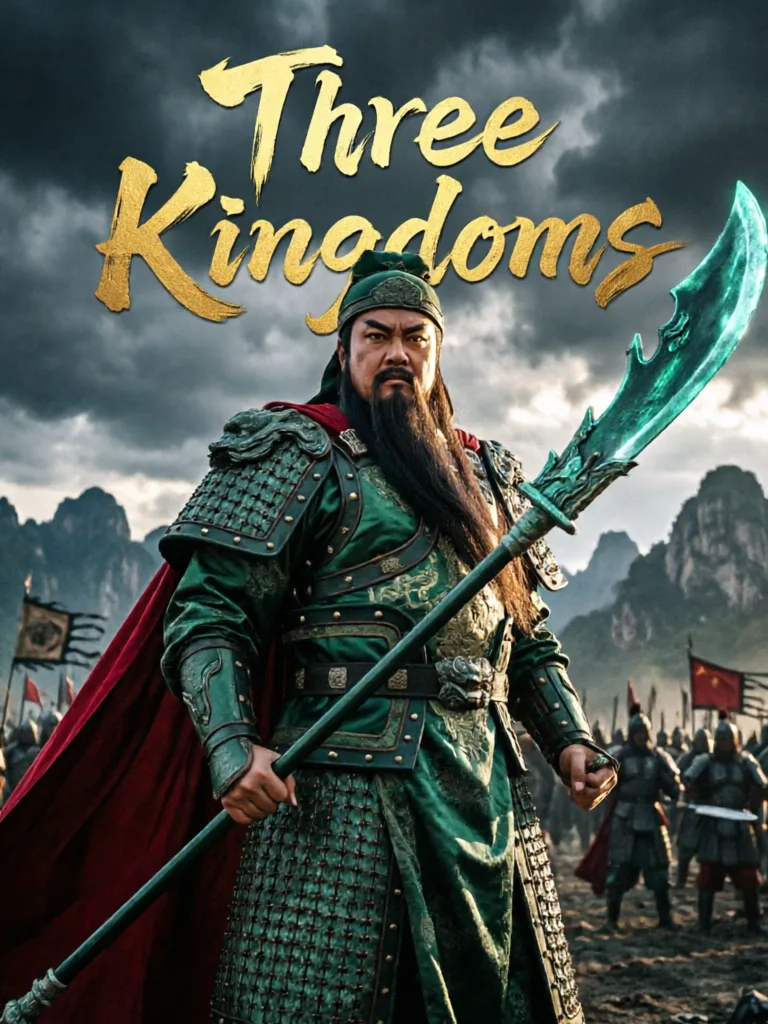
Suddenly, from the northeast corner, a great clamor arose. The Wei troops scattered in confusion as a fresh force burst through. At the head of this relief column was a great general wielding an eighteen-foot steel-tipped spear. From his horse’s neck dangled a human head. Zhao Yun recognized him as Zhang Bao. Zhang Bao saw Zhao Yun and said, “The Chancellor feared that you, Old General, might come to harm, so he sent me with five thousand men as reinforcements. I heard you were surrounded, so I fought my way through the encirclement. On the way, I encountered the Wei general Xue Ze blocking the road, and I slew him.” Zhao Yun was overjoyed. He and Zhang Bao immediately fought their way out through the northwest corner. There, they saw the Wei troops casting aside their weapons and fleeing. Another force was charging in from outside, shouting war cries. At its head was a great general wielding the Green Dragon Crescent Blade, also carrying a severed head. Zhao Yun recognized him as Guan Xing. Guan Xing said, “I, too, was sent by the Chancellor, fearing you might be in danger. I led five thousand men as reinforcements. In the battle, I met the Wei general Dong Xi and cut him down with one blow. Here is his head. The Chancellor himself is coming soon.” Zhao Yun said, “You two young generals have already achieved great merit. Why not seize this moment to capture Xiahou Mao and settle the matter?” Hearing this, Zhang Bao immediately led his men away. Guan Xing said, “I, too, will seek glory!” and also departed with his troops. Zhao Yun looked at his remaining men and said, “These two are my juniors, yet they compete to be the first to achieve merit. I am a senior general of the state, a veteran of the court. Am I to be outdone by such youths? I will risk this old life to repay the kindness of the late Emperor!” He then led his men to capture Xiahou Mao.
That night, the three Shu forces attacked in concert and utterly shattered the Wei army. Deng Zhi led his men in the final assault. The field was covered with corpses, and the rivers ran with blood. Xiahou Mao, a man of no strategic ability and young, having never experienced real battle, saw his army in chaos. He fled with a hundred of his personal guards toward the city of Nan’an. The main army, seeing their commander gone, scattered in all directions. Guan Xing and Zhang Bao, hearing that Xiahou Mao had fled toward Nan’an, pursued him through the night. Xiahou Mao entered the city and ordered the gates sealed and the defenses manned. Guan Xing and Zhang Bao arrived and laid siege to the city. Zhao Yun soon followed, and they attacked from three sides. Shortly after, Deng Zhi also arrived with his men. They besieged the city for ten days but could not take it.
Suddenly, word arrived that the Chancellor had left the rear army at Mianyang, the left army at Yangping, and the right army at Shicheng, while he himself was approaching with the central army. Zhao Yun, Deng Zhi, Guan Xing, and Zhang Bao all went to pay their respects and report that the city had not fallen despite days of assault. Zhuge Liang then mounted a small carriage and personally rode to the city walls to inspect them. He circled the entire perimeter, then returned to his camp, ascended his command seat, and sat down. The generals stood in a circle awaiting his orders. Zhuge Liang said, “This city has deep moats and high walls. It will not be easy to take. Our main objective is not this city. If we waste time here, the Wei forces might take a different route and attack Hanzhong. Our army would be in danger.” Deng Zhi objected, “Xiahou Mao is the Imperial Son-in-Law of Wei. Capturing him is worth more than slaying a hundred generals. Now that he is trapped here, how can we abandon the siege and withdraw?” Zhuge Liang replied, “I have a plan. To the west of this place lies Tianshui Commandery, and to the north, Anding Commandery. Who are the Grand Administrators of those two places?” A scout replied, “The Grand Administrator of Tianshui is Ma Zun. The Grand Administrator of Anding is Cui Liang.” Zhuge Liang was greatly pleased. He summoned Wei Yan and whispered his instructions. He then summoned Guan Xing and Zhang Bao and whispered further orders. Finally, he called two trusted soldiers and gave them their secret commands. Each officer received his orders and departed with his men. Meanwhile, outside Nan’an, Zhuge Liang ordered his troops to pile firewood beneath the city walls, announcing that they would burn the city. The Wei soldiers inside laughed heartily, unafraid.
Now, Cui Liang, the Grand Administrator of Anding, heard within his city that the Shu army had besieged Nan’an and trapped Xiahou Mao. He was deeply alarmed. He mustered about four thousand men and prepared to defend his city. Suddenly, a man arrived from the south, claiming to have urgent secret business. Cui Liang summoned him and questioned him. The man replied, “I am Pei Xu, a trusted officer of Commander Xiahou Mao. I have been sent by the Commander to seek reinforcements from Tianshui and Anding. Nan’an is in dire straits. Every day, we light signal fires on the walls, hoping for relief from your two commanderies, but none has come. I fought my way out of the encirclement to beg for your aid. You must raise your troops and come to our relief under cover of darkness. When the Commander sees the banners of your two commanderies, he will open the gates and attack from within.” Cui Liang asked, “Do you have the Commander’s official dispatch?” Pei Xu reached inside his clothing and produced a document, soaked through with sweat. Cui Liang glanced at it briefly, then ordered a fresh horse for the messenger, who immediately departed for Tianshui. Within two days, another rider arrived, reporting that the Grand Administrator of Tianshui had already raised his army and was marching to Nan’an’s relief. The message urged Anding to do the same. Cui Liang consulted his officials. Most of them said, “If we do not go to the rescue, and Nan’an falls and the Imperial Son-in-Law is lost, the blame will fall on both our commanderies. We have no choice but to go.” Cui Liang then mustered his troops and left the city, leaving only civil officials to guard Anding.
Cui Liang led his army along the main road toward Nan’an. In the distance, he saw flames leaping into the sky. He urged his men forward through the night. When he was still about fifty li from Nan’an, he suddenly heard war cries from both front and rear. A scout reported, “Ahead, Guan Xing blocks the road! Behind us, Zhang Bao is closing in!” The Anding troops scattered in all directions. Cui Liang, terrified, led a hundred of his personal guards in a desperate fight along a side path. He managed to escape and fled back toward Anding. As he reached the city moat, a volley of arrows rained down from the walls. The Shu general Wei Yan stood on the battlements and shouted, “I have already taken the city! Why do you not surrender?” It turned out that Wei Yan had disguised himself and his men as Anding troops, and under cover of darkness, had tricked the gatekeepers into opening the gates. The Shu army had then poured in and seized the city.
Cui Liang, in panic, fled toward Tianshui. Before he had traveled far, a force of soldiers blocked his path. Beneath a great banner, a man sat upright in a carriage, wearing a scholar’s headdress and a feather fan, clad in a Daoist robe and a crane-feather cloak. Cui Liang recognized him as Zhuge Liang. He immediately wheeled his horse to flee, but Guan Xing and Zhang Bao pursued from both sides, shouting, “Surrender now!” Seeing the Shu forces closing in from all sides, Cui Liang had no choice but to surrender. He was brought back to the main camp, where Zhuge Liang treated him as an honored guest. Zhuge Liang asked, “Is the Grand Administrator of Nan’an a close friend of yours?” Cui Liang replied, “He is Yang Ling, a younger cousin of Yang Fu. Our commanderies are neighbors, and we are bound by deep friendship.” Zhuge Liang said, “I would like to trouble you to enter the city and persuade Yang Ling to capture Xiahou Mao. Can you do this?” Cui Liang said, “If the Chancellor sends me, you must first withdraw your troops so that I may enter the city and speak with him.” Zhuge Liang agreed and immediately ordered the surrounding forces to retreat twenty li and make camp. Cui Liang rode alone to the city gates, called for them to be opened, and entered. He went to the government office, exchanged greetings with Yang Ling, and recounted the entire matter in detail. Yang Ling said, “We have received great kindness from the Wei Emperor. How could I bear to betray him? We should turn this plan back against them.” He then took Cui Liang to see Xiahou Mao and explained the situation. Xiahou Mao asked, “What plan should we use?” Yang Ling said, “We will pretend to surrender the city and lure the Shu troops inside. Then, we will slaughter them within the walls.”
Cui Liang followed this plan and left the city to see Zhuge Liang. He said, “Yang Ling is willing to open the gates and let the main army enter to capture Xiahou Mao. Yang Ling wanted to take him himself, but he lacks enough courageous men to act alone.” Zhuge Liang replied, “This is very simple. You have slightly more than a hundred surrendered troops from Anding. We will disguise some of our Shu generals as Anding soldiers and hide them among your men. They will enter the city and conceal themselves near Xiahou Mao’s residence. Then, secretly agree with Yang Ling that at midnight, he will open the gates, and we will attack from within and without.” Cui Liang thought to himself, “If I do not take Shu generals with me, Kongming will suspect me. I will take them, kill them inside the city first, then light a signal fire to lure Kongming in. I can then kill him as well.” So he agreed. Zhuge Liang instructed him, “I will send my trusted generals, Guan Xing and Zhang Bao, to accompany you. They will pretend to be relief troops entering the city to reassure Xiahou Mao. When you light the signal fire, I will personally enter the city to capture him.” As dusk fell, Guan Xing and Zhang Bao, having received Zhuge Liang’s secret orders, donned their armor, mounted their horses, and armed themselves. They mingled with the Anding troops and followed Cui Liang to the gates of Nan’an. Yang Ling stood on the wall, leaning against the parapet, and called down, “Whose troops are these?” Cui Liang replied, “Reinforcements from Anding.” Cui Liang first shot a signal arrow up to the wall. Attached to it was a secret letter: “Zhuge Liang has sent two generals ahead to hide in the city and coordinate an attack from within. Do not alarm them, lest the plan be exposed. We will deal with them when they reach the government office.” Yang Ling took the letter to Xiahou Mao and explained everything. Xiahou Mao said, “Since Zhuge Liang has fallen for the trap, have a hundred executioners hide in the government office. When the two generals follow Cui Liang into the compound and dismount, close the gates and kill them. Then, light the signal fire on the wall to lure Zhuge Liang into the city. When our ambush springs, Kongming can be captured.”
After these arrangements were made, Yang Ling returned to the wall and shouted, “Since these are Anding troops, let them in!” Guan Xing followed Cui Liang through the gate first, with Zhang Bao behind him. Yang Ling descended from the wall to greet them at the gate. Guan Xing raised his blade and, with one stroke, cut Yang Ling down from his horse. Cui Liang was horrified. He quickly wheeled his horse toward the drawbridge. Zhang Bao roared, “Traitor, do not flee! Did you think your petty trick could fool the Chancellor?” He raised his spear and ran Cui Liang through, killing him instantly. Guan Xing had already reached the wall and lit the signal fire. From all sides, the Shu army poured into the city. Xiahou Mao, caught completely off guard, opened the southern gate and fought desperately to break out. A fresh force blocked his path. At its head was the great general Wang Ping. In a single exchange, Wang Ping seized Xiahou Mao from his horse. The rest of the Wei defenders were slain.
Zhuge Liang entered Nan’an, issued proclamations to the people and the soldiers, and ordered that not a single person be harmed. The generals each presented their trophies. Zhuge Liang had Xiahou Mao placed in a prison cart. Deng Zhi asked, “Chancellor, how did you know that Cui Liang’s surrender was false?” Zhuge Liang replied, “I knew from the start that the man had no intention of surrendering. I deliberately sent him into the city. He would surely tell everything to Xiahou Mao and try to turn the plan back on us. I saw through his ruse from the beginning. I sent the two generals with him to put his mind at ease. If he had been sincere, he would have objected to taking them. But he agreed eagerly because he feared I would suspect him. He thought he could take the two generals into the city, kill them at his leisure, and then use them as a pretext to lure me in. But I had secretly instructed the two generals to strike at the city gate. The enemy inside would have no time to prepare, and our army would follow immediately. This was the element of surprise.” All the generals bowed in admiration. Zhuge Liang continued, “The man who tricked Cui Liang was one of my trusted agents, disguised as the Wei officer Pei Xu. I also sent a similar ruse to Tianshui, but no word has come back yet. I wonder what happened. Now, we must take advantage of this momentum and seize Tianshui.” He left Wu Yi to guard Nan’an and Liu Yan to guard Anding, freeing Wei Yan’s troops for the attack on Tianshui.
Now, Ma Zun, the Grand Administrator of Tianshui, had heard that Xiahou Mao was trapped in Nan’an. He assembled his civil and military officers to discuss the situation. The Merit Officer Liang Xu, the Recorder Yin Shang, and the Chief Scribe Liang Qian all said, “The Imperial Son-in-Law is of the imperial bloodline. If harm comes to him, we cannot escape the charge of standing idly by. Grand Administrator, why not raise all the troops of this commandery to go to his rescue?” Ma Zun was still hesitating when a messenger arrived, claiming to be Pei Xu, a trusted officer of Xiahou Mao. Pei Xu entered the government office, presented an official dispatch to Ma Zun, and said, “The Commander requests the troops of Anding and Tianshui to come to his relief without delay.” He then departed hastily. The next day, another rider arrived, reporting, “The Anding army has already set out. The Grand Administrator is urged to come quickly and join forces.”
Ma Zun was about to raise his army when a man suddenly entered from outside and said, “Grand Administrator, you have fallen into Zhuge Liang’s trap!” Everyone looked at him. He was a man of Ji County in Tianshui, named Jiang Wei, styled Boyue. His father, Jiang Jiong, had once served as a Merit Officer in Tianshui and had died in the line of duty during a rebellion of the Qiang tribes. From his youth, Jiang Wei had read widely, mastering both military texts and martial arts. He was a devoted son to his mother and was respected by all in the commandery. He now held the rank of General of the Household and advised on military affairs for the region. Jiang Wei said to Ma Zun, “I have heard that Zhuge Liang recently defeated Xiahou Mao and has him trapped in Nan’an, surrounded so tightly that not a drop of water can pass. How could anyone have fought their way out of such an encirclement? Furthermore, this ‘Pei Xu’ is an unknown officer whom no one has ever seen. The messenger from Anding also carried no official dispatch. From this, I deduce that this man is a Shu general disguised as a Wei officer. He has tricked you, Grand Administrator, into leaving the city. He assumes the city will be undefended and has surely hidden an ambush nearby to seize Tianshui while it is empty.” Ma Zun suddenly saw the truth. “Without Boyue’s words,” he said, “I would have fallen for the enemy’s scheme!” Jiang Wei smiled. “Grand Administrator, do not worry. I have a plan that can capture Zhuge Liang and relieve the siege of Nan’an.”
Truly, as the saying goes: “When one strategist meets another, the contest of wits finds an unexpected challenger.” What this plan was, the next chapter will reveal.