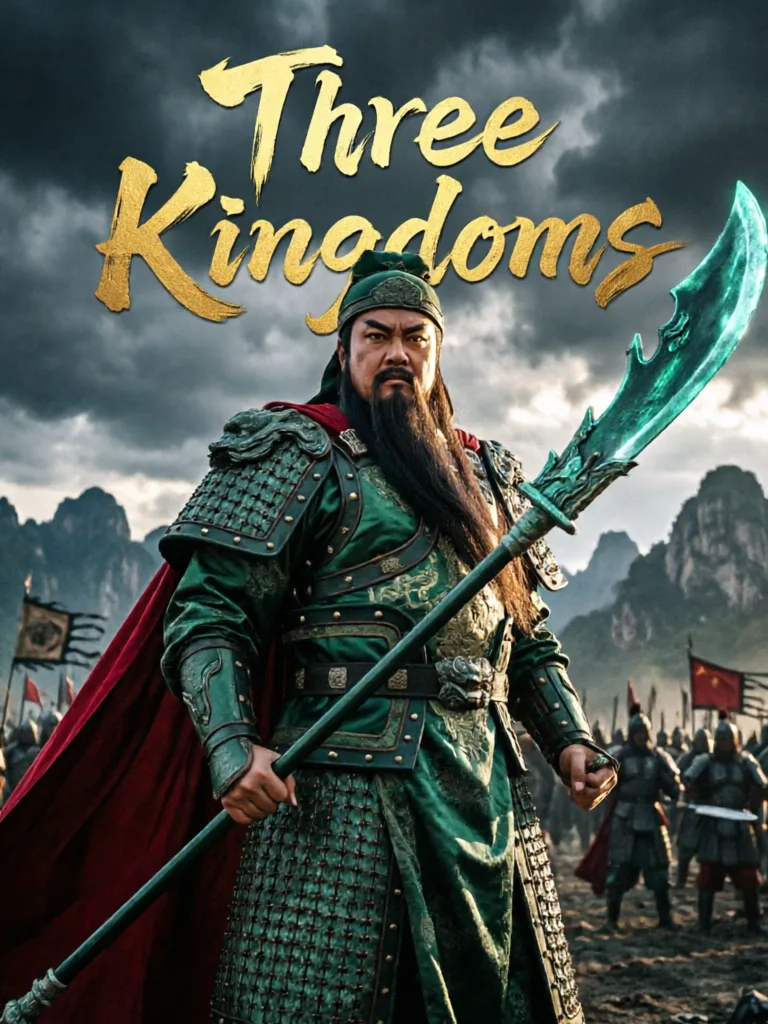
Mi Fang, having heard that Jing Province had fallen, was at his wit’s end. Suddenly, word arrived that Fu Shiren, the defender of Gong’an, had come. Fang hurriedly admitted him to the city and asked what had happened. Shiren said, “It is not that I am disloyal. The situation was desperate, our strength exhausted; I could hold out no longer, and I have now surrendered to Eastern Wu. General, you would do well to surrender early as well.” Fang replied, “We have received the deep kindness of the King of Hanzhong; how can I bear to betray him?” Shiren countered, “When Lord Guan departed, he harbored a deep hatred for us two. If he should one day return victorious, he will certainly not forgive us lightly. Consider this carefully.” Fang said, “My brother and I have long served the King of Hanzhong; how can I turn my back on him in a single day?” While he was still hesitating, a messenger from Guan Yu arrived. Fang received him in the hall. The messenger said, “Lord Guan’s army is short of grain. He has sent me to take one hundred thousand bushels of white rice from the two commanderies of Nanjun and Gong’an, and orders the two generals to deliver it to the army with all speed. Any delay will be punished by immediate execution.” Fang was greatly alarmed. He turned to Fu Shiren and said, “Jing Province has already been taken by Eastern Wu. How can this grain get through?” Shiren said harshly, “There is no need for further doubt!” He drew his sword and cut down the messenger in the hall. Fang was shocked. “Why have you killed him?” he asked. Shiren replied, “Lord Guan’s intention was to have us both killed. How can we sit idly by and wait for death? If you do not surrender to Eastern Wu now, you will surely be slain by Lord Guan.” As they were speaking, a report came that Lü Meng was leading his troops to the city walls. Fang, terrified, went out of the city with Fu Shiren and surrendered. Lü Meng was overjoyed and brought them before Sun Quan, who rewarded them handsomely. After pacifying the people, he gave a great feast to his entire army.
At that time, Cao Cao was in Xuchang, discussing the affairs of Jing Province with his advisors, when word arrived that Eastern Wu had sent an envoy bearing a letter. Cao Cao summoned him, and the envoy presented the letter. Cao Cao opened and read it. The letter stated that Wu’s army was about to attack Jing Province and requested that Cao Cao attack Guan Yu from the other side. It also warned him not to let the secret leak, lest Guan Yu should prepare. Cao Cao discussed the matter with his advisors. Chief Clerk Dong Zhao said, “Now, Fancheng is besieged, and its defenders are straining their necks for rescue. It would be better to have someone shoot this letter into the city on an arrow to steady the troops’ morale. Moreover, it will let Guan Yu know that Eastern Wu is about to attack Jing Province. Fearing for Jing Province’s safety, he will surely withdraw his army quickly. Then we can order Xu Huang to pursue and attack, and we will achieve complete success.” Cao Cao adopted this plan. He sent word to Xu Huang to press the attack urgently, while he himself led the main army directly to a place called Mopo, south of Luoyang, where he encamped to relieve Cao Ren.
Meanwhile, Xu Huang was sitting in his tent when a messenger from the King of Wei arrived. Xu Huang received him and asked his business. The messenger said, “The King of Wei has led his army past Luoyang and orders you to attack Guan Yu immediately to lift the siege of Fancheng.” As they spoke, a scout reported, “Guan Ping is encamped at Yancheng, and Liao Hua at Sizhong. They have twelve stockades in a continuous line, one behind the other.” Xu Huang immediately ordered his deputy generals Xu Shang and Lü Jian to take his own banners and advance to Yancheng to engage Guan Ping. He himself took five hundred elite troops and followed the Mian River to attack Yancheng from the rear. Guan Ping, hearing that Xu Huang himself was coming, led his own troops to meet the enemy. The two armies drew up in battle array. Guan Ping rode out and engaged Xu Shang. After only three passes, Xu Shang was defeated and fled. Lü Jian then came out; after five or six passes, he too was defeated and fled. Guan Ping pressed his advantage and pursued for over twenty li. Suddenly, he saw that fires had broken out in the city. Realizing he had fallen into a trap, he quickly reined in his horse and turned back to rescue Yancheng. There, he encountered a body of troops drawn up in formation. Xu Huang stood beneath his banner and shouted, “Nephew Guan Ping, you know not death! Jing Province has already been taken by Eastern Wu, and you still act so arrogantly here!” Guan Ping, enraged, spurred his horse, swung his blade, and charged straight at Xu Huang. Before they had exchanged three or four passes, a great shout arose from the three armies, and flames burst forth from Yancheng. Guan Ping dared not linger in the fight. He cut a path through and fled straight to the stockade at Sizhong. Liao Hua met him. “People say that Lü Meng has already taken Jing Province,” said Liao Hua. “The army’s morale is shaken. What are we to do?” Guan Ping replied, “This must be a false rumor. Any soldier who repeats it shall be executed.”
Suddenly, a swift rider arrived, reporting that the first stockade to the north was being attacked by Xu Huang’s troops. Guan Ping said, “If the first stockade falls, how can the other camps be secure? This area is all backed by the Mian River, so the enemy troops dare not come here. You and I will go together to rescue the first stockade.” Liao Hua called his deputy and instructed him, “Hold the camp firmly. If the enemy comes, raise a fire signal immediately.” The deputy said, “The Sizhong stockade has ten layers of deer-horn barriers. Even a bird could not fly in. Why worry about the enemy!” So Guan Ping and Liao Hua took all the elite troops from Sizhong and hurried to the first stockade, where they took up positions. Guan Ping saw that the Wei troops were encamped on a low hill. He said to Liao Hua, “Xu Huang has chosen a position that gives him no advantage of terrain. Tonight, we can lead a force to raid his camp.” Liao Hua said, “General, you take half the troops and go. I will guard our own camp.”
That night, Guan Ping led a force into the Wei camp. It was empty. He realized it was a trap. As he hastily withdrew, Xu Shang attacked from the left and Lü Jian from the right, closing in on him from both sides. Guan Ping was utterly defeated and fled back to his camp. The Wei troops pursued, surrounding them on all sides. Guan Ping and Liao Hua could not hold their ground. They abandoned the first stockade and fled straight to Sizhong. But before they reached it, they saw flames rising from the camp. When they arrived at the stockade, they saw only Wei banners. Guan Ping and his men retreated and fled along the main road to Fancheng. A force blocked their path, led by none other than Xu Huang himself. Guan Ping and Liao Hua fought desperately, cutting their way through, and finally returned to their main camp. They came before Guan Yu and reported, “Xu Huang has taken Yancheng and other positions. Moreover, Cao Cao himself is leading a great army in three columns to relieve Fancheng. Many people say that Lü Meng has already taken Jing Province.” Guan Yu shouted, “These are enemy lies to confuse our army! Lü Meng of Eastern Wu is critically ill, and the boy Lu Xun has replaced him. He is not worth worrying about!”
Before he had finished speaking, word came that Xu Huang’s troops had arrived. Guan Yu ordered his horse to be saddled. Guan Ping remonstrated, “Father, you are not yet recovered from your illness. You cannot face the enemy.” Guan Yu said, “Xu Huang and I are old acquaintances. I know his abilities well. If he does not withdraw, I will cut him down first to warn the other Wei generals.” He put on his armor, took up his blade, and mounted his horse, riding out with fierce determination. When the Wei troops saw him, they were all struck with fear. Guan Yu reined in his horse and called out, “Where is Xu Gongming?” The banners before the Wei camp parted, and Xu Huang rode out. He bowed and said, “Since I parted from you, Marquis, many years have passed. I never thought I would see your hair and beard so white! I recall in my younger days, when I followed you, I received much instruction, for which I am ever grateful. Now, your heroic fame shakes the land of Hua Xia. When I, your old friend, hear of it, I cannot but sigh in admiration! I am fortunate to see you today, and it deeply satisfies my thirst for a meeting.” Guan Yu said, “You and I have always been bound by deep friendship, unlike others. Why, then, do you press my son so hard?” Xu Huang turned to his generals and shouted loudly, “Whoever takes Guan Yu’s head shall be rewarded with a thousand pieces of gold!” Guan Yu was shocked. “Gongming, why do you say such a thing?” he asked. Xu Huang replied, “Today, this is a matter of state.
I dare not set aside public duty for private friendship.” With that, he swung his great axe and charged straight at Guan Yu. Guan Yu, enraged, also swung his blade to meet him. They fought for over eighty passes. Although Guan Yu’s martial skill was unmatched, his right arm was still weak. Guan Ping, fearing his father might come to harm, hastily sounded the gong to retreat. Guan Yu turned his horse and rode back to his camp. Suddenly, shouts erupted from all sides. It was Cao Ren of Fancheng, who, hearing that Cao Cao’s relief force had arrived, led his troops out of the city and joined with Xu Huang. Attacked from both sides, Guan Yu’s Jing Province troops fell into great disorder. Guan Yu mounted his horse and led his generals in a desperate dash to the upper reaches of the Xiang River. The Wei troops pursued from behind. Guan Yu hurriedly crossed the Xiang River and fled toward Xiangyang. Then a swift rider arrived, reporting, “Jing Province has been taken by Lü Meng, and your family has fallen into his hands.” Guan Yu was greatly alarmed. He dared not go to Xiangyang. Instead, he led his troops toward Gong’an. Another scout reported, “Fu Shiren of Gong’an has already surrendered to Eastern Wu.” Guan Yu was furious. Then a grain convoy officer arrived and reported, “Fu Shiren went to Nanjun, killed the messenger, and induced Mi Fang to surrender to Eastern Wu as well.”
When Guan Yu heard this, his anger swelled within him. His wound burst open, and he collapsed unconscious to the ground. His generals revived him. Guan Yu turned to his advisor, Wang Fu, and said, “I regret that I did not heed your words. Now this has indeed come to pass!” He asked, “Why were no beacon fires lit along the river?” The scout replied, “Lü Meng had his sailors dress all in white, disguised as merchants, and crossed the river. He hid his elite troops inside the ships’ holds. They seized the beacon tower soldiers first, so no fires could be lit.” Guan Yu stamped his foot and sighed, “I have fallen for the traitor’s scheme! How can I face my elder brother again?” Zhao Lei, the grain supply commander, said, “The situation is urgent. We must send someone to Chengdu for help, and at the same time, take the overland route to retake Jing Province.” Guan Yu agreed. He sent Ma Liang and Yi Ji with three letters, traveling day and night to Chengdu to beg for aid. Meanwhile, he led his troops to retake Jing Province, taking the vanguard himself, while Liao Hua and Guan Ping covered the rear.
Now, the siege of Fancheng having been lifted, Cao Ren led his generals to see Cao Cao. They knelt and wept, begging to be punished. Cao Cao said, “This was the will of Heaven, not your fault.” He richly rewarded the three armies and personally went to inspect the area around the Sizhong stockade. He said to his generals, “Guan Yu’s troops had layers of moats and deer-horn barriers. Xu Gongming penetrated deep into their midst and achieved complete success. In over thirty years of leading armies, I have never dared to drive so deeply into an enemy encirclement. Gongming truly possesses both courage and insight!” All the generals sighed in admiration. Cao Cao then withdrew his army and encamped at Mopo. When Xu Huang’s troops arrived, Cao Cao personally went out of the camp to meet him. He saw that Xu Huang’s army marched in perfect order, without any disorder. Cao Cao was overjoyed. “General Xu truly has the style of Zhou Yafu!” he said. He then appointed Xu Huang as General Who Pacifies the South, and ordered him, together with Xiahou Shang, to guard Xiangyang and block Guan Yu’s army. As Jing Province was not yet settled, Cao Cao stayed encamped at Mopo to await further news.
Meanwhile, Guan Yu, on the road to Jing Province, found himself with no way forward or back. He said to Zhao Lei, “Now, we have Wu troops ahead and Wei troops behind. I am caught between them, and no reinforcements have come. What can we do?” Zhao Lei said, “In the past, when Lü Meng was at Lukou, he often wrote to you, and the two sides agreed to ally and destroy the traitor Cao Cao. Now he helps Cao Cao and attacks us—this is a breach of the covenant. You should halt here for now and send a letter to Lü Meng, rebuking him, and see how he responds.” Guan Yu agreed. He wrote a letter and sent an envoy to Jing Province.
Now, Lü Meng, in Jing Province, had issued orders that no Wu soldier was to disturb the families of the officers who had followed Guan Yu on his campaign. They were to be given grain monthly, and those who were ill were to be treated by physicians. The families felt grateful for his kindness and remained peacefully in their homes. Suddenly, word came that Guan Yu’s envoy had arrived. Lü Meng went outside the city to greet him, brought him into the city, and treated him with the courtesy due a guest. The envoy presented the letter. Lü Meng read it and said to the envoy, “My former friendship with General Guan was a matter of personal feeling. Today’s affairs are ordered by my lord, and I cannot act on my own. Please return and convey my good wishes to the general.” He then hosted a banquet for the envoy and sent him to the guesthouse to rest. The families of the officers who had gone on campaign all came to ask for news. Some sent letters, some sent verbal messages, all saying that their families were safe and had food and clothing.
The envoy took his leave of Lü Meng, who personally escorted him out of the city. The envoy returned to Guan Yu and reported Lü Meng’s words, saying, “In Jing Province city, your noble family and the families of all the generals are safe and well supplied.” Guan Yu was furious. “This is the traitor’s scheme!” he cried. “If I cannot kill him in life, I will surely kill him in death to avenge this wrong!” He drove the envoy away. When the envoy left the camp, the generals all came to ask about their families. The envoy told them that each family was safe and that Lü Meng had shown them great kindness. He also delivered letters to the various generals. The generals were overjoyed and lost all will to fight.
Guan Yu led his troops to retake Jing Province. As they marched, many soldiers deserted and fled back to Jing Province. Guan Yu grew even more enraged and urged his troops forward. Suddenly, a great shout arose, and a body of troops blocked the way. At their head was General Jiang Qin, who reined in his horse, raised his spear, and shouted, “Yunchang, why do you not surrender quickly?” Guan Yu cursed him, saying, “I am a general of Han. How could I surrender to a rebel?” He spurred his horse, swung his blade, and charged straight at Jiang Qin. Before they had exchanged three passes, Jiang Qin was defeated and fled. Guan Yu pursued him for over twenty li, his blade raised. Then shouts arose again. From the valley on the left, Han Dang led his troops out; from the valley on the right, Zhou Tai led his troops out. Jiang Qin turned his horse and rejoined the battle. Attacked from three sides, Guan Yu hastily withdrew his troops. They had not gone far when they saw a crowd of people gathered on a hill to the south. A white banner fluttered in the wind, bearing the words “Natives of Jing Province.” The people shouted for the locals to surrender quickly. Guan Yu was enraged and wanted to ride up the hill to kill them. But from the folds of the hills, two more forces emerged: Ding Feng on the left and Xu Sheng on the right. Together with Jiang Qin’s troops, they surrounded Guan Yu, their shouts shaking the earth and their drums and horns filling the sky. Guan Yu’s men grew fewer and fewer. By the time they had fought until dusk, Guan Yu looked around and saw that the surrounding hills were covered with troops from Jing Province, calling out for brothers, sons, and fathers. The shouts never ceased. The army’s morale completely collapsed, and the soldiers answered the calls and deserted. Guan Yu could not stop them. Only about three hundred men remained.
They fought until the third watch. From the east, a great cry arose. It was Guan Ping and Liao Hua, each leading a force, who had broken through the encirclement and rescued Guan Yu. Guan Ping said, “The army’s morale is in chaos. We must find a city to hold for a while and await reinforcements. Maicheng is small, but it is enough to garrison.” Guan Yu agreed. He hurried his remaining troops to Maicheng, divided his forces to guard the four gates, and gathered his officers to discuss the situation. Zhao Lei said, “This place is close to Shangyong, where Liu Feng and Meng Da are stationed. We should send someone quickly to ask for help. If we can get that force to support us and await the arrival of the main army from Shu, the army’s morale will be restored.”
As they were discussing this, word came that the Wu troops had arrived and surrounded the city on all sides. Guan Yu asked, “Who dares to break out of the encirclement and go to Shangyong to ask for help?” Liao Hua said, “I am willing to go.” Guan Ping said, “I will escort you out of the encirclement.” Guan Yu wrote a letter and gave it to Liao Hua, who hid it on his person. After eating their fill, they mounted their horses and opened the city gates to ride out. They were met by the Wu general Ding Feng, who blocked their way. Guan Ping fought fiercely and routed Ding Feng. Liao Hua took the opportunity to break through the encirclement and rode off to Shangyong. Guan Ping returned to the city and held it, refusing to come out.
Now, Liu Feng and Meng Da, after taking Shangyong, had been joined by the Grand Administrator Shen Dan, who had surrendered. The King of Hanzhong had therefore appointed Liu Feng as Deputy General to guard Shangyong together with Meng Da. On this day, they learned of Guan Yu’s defeat. As they were discussing it, word came that Liao Hua had arrived. Liu Feng ordered him to be brought in and asked him what had happened. Liao Hua said, “Lord Guan has been defeated and is now trapped in Maicheng, besieged and in dire straits. Reinforcements from Shu cannot arrive immediately. He ordered me to break out of the encirclement and come here to beg for help. I hope you two generals will quickly raise the troops of Shangyong to save him from this crisis. If you delay, Lord Guan will surely fall.” Liu Feng said, “General, rest for a while. Let me consider this.”
Liao Hua went to the guesthouse to rest, awaiting the order to march. Liu Feng said to Meng Da, “My uncle is trapped. What can we do?” Meng Da said, “Eastern Wu’s troops are well-trained and their generals are brave. Moreover, all nine commanderies of Jing Province are already in their hands. Only Maicheng remains, a mere speck of a city. And I hear that Cao Cao himself is leading a great army of four to five hundred thousand, encamped at Mopo. How can our mountain city’s troops withstand the combined forces of two such powers? We must not take this lightly.” Liu Feng said, “I know this. But Guan Yu is my uncle. How can I bear to sit by and not go to his rescue?” Meng Da laughed and said, “You may consider Guan Yu your uncle, but I fear he does not consider you his nephew. I have heard that when the King of Hanzhong first adopted you as his son, Guan Yu was displeased. Later, when the King of Hanzhong ascended the throne and wished to name his heir, he consulted Kongming. Kongming said, ‘This is a family matter. You should ask Guan Yu and Zhang Fei.’ So the King of Hanzhong sent someone to ask Guan Yu, and Guan Yu said that you were only an adopted son and should not be allowed to inherit the throne. He advised the King of Hanzhong to send you far away to the mountain city of Shangyong to prevent future trouble. Everyone knows this. How can you not know it? Why, then, do you still cling to the idea of uncle and nephew and want to take such a reckless risk?” Liu Feng said, “What you say is true. But what excuse can I give?” Meng Da said, “Just say that the mountain city has only recently submitted, the people’s hearts are not yet settled, and we dare not act rashly for fear of losing the city.” Liu Feng agreed.
The next day, they summoned Liao Hua and told him that the mountain city had only just been pacified and that they could not spare any troops to help. Liao Hua was horrified. He knocked his head on the ground and said, “If this is so, then Lord Guan is lost!” Meng Da said, “Even if I went now, a cup of water cannot put out a cartload of burning firewood. General, return quickly and await the arrival of the Shu army.” Liao Hua wept bitterly and begged, but Liu Feng and Meng Da both shook their sleeves and withdrew. Liao Hua knew that nothing could be done. He thought that he must go to the King of Hanzhong to beg for help. So he mounted his horse, cursed loudly as he rode out of the city, and headed for Chengdu.
Meanwhile, Guan Yu, in Maicheng, waited for the Shangyong troops to arrive, but no one came. He had only five or six hundred men left, most of them wounded. There was no grain in the city, and the suffering was great. Suddenly, a report came that someone below the city wall was asking them not to shoot arrows, as he had words for the Marquis. Guan Yu ordered him to be admitted. When he came in, Guan Yu asked him who he was. It was Zhuge Jin. After the formalities and tea, Zhuge Jin said, “I have come by order of the Lord of Wu to persuade you, General. From ancient times, it has been said that he who knows the times is a hero. Now, the nine commanderies of Han River that you commanded have all fallen into other hands. You have only this solitary city, with no grain within and no relief without. You are in imminent danger. Why do you not follow my advice, surrender to the Lord of Wu, and be restored to the governorship of Jing and Xiang? This will preserve your family. I beg you to consider this carefully.” Guan Yu said sternly, “I am but a common soldier from Jieliang. My lord has treated me like a brother. How could I turn my back on righteousness and surrender to an enemy state? If the city falls, I will die. A piece of jade may be shattered, but its whiteness cannot be changed. Bamboo may be burned, but its integrity cannot be destroyed. My body may perish, but my name will live on in history. Say no more. Leave the city at once. I wish to fight Sun Quan to the death!” Zhuge Jin said, “The Lord of Wu wishes to form a marriage alliance with you, to join forces and destroy Cao Cao, and together support the House of Han. There is no other intention. Why are you so obstinate?” Before he had finished speaking, Guan Ping drew his sword and stepped forward, intending to kill Zhuge Jin. Guan Yu stopped him, saying, “His younger brother, Kongming, is in Shu, serving your uncle. If you kill him now, it will harm the bond between brothers.” He then ordered his attendants to drive Zhuge Jin out.
Zhuge Jin, deeply ashamed, mounted his horse and left the city. He returned to the Lord of Wu and said, “Guan Yu’s heart is like iron and stone. He cannot be persuaded.” Sun Quan said, “A truly loyal minister! What can be done about this?” Lü Fan said, “Allow me to divine his fate.” Sun Quan ordered him to do so. Lü Fan cast the yarrow stalks and obtained the hexagram “Earth and Water, the Army,” with the Xuanwu spirit presiding over the response, indicating that the enemy would flee far away. Sun Quan asked Lü Meng, “The hexagram indicates that the enemy will flee far away. What strategy do you propose to capture him?” Lü Meng laughed and said, “The hexagram’s sign matches my plan perfectly. Even if Guan Yu had wings to soar to the heavens, he cannot escape my net!”
A poet of the time lamented: A dragon swimming in a ditch is mocked by shrimps; a phoenix entering a cage is tormented by crows. Thus, Guan Yu, once the mightiest of warriors, found himself trapped and humbled by lesser men.
What was Lü Meng’s plan? Read on to find out.