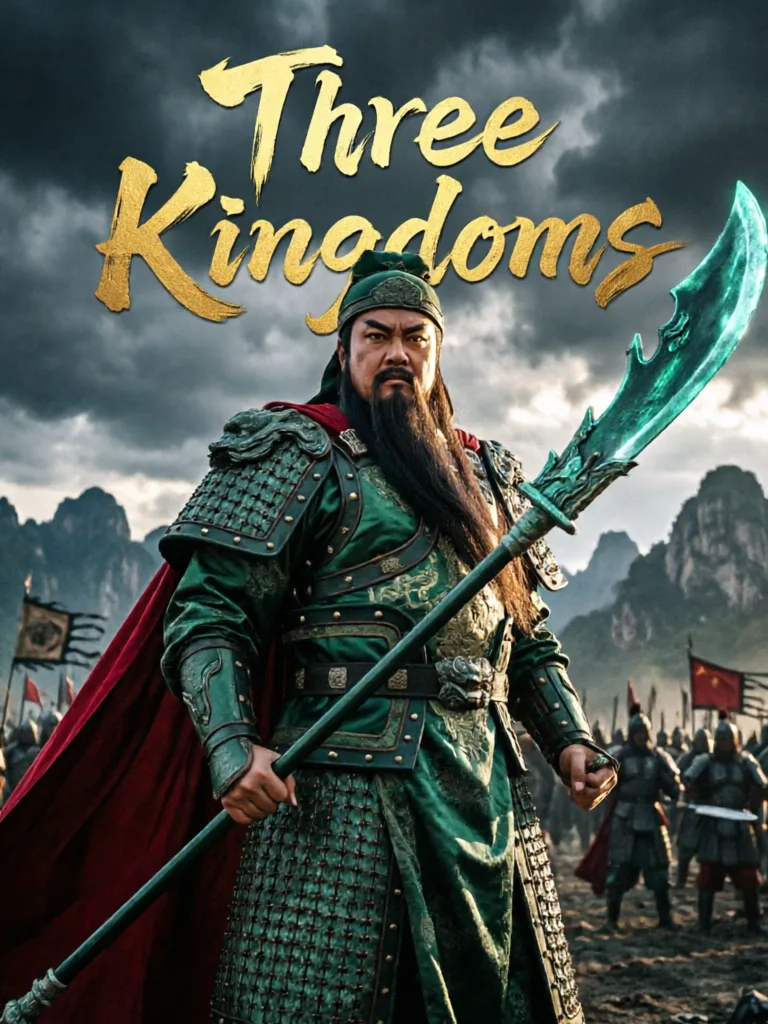
Just as Zhuge Liang was about to order Guan Yu beheaded, Liu Bei interceded: "When we three swore brotherhood in the Peach Garden, we vowed to live and die together. Though Yunchang has broken the law, I cannot bear to violate our sacred oath. I beg you to record this offense temporarily and allow him to atone for it through future merit." Zhuge Liang relented and spared Guan Yu.
Meanwhile, Zhou Yu gathered his forces to tally achievements and report them to Lord Sun Quan. The surrendered soldiers were all sent across the river, and the entire army was richly rewarded. Zhou Yu then advanced to attack Nan Commandery. His vanguard established camp along the river, with five separate encampments arrayed in a line, Zhou Yu commanding from the center. As he was discussing strategy with his officers, a scout reported: "Liu Bei has sent Sun Qian to congratulate the Commander-in-Chief." Zhou Yu ordered him admitted. After exchanging formal greetings, Sun Qian said: "My lord sends me to thank the Commander-in-Chief for his great kindness, with a modest gift as tribute." Zhou Yu asked: "Where is Xuande now?" Sun Qian replied: "He has moved his troops to the mouth of the Youjiang River." Zhou Yu started in alarm: "Is Kongming also at Youjiang?" Sun Qian answered: "Kongming and my lord are together there." Zhou Yu said: "Return first; I will come personally to express my thanks." He accepted the gifts and sent Sun Qian away. Lu Su asked: "Why did the Commander-in-Chief seem so startled just now?" Zhou Yu replied: "Liu Bei's encampment at Youjiang means he intends to seize Nan Commandery. We have spent countless troops and resources, and Nan Commandery is ours for the taking. These men harbor ill intentions, wanting to reap where they have not sown. But as long as Zhou Yu lives, they will not succeed!" Lu Su asked: "What strategy should we use to stop them?" Zhou Yu said: "I will go speak with him myself. If he is reasonable, all is well. If not—before he can take Nan Commandery, I will destroy Liu Bei first!" Lu Su volunteered: "I will accompany you." Thus Zhou Yu and Lu Su led three thousand light cavalry straight to the mouth of the Youjiang River.
Sun Qian returned to Liu Bei and reported that Zhou Yu would come personally to express thanks. Liu Bei asked Zhuge Liang: "What does he truly intend?" Zhuge Liang smiled: "Do you think he comes for such a paltry gift? He comes for Nan Commandery." Liu Bei said: "If he brings his army, how shall we respond?" Zhuge Liang replied: "When he arrives, answer him in this manner." They arrayed their warships at Youjiang and drew up their troops along the shore. A scout reported: "Zhou Yu and Lu Su are approaching with their forces." Zhuge Liang sent Zhao Yun with a few cavalry to greet them. When Zhou Yu saw the impressive military display, he grew uneasy. Reaching the camp gate, Liu Bei and Zhuge Liang welcomed him into the tent. After exchanging courtesies, a feast was laid. Liu Bei raised his cup to thank Zhou Yu for the recent fierce battle. After several rounds of wine, Zhou Yu said: "Imperial Uncle, you have moved your troops here. Do you perhaps intend to take Nan Commandery?" Liu Bei replied: "I heard the Commander-in-Chief intended to take it, so I came to assist. If you do not take it, then I certainly will." Zhou Yu laughed: "We of Wu have long desired to swallow the lands of the Han River. Now Nan Commandery is within our grasp—why would we not take it?" Liu Bei said: "Victory and defeat are never certain. Before Cao Cao departed, he left Cao Ren to defend Nan Commandery and other places; he must have devised some brilliant stratagem. Moreover, Cao Ren is a fierce warrior. I fear the Commander-in-Chief may not be able to take it." Zhou Yu replied: "If I cannot take it, then you may do so." Liu Bei said: "Lu Su and Kongming are witnesses here. Do not regret your words, Commander-in-Chief." Lu Su hesitated, not answering. Zhou Yu declared: "A true man's word is his bond—what regret could there be?" Zhuge Liang said: "The Commander-in-Chief's words are most fair. Let Wu try first. If they fail, my lord may take it. What objection could there be?" Zhou Yu and Lu Su took their leave, mounted their horses, and departed.
Liu Bei asked Zhuge Liang: "You instructed me to answer thus, and I did so on the spur of the moment. But thinking it over, it seems unwise. I am alone and destitute, with no place to call my own. I wanted Nan Commandery as a temporary refuge. If Zhou Yu takes it first, the city will belong to Wu—how then can I dwell there?" Zhuge Liang laughed heartily: "I advised you earlier to take Jing Province, but you refused. Now you regret it?" Liu Bei said: "Before, it was Liu Biao's land, and I could not bear to take it. Now it is Cao Cao's land, and it is only right that I take it." Zhuge Liang said: "Do not worry, my lord. Let Zhou Yu do the fighting. Sooner or later, I will have you seated high in Nan Commandery's hall." Liu Bei asked eagerly: "What plan do you have?" Zhuge Liang replied: "It is simple—do this and that." Liu Bei was overjoyed and remained encamped at the river mouth, keeping his troops idle.
Back at his camp, Lu Su asked Zhou Yu: "Why did you promise Xuande that he could take Nan Commandery?" Zhou Yu replied: "I can take it with a snap of my fingers. It costs nothing to play the generous man." He then called out to his officers: "Who dares take Nan Commandery first?" One stepped forward: Jiang Qin. Zhou Yu said: "You will be the vanguard, with Xu Sheng and Ding Feng as your lieutenants. Take five thousand elite troops and cross the river first. I will follow with reinforcements."
Now Cao Ren, defending Nan Commandery, had ordered Cao Hong to hold Yiling, forming a pincer formation. A scout reported: "Wu troops have crossed the Han River." Cao Ren said: "Our best strategy is to hold fast and not engage." But the fierce general Niu Jin stepped forward: "When the enemy is at the gates and we refuse battle, that is cowardice. Besides, our army has just suffered defeat—we must rekindle our fighting spirit. Let me take five hundred elite troops and fight to the death!" Cao Ren agreed and ordered Niu Jin out with five hundred men. Ding Feng rode out to meet him. After about four or five clashes, Ding Feng feigned defeat, and Niu Jin pursued him into the Wu formation. Ding Feng then signaled his troops to surround Niu Jin. Niu Jin charged left and right but could not break free. From the city walls, Cao Ren saw Niu Jin trapped. He donned his armor, mounted his horse, and led several hundred of his bravest riders out of the city. Slashing furiously with his blade, he carved into the Wu ranks. Xu Sheng tried to stop him but could not hold. Cao Ren reached the center, rescued Niu Jin, and looked back. Seeing that several dozen of his riders were still trapped, he turned and plunged back into the fray, cutting his way out again. Just then, Jiang Qin blocked their path. Cao Ren and Niu Jin fought fiercely and scattered him. Cao Ren's younger brother Cao Chun also arrived with reinforcements, and a chaotic melee ensued. The Wu forces were routed, and Cao Ren returned victorious. When Jiang Qin reported his defeat, Zhou Yu was furious and wanted to behead him, but the other officers pleaded for his life.
Zhou Yu then mustered his troops, determined to fight Cao Ren personally. Gan Ning advised: "Commander-in-Chief, do not act rashly. Cao Ren has placed Cao Hong at Yiling to form a pincer. Let me take three thousand elite troops and seize Yiling. Then you can take Nan Commandery at your leisure." Zhou Yu agreed and ordered Gan Ning to attack Yiling with three thousand men. A spy reported this to Cao Ren, who consulted his advisor Chen Jiao. Chen Jiao said: "If Yiling falls, Nan Commandery cannot be held. We must reinforce it quickly." Cao Ren ordered Cao Chun and Niu Jin to secretly lead troops to aid Cao Hong. Cao Chun first sent word to Cao Hong, instructing him to lure the enemy out of the city. When Gan Ning arrived at Yiling, Cao Hong came out to fight. After some twenty clashes, Cao Hong feigned defeat and fled. Gan Ning seized Yiling. But at dusk, Cao Chun and Niu Jin arrived with their forces, and together they surrounded the city. A scout galloped to Zhou Yu with the news that Gan Ning was trapped in Yiling. Zhou Yu was greatly alarmed. Cheng Pu said: "We must send reinforcements immediately." Zhou Yu replied: "This is a strategic position. If I divide my forces to rescue him, Cao Ren might attack us here." Lü Meng said: "Gan Xingba is a great general of Jiangdong—how can we abandon him?" Zhou Yu said: "I wish to go myself, but who can take command here in my absence?" Lü Meng replied: "Leave Ling Gongji in charge. I will lead the vanguard, and you can command the rear. Within ten days, we will surely return victorious." Zhou Yu asked: "Will Ling Gongji agree to take command temporarily?" Ling Tong said: "If it is only for ten days, I can manage. Beyond that, I cannot bear the responsibility." Zhou Yu was delighted. He left ten thousand troops with Ling Tong and set out that very day for Yiling with the main army. Lü Meng advised Zhou Yu: "There is a remote path south of Yiling that leads straight to Nan Commandery. Send five hundred men to fell trees and block that road. If the enemy is defeated, they will flee that way. Their horses will not be able to pass, and they will abandon them—we will capture their mounts." Zhou Yu agreed and sent men to do so.
As the main army approached Yiling, Zhou Yu asked: "Who can break through the encirclement and rescue Gan Ning?" Zhou Tai volunteered. Instantly, he seized his blade, spurred his horse, and charged straight into the Cao army, reaching the city walls. Gan Ning saw Zhou Tai coming and rode out to meet him. Zhou Tai said: "The Commander-in-Chief is here with the main army." Gan Ning ordered his men to arm themselves, eat heartily, and prepare to strike from within. When Cao Hong, Cao Chun, and Niu Jin heard that Zhou Yu was approaching, they sent word to Cao Ren in Nan Commandery and deployed their forces to resist. As the Wu army arrived, the Cao troops engaged them. Just as the battle was joined, Gan Ning and Zhou Tai burst out from two sides. The Cao army fell into chaos, and the Wu troops slaughtered them from all directions. Cao Hong, Cao Chun, and Niu Jin fled along the remote path, only to find it blocked with felled trees and debris. Their horses could not pass, so they abandoned them and fled on foot. The Wu forces captured over five hundred horses. Zhou Yu drove his army forward day and night, reaching Nan Commandery just as Cao Ren's relief force arrived. The two armies clashed in a chaotic battle. As night fell, both sides withdrew.
Back in the city, Cao Ren gathered his officers. Cao Hong said: "Now that Yiling is lost, the situation is critical. Why not open the late Chancellor's sealed plan and see how to escape this crisis?" Cao Ren replied: "You read my mind." He opened the letter, read it, and was overjoyed. He ordered the troops to prepare meals before dawn. At daybreak, the entire army would abandon the city. The walls were covered with banners to create a show of strength. The troops would exit through three gates.
Meanwhile, Zhou Yu, having rescued Gan Ning, arrayed his forces before Nan Commandery. Seeing the Cao army emerge from three gates, Zhou Yu ascended a watchtower to observe. He noticed that the battlements were lined with banners but no one guarded them. He also saw that the soldiers had bundles tied at their waists. Zhou Yu concluded that Cao Ren was preparing to flee. He descended from the tower and issued orders: he divided his army into two wings. If the vanguard was victorious, they were to pursue the enemy relentlessly until they heard the signal gongs to retreat. He ordered Cheng Pu to command the rear guard, while he himself led the assault on the city. At the sound of drums, Cao Hong rode out to challenge. Zhou Yu, beneath his command banner, sent Han Dang to meet him. After thirty clashes, Cao Hong fled in defeat. Cao Ren then rode out himself, and Zhou Tai engaged him. After ten clashes, Cao Ren also fled. The Cao formation fell into disarray. Zhou Yu waved his two wings forward, and the Cao army was utterly routed.
Zhou Yu led the pursuit all the way to the walls of Nan Commandery. The Cao troops did not enter the city but fled northwest. Han Dang and Zhou Tai led the vanguard in hot pursuit. Seeing the city gates wide open and the walls unmanned, Zhou Yu ordered his men to seize the city. Several dozen riders charged in first. Zhou Yu spurred his horse and galloped into the barbican. Chen Jiao, watching from the gate tower, saw Zhou Yu enter the city and silently praised: "The Chancellor's plan is truly divine!" A signal clapper sounded, and arrows rained down from both sides like a sudden storm. The first men into the city tumbled into hidden pits. Zhou Yu desperately reined his horse, but an arrow struck him in the left side. He fell from his saddle. Niu Jin burst out from within the city to capture Zhou Yu, but Xu Sheng and Ding Feng risked their lives to rescue him. Cao troops poured out of the city, and the Wu soldiers trampled each other in panic, countless falling into the pits. Cheng Pu hurriedly withdrew his forces, but Cao Ren and Cao Hong split their troops and attacked from two sides. The Wu army suffered a great defeat. Fortunately, Ling Tong arrived with a force from a side road and held off the Cao troops. Cao Ren led his victorious army back into the city, while Cheng Pu gathered the defeated remnants and returned to camp.
Xu Sheng and Ding Feng carried the wounded Zhou Yu to his tent. The army surgeon used iron forceps to extract the arrowhead and applied ointment to the wound. The pain was unbearable, and Zhou Yu could neither eat nor drink. The surgeon said: "The arrowhead was poisoned. This wound will not heal quickly. If he becomes enraged, it will open again." Cheng Pu ordered the troops to guard their camps strictly and not to venture out. Three days later, Niu Jin came to challenge them. Cheng Pu held his ground. Niu Jin cursed until dusk and then withdrew. The next day, he returned to curse again. Cheng Pu did not dare report this to Zhou Yu, fearing it would anger him. On the third day, Niu Jin came right up to the camp gate, shouting that he would capture Zhou Yu. Cheng Pu discussed with his officers whether to retreat temporarily and report to Lord Sun Quan before deciding what to do.
But Zhou Yu, despite his pain, was still alert. He knew that the Cao army had been coming to curse at the camp, yet none of his officers had informed him. One day, Cao Ren himself led a large force, beating drums and shouting, to provoke battle. Cheng Pu refused to come out. Zhou Yu summoned his officers and asked: "Where is that drumming and shouting coming from?" The officers replied: "It is the troops drilling." Zhou Yu said angrily: "Do not lie to me! I know the Cao army has been coming to curse at our camp daily. Cheng Demou shares command with me—why does he sit idly by?" He ordered Cheng Pu brought before him and asked: "Why have you not told me?" Cheng Pu replied: "Seeing you wounded, and the surgeon warning against anger, I dared not report the Cao army's provocations." Zhou Yu asked: "If you do not fight, what do you intend?" Cheng Pu answered: "The officers all wish to retreat temporarily to Jiangdong, wait until your wound heals, and then decide." Zhou Yu, upon hearing this, leaped up from his bed: "A true man who eats his lord's grain should die on the battlefield, wrapped in his horse's hide—that is a worthy death! How can I let one man's injury ruin the nation's great enterprise?" So saying, he donned his armor and mounted his horse. All the officers were stunned. He led several hundred riders out of the camp. The Cao army was already drawn up in formation. Cao Ren stood beneath his command banner, raised his whip, and cursed: "Zhou Yu, you brat! You are surely doomed to die young!
You dare not even look at my troops!" Before he finished cursing, Zhou Yu suddenly rode out from among his cavalry and shouted: "Cao Ren, you base fellow! Do you see Zhou Yu before you?" The Cao soldiers were all astonished. Cao Ren turned to his officers: "Curse him loudly!" The Cao troops shouted abuse. Zhou Yu flew into a rage and ordered Pan Zhang to engage. But before they could clash, Zhou Yu suddenly cried out, spat blood, and fell from his horse. The Cao troops charged forward. The Wu officers held them off in a chaotic melee, rescued Zhou Yu, and carried him back to his tent. Cheng Pu asked: "Commander-in-Chief, how are you?" Zhou Yu whispered to him: "This was my plan." Cheng Pu asked: "What plan?" Zhou Yu replied: "I am not really in such pain. I did this to make the Cao army believe I am mortally wounded, so they will grow overconfident. Send a trusted soldier into the city to pretend to surrender and say that I am dead. Cao Ren will surely raid our camp tonight. I will set an ambush on all sides and capture him in one stroke." Cheng Pu exclaimed: "An excellent plan!" He then ordered loud wailing from the tent. The soldiers were greatly alarmed, and word spread that the Commander-in-Chief had died of his wound. All the camps hung white mourning cloth.
In the city, Cao Ren discussed with his officers how Zhou Yu's rage had burst his wound, causing him to spit blood and fall from his horse. He would surely die soon. Just then, a scout reported: "Over a dozen soldiers have come from the Wu camp to surrender. Among them are two who were originally Cao soldiers captured by the enemy." Cao Ren hastily summoned them and questioned them. The soldiers said: "Today, Zhou Yu's wound burst open before the battle. He died as soon as he reached his camp. Now all the officers are in mourning, wearing white. We were insulted by Cheng Pu, so we came to surrender and report this." Cao Ren was overjoyed and immediately decided to raid the camp that night, seize Zhou Yu's corpse, cut off his head, and send it to Xuchang. Chen Jiao urged: "Act quickly—do not delay."
Cao Ren ordered Niu Jin as the vanguard, took the center himself, and placed Cao Hong and Cao Chun in the rear. Only Chen Jiao was left with a few soldiers to guard the city; all other troops were mobilized. After the first watch, they left the city and headed straight for Zhou Yu's main camp. When they reached the camp gate, they saw no one—only banners and spears stuck in the ground. Realizing they had fallen into a trap, they hastily retreated. But then cannon fire erupted from all sides. From the east, Han Dang and Jiang Qin attacked; from the west, Zhou Tai and Pan Zhang; from the south, Xu Sheng and Ding Feng; from the north, Chen Wu and Lü Meng. The Cao army was crushed. All three divisions were scattered, unable to support each other. Cao Ren fought his way out with a dozen riders and met Cao Hong. Together, they led the remnants in flight. By the fifth watch, they were not far from Nan Commandery when a drum roll announced Ling Tong blocking their path. After a fierce skirmish, Cao Ren fled down a side road, only to run into Gan Ning, who inflicted heavy losses. Cao Ren dared not return to Nan Commandery and fled straight toward Xiangyang. The Wu army pursued for a distance and then turned back.
Zhou Yu and Cheng Pu gathered their forces and marched to the walls of Nan Commandery. The city was covered with banners. On the gate tower, a general called out: "Forgive me, Commander-in-Chief! I have taken the city on the orders of our military strategist. I am Zhao Zilong of Changshan!" Zhou Yu was furious and ordered an assault. But arrows rained down from the walls. Zhou Yu ordered a retreat to discuss strategy. He planned to send Gan Ning with several thousand men to take Jing Province, Ling Tong with several thousand to take Xiangyang, and then deal with Nan Commandery later. But just as he was giving orders, a scout galloped in with urgent news: "Zhuge Liang, after taking Nan Commandery, used the captured military tallies to forge orders summoning the defenders of Jing Province to reinforce Cao Ren. Then he sent Zhang Fei to seize Jing Province." Another scout arrived: "Xiahou Dun was in Xiangyang. Zhuge Liang sent men with forged tallies, claiming Cao Ren was begging for help, lured Xiahou Dun out of the city, and then sent Guan Yu to seize Xiangyang. Both cities were taken without a fight, and now belong to Liu Xuande." Zhou Yu cried out: "How did Zhuge Liang get the military tallies?" Cheng Pu replied: "He captured Chen Jiao. All the tallies fell into his hands." Zhou Yu let out a great cry, and his wound burst open.
Truly, the poet's words rang true: "Several cities—none for me; all this bitter toil—for whom?"
A poet of the time lamented: "Several commanderies and towns, yet not one fell to my share; all this bitter hardship and struggle—for whose benefit was it endured?"
Whether Zhou Yu would live or die, the next chapter will reveal.