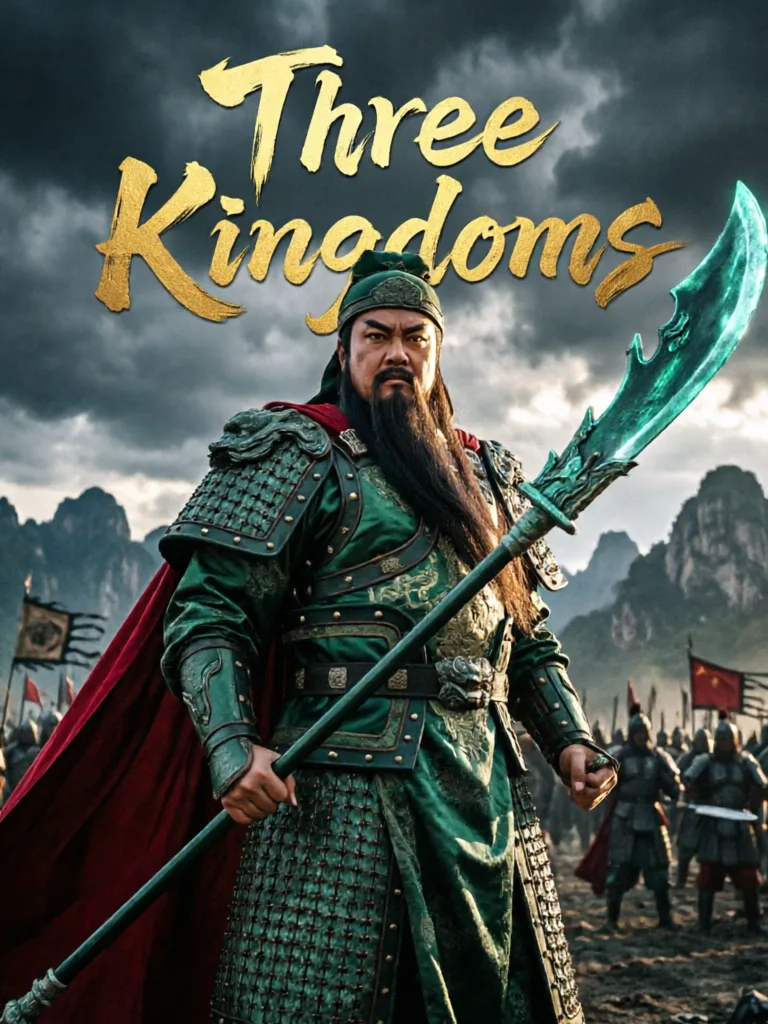
In the city of Chengdu, Chancellor Zhuge Liang governed with meticulous attention, handling all matters of state, great and small, with impartial justice. The people of the two Riverlands—Yi Province and the surrounding territories—enjoyed such peace and prosperity that they left their doors unlocked at night and never picked up lost items from the roads. Fortunate harvests followed one after another, and the old and young alike sang songs of contentment, their bellies full. Whenever corvée labor was required, the people eagerly volunteered, completing their tasks ahead of schedule. Thus, all military supplies and equipment were fully prepared; granaries overflowed with grain, and treasuries were piled high with wealth.
In the third year of the Jianxing reign (225 AD), urgent news arrived from Yi Province: the King Meng Huo of the Southern Tribes had raised a massive army of 100,000 men and was invading the borderlands, plundering villages. Yong Kai, the Grand Administrator of Jianning—a descendant of Yong Chi, the Marquis of Shifang from the Han Dynasty—had allied with Meng Huo in rebellion. Zhu Bao, the Grand Administrator of Zangke Commandery, and Gao Ding, the Grand Administrator of Yuexi Commandery, had both surrendered their cities. Only Wang Kang, the Grand Administrator of Yongchang, refused to join the revolt. Now, the forces of Yong Kai, Zhu Bao, and Gao Ding were serving as guides for Meng Huo’s army, attacking Yongchang Commandery. Wang Kang, together with his aide Lü Kai, had rallied the people and was defending the city with desperate resolve, but the situation grew ever more dire. Kongming entered the court and addressed the Later Emperor: “Your servant sees that the the Southern Tribes remain unsubmissive—this is a great scourge upon our state. I must personally lead the main army to campaign against them.” The Later Emperor replied, “To the east we have Sun Quan, to the north Cao Pi. If my Chancellor abandons me now, what shall I do should Wu and Wei attack?” Kongming answered, “The Eastern Wu has recently made peace with us; I doubt they harbor treacherous intentions. If they do, Li Yan is stationed at Baidi City—he can match Lu Xun. Cao Pi has just suffered a fresh defeat; his fighting spirit is broken, and he cannot plan far-reaching campaigns. Moreover, Ma Chao guards the passes in Hanzhong; there is no need for worry. I have also left Guan Xing and Zhang Bao with two separate armies as reserves, ensuring Your Majesty’s safety. Let me first sweep clean the southern lands, then march north to reclaim the Central Plains, repaying the late Emperor’s three visits to my thatched cottage and his dying charge to protect his son.” The Later Emperor said, “I am young and ignorant; let my Chancellor act as he sees fit.” Before he finished speaking, an official stepped forward from the ranks and cried, “No! No!” All eyes turned to see a man from Nanyang—Wang Lian, styled Wenyi, serving as Remonstrance Counselor. Wang Lian admonished, “The south is a barren land, rife with miasma and plague. My Lord Chancellor bears the heavy burden of state; personally leading a distant campaign is most unwise. Besides, Yong Kai and his ilk are but a minor itch; a single general sent to suppress them would surely succeed.” Kongming replied, “The southern lands are far from our heartland, and their people are unaccustomed to the civilizing influence of the throne. Subduing them will be difficult. I must go myself. I can be both firm and flexible, adapting as needed—this cannot be entrusted lightly to another.”
Wang Lian pleaded repeatedly, but Kongming would not be swayed. That day, Kongming took leave of the Later Emperor. He appointed Jiang Wan as his Advisor, Fei Yi as his Chief Clerk, Dong Jue and Fan Jian as his Secretaries; Zhao Yun and Wei Yan as Grand Generals to command the armies; Wang Ping and Zhang Yi as Deputy Generals; and several dozen Sichuan generals. In total, he raised an army of 500,000 men from the Riverlands and marched toward Yi Province. Suddenly, Guan Suo, the third son of Guan Yu, arrived at the camp to see Kongming. “Since the fall of Jing Province,” he said, “I fled to the Bao family estate to recover from my wounds. I always wished to come to Sichuan to avenge my father, but my scars had not healed, and I could not travel. Recently, I have fully recovered. I learned that the Wu enemies who wronged my family have all been slain, so I came directly to see the Emperor. On the road, I encountered the southern expeditionary army and have come to present myself.” Kongming sighed deeply upon hearing this. He sent word to the court and appointed Guan Suo as Vanguard Commander to join the southern campaign. The great army advanced in orderly ranks, marching by day and resting by night, eating when hungry and drinking when thirsty. They passed through villages without causing the slightest disturbance.
When Yong Kai learned that Kongming himself was leading the main army, he summoned Gao Ding and Zhu Bao to council. They decided to divide their forces into three: Gao Ding would take the center, Yong Kai the left, and Zhu Bao the right, each leading 50,000 to 60,000 men to meet the enemy. Gao Ding appointed E Huan as his Vanguard Commander. E Huan stood nine feet tall, with a hideous face, and wielded a sky-piercing halberd with strength unmatched by ten thousand men. Leading his own troops, he left the main camp to confront the Shu army.
Kongming’s forces had already reached the borders of Yi Province. The vanguard—Wei Yan, with deputies Zhang Yi and Wang Ping—had just entered the frontier when they encountered E Huan’s troops. The two armies drew up in battle formation. Wei Yan rode forward and shouted, “Rebels! Surrender now!” E Huan spurred his horse and clashed with Wei Yan. After only a few exchanges, Wei Yan feigned defeat and fled. E Huan pursued. But after a few li, a great cry arose. Zhang Yi and Wang Ping’s forces sprang from ambush, cutting off E Huan’s retreat. Wei Yan wheeled around, and the three generals fought together, capturing E Huan alive. They brought him to Kongming’s main camp. Kongming ordered his bonds removed and treated him to wine and food. “Whose officer are you?” Kongming asked. “I am an officer under Gao Ding,” E Huan replied. Kongming said, “I know Gao Ding is a loyal and righteous man. He has been misled by Yong Kai into this folly. I now release you. Tell Grand Administrator Gao to surrender soon, lest he bring disaster upon himself.” E Huan bowed in thanks and departed. Returning to Gao Ding, he recounted Kongming’s virtue. Gao Ding was deeply moved. The next day, Yong Kai arrived at the camp. After the formal greetings, Yong Kai asked, “How did E Huan return?” Gao Ding replied, “Zhuge Liang released him out of righteousness.” Yong Kai said, “This is Zhuge Liang’s scheme to sow discord—he wants to turn us against each other.” Gao Ding was half-convinced, half-doubtful, his mind wavering. Suddenly, word came that a Shu general was challenging them to battle. Yong Kai personally led 30,000 men to meet the enemy. After only a few exchanges, Yong Kai turned his horse and fled. Wei Yan pursued with his main force, driving them back over twenty li. The next day, Yong Kai again advanced to give battle. Kongming remained within his camp for three days straight. On the fourth day, Yong Kai and Gao Ding divided their forces into two columns to attack the Shu camp.
Kongming had already ordered Wei Yan to prepare ambushes on both sides. When Yong Kai and Gao Ding’s forces arrived, they were caught in a trap. More than half were killed or wounded, and countless were captured alive, all brought back to the main camp. The prisoners from Yong Kai’s force were held separately from those of Gao Ding. Kongming then ordered his soldiers to spread a rumor: “All of Gao Ding’s men will be spared; all of Yong Kai’s men will be executed.” The prisoners heard this. After a while, Kongming summoned the prisoners from Yong Kai’s force to his tent and asked, “Whose troops are you?” They all lied, “We are Gao Ding’s men.” Kongming spared their lives, gave them wine and food as a reward, and had them escorted to the border, releasing them back to their camp. Then he summoned Gao Ding’s men. They all confessed, “We truly are Gao Ding’s soldiers.” Kongming also spared them, feasted them, and then announced loudly, “Yong Kai sent a messenger to surrender today, offering to deliver the heads of your master and Zhu Bao as proof of his loyalty. I cannot bear to accept such treachery. Since you are Gao Ding’s men, I release you. Do not rebel again. If you are captured a second time, you will not be shown mercy.”
The men bowed in thanks and left. Returning to their camp, they reported everything to Gao Ding. Gao Ding secretly sent men to spy on Yong Kai’s camp. There, they found that the released prisoners were all praising Kongming’s virtue, and many of Yong Kai’s soldiers were inclined to defect to Gao Ding. Despite this, Gao Ding remained uneasy. He sent another man to Kongming’s camp to probe the situation. The spy was captured by patrols and brought before Kongming. Kongming, pretending to mistake him for one of Yong Kai’s men, called him into the tent and demanded, “Your commander promised to deliver the heads of Gao Ding and Zhu Bao. Why has he missed the appointed day? You careless fool—how can you be trusted as a spy?” The soldier stammered an evasive answer. Kongming gave him wine and food, then wrote a secret letter and handed it to him. “Take this to Yong Kai. Tell him to act quickly and not to fail.” The spy bowed in thanks and left. Returning to Gao Ding, he presented the letter and recounted what Kongming had said about Yong Kai. Gao Ding read the letter and flew into a rage. “I treated him with sincerity, and he plots against me! This is an unforgivable outrage!” He summoned E Huan to discuss the matter. E Huan said, “Kongming is a benevolent man; to betray him would be unlucky. All our rebellion and wrongdoing stem from Yong Kai. Better to kill Yong Kai and surrender to Kongming.” Gao Ding asked, “How shall we proceed?” E Huan replied, “Prepare a banquet and invite Yong Kai. If he has no treacherous intent, he will come openly. If he does not, his guilt is clear. You can attack him from the front, while I lie in ambush on the path behind the camp. Yong Kai will be captured.” Gao Ding agreed and prepared a feast, sending an invitation to Yong Kai. Yong Kai, suspicious of the rumors spread by the released prisoners, feared to come. That night, Gao Ding led his troops to attack Yong Kai’s camp. The prisoners Kongming had spared, grateful for Gao Ding’s mercy, joined the fight. Yong Kai’s army collapsed without a real battle.
Yong Kai mounted his horse and fled along a mountain path. He had not gone two li when war drums thundered and a column of troops appeared—it was E Huan, his halberd at the ready, charging forward. Before Yong Kai could react, E Huan struck him down with a single thrust of his halberd and cut off his head. Yong Kai’s soldiers surrendered to Gao Ding. Gao Ding then led both armies to surrender to Kongming, presenting Yong Kai’s head before his tent. Kongming sat high in his tent and ordered his guards to seize Gao Ding and behead him. Gao Ding cried out, “I was moved by your great kindness, Chancellor, and have brought Yong Kai’s head in surrender. Why do you order my execution?” Kongming laughed loudly. “You come to feign surrender. Do you think you can deceive me?” Gao Ding asked, “How does the Chancellor know I am feigning?” Kongming took a letter from a casket and handed it to Gao Ding. “Zhu Bao has secretly sent a letter of surrender, saying you and Yong Kai were sworn brothers in life and death—how could you suddenly kill him? That is why I know you are false.” Gao Ding protested, “Zhu Bao is trying to sow discord! Chancellor, do not believe him!” Kongming replied, “I cannot rely on one side’s word alone. If you capture Zhu Bao, you will prove your sincerity.” Gao Ding said, “Chancellor, do not doubt me. I will go and capture Zhu Bao to present before you—what say you?” Kongming answered, “If you do that, my doubts will be dispelled.”
Gao Ding immediately led his general E Huan and his troops to Zhu Bao’s camp. About ten li from the camp, a column of troops appeared from behind a mountain—it was Zhu Bao himself. Seeing Gao Ding’s army, Zhu Bao hurried forward to speak. Gao Ding cursed him loudly, “Why did you write to Chancellor Zhuge, trying to use a scheme of discord to destroy me?” Zhu Bao was stunned, unable to reply. Suddenly, E Huan rode up from behind and struck Zhu Bao down with his halberd. Gao Ding shouted, “Anyone who does not submit will die!” The entire army knelt in surrender. Gao Ding led both forces to see Kongming, presenting Zhu Bao’s head. Kongming laughed heartily. “I made you kill these two villains to prove your loyalty.” He then appointed Gao Ding as Grand Administrator of Yi Province, governing all three commanderies, and made E Huan a Commandant. The three rebel armies were thus pacified.
Wang Kang, the Grand Administrator of Yongchang, came out of the city to welcome Kongming. After entering the city, Kongming asked, “Who helped you defend this city and keep it safe?” Wang Kang replied, “That this commandery remains secure is all thanks to a man of Yongchang, a native of Bowei—Lü Kai, styled Jiping. All credit goes to him.” Kongming summoned Lü Kai. Lü Kai entered and paid his respects. Kongming said, “I have long heard of you as a worthy scholar of Yongchang. Much credit goes to you for holding this city. Now I wish to pacify the southern lands—what advice do you have?” Lü Kai produced a map and presented it to Kongming. “Since I began my official career, I have known that the southerners have long harbored rebellious intentions. I secretly sent men into their territory to survey all the places suitable for troop deployments and battles, and drew this map, called the ‘Complete Map for Pacifying the tribesmen.’ I now present it to Your Excellency. Study it—it may aid the campaign.” Kongming was overjoyed and appointed Lü Kai as his Field Instructor and Guide. He then advanced his army deep into the southern lands.
As they marched, word arrived that the Emperor had sent an envoy. Kongming invited the man into his command tent. The envoy entered, dressed in white mourning robes—it was Ma Su, grieving for his recently deceased elder brother Ma Liang. Ma Su said, “I bear the Emperor’s decree, bestowing wine and silk upon the troops.” Kongming received the edict and distributed the gifts as commanded. He then kept Ma Su in his tent for a private conversation. “I have received the Emperor’s command to pacify the tribesmen,” Kongming said. “I have long heard of your profound insights, Youchang. I beg you to enlighten me.” Ma Su replied, “I have a humble opinion, which I hope the Chancellor will consider. The the Southern Tribes, relying on their distant, rugged mountains, have long refused to submit. Even if we defeat them today, they will rebel again tomorrow. When your great army arrives, they will surely be subdued. But once you withdraw to march north against Cao Pi, the tribesmen, learning that our interior is undefended, will rise again swiftly. The art of war teaches: to conquer the heart is the highest; to conquer the city is the lowest. Psychological warfare is supreme; armed combat is inferior. I hope the Chancellor will aim only to win their hearts.” Kongming sighed in admiration. “Youchang, you truly understand my innermost thoughts!” He appointed Ma Su as his Advisor and continued the advance.
When the King Meng Huo of the Southern Tribes learned that Kongming had outwitted and defeated Yong Kai and his allies, he summoned his three cave chieftains to council. The first was Chieftain Golden Ring Triad, the second was Chieftain Dong Tuna, and the third was Chieftain A He Nan. The three chieftains came before Meng Huo. He said, “Now Chancellor Zhuge Liang leads a great army to invade our lands; we must unite our strength to resist. You three shall divide your forces into three columns and advance. Whoever wins victory shall be made Cave Lord.” Golden Ring Triad took the center, Dong Tuna the left, and A He Nan the right, each leading 50,000 tribal troops, and set out as ordered.
Kongming was in his camp discussing strategy when scouts reported that the three chieftains were advancing in three columns. Kongming summoned Zhao Yun and Wei Yan but gave them no orders. Instead, he called Wang Ping and Ma Zhong and instructed them: “the tribesmen approach in three columns. I wished to send Zilong and Wenchang, but they do not know the terrain, so I dare not use them. Wang Ping, you will take the left road to meet the enemy; Ma Zhong, the right. I will have Zilong and Wenchang follow as support. Prepare your troops today; set out at dawn tomorrow.” The two left to carry out their orders. Then Kongming summoned Zhang Ni and Zhang Yi: “You two will lead a single force to meet the enemy on the central road. Prepare today and coordinate with Wang Ping and Ma Zhong. I wanted to send Zilong and Wenchang, but they do not know the terrain, so I dare not use them.” Zhang Ni and Zhang Yi departed.
Zhao Yun and Wei Yan, seeing that Kongming had not used them, were visibly displeased. Kongming said, “It is not that I do not wish to use you two. But I fear that men of middle age, venturing into dangerous terrain, might fall prey to tribesman schemes and lose their edge.” Zhao Yun asked, “What if we knew the terrain?” Kongming replied, “You two must simply be cautious and not act rashly.” The two withdrew, disgruntled. Zhao Yun invited Wei Yan to his own tent to discuss. “We are the vanguard commanders,” Zhao Yun said, “yet he says we do not know the terrain and refuses to use us. Now he sends these juniors—are we not shamed?” Wei Yan replied, “Let us mount our horses and scout the terrain ourselves. We will capture some natives and force them to guide us. Then we can confront the tribesmen and achieve great things.” Zhao Yun agreed. They mounted and rode directly toward the central road. After a few li, they saw a great cloud of dust in the distance. Climbing a slope, they spotted several dozen tribesman horsemen galloping toward them. The two generals charged from both sides. the tribesmen, terrified, fled. Zhao Yun and Wei Yan each captured several men alive and returned to camp. They treated the prisoners to wine and food and carefully questioned them. the tribesmen told them, “Ahead lies the main camp of Chieftain Golden Ring Triad, right at the mountain pass. To the east and west of the camp, paths lead to the Five Streams Cave and to the rear camps of Dong Tuna and A He Nan.”
Hearing this, Zhao Yun and Wei Yan selected 5,000 elite troops and ordered the captured tribesmans to guide them. It was already the second watch of the night when they set out. The moon was bright, the stars clear, and they marched by its light. They reached Golden Ring Triad’s camp around the fourth watch. the tribesmen were just preparing their morning meal, readying for battle at dawn. Suddenly, Zhao Yun and Wei Yan’s forces burst in from two sides. the tribesmen fell into chaos. Zhao Yun charged straight into the command tent, where he encountered Chieftain Golden Ring Triad. In a single exchange, Zhao Yun ran him through with his spear and cut off his head. The remaining troops scattered. Wei Yan divided his force in half and headed east to attack Dong Tuna’s camp. Zhao Yun took the other half and headed west to attack A He Nan’s camp. By the time they reached the tribesmen’ main camps, dawn had broken.
Wei Yan attacked Dong Tuna’s camp from the rear. Dong Tuna, hearing that troops were approaching from behind, led his men out to resist. Suddenly, a great cry arose from the front gate—Wang Ping’s forces had already arrived. Attacked from both sides, the tribesmen were utterly routed. Dong Tuna fought his way out and escaped, with Wei Yan unable to catch him.
Meanwhile, Zhao Yun attacked A He Nan’s camp from the rear. Ma Zhong had already struck from the front. Attacked from both sides, the tribesmen were crushed. A He Nan slipped away in the chaos. Both generals withdrew their forces and returned to report to Kongming. Kongming asked, “Of the three tribal chieftains, two have escaped. Where is the head of Golden Ring Triad?” Zhao Yun presented the head as a trophy. The generals said, “Dong Tuna and A He Nan abandoned their horses and fled over the mountains—we could not catch them.” Kongming laughed. “I have already captured them both.” Zhao Yun, Wei Yan, and the other generals did not believe him. After a short while, Zhang Ni arrived, escorting Dong Tuna in chains, and Zhang Yi arrived with A He Nan. All were astonished. Kongming explained, “I studied Lü Kai’s map and knew the positions of each camp. So I provoked Zilong and Wenchang’s fighting spirit, sending them deep into enemy territory to first destroy Golden Ring Triad, then split forces to attack the rear camps from both sides, with Wang Ping and Ma Zhong supporting from the front. No one else could have handled that task. I knew Dong Tuna and A He Nan would flee along mountain paths, so I sent Zhang Ni and Zhang Yi to lie in ambush, with Guan Suo as reinforcement, and captured them.” The generals bowed in admiration. “The Chancellor’s calculations are beyond the comprehension of gods and demons!”
Kongming ordered Dong Tuna and A He Nan brought before him. He removed their bonds, gave them wine, food, and clothing, and sent them back to their caves, commanding them not to aid the rebellion again. Weeping, they bowed and departed along the mountain paths. Kongming said to his generals, “Tomorrow, Meng Huo will surely come to fight in person. We can capture him then.” He summoned Zhao Yun and Wei Yan, gave them their orders, and sent them off with 5,000 men each. He then summoned Wang Ping and Guan Suo, gave them their orders, and sent them off as well. Having made all his arrangements, Kongming sat in his tent to await events.
In his camp, the King Meng Huo of the Southern Tribes sat in council when scouts reported that all three chieftains had been captured by Kongming and their armies scattered. Furious, Meng Huo raised his tribal troops and advanced. He soon encountered Wang Ping’s force. The two armies drew up in formation. Wang Ping rode forward, his sword held horizontally, and observed the enemy. The tribesman banners parted, and several hundred southern horsemen arrayed themselves in two wings. In the center, Meng Huo appeared: on his head, a purple-gold crown studded with gems; on his body, a red brocade robe embroidered with tassels; at his waist, a belt carved with jade lions; on his feet, eagle-beak green boots. He rode a curly-maned Red Hare horse and wore two swords inlaid with swirling patterns at his side. He looked around proudly and said to his tribal generals, “People always say Zhuge Liang is a master of military strategy. But looking at this formation—banners in disarray, troops in confusion, weapons and armor unimpressive—I see now that all I heard before was nonsense. If I had known this, I would have rebelled long ago. Who will capture this Shu general and show our might?” Before he finished speaking, a general named Mang Yachang stepped forward. Wielding a broad-bladed sword and riding a yellow-maned horse, he charged at Wang Ping. The two clashed. After only a few exchanges, Wang Ping fled. Meng Huo drove his army forward in hot pursuit. Guan Suo fought briefly, then also fled. They retreated about twenty li. As Meng Huo pressed the chase, war cries erupted from both sides. Zhang Ni appeared on the left, Zhang Yi on the right, cutting off the tribesmen’ retreat. Wang Ping and Guan Suo wheeled around and attacked. Caught between two forces, the tribesmen were crushed. Meng Huo fought desperately with his officers and managed to break free, fleeing toward Mount Brocade Belt. Three pursuing armies chased him. As he fled, another war cry arose from ahead—a column of troops blocked his path. At their head was Zhao Zilong of Changshan. Meng Huo was terrified. He turned and fled along a narrow mountain path. Zhao Yun charged into the tribal ranks, killing many and capturing countless prisoners. Meng Huo, with only a few dozen riders, fled into a valley. The pursuers were closing in, and the path grew too narrow for horses. He abandoned his mount and fled on foot, climbing over the mountains. Suddenly, a drum roll echoed through the valley. Wei Yan, acting on Kongming’s plan, had hidden 500 infantrymen here. Meng Huo could not resist and was captured alive by Wei Yan. His remaining followers all surrendered.
Wei Yan brought Meng Huo in chains to Kongming’s main camp. Kongming had already slaughtered cattle and sheep and prepared a feast. The tent was arranged with seven ranks of guards, their weapons gleaming like frost and snow. Kongming held the imperial golden battle-axe, a curved ceremonial umbrella above him, and was surrounded by the imperial guard with feathered banners and drums, all arranged in strict order. Kongming sat solemnly in the tent as the captured tribesmans were brought in, countless in number. He summoned them all before him, removed their bonds, and comforted them: “You are all good people, unfortunate to have been forced into rebellion by Meng Huo. You have suffered much. I know your parents, brothers, wives, and children are waiting at home, heartsick with worry. Hearing of your defeat, they must be torn with grief. I now release you all, to ease the hearts of your families.” He then gave each of them wine, food, and grain, and sent them on their way. The tribal soldiers, deeply moved by his kindness, wept and bowed in thanks before leaving. Kongming then ordered his guards to bring Meng Huo forward. Soon, the the southern king was pushed and dragged before the tent, bound, and forced to kneel. Kongming said, “The late Emperor treated you well. How dare you rebel?” Meng Huo replied, “The lands of the two Riverlands were all taken by others. Your master seized them by force and proclaimed himself emperor. My people have lived here for generations. It is you who are lawless, invading our lands. How can you call me a rebel?” Kongming said, “I have captured you now. Do you submit?” Meng Huo answered, “The mountain paths were narrow and treacherous—I fell into your hands by accident. How could I submit?” Kongming asked, “Since you do not submit, what if I release you?” Meng Huo said, “If you release me, I will reorganize my army and fight you to the finish. If you capture me again, then I will submit.” Kongming immediately ordered his bonds removed, gave him clothes to wear, feasted him with wine and food, provided him with a horse and saddle, and had him escorted out of the camp, sent back to his own territory.
Truly, a poet of the age lamented: The invader, once in the palm of the hand, was released again; a man from beyond the pale of civilization could not yet be brought to submission. What would happen when they fought again? Let the next chapter reveal.