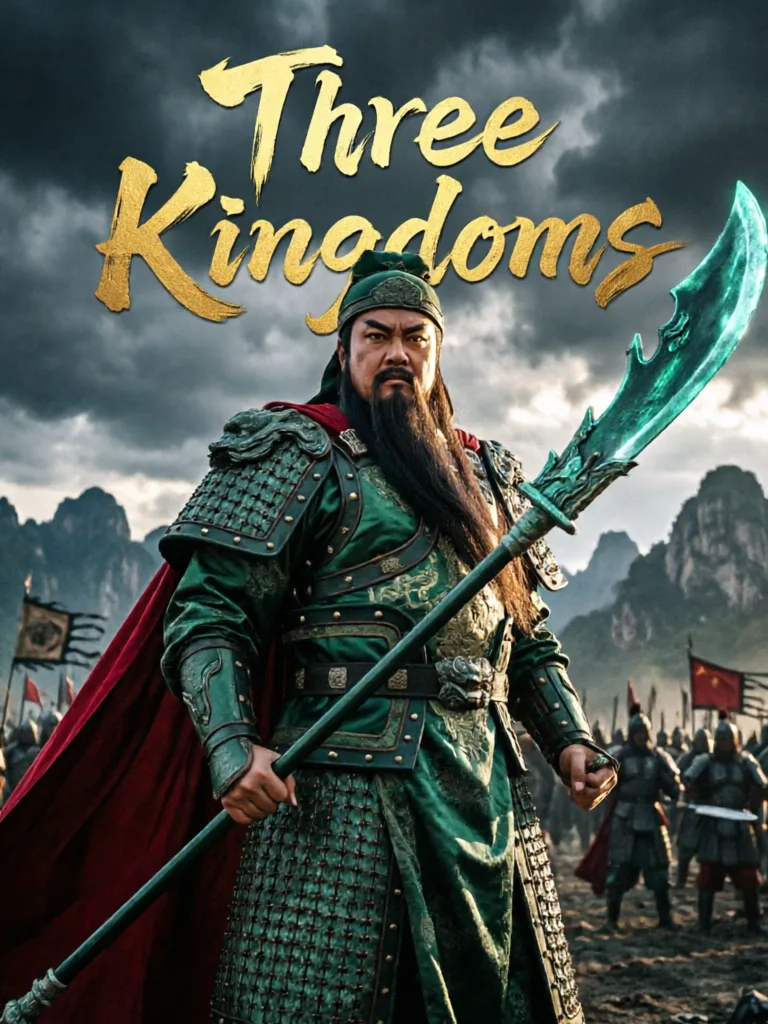
It was the second year of the Zhangwu era, in the spring of the first month. Huang Zhong, the General of the Rear and Marquis of Weiwu, had joined Liu Bei's campaign against Wu. When he heard Liu Bei remark that the old generals were useless, he seized his blade, mounted his steed, and taking only five or six of his personal guards, rode directly to the camp at Yiling. Wu Ban, Zhang Nan, and Feng Xi received him, asking, "Old General, what brings you here?" Huang Zhong replied, "I have followed the Emperor from Changsha to this day, bearing much toil and hardship. Though I am now past seventy, I can still devour ten catties of meat, draw a two-stone bow, and ride a thousand-li horse—I am not yet old. Yesterday, the Lord said that men like me are old and useless, so I have come here to face the forces of Eastern Wu. Watch me take an enemy head, and you shall see whether I am old or not!"
As he spoke, a report came that the vanguard of Wu's army had arrived, with scouts already approaching the camp. Huang Zhong rose with fiery energy, strode out of his tent, and mounted his horse. Feng Xi and the others urged him, "Old General, do not advance so rashly." Huang Zhong would not listen. He spurred his horse and galloped forth. Wu Ban ordered Feng Xi to lead troops in support. In front of the Wu formation, Huang Zhong reined in his horse, brandished his blade, and single-handedly challenged Pan Zhang, the Wu vanguard commander, to combat. Pan Zhang led his subordinate officer, Shi Ji, into the field. Shi Ji, despising Huang Zhong for his age, thrust his spear forward and charged. But before three exchanges had passed, Huang Zhong cut him down with a single stroke of his blade. Enraged, Pan Zhang seized the Green Dragon Crescent Blade—the very weapon of Guan Yu—and rode out to battle Huang Zhong. They exchanged several passes, neither gaining the upper hand. Huang Zhong fought with savage determination. Pan Zhang, realizing he could not overcome his opponent, wheeled his horse and fled. Huang Zhong pressed the pursuit, winning a complete victory as he returned. On the road, he encountered Guan Xing and Zhang Bao. Guan Xing said, "We have come by imperial decree to assist you, old general. Since you have already achieved merit, please return to camp quickly." Huang Zhong refused.
The next day, Pan Zhang issued another challenge. Huang Zhong mounted his horse with fierce resolve. Guan Xing and Zhang Bao wished to aid him, but Huang Zhong would not allow it. Wu Ban also offered to help, but again Huang Zhong refused. He took only five thousand men and rode out to meet the enemy. After a few exchanges, Pan Zhang feigned defeat, dragging his blade as he retreated. Huang Zhong pursued at full gallop, shouting fiercely, "Rebel general, do not flee! Today I avenge Lord Guan!" He chased Pan Zhang for over thirty li. Suddenly, war cries erupted from all sides as an ambush sprang forth: Zhou Tai on the right, Han Dang on the left, Pan Zhang ahead, and Ling Tong behind—Huang Zhong was trapped in the center. A fierce wind arose. As Huang Zhong tried to retreat, Ma Zhong led a force down from a hillside and loosed an arrow that struck Huang Zhong in the shoulder, nearly unhorsing him. Seeing Huang Zhong wounded, the Wu soldiers pressed the attack. But then a thunderous roar came from behind, and two columns of troops charged in, scattering the Wu forces and rescuing Huang Zhong. It was Guan Xing and Zhang Bao. The two young generals escorted Huang Zhong back to the imperial camp. Huang Zhong was old and his blood was thin; the arrow wound festered and caused him great agony, and his illness grew severe. Liu Bei came personally to see him, touching his back and saying, "That you, old general, have been wounded—this is my fault!" Huang Zhong replied, "I am but a common warrior, fortunate to have met Your Majesty. I am now seventy-five years old, and my years have been sufficient. I beg Your Majesty to take good care of the dragon's person and strive for the Central Plains." With these words, he lost consciousness. That night, he died in the imperial camp.
A poet of the time lamented: Of the old generals, Huang Zhong was spoken of—he achieved great merit in the conquest of Shu. He donned his golden armor once more and drew his iron-backed bow with both hands. His bold spirit shook the lands north of the Yellow River, and his fame steadied the heart of Shu. In death, his hair was white as snow, yet still he showed himself a hero.
When Liu Bei saw that Huang Zhong had breathed his last, his grief was beyond measure. He ordered a coffin and burial in Chengdu. Liu Bei sighed, "Of the Five Tiger Generals, three are now gone. I cannot even avenge them—how deeply painful this is!" He then led the Imperial Guard directly to Xiaoting, where he assembled all his generals, divided his forces into eight columns, and advanced by both water and land. The water route was commanded by Huang Quan, while Liu Bei himself led the main army by land. It was now the middle of the second month of the second year of the Zhangwu era.
When Han Dang and Zhou Tai learned that Liu Bei was personally leading the campaign, they led their troops out to meet him. The two armies drew up in battle formation. Han Dang and Zhou Tai rode forward. From the Shu camp, the gate banners parted, and Liu Bei himself appeared, beneath a yellow silk canopy with golden tassels, surrounded by white standards, golden battle-axes, and ceremonial banners of gold and silver. Han Dang shouted, "Your Majesty is now the lord of Shu—why do you come forth so lightly? If something goes wrong, regret will be too late!" Liu Bei pointed at him from afar and cursed, "You dogs of Wu! You have wounded my brothers! I swear I will not stand under the same Heaven with you!" Han Dang turned to his generals and asked, "Who dares to charge the Shu army?" His subordinate, Xia Xun, thrust his spear forward and rode out. From behind Liu Bei, Zhang Bao brandished his eighteen-foot serpent spear, spurred his horse, and with a thunderous roar, rode straight for Xia Xun. Xia Xun, hearing Zhang Bao's voice like a clap of thunder, was struck with fear. As he was about to flee, Zhou Tai's younger brother, Zhou Ping, seeing Xia Xun outmatched, raised his blade and charged. Guan Xing saw this, leaped onto his horse, and raised his own blade to meet him. Zhang Bao gave a great shout and drove his spear through Xia Xun, who toppled from his horse. Zhou Ping, startled and caught off guard, was cut down by Guan Xing's blade. The two young generals then pressed toward Han Dang and Zhou Tai. Han and Zhou, panic-stricken, fled back into their formation. Liu Bei watched and sighed, "A tiger's father does not beget a dog's son!" He pointed his imperial whip forward, and the Shu army surged as one, overwhelming the enemy. The Wu army was utterly routed. The eight columns of Shu troops advanced like a spring tide, slaughtering the Wu soldiers until corpses covered the fields and blood flowed like rivers.
As for Gan Ning, he was recuperating from illness aboard a boat. When he heard that the Shu army had arrived in force, he hastily mounted his horse. He encountered a band of tribal troops, all with disheveled hair and bare feet, wielding bows, crossbows, long spears, shields, and axes. Their leader was the King Shamoke of the Southern Tribes, whose face was as red as if splashed with blood, with bulging green eyes. He wielded a spiked iron mace and wore two bows at his belt, exuding fierce majesty. Gan Ning, seeing their overwhelming numbers, dared not engage and turned his horse to flee. But Shamoke loosed an arrow that struck Gan Ning in the head. Gan Ning, with the arrow still in him, rode to Fuchi Ford, where he sat down beneath a great tree and died. Hundreds of crows gathered around his corpse. When the King of Wu heard of this, he was deeply grieved, ordered a lavish funeral, and had a temple built for his worship.
A poet of the time lamented: Gan Xingba of Wu commandery, whose boat with silken sails plied the Yangtze. He repaid his lord's heavy trust, and avenged his friend by turning enmity to dust. He raided camps with light cavalry, and drove his troops to drink from great vessels. The divine crows showed his spirit, and his incense burns through a thousand autumns.
Liu Bei pressed the pursuit and captured Xiaoting. The Wu forces scattered in all directions. As Liu Bei gathered his troops, he noticed that Guan Xing was missing. Alarmed, he ordered Zhang Bao and others to search everywhere. It turned out that Guan Xing had charged deep into the Wu formation and encountered his sworn enemy, Pan Zhang. Guan Xing spurred his horse in pursuit. Pan Zhang, terrified, fled into a mountain valley and disappeared. Guan Xing searched the hills but could not find him. As dusk fell, he lost his way. Fortunately, the moon and stars gave some light. He pursued until the second watch, arriving at a farmhouse. He dismounted and knocked on the door. An old man came out and asked who he was. Guan Xing replied, "I am a battle commander who has lost his way. I beg only for a meal to ease my hunger." The old man led him inside. Guan Xing saw a bright candle burning in the hall, and in the center hung a painted portrait of Guan Yu. Guan Xing wept bitterly and knelt to pay homage. The old man asked, "General, why do you weep and bow?" Guan Xing answered, "This is my father." Hearing this, the old man also knelt and bowed. Guan Xing asked, "Why do you keep an offering for my father?" The old man replied, "This entire region is the domain of your honored father. While he lived, every household served him; how much more so now that he is a god? I have only hoped that the Shu army would exact vengeance soon. Now that you, General, have come, the people are blessed." He then set out wine and food to entertain Guan Xing, and unsaddled his horse to feed it.
After the third watch, another man knocked at the door. The old man went out to ask who it was—it was the Wu general, Pan Zhang, also seeking lodging. As Pan Zhang entered the thatched hall, Guan Xing saw him, seized his sword, and roared, "Villain, do not flee!" Pan Zhang turned and ran. But at the door, a figure appeared: a face as red as a date, with phoenix eyes and silkworm eyebrows, a flowing beard of three strands, dressed in a green robe and golden armor, sword in hand. Pan Zhang recognized the apparition of Guan Yu. He gave a great cry, his soul shattered with terror. Before he could turn, Guan Xing's sword fell, cutting him down. Guan Xing took Pan Zhang's heart and blood and offered them before the portrait of Guan Yu. He retrieved his father's Green Dragon Crescent Blade, tied Pan Zhang's head to his horse's neck, bid farewell to the old man, mounted Pan Zhang's horse, and rode back toward his own camp. The old man dragged Pan Zhang's corpse out and burned it.
Guan Xing had not traveled far when he heard voices and horses. A troop of soldiers approached, led by none other than Ma Zhong, Pan Zhang's subordinate. When Ma Zhong saw that Guan Xing had killed his commander, with the head hanging from the horse's neck and the Green Dragon Crescent Blade in Guan Xing's hands, he was furious. He spurred his horse to attack Guan Xing. Guan Xing, seeing the man who had killed his father, was filled with righteous wrath. He raised the Green Dragon Crescent Blade and struck at Ma Zhong. Ma Zhong's three hundred soldiers rushed forward together with a shout, surrounding Guan Xing. Guan Xing was isolated and in dire straits. Suddenly, a force appeared from the northwest—it was Zhang Bao. Seeing reinforcements arrive, Ma Zhong hastily withdrew his troops. Guan Xing and Zhang Bao joined in pursuit. After a few li, Mi Fang and Fu Shiren led a force to meet Ma Zhong. The two armies clashed in a chaotic melee. Outnumbered, Zhang Bao and Guan Xing quickly retreated and returned to Xiaoting. They reported to Liu Bei, presenting the severed head and recounting all that had happened. Liu Bei was astonished and rewarded the entire army.
Ma Zhong returned to Han Dang and Zhou Tai, gathered the scattered troops, and ordered them to hold their positions. The number of wounded was beyond count. Ma Zhong led Fu Shiren and Mi Fang to camp by the riverbank. That night, at the third watch, the soldiers wept without ceasing. Mi Fang overheard a group of soldiers saying, "We are all Jing Province troops. Lü Meng's treacherous schemes cost our lord his life. Now Imperial Uncle Liu has come in person—Eastern Wu's days are numbered. What we hate most are Mi Fang and Fu Shiren. Why don't we kill those two traitors and surrender to the Shu camp? That would be no small merit." Another group said, "Don't be hasty. Wait for an opportunity, then act."
Mi Fang was terrified. He consulted with Fu Shiren, saying, "The soldiers' hearts are turning. Our lives are in danger. The one Liu Bei hates most is Ma Zhong. Why don't we kill him, take his head to the Shu lord, and claim that we were forced to surrender to Wu, and now that the imperial army has come, we have come to beg forgiveness?" Fu Shiren said, "That won't do. If we go, we will surely meet disaster." Mi Fang replied, "Liu Bei is merciful and virtuous. His son, Adou, is my nephew. He will surely think of our family ties and will not harm us." Having agreed on their plan, they prepared their horses. At the third watch, they entered the tent, assassinated Ma Zhong, cut off his head, and taking a few dozen riders, rode straight to Xiaoting. The sentries on the road first led them to Zhang Nan and Feng Xi, to whom they explained everything. The next day, they appeared before Liu Bei in the imperial camp, presenting Ma Zhong's head and weeping, "We never truly rebelled. Lü Meng's treachery—claiming Lord Guan was dead—tricked us into opening the gates. We surrendered unwillingly. Now that Your Majesty has come, we have killed this villain to assuage your wrath. We beg Your Majesty to forgive our crimes." Liu Bei was enraged. "Since I left Chengdu, why have you not come to beg forgiveness? Now that the situation is desperate, you come with smooth words to save your skins! If I spare you, what face will I have to meet Lord Guan in the underworld?" He ordered Guan Xing to set up an altar for Guan Yu's spirit in the imperial camp. Liu Bei himself took Ma Zhong's head and offered it in sacrifice. He then commanded Guan Xing to strip Mi Fang and Fu Shiren of their clothes, make them kneel before the altar, and personally cut them to pieces as an offering to Guan Yu. Suddenly, Zhang Bao entered the tent, weeping and kneeling before Liu Bei. "The murderers of my uncle have all been executed. When will my own father's wrongs be avenged?" Liu Bei said, "Nephew, do not worry. I will pacify Jiangnan, kill every dog of Wu, and capture those two villains. I will personally have them minced to a paste to sacrifice to your father." Zhang Bao wept and withdrew in gratitude.
At this time, Liu Bei's might shook the realm. The people of Jiangnan were terrified, weeping day and night. Han Dang and Zhou Tai were greatly alarmed and urgently reported to the King of Wu, detailing how Mi Fang and Fu Shiren had killed Ma Zhong and surrendered to the Shu emperor, only to be executed themselves. Sun Quan was frightened and assembled his civil and military officials to discuss the matter. Bu Zhi submitted a memorial, saying, "What Liu Bei hates most are Lü Meng, Pan Zhang, Ma Zhong, Mi Fang, and Fu Shiren. All these men are now dead. Only Fan Jiang and Zhang Da remain in Eastern Wu. Why not seize these two, along with Zhang Fei's head, send them back, return Jing Province, send back Lady Sun, and submit a memorial suing for peace? We can renew our former alliance and together destroy Wei. Then the Shu army will withdraw of its own accord." Sun Quan agreed. He had an aloeswood box prepared to hold Zhang Fei's head, bound Fan Jiang and Zhang Da in a prison cart, and sent Cheng Bing as an envoy with a state letter to Xiaoting.
Liu Bei was about to advance further when a close minister reported, "Eastern Wu has sent an envoy bearing the head of General Zhang Fei, along with the traitors Fan Jiang and Zhang Da in chains." Liu Bei raised his hands to his forehead and said, "This is a gift from Heaven, and the spirit of my third brother!" He ordered Zhang Bao to set up an altar for Zhang Fei's spirit. When Liu Bei saw Zhang Fei's head in the box, its expression unchanged, he wept aloud. Zhang Bao himself took a sharp blade and sliced Fan Jiang and Zhang Da to pieces as an offering to his father's spirit.
After the sacrifice, Liu Bei's anger did not subside. He was determined to destroy Wu. Ma Liang submitted a memorial, saying, "All the murderers have been executed, and your grievance is avenged. Wu's Grand Master, Cheng Bing, has come to return Jing Province, send back Lady Sun, and form a lasting alliance to destroy Wei together. We await your decree." Liu Bei said angrily, "The man I hate with gnashing teeth is Sun Quan. If I make peace with him now, I will have betrayed the oath I swore with my brothers. First, I will destroy Wu; then, I will destroy Wei." He ordered the envoy executed to sever all ties with Wu. Only after many officials pleaded earnestly did he relent. Cheng Bing fled with his head tucked under his arm and reported to his lord, "Shu refuses peace talks. They swear to destroy Eastern Wu first, then attack Wei. The officials pleaded, but he would not listen. What can be done?"
Sun Quan was greatly alarmed and at a loss. Kan Ze stepped forward and said, "There is a pillar of Heaven right before us—why not use him?" Sun Quan urgently asked who. Kan Ze replied, "In the past, the great affairs of Eastern Wu were entirely entrusted to Zhou Yu. Then Lu Su took his place. After Lu Su's death, the decisions fell to Lü Meng. Though Lü Meng is gone, there is Lu Xun in Jing Province. This man, though a scholar by name, possesses true talent and grand strategy. In my view, he is no less than Zhou Yu. It was his plans that defeated Guan Yu. If Your Majesty employs him, the destruction of Shu is certain. If he fails, I am willing to share his punishment." Sun Quan said, "Without your words, I would have made a grave mistake." Zhang Zhao objected, "Lu Xun is but a bookish youth—no match for Liu Bei. I fear he cannot be used." Gu Yong also said, "Lu Xun is young and lacks reputation. The other generals will not obey him. Disobedience will breed chaos and ruin our cause." Bu Zhi added, "Lu Xun's talent is sufficient only to govern a commandery. Entrusting him with a great task is inappropriate." Kan Ze cried out, "If we do not use Lu Xun, Eastern Wu is finished! I stake my entire family on him!" Sun Quan said, "I have always known Lu Xun to be a man of extraordinary talent. My mind is made up. Say no more."
He summoned Lu Xun. Lu Xun, originally named Lu Yi, later changed his name to Xun, with the style name Boyan, was a native of Wu Commandery. He was the grandson of Lu Yu, a Commandant of the City Gates under the Han, and the son of Lu Jun, a Chief Commandant of Jiujiang. He stood eight feet tall, with a face like fine jade, and held the rank of General Who Pacifies the West. When summoned, he came and paid his respects. Sun Quan said, "The Shu army is at our border. I am specially appointing you as Commander-in-Chief of all forces to defeat Liu Bei." Lu Xun said, "The civil and military officials of Jiangdong are all old friends of Your Majesty. I am young and without talent—how can I control them?" Sun Quan replied, "Kan Ze has staked his entire family on you, and I have long known your ability. I now appoint you as Commander-in-Chief. Do not refuse." Lu Xun asked, "What if the officials refuse to obey?" Sun Quan took his sword and gave it to him, saying, "If anyone disobeys your orders, execute them first and report afterward." Lu Xun said, "I humbly accept this great trust. But I beg Your Majesty to assemble all the officials tomorrow before bestowing this command upon me." Kan Ze said, "In ancient times, when appointing a general, a platform was built, the officials were gathered, and the white yak-tail standard and golden battle-axes were bestowed, along with the seal and tally of command. Only then could orders be carried out with authority. Your Majesty should follow this ritual. Choose a day, build a platform, and appoint Lu Xun as Commander-in-Chief, granting him the authority of the ceremonial axe and seal. Then no one will dare disobey." Sun Quan agreed. He ordered a platform built overnight. The next day, he assembled all the officials, invited Lu Xun to ascend the platform, and appointed him Commander-in-Chief, Right Protector of the Army, General Who Pacifies the West, and enfeoffed him as Marquis of Lou. He bestowed upon him the sword, seal, and tally of command, giving him authority over the armies of six commanderies, eighty-one counties, and all the forces of Jing Province and Chu. The King of Wu instructed him, "Within the court, I rule; beyond the court, you command."
Lu Xun accepted the command and descended from the platform. He appointed Xu Sheng and Ding Feng as his personal guards and set out that very day. He also issued orders to all the regional forces to advance by both land and water. When the dispatch reached Xiaoting, Han Dang and Zhou Tai were shocked. "How could the lord entrust the entire army to a mere scholar?" When Lu Xun arrived, all the generals were resentful. Lu Xun ascended his tent to discuss affairs, and the men offered their congratulations with ill grace. Lu Xun said, "The lord has appointed me as commander to break Shu. The army has its laws. Each of you must obey. The king's law shows no favor—do not bring regret upon yourselves." All were silent. Zhou Tai said, "Sun Huan, the General Who Pacifies the East, is the lord's nephew. He is now trapped in the city of Yiling, with no food inside and no reinforcements outside. I beg you, Commander, to devise a plan quickly to rescue Sun Huan and ease the lord's mind." Lu Xun replied, "I know that Sun Huan has won the hearts of his troops and can surely hold out. There is no need to rescue him. After I have broken Shu, he will come out on his own." The generals withdrew, laughing secretly. Han Dang said to Zhou Tai, "Appointing this boy as commander—Eastern Wu is finished! Did you see his plan?" Zhou Tai said, "I tested him with words, and he had no plan at all. How can he break Shu?"
The next day, Lu Xun issued orders for all generals to guard their posts strictly, hold the passes firmly, and not engage the enemy lightly. The generals laughed at his timidity and refused to hold their positions. The following day, Lu Xun summoned the generals and said, "I have received the king's command to lead the army. Yesterday, I gave repeated orders for you to hold your positions, yet none of you obeyed. Why?" Han Dang said, "I have followed General Sun in pacifying Jiangnan through hundreds of battles. The other generals have either served with the late General Sun Jian or with the present king. We are men who have worn armor and faced death. Now the lord has appointed you as Commander-in-Chief to drive back Shu. You should decide on a plan quickly, deploy the troops, and advance in force to achieve our goal. Instead, you only order us to hold and not fight. Do you expect Heaven to kill the enemy for us? I am no coward—why do you make us lose our fighting spirit?" The other generals echoed, "General Han is right. We are willing to fight to the death!" Lu Xun listened, then drew his sword and said sternly, "Though I am but a scholar, the lord has entrusted me with this great task because I have some small ability and can endure humiliation and bear heavy burdens. Each of you will guard your passes and hold the strategic points. Do not act rashly. Anyone who disobeys shall be executed!" The generals withdrew in anger.
Liu Bei deployed his forces from Xiaoting all the way to the Sichuan border, a line of seven hundred li, with forty camps in total. By day, the banners blotted out the sun; by night, the campfires lit up the sky. Suddenly, spies reported, "Eastern Wu has appointed Lu Xun as Commander-in-Chief. He has ordered all his generals to hold the strategic points and not come out." Liu Bei asked, "What kind of man is Lu Xun?" Ma Liang replied, "Though Lu Xun is a scholar of Wu, he is young, talented, and deeply strategic. The attack on Jing Province was all his doing." Liu Bei was furious. "That boy's schemes cost me my brother! I will capture him now!" He ordered an advance. Ma Liang advised, "Lu Xun's talent is no less than Zhou Yu's. Do not underestimate him." Liu Bei said, "I have grown old in the art of war. Am I to be outdone by a beardless youth?" He personally led the vanguard to attack the various passes and strategic points.
When Han Dang saw Liu Bei's army approaching, he sent word to Lu Xun. Fearing that Han Dang would act rashly, Lu Xun galloped to the front himself. He saw Han Dang standing on a hill, gazing at the Shu army spreading across the mountains and plains, with a yellow canopy faintly visible among them. Han Dang met Lu Xun, and they observed together from horseback. Han Dang pointed and said, "Liu Bei must be in that army. I want to attack." Lu Xun said, "Liu Bei has come east with his entire force, winning over ten consecutive battles. His spirit is at its peak. For now, we must hold the high ground and guard the passes. If we attack rashly, we will lose. We should encourage the troops, strengthen our defenses, and wait for an opening. He is now galloping across the open plains, full of confidence. If we hold firm and refuse battle, he will be unable to fight and will be forced to move his camps into the woods and hills. Then I will defeat him with a cunning plan."
Han Dang agreed verbally but remained unconvinced. Liu Bei sent forward troops to challenge the Wu forces, hurling every insult imaginable. Lu Xun ordered his men to stop their ears and ignore the provocations. He personally inspected all the passes, encouraging the soldiers to hold fast. When Liu Bei saw that the Wu army would not come out, he grew restless. Ma Liang said, "Lu Xun is deeply strategic. Your Majesty has come from afar to attack, from spring into summer. His refusal to fight is meant to wait for a change in our army. I beg Your Majesty to consider this." Liu Bei replied, "What strategy does he have? He is merely afraid. After so many defeats, how dare he come out again?" Feng Xi, the vanguard commander, reported, "The weather is now scorching hot. The army is camped in the blazing sun, and fetching water is very inconvenient." Liu Bei then ordered all camps to move to areas of dense forest, near streams and ravines, to wait out the summer and attack in autumn with full force. Feng Xi carried out the order, moving all the camps to shaded, wooded areas. Ma Liang said, "If our army moves, what if the Wu army attacks suddenly?" Liu Bei replied, "I will order Wu Ban to lead ten thousand weak troops to camp on the flat ground near the Wu positions. I will personally select eight thousand elite soldiers to ambush in the hills. If Lu Xun learns of the camp move and attacks, Wu Ban will feign defeat. When Lu Xun pursues, I will spring the ambush and cut off his retreat. That boy will be captured." All the civil and military officials congratulated him, saying, "Your Majesty's divine plans are beyond our reach!"
Ma Liang said, "I have heard that Chancellor Zhuge is inspecting the passes in Eastern Sichuan, fearing an invasion by Wei. Why not draw a map of the new camp positions and send it to the Chancellor for his advice?" Liu Bei said, "I am well-versed in the art of war. Why consult the Chancellor again?" Ma Liang replied, "The ancients said, 'Listen to both sides and you will be enlightened; listen to one side and you will be in the dark.' I beg Your Majesty to consider this." Liu Bei said, "You may go to the camps, draw a complete map, and take it to the Chancellor in Eastern Sichuan. If he sees any problem, report back quickly." Ma Liang accepted the order and left. Liu Bei then moved his troops into the shaded forests to escape the heat. Spies soon reported this to Han Dang and Zhou Tai. Delighted, they went to see Lu Xun and said, "The Shu army, with over forty camps, has moved into the wooded areas near streams and rivers to cool off. You can now attack them while they are vulnerable." Truly: The lord of Shu had a plan to set an ambush, but the bold soldiers of Wu were destined to be captured. Whether Lu Xun would follow their advice must be left for the next chapter to explain.