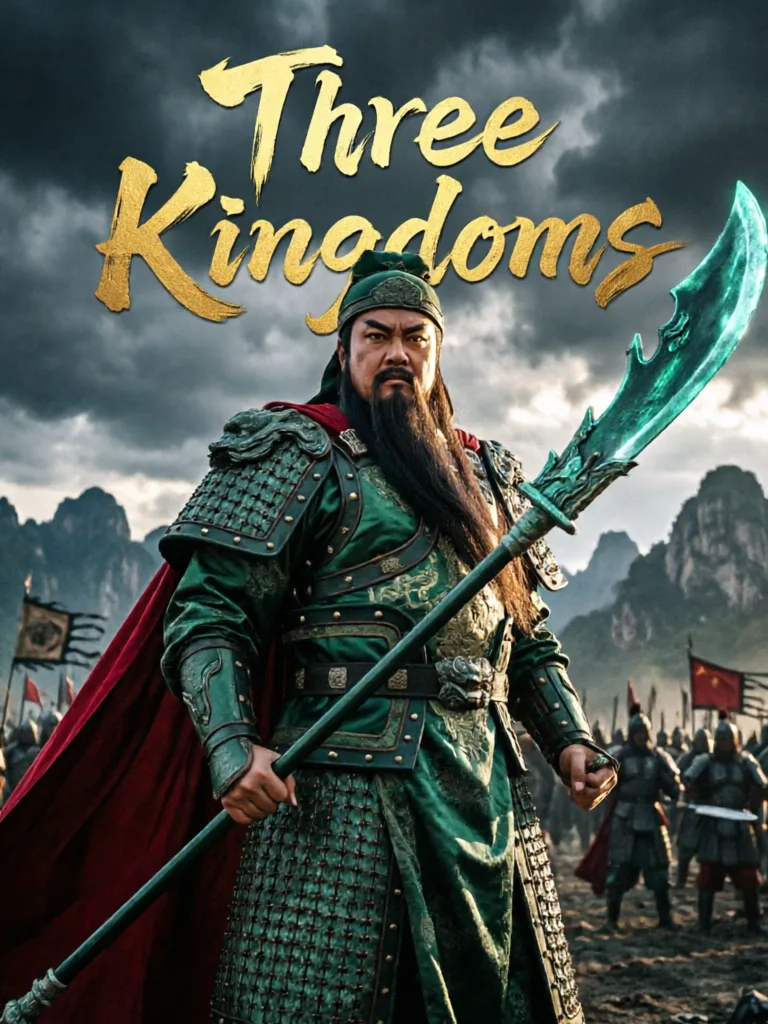
In the fourth month of the seventh year of the Jianxing reign of Shu-Han, in the summer, Kongming had stationed his army at Mount Qi, dividing his forces into three camps, waiting exclusively for the Wei army. Now, Sima Yi led his troops to Chang'an, where Zhang He met him and reported in detail on previous events. Yi ordered Zhang He to serve as vanguard commander, with Dai Ling as his deputy, leading 100,000 troops to Mount Qi, where they established a camp south of the Wei River. Guo Huai and Sun Li entered the camp to pay their respects. Yi asked them, "Have you engaged the Shu army in battle yet?" The two replied, "Not yet." Yi said, "The Shu army has come from a thousand li away; their advantage lies in a swift battle. Since they have arrived here without fighting, they must have a plan. Have there been any reports from the various districts west of Longxi?" Huai replied, "Our spies have reported that all the commanderies are on high alert, guarding day and night, and there is no trouble. Only the two commanderies of Wudu and Yinping have not yet reported back." Yi said, "I will personally send men to engage Kongming in battle. You two must hurry via a small path to rescue those two commanderies, and then fall upon the Shu army from behind—they will surely fall into chaos."
The two received their orders and led five thousand troops, taking a small path west of Longxi to rescue Wudu and Yinping, planning to strike the Shu army from the rear. On the road, Guo Huai said to Sun Li, "How does Zhongda compare to Kongming?" Li replied, "Kongming is far superior to Zhongda." Huai said, "Though Kongming may be superior, this plan alone shows that Zhongda possesses surpassing wisdom. If the Shu army is attacking both commanderies, and we fall upon them from behind, how could they not fall into chaos?" Just as they were speaking, a scout on horseback suddenly arrived with a report: "Yinping has already been taken by Wang Ping, and Wudu has already been taken by Jiang Wei. We are not far from the Shu army ahead." Li said, "If the Shu army has already captured the cities, why are they deploying their troops outside? There must be a trick. It would be better to retreat quickly." Guo Huai agreed. Just as they were giving the order for the army to withdraw, a cannon suddenly roared, and from behind a mountain ridge a force of cavalry emerged, their banner bearing the large characters: "Han Chancellor Zhuge Liang." In the center was a four-wheeled chariot, with Kongming seated upright upon it; to his left was Guan Xing, and to his right, Zhang Bao. When Sun and Guo saw this, they were greatly alarmed. Kongming laughed loudly and said, "Guo Huai and Sun Li, do not flee! How could Sima Yi's plan possibly deceive me? He has been sending men to engage me in front every day, while ordering you to attack my rear. I have already taken Wudu and Yinping. Why do you two not surrender early, and instead insist on driving your troops to a decisive battle with me?" When Guo Huai and Sun Li heard this, they were seized with panic. Suddenly, shouts and killing cries filled the sky behind them—Wang Ping and Jiang Wei were leading their troops in an attack from the rear. Generals Xing and Bao also led their forces in an assault from the front. Attacked from both sides, the Wei army was utterly routed. Guo and Sun abandoned their horses and fled into the mountains on foot. Zhang Bao saw them and spurred his horse in pursuit; but unexpectedly, horse and rider plunged into a ravine. The rear troops hastily rescued him, but his head was already broken. Kongming ordered him sent back to Chengdu to recover from his wounds.
Now, Guo and Sun, having escaped, returned to see Sima Yi and reported: "The two commanderies of Wudu and Yinping are lost. Kongming had set an ambush on the main road, attacking us from front and rear, so we suffered a great defeat. We abandoned our horses and fled on foot, and only thus managed to escape." Yi said, "This is not your fault; Kongming's wisdom surpasses mine. You may lead troops again to defend the cities of Yong and Mei, but do not engage in battle. I have my own plan to defeat the enemy." The two took their leave and departed. Yi then summoned Zhang He and Dai Ling and instructed them: "Now that Kongming has taken Wudu and Yinping, he will surely be pacifying the people to calm their hearts, and will not be in his camp. You two shall each lead ten thousand elite troops. Tonight, set out and circle around behind the Shu camp. Then, with one concerted effort, charge forward and attack. I will lead the main force and deploy in front, waiting for the Shu army to fall into disarray. Then I will drive my troops forward in a massive assault. With both armies working together, we can seize the Shu camp. If we can gain control of this mountainous terrain, what difficulty will there be in defeating the enemy?" The two received their orders and led their troops away.
Dai Ling was on the left, Zhang He on the right, each taking a small path forward, penetrating deep behind the Shu army. At the third watch, they reached the main road, where the two forces met and merged into one. They then attacked from behind the Shu camp. After advancing less than thirty li, the forward troops halted. Zhang and Dai themselves spurred their horses forward to see, and found hundreds of carts loaded with straw blocking the road. Zhang He said, "This means they are prepared. We must quickly find another way back." Just as they gave the order to retreat, suddenly flames blazed across the entire mountain, drums and horns shook the air, and ambush troops emerged from all sides, surrounding the two commanders. Kongming, from atop Mount Qi, shouted loudly: "Dai Ling and Zhang He, listen to my words: Sima Yi assumed that I had gone to Wudu and Yinping to pacify the people and was not in camp, so he ordered you to raid my camp. But you have fallen into my trap. You two are nameless, low-ranking generals; I will not kill you. Dismount and surrender at once!" Zhang He was enraged and, pointing at Kongming, cursed him: "You are nothing but a rustic country bumpkin, invading the borders of our great kingdom—how dare you speak such words! If I capture you, I will cut you into a thousand pieces!" With that, he spurred his horse, raised his spear, and charged up the mountain. But arrows and rocks rained down like a storm from above, and Zhang He could not ascend the mountain. He then wheeled his horse, brandished his spear, and burst out of the encirclement, with none daring to stand in his way. The Shu army trapped Dai Ling in the center of the siege. Zhang He cut his way back along his original path, but did not see Dai Ling. He then, with renewed ferocity, turned and charged back into the encirclement, rescued Dai Ling, and returned with him. Kongming, watching from the mountain, saw Zhang He charging back and forth amidst the myriad troops, displaying extraordinary bravery. He said to his attendants, "I have heard of Zhang Yide's great battle with Zhang He, and how all men feared him. Now that I have seen Zhang He with my own eyes, I realize his valor. If I allow this man to live, he will surely become a calamity for Shu. I must eliminate him." He then withdrew his troops and returned to camp.
Now, Sima Yi had deployed his troops in battle formation, waiting only for the Shu army to stir so he could attack them all at once. Suddenly, he saw Zhang He and Dai Ling approaching in a state of utter disarray. They reported: "Kongming had prepared for this in advance, and thus we suffered a great defeat and returned." Yi was greatly alarmed and said, "Kongming is truly a divine being! It would be better to retreat for now." He immediately ordered the entire army to return to their main camp and hold their positions without engaging. Now, Kongming had won a great victory, capturing an incalculable number of weapons, armor, and horses. He led the main army back to camp. Every day, he ordered Wei Yan to challenge the enemy to battle, but the Wei army did not respond. For half a month, there was no engagement between the two sides. Kongming was in his tent, deep in thought, when suddenly a report arrived that the Son of Heaven had sent the Imperial Attendant Fei Yi with an imperial edict. Kongming received him into the camp, burned incense, performed the rites, and opened the edict to read:
"The disaster at Jieting was the fault of Ma Su; yet you took the blame upon yourself and deeply demoted yourself. I respected your wishes and allowed you to keep your reduced rank. Last year, you displayed your might, cutting down Wang Shuang. This year, on your campaign, Guo Huai fled; you subdued the Di and Qiang tribes and restored two commanderies. Your might has shaken the violent, and your achievements are evident. Now, the realm is in turmoil, and the chief villain has not yet been executed. You bear a great responsibility, the weight of the state. Yet you have long diminished yourself—this is not the way to glorify our great cause. Therefore, I now restore you to the position of Chancellor. Do not refuse!"
After Kongming finished listening to the edict, he said to Fei Yi, "Our state's great enterprise is not yet accomplished; how can I accept the post of Chancellor again?" He firmly declined. Fei Yi said, "If the Chancellor does not accept the post, you will go against the Emperor's will and dampen the spirits of the soldiers and officers. It would be better to accept it temporarily." Only then did Kongming bow and accept. Fei Yi then took his leave and departed.
Kongming, seeing that Sima Yi would not come out, devised a plan. He ordered all units to break camp and move. Spies reported this to Sima Yi, saying that Kongming was retreating. Yi said, "Kongming must have a deep-laid scheme; we cannot act rashly." Zhang He said, "This must be because his supplies have run out and he is returning. Why not pursue him?" Yi replied, "I calculate that Kongming had a great harvest last year, and this year the wheat is ripe; his grain and fodder are abundant. Though transport is difficult, he could still sustain himself for half a year. Why would he be willing to leave so soon? Seeing that I have not engaged in battle for many days, he has devised this ruse to lure us. We should send men to scout from a distance." Scouts investigated and returned to report: "Kongming has set up camp thirty li from here." Yi said, "I knew Kongming would not really leave. We will hold our positions firmly and not advance rashly." After ten days passed, there was no news at all, and no Shu generals came to challenge them. Yi sent scouts again, who reported: "The Shu army has broken camp and moved." Yi did not believe it. He changed his clothes, mingled with the troops, and went to see for himself. He indeed saw that the Shu army had retreated another thirty li and set up camp. Yi returned to his camp and said to Zhang He, "This is one of Kongming's schemes; we cannot pursue." Another ten days passed, and he sent scouts once more. They reported: "The Shu army has retreated another thirty li and set up camp." Zhang He said, "Kongming is using a delaying tactic, gradually retreating toward Hanzhong. Why does the Commander-in-Chief hesitate and not pursue him early? I am willing to go and fight a decisive battle!" Yi said, "Kongming has an endless supply of cunning schemes. If there is any mishap, it will sap our army's morale. We cannot advance rashly." Zhang He said, "If I go and am defeated, I will gladly accept military punishment." Yi said, "Since you insist on going, we must divide our forces into two groups. You will lead one group forward, and you must fight with all your might. I will follow behind to support you and guard against ambushes. You will advance first tomorrow, halt halfway, and then engage in battle the day after, so that our troops will not be exhausted." With that, the forces were divided.
The next day, Zhang He and Dai Ling led several dozen deputy generals and thirty thousand elite troops, advancing with great ferocity. They halted halfway and set up camp. Sima Yi left many troops to guard the main camp and led only five thousand elite troops, following behind. Now, Kongming had secretly sent scouts to observe the Wei army, and they reported that the Wei forces had halted halfway. That night, Kongming summoned his generals for a council: "The Wei army is now coming in pursuit, and they will surely fight to the death. You must each fight as if you were ten men. I will set up ambushes to cut off their rear. This task requires a commander of both wisdom and courage." Having said this, he looked pointedly at Wei Yan. Wei Yan lowered his head and remained silent. Wang Ping stepped forward and said, "I am willing to take on this task." Kongming asked, "If something goes wrong, what then?" Wang Ping replied, "I will accept military punishment." Kongming sighed and said, "Wang Ping is willing to sacrifice himself and face arrows and stones—truly a loyal minister! However, the Wei army is coming in two groups, front and rear, and will cut off our ambush force in the middle. Even with your wisdom and courage, you can only handle one side; how can you be in two places at once? We need another general to go with you. But it is a pity that there is no one else in the army willing to risk death and lead the way!" Before he finished speaking, another general stepped forward and said, "I am willing to go!" Kongming looked at him—it was Zhang Yi. Kongming said, "Zhang He is a famous general of Wei, with valor unmatched by ten thousand men. You are no match for him." Zhang Yi said, "If I fail, I will offer my head at your tent." Kongming said, "Since you dare to go, you and Wang Ping shall each lead ten thousand elite troops and lie in ambush in the mountain valleys. Wait until the Wei army catches up, let them all pass, and then you lead your ambush troops to attack them from the rear. If Sima Yi follows behind, then divide your forces into two: Zhang Yi will lead one group to block the rear, and Wang Ping will lead the other to cut off the front. Both forces must fight to the death. I have another plan to assist you." The two received their orders and led their troops away.
Kongming then summoned Jiang Wei and Liao Hua and instructed them: "I am giving you two a silk pouch. Lead three thousand elite troops, lower your banners and silence your drums, and lie in ambush on the front mountain. If you see that Wang Ping and Zhang Yi are surrounded by the Wei army and in extreme danger, do not go to their rescue. Instead, open the pouch and read it; it will contain a plan to resolve the crisis." The two received their orders and led their troops away. He then called the four generals Wu Ban, Wu Yi, Ma Zhong, and Zhang Ni, and whispered in their ears: "Tomorrow, when the Wei army arrives, their morale will be at its peak. Do not meet them head-on. Fight and then retreat. When you see Guan Xing leading his troops to join the fray, then turn your forces around and pursue and attack. I will have troops to support you." The four generals received their orders and led their troops away. He then summoned Guan Xing and instructed him: "Lead five thousand elite troops and lie in ambush in the mountain valley. Wait until you see a red flag waving on the mountain, then lead your troops out to attack." Guan Xing received his orders and led his troops away.
Now, Zhang He and Dai Ling led their troops forward like a storm. The four generals Ma Zhong, Zhang Ni, Wu Yi, and Wu Ban met them and rode out to engage. Zhang He was furious and drove his troops in pursuit. The Shu army fought and retreated at the same time, and the Wei army pursued them for about twenty li. It was the sixth month, and the weather was extremely hot. Men and horses were drenched in sweat. After pursuing for over fifty li, the Wei troops were all gasping for breath. Kongming, on the mountain, waved a red banner, and Guan Xing led his troops out to attack. The four generals, Ma Zhong and the others, simultaneously turned their forces around and charged back. Zhang He and Dai Ling fought desperately and did not retreat. Suddenly, shouts shook the heavens, and two columns of troops emerged—Wang Ping and Zhang Yi. They each fought with great ferocity, cutting off the Wei army's retreat. Zhang He shouted to his generals, "Now that you are here, if you do not fight to the death, when will you?!" The Wei troops fought with all their might but could not break free. Suddenly, drums and horns thundered from behind, and Sima Yi himself led his elite troops to the attack. Yi directed his generals to surround Wang Ping and Zhang Yi in the center. Zhang Yi shouted loudly, "The Chancellor is truly a divine being! His calculations are already made, and he must have a good plan. We must fight to the death!" He then divided his forces into two: Wang Ping led one group to block Zhang He and Dai Ling, and Zhang Yi led the other to resist Sima Yi. Both sides fought to the death, with shouts and killing cries filling the sky.
Jiang Wei and Liao Hua watched from the mountain. Seeing that the Wei army was powerful and the Shu forces were in danger, gradually unable to hold their ground, Jiang Wei said to Liao Hua, "The situation is this critical—let us open the silk pouch and see the plan." The two tore it open and read. Inside, it said: "If Sima Yi's army surrounds Wang Ping and Zhang Yi in extreme danger, you two shall divide your forces into two groups and directly attack Sima Yi's camp. Yi will surely retreat in haste, and you can then attack him in the chaos. Even if you cannot take the camp, you will achieve a complete victory." The two were overjoyed. They immediately divided their forces into two and headed straight for Sima Yi's camp.
Now, Sima Yi had also feared falling into one of Kongming's traps, and had been sending messengers continuously along the road to report. As Yi was urging his troops on in battle, a galloping scout suddenly arrived with a flying report: "Two columns of Shu troops are heading straight for our main camp!" Sima Yi's face turned pale with shock. He said to his generals, "I knew Kongming had a plan, but you would not believe me. You insisted on pursuing, and now you have ruined a great matter!" He immediately turned his army and rushed back. The soldiers' hearts were thrown into panic, and they fled in disorder. Zhang Yi pursued and attacked from behind, and the Wei army suffered a great defeat. Zhang He and Dai Ling, seeing themselves isolated, also fled along remote mountain paths. The Shu army won a great victory. Behind them, Guan Xing led his troops to support the various units. Sima Yi, after suffering a great defeat, rushed back into his camp, only to find that the Shu army had already withdrawn. Yi gathered his defeated troops and berated his generals: "You do not understand the art of war! Relying only on hot-blooded courage, you insisted on going out to battle, leading to this defeat. From now on, you must not act rashly. If anyone disobeys again, they will be dealt with according to military law!" The generals, filled with shame, withdrew. In this battle, countless Wei soldiers died, and they abandoned an incalculable number of horses and weapons.
Now, Kongming led his victorious army back into camp and was about to advance again when a report arrived from Chengdu that Zhang Bao had died. When Kongming heard this, he burst into loud wailing, spat blood from his mouth, and fell unconscious to the ground. The men revived him. From then on, Kongming fell ill and took to his bed, unable to manage affairs. All the generals were deeply moved.
A poet of the time lamented: The fierce and brave Zhang Bao sought to establish his merit, but it was a pity that Heaven did not aid this hero! The Marquis of Wu shed his tears into the west wind, grieving that there was no one left to assist him in his tireless efforts.
After ten days, Kongming summoned Dong Jue and Fan Jian into his tent and instructed them: "I feel dizzy and drowsy, and cannot manage affairs. It would be better to return to Hanzhong to recover from my illness and then make further plans. You must not let this leak out. If Sima Yi learns of it, he will surely come to attack." He then issued orders to break camp secretly that night and return to Hanzhong. Kongming had been gone for five days before Sima Yi learned of it. He let out a long sigh and said, "Kongming truly possesses supernatural strategies for appearing and disappearing—I cannot match him!" So Sima Yi left his generals in the camp, divided his troops to guard the various passes, and then led his main army back in triumph.
Now, Kongming stationed his main army in Hanzhong and returned to Chengdu to recover from his illness. The civil and military officials came out of the city to welcome him and escorted him to the Chancellor's residence. The Later Emperor himself came to inquire about his illness and ordered the imperial physicians to treat him. Kongming gradually recovered.
In the autumn of the eighth year of the Jianxing reign, in the seventh month, the Wei Commander-in-Chief Cao Zhen recovered from his illness and submitted a memorial: "The Shu army has repeatedly invaded our borders and encroached upon the Central Plains. If we do not eradicate them, they will surely become a future calamity. Now that autumn has arrived and the weather is cool, both men and horses are at ease—this is the perfect time for an expedition. I am willing to lead a great army together with Sima Yi, march directly into Hanzhong, and annihilate the treacherous faction to clear the border." The Wei Emperor was overjoyed and asked the Imperial Attendant Liu Ye, "Zidan advises me to attack Shu—what do you think?" Liu Ye replied, "The Grand General's words are correct. If we do not eradicate them now, they will surely become a great threat in the future. Your Majesty should proceed." Emperor Rui nodded. Liu Ye left the court and returned home. Many high officials came to visit him and asked, "We heard that the Son of Heaven discussed with you the matter of raising an army to attack Shu. What about this?" Liu Ye replied, "There is no such thing. Shu has the natural defenses of its mountains and rivers; it is not an easy target. To waste the labor of our troops and horses would be of no benefit to the state." All the officials left in silence. Yang Ji entered the court and reported to the Emperor: "Yesterday, I heard Liu Ye urging Your Majesty to attack Shu. Today, when speaking with the other officials, he said it should not be done. This is to deceive Your Majesty. Why does Your Majesty not summon him and question him?" Emperor Rui immediately summoned Liu Ye into the court and asked him, "You urged me to attack Shu. Now you say it cannot be done—why is that?" Liu Ye replied, "I have thought it over carefully; Shu cannot be attacked." Emperor Rui laughed heartily. A short while later, Yang Ji left the court. Liu Ye then memorialized: "Yesterday, I urged Your Majesty to attack Shu—this is a great matter of state. How could I carelessly reveal it to others? Warfare is the art of deception. Before a plan is set in motion, it must be kept secret." Emperor Rui was greatly enlightened and said, "Your words are correct." From then on, he held Liu Ye in even higher regard.
Within ten days, Sima Yi entered the court. The Wei Emperor told him in detail about Cao Zhen's memorial. Sima Yi memorialized: "I calculate that the Eastern Wu will not dare to move their troops. Now is precisely the time to take advantage and attack Shu." Emperor Rui immediately appointed Cao Zhen as Grand Marshal and Supreme Commander of the Western Expedition, Sima Yi as Grand General and Deputy Commander of the Western Expedition, and Liu Ye as Army Advisor. The three took their leave of the Wei Emperor, led a force of 400,000 troops, and marched to Chang'an. From there, they headed straight for the Sword Gate Pass, aiming to take Hanzhong. The other generals, Guo Huai and Sun Li, each took their own routes. A report from Hanzhong reached Chengdu.
By this time, Kongming had recovered from his illness for some time. He trained his troops daily, drilling them in the Eightfold Formation method until they were all highly proficient, intending to take the Central Plains. When he heard this news, he summoned Zhang Ni and Wang Ping and instructed them: "You two shall lead a thousand troops first to guard the ancient road at Chencang, to hold back the Wei army. I will then lead the main army to support you." The two replied, "We have been told that the Wei army is 400,000 strong, though they claim to be 800,000, and their momentum is immense. How can you send only a thousand troops to guard such a strategic pass? If the great Wei army arrives, how will we resist them?" Kongming said, "I would give you more, but I fear the soldiers would suffer hardship." Zhang Ni and Wang Ping exchanged glances, neither daring to go. Kongming said, "If there is any mishap, it will not be your fault. Do not argue further—go at once." The two pleaded again, "If the Chancellor wishes to kill us two, then do it here and now, for we dare not go." Kongming laughed and said, "How foolish you are! I am ordering you to go because I have my own reasoning. Last night, I observed the heavens and saw that the Bi constellation was converging on the region of the Great Yin. This month, there will surely be heavy rain. Though the Wei army is 400,000 strong, how would they dare to venture deep into such treacherous mountain terrain? Therefore, I do not need many troops, and you will certainly not come to harm. I will keep the main army comfortably in Hanzhong for a month. When the Wei army retreats, I will then strike them with overwhelming force. Meeting the enemy at our leisure after they have been fatigued, my 100,000 troops can defeat the Wei army of 400,000." When the two heard this, they were overjoyed. They bowed and took their leave.
Kongming then led the main army out of Hanzhong and issued orders for all the passes to prepare dry firewood, fodder, and fine grain, enough to supply both men and horses for a month, to guard against the autumn rains. He gave the main army a month's grace, first providing them with clothing and food, and then waiting for the order to march.
Now, Cao Zhen and Sima Yi led the great army directly to the city of Chencang, where they found not a single house standing. They sought out local people and questioned them, and were told that Kongming had set fire to the city when he retreated. Cao Zhen wanted to advance through the Chencang route. Sima Yi said, "We cannot advance rashly. Last night, I observed the heavens and saw that the Bi constellation was converging on the region of the Great Yin. This month, there will surely be heavy rain. If we penetrate deep into this dangerous territory, success will depend on constant victory. If there is any mishap, both men and horses will suffer, and retreat will be difficult. It would be better to set up shelters within the city and camp there to guard against the rain." Cao Zhen agreed with him. Before half a month had passed, the rain began to fall heavily, coming down without cease. Outside the city of Chencang, the water on level ground was three feet deep. All the weapons were soaked, the men could not sleep, and they were restless day and night. The heavy rain continued for thirty days. The horses had no fodder, and countless numbers died. The soldiers' complaints were endless. News of this reached Luoyang. The Wei Emperor set up an altar and prayed for clear weather, but to no avail. The Imperial Attendant of the Yellow Gate, Wang Su, submitted a memorial:
"Ancient records say: 'If grain is transported over a thousand li, the soldiers will show signs of hunger; if firewood is gathered only after the army has stopped, the troops will never have a full belly.' This refers to armies marching on level ground. How much more so when they penetrate deep into dangerous and treacherous terrain, cutting roads as they go? In that case, their hardship will be a hundred times greater. Now, with the added burden of incessant rain, the mountain slopes are steep and slippery. The troops are crowded together and cannot deploy; the grain is far away and difficult to transport. These are the greatest taboos in military operations. I have heard that Cao Zhen set out over a month ago, but his army has only advanced halfway through the valley. The work of building roads is immense, and all the soldiers are engaged in it. This means that the enemy can meet us at their leisure after we have been fatigued—a thing dreaded by all military strategists. Looking to ancient times, King Wu of Zhou attacked the Shang, but turned back after leaving the pass. Looking at recent events, Emperors Wu and Wen campaigned against Sun Quan but turned back at the riverbank. Were these not examples of following Heaven's will, knowing the season, and understanding the need for flexibility? I beg Your Majesty to consider the difficulties caused by the rain and give the soldiers a rest. Later, when an opportunity arises, you can take advantage of it. This is what is meant by 'making the people joyful, and they will forget death in facing danger.'"
The Wei Emperor was still hesitant after reading the memorial when Yang Fu and Hua Xin also submitted memorials of remonstrance. The Wei Emperor then issued an edict, sending an envoy to summon Cao Zhen and Sima Yi back to court.
Now, Cao Zhen and Sima Yi discussed the situation. Cao Zhen said, "It has been raining continuously for thirty days. The army has no will to fight, and everyone is thinking of returning home. How can we stop them?" Sima Yi said, "It would be better to retreat for now." Cao Zhen asked, "If Kongming pursues us, how will we drive him back?" Sima Yi replied, "We will first station two forces to cover the rear, and then we can retreat." As they were discussing, the imperial envoy arrived with the summons. The two generals then turned the vanguard into the rearguard and the rearguard into the vanguard, and slowly began their withdrawal.
Now, Kongming calculated that the month of autumn rain was nearly over, but the sky had still not cleared. He himself led a force and camped at Chenggu, and also ordered the main army to assemble and camp at Chipo. Kongming ascended his tent and summoned his generals, saying, "I calculate that the Wei army will surely retreat, and that the Wei Emperor will certainly issue an edict recalling Cao Zhen and Sima Yi's army. If I pursue them, they will surely be prepared. It would be better to let them go for now and make further plans." Suddenly, a messenger from Wang Ping arrived, reporting that the Wei army had already retreated. Kongming instructed the messenger to tell Wang Ping: "Do not pursue them. I have my own plan to defeat the Wei army." And so it was that:
Though the Wei army might set ambushes, the Han Chancellor would not give chase.
What plan Kongming would devise to defeat Wei, let the next chapter reveal.