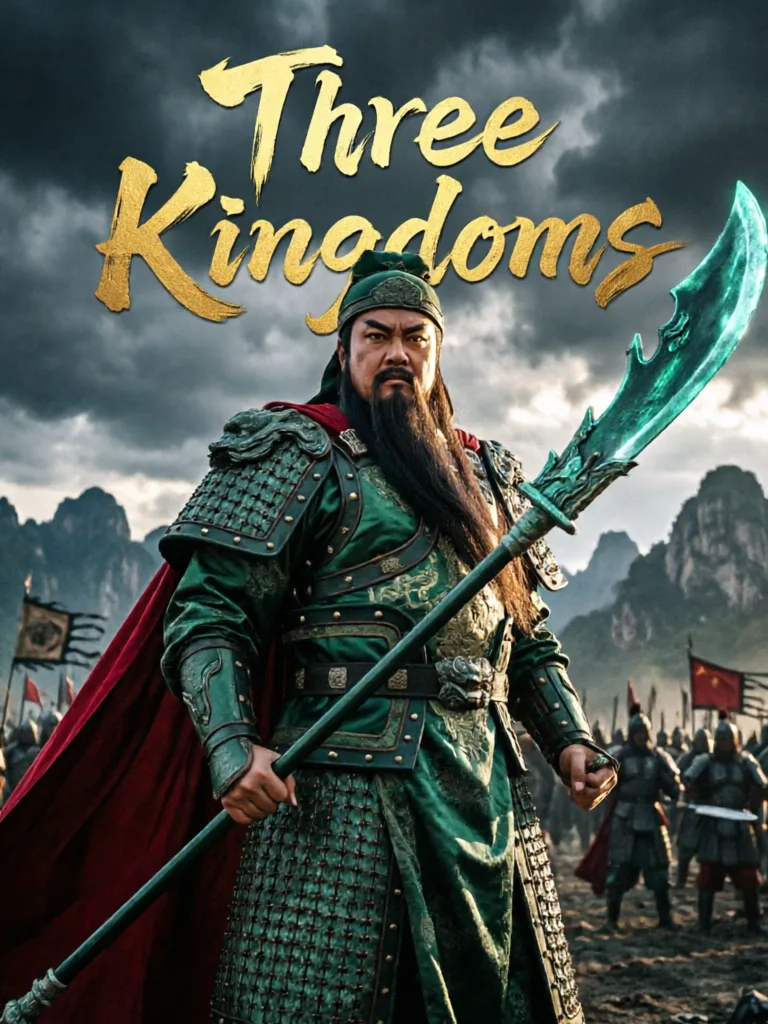
In the autumn of the sixteenth year of the Yanxi era of Shu Han, General Jiang Wei raised an army of 200,000 men. He appointed Liao Hua and Zhang Yi as his left and right vanguard commanders, Xiahou Ba as his strategist, and Zhang Ni as his supply officer. The great army marched out of Yangping Pass to invade Wei. Jiang Wei consulted with Xiahou Ba, saying, "In our previous campaign against Yong Province, we failed and returned. If we march out again now, the enemy will surely be prepared. What strategy does my lord suggest?" Xiahou Ba replied, "Among the commanderies in the Longyou region, only Nanan has the most abundant wealth and grain. If we capture it first, it will serve as a solid base. Our previous failure was due to the Qiang tribes not arriving in time. Now, we should first send an envoy to meet with the Qiang in the Longyou region, and only then advance our army through Shiying, heading straight for Nanan via Dongting." Jiang Wei was overjoyed. "Your plan is excellent!" He then dispatched Xi Zheng as an envoy, carrying gold, pearls, and Shu brocade to the Qiang tribes, to secure an alliance with the Qiang king. The Qiang king, Mi Dang, accepted the gifts and raised an army of 50,000 men, appointing the Qiang general E He Shao Ge as his great vanguard, leading the troops toward Nanan.
When Wei’s Left General Guo Huai received the report, he swiftly sent a mounted messenger to Luoyang. Sima Shi asked his generals, "Who dares to face the Shu army?" The Defender General Xu Zhi stepped forward. "I am willing to go." Sima Shi had long known of Xu Zhi’s extraordinary bravery and was overjoyed. He immediately appointed Xu Zhi as vanguard commander and Sima Zhao as Commander-in-Chief, leading the army toward Longxi. The Wei forces arrived at Dongting and encountered Jiang Wei’s army. The two armies drew up in battle formation. Xu Zhi, wielding a great axe, rode out to challenge the enemy. From the Shu ranks, Liao Hua rode forth to meet him. After only a few exchanges, Liao Hua feigned defeat and withdrew, dragging his blade. Zhang Yi then charged forward, his spear leveled, but after a few more clashes, he too retreated back into the formation. Xu Zhi drove his troops forward in a fierce assault, and the Shu army was badly routed, retreating over thirty li. Sima Zhao also recalled his troops, and both sides made camp.
Jiang Wei conferred with Xiahou Ba. "Xu Zhi is a formidable warrior. What plan can we use to capture him?" Xiahou Ba said, "Tomorrow, we feign defeat and use an ambush to overcome him." Jiang Wei replied, "Sima Zhao is the son of Sima Yi—how could he be ignorant of military tactics? If he sees the terrain is favorable for concealment, he will surely not pursue. I have noticed that the Wei forces repeatedly cut off our supply lines. This time, we will use that very tactic to lure him in, and we can slay Xu Zhi." He then summoned Liao Hua and gave him specific instructions, and did the same with Zhang Yi. The two officers departed with their troops. Meanwhile, Jiang Wei ordered his soldiers to scatter iron caltrops on the roads and to place many abatis outside the camp, giving the appearance of a prolonged siege.
For several days, Xu Zhi led his troops to challenge the Shu army, but they refused to come out. Scouts reported to Sima Zhao, "The Shu army is behind Iron Cage Mountain, using wooden oxen and flowing horses to transport grain and fodder, preparing for a long campaign. They are only waiting for the Qiang reinforcements." Sima Zhao summoned Xu Zhi and said, "In the past, we defeated Shu precisely by cutting off their supply lines. Now the Shu army is moving supplies behind Iron Cage Mountain. Tonight, you will lead five thousand men to cut off their grain route, and the Shu army will naturally retreat." Xu Zhi accepted the order. At the first watch of the night, he led his troops toward Iron Cage Mountain. There, he indeed saw over two hundred Shu soldiers driving more than a hundred wooden oxen and flowing horses, loaded with grain. With a great shout, the Wei troops attacked, and Xu Zhi blocked their path. The Shu soldiers abandoned their grain and fled. Xu Zhi divided his force: half to escort the captured grain back to camp, while he led the other half in pursuit. After chasing for less than ten li, they found their path blocked by carts and wagons. Xu Zhi ordered his men to dismount and clear the way, but suddenly fires erupted on both sides. Xu Zhi frantically reined his horse and turned back, only to find the narrow mountain path behind them also blocked by burning wagons, flames leaping high. Xu Zhi and his men charged through the smoke and fire, forcing their horses out. Then, with the thunderous blast of a signal cannon, two columns of troops attacked: Liao Hua from the left and Zhang Yi from the right. A great slaughter ensued, and the Wei army was utterly defeated.
Xu Zhi fought desperately and fled alone, his horse exhausted and himself weary. As he fled, another force blocked his path—Jiang Wei himself. Xu Zhi was struck with terror and could not react. Jiang Wei thrust his spear, striking Xu Zhi’s horse, which collapsed. Xu Zhi was thrown to the ground, and the surrounding soldiers cut him down with their swords. The half of Xu Zhi’s force that had been escorting the grain was also captured by Xiahou Ba, and they all surrendered. Xiahou Ba took the armor and horses of the Wei soldiers, had the Shu troops put them on, and mounted them. Flying the Wei army’s banners, they took a small path and raced back to the Wei camp. The Wei soldiers, seeing their own troops returning, opened the gates to let them in. Once inside, the Shu soldiers began to attack from within the camp. Sima Zhao was thrown into panic. He hurriedly mounted his horse to flee, but Liao Hua blocked his path ahead. Unable to advance, he turned back, only to find Jiang Wei charging in from a small path. With no escape route left, Sima Zhao was forced to lead his troops up Iron Cage Mountain to make a stand. The mountain had only one path up, and the terrain was steep and treacherous on all sides. At the summit, there was but a single spring, which could only provide water for a hundred men. Sima Zhao now had six thousand men under his command. Jiang Wei sealed off the path, and the water from the spring was insufficient. Men and horses alike suffered from thirst. Sima Zhao looked up to the heavens and sighed deeply, "I am going to die here!"
A poet of the time lamented: Jiang Wei’s brilliant calculations were no ordinary feat, trapping the Wei commander within Iron Cage’s seat. Like Pang Juan entering the Maling defile, or Xiang Yu encircled at Jiuli Mountain’s mile.
The chief clerk, Wang Tao, said, "In the past, when Geng Gong was besieged, he prayed at a well and sweet water gushed forth. Why does the general not follow his example?" Sima Zhao heeded his advice. He went to the summit, to the edge of the spring, and bowed twice, praying, "I, Sima Zhao, have been sent by imperial decree to repel the Shu army. If it is my fate to die, let this sweet spring dry up, and I will cut my own throat and order my troops to surrender. But if my fortune and lifespan are not yet ended, may Heaven grant us sweet water to save our lives!" As he finished his prayer, water surged forth from the spring, inexhaustible. Thus, men and horses were saved from death.
Down below, Jiang Wei had the Wei army surrounded. He said to his officers, "In the past, the Chancellor trapped Sima Yi at Shangfang Valley but failed to capture him—a source of deep regret for me. Now, Sima Zhao will surely be taken by my hand."
Meanwhile, Guo Huai, having learned of Sima Zhao’s predicament on Iron Cage Mountain, prepared to lead his troops to the rescue. Chen Tai said, "Jiang Wei has allied with the Qiang and intends to capture Nanan first. The Qiang army has already arrived. If you withdraw to rescue Sima Zhao, the Qiang will surely seize the opportunity to attack our rear. We should first send someone to feign surrender to the Qiang and create discord within their ranks. Once we have dealt with them, we can then relieve the siege of Iron Cage Mountain." Guo Huai agreed. He ordered Chen Tai to lead five thousand men directly to the Qiang king’s camp. Chen Tai disarmed himself and entered, weeping and bowing before the Qiang king, Mi Dang. "Guo Huai is arrogant and self-important, and he has always wanted to kill me. That is why I have come to surrender. I know all the secrets of Guo Huai’s army. Tonight, let me lead a force to raid his camp, and I will succeed. When we attack the Wei camp, there will be an inside response." Mi Dang was overjoyed and ordered E He Shao Ge to accompany Chen Tai in the raid. E He Shao Ge instructed Chen Tai to have his surrendered troops bring up the rear, while Chen Tai himself led the Qiang troops as the vanguard. At the second watch that night, they arrived at the Wei camp. The camp gates were wide open. Chen Tai rode in first. As E He Shao Ge spurred his horse and charged into the camp, spear at the ready, he only had time to cry out in despair before he and his horse fell into a concealed pit. Chen Tai’s troops attacked from behind, and Guo Huai’s forces charged from the left. The Qiang army fell into chaos, trampling each other. Countless were killed, and the survivors all surrendered. E He Shao Ge cut his own throat and died. Guo Huai and Chen Tai led their men straight to the Qiang camp. King Mi Dang, rushing out of his tent to mount his horse, was captured alive by the Wei soldiers and brought before Guo Huai. Guo Huai hastily dismounted, personally untied the king’s bonds, and comforted him with kind words. "The court has always regarded you as a loyal and righteous man. Why have you now chosen to aid the men of Shu?" Ashamed, Mi Dang confessed his fault. Guo Huai then persuaded him, "Now, you will lead the vanguard to lift the siege of Iron Cage Mountain and drive back the Shu army. I will memorialize the Son of Heaven on your behalf, and you will be richly rewarded."
Mi Dang agreed. He led the Qiang troops in front, with the Wei army following behind, and they marched straight for Iron Cage Mountain. It was the third watch. Mi Dang first sent a man to report to Jiang Wei. Jiang Wei was delighted and ordered the king to be brought in for an audience. Most of the Wei soldiers were mingled among the Qiang ranks. When they reached the Shu camp, Jiang Wei ordered the main army to encamp outside while Mi Dang led over a hundred men to the central command tent. Jiang Wei and Xiahou Ba came out to greet them. Before Mi Dang could speak, the Wei generals hidden among his escort attacked from behind. Jiang Wei was stunned. He hurriedly mounted his horse and fled. The Qiang and Wei troops charged in together. The Shu army was scattered in all directions, each man fleeing for his life. Jiang Wei was unarmed, with only a bow and a quiver of arrows at his waist. In his panicked flight, all his arrows fell out, leaving only an empty quiver. He fled into the mountains, with Guo Huai in hot pursuit. Seeing Jiang Wei weaponless, Guo Huai spurred his horse and charged, spear leveled. As Guo Huai drew near, Jiang Wei drew his empty bowstring and snapped it repeatedly. Guo Huai dodged several times, but no arrows came. Realizing Jiang Wei had no arrows, Guo Huai hung his spear on his saddle, nocked an arrow, and shot. Jiang Wei quickly dodged, caught the arrow in mid-air, and nocked it onto his own bowstring. As Guo Huai closed in, Jiang Wei aimed at his face and shot with all his might. Guo Huai fell from his horse, the arrow striking true. Jiang Wei wheeled his horse around to finish Guo Huai, but the Wei troops rushed forward. Jiang Wei had no time to strike; he could only snatch Guo Huai’s spear and flee. The Wei soldiers dared not pursue further. They hastily carried Guo Huai back to camp, pulled out the arrow, but he bled profusely and died. Sima Zhao descended the mountain to pursue, but turned back halfway. Xiahou Ba soon arrived, fleeing alongside Jiang Wei. Jiang Wei had lost many men and could not rally them. He retreated back to Hanzhong. Though he had suffered defeat, he had killed Guo Huai with an arrow and slain Xu Zhi, dealing a blow to Wei’s prestige, which somewhat compensated for his loss.
Meanwhile, Sima Zhao rewarded the Qiang troops and sent them back to their own lands. He then led his army in triumph back to Luoyang, where he and his elder brother Sima Shi dominated the court, and no official dared to oppose them. Whenever Wei Emperor Cao Fang saw Sima Shi enter the court, he trembled uncontrollably, as if needles were pricking his back. One day, Cao Fang was holding court when he saw Sima Shi ascend the hall with his sword. The emperor hastily descended from his throne to greet him. Sima Shi laughed. "Is it proper for a ruler to greet his minister? Please, Your Majesty, be at ease." Soon, the ministers began to present matters of state. Sima Shi made all the decisions himself, not even informing the Wei emperor. When the court adjourned, Sima Shi strode out proudly, boarded his carriage, and left the palace, surrounded by an escort of thousands of men.
Cao Fang retreated to the rear hall. He looked around and saw only three men with him: Xiahou Xuan, the Grand Master of Ceremonies; Li Feng, the Prefect of the Palace Secretariat; and Zhang Ji, the Grand Master of the Palace, who was also the father of Empress Zhang and the emperor’s father-in-law. Cao Fang dismissed the attendants and went with the three men to a private chamber to discuss the matter. Cao Fang took Zhang Ji’s hand and wept. "Sima Shi treats me like a child and regards the ministers as nothing but weeds. The state will soon fall into his hands!" He wept bitterly. Li Feng spoke up, "Your Majesty, do not worry. Though I am unworthy, I am willing to take Your Majesty’s clear decree, gather the heroes of the realm, and exterminate this traitor." Xiahou Xuan added, "My uncle, Xiahou Ba, defected to Shu only because he feared the Sima brothers’ machinations. If we eliminate this villain now, my uncle will surely return. I am a relative of the imperial house—how could I stand idly by while a treacherous minister throws the state into chaos? I am willing to join in obeying the imperial decree to punish him." Cao Fang said, "I fear it cannot be done." The three men wept and replied, "We swear to unite our hearts and destroy the traitor to repay Your Majesty!" Cao Fang took off his dragon-and-phoenix undershirt, bit his finger, and wrote a blood oath on it. He handed it to Zhang Ji, admonishing him, "My ancestor, the Martial Emperor, executed Dong Cheng precisely because their plans were not kept secret. You must be careful and not let this leak out." Li Feng said, "Why does Your Majesty speak such inauspicious words? We are not like Dong Cheng and his ilk. How can Sima Shi be compared to the Martial Emperor? Your Majesty, do not doubt us."
The three men took their leave. As they reached the eastern side of the East Prosperity Gate, they saw Sima Shi approaching, his sword at his side, accompanied by hundreds of armed attendants. The three men stood by the roadside. Sima Shi asked, "Why are you three so late leaving court?" Li Feng replied, "The emperor was reading in the inner palace, and we three were serving as his readers." Sima Shi asked, "What book was he reading?" Li Feng said, "A book on the Xia, Shang, and Zhou dynasties." Sima Shi pressed, "And what stories did the emperor ask about upon seeing this book?" Li Feng answered, "The Son of Heaven asked about Yi Yin assisting the Shang and the Duke of Zhou acting as regent. We all replied, 'The Grand General Sima is the Yi Yin and the Duke of Zhou of our time.'" Sima Shi sneered coldly. "You compare me to Yi Yin and the Duke of Zhou? In your hearts, you truly compare me to Wang Mang and Dong Zhuo!" The three men protested, "We are all men under your command, General. How would we dare to do such a thing?" Sima Shi roared in anger, "You are nothing but flatterers! Just now, what were you weeping about with the emperor in the private chamber?" The three men said, "There was no such thing." Sima Shi shouted, "Your eyes are still red from crying! How can you deny it?" Xiahou Xuan knew the secret was out. He cursed loudly, "We wept because you overawe the ruler and plot treason!"
Enraged, Sima Shi ordered his guards to seize Xiahou Xuan. Xiahou Xuan rolled up his sleeves and charged at Sima Shi, but the guards caught him. Sima Shi had all three men searched. On Zhang Ji’s person, they found the dragon-and-phoenix undershirt, stained with blood writing. The guards presented it to Sima Shi. He looked at it—it was a secret imperial edict. It read: "Sima Shi and his brother together hold great power and plot to usurp the throne. All the decrees they issue are not my will. Let all officers, soldiers, and generals join in righteous loyalty to punish and destroy these traitorous ministers and restore the state. When the task is accomplished, generous rewards and titles will be given."
After reading it, Sima Shi flew into a violent rage. "So you were plotting to murder us brothers! This is unforgivable!" He ordered the three men to be executed by waist-cutting in the marketplace and their families to be exterminated. The three men cursed without cease. When they were brought to the eastern market, their teeth were all knocked out, and they continued to curse, though their words were garbled, until they died.
Sima Shi went straight into the inner palace. Emperor Cao Fang was discussing the matter with Empress Zhang. The empress said, "There are many eyes and ears in the inner palace. If this leaks out, it will surely implicate me!" Just as she spoke, Sima Shi entered, and the empress was terrified. Sima Shi, hand on his sword, said to Cao Fang, "My father placed Your Majesty on the throne—his merit and virtue are no less than the Duke of Zhou’s. My service to Your Majesty is no different from Yi Yin’s. Yet you repay kindness with enmity and treat merit as fault, plotting with a few petty officials to murder us brothers. Why?" Cao Fang said, "I had no such intention." Sima Shi took the undershirt from his sleeve and threw it to the ground. "Who made this, then?" Cao Fang’s soul fled to the heavens and scattered beyond the clouds. Trembling, he replied, "I was forced into this by others. How would I dare to conceive such a thought?" Sima Shi said, "To falsely accuse a high minister of rebellion—what punishment does that deserve?" Cao Fang knelt and pleaded, "I am guilty. I beg the Grand General to forgive me!" Sima Shi said, "Your Majesty, please rise. But the law of the state cannot be set aside." He then pointed at Empress Zhang. "She is Zhang Ji’s daughter. She must be executed!" Cao Fang wept and begged for mercy, but Sima Shi would not listen. He ordered his guards to drag the empress out. At the East Prosperity Gate, she was strangled with a white silk cord.
A poet of the time lamented: In years past, Empress Fu was led from the palace gate, Barefoot and wailing, bidding her lord a bitter fate. Today, Sima Shi follows that same cruel decree, Heaven’s retribution visits his own progeny.
The next day, Sima Shi convened a great assembly of officials. "The present ruler is dissolute and unprincipled. He debases himself with actors and prostitutes, listens to slander, and blocks the path of the worthy. His crimes exceed those of Emperor Changyi of Han. He cannot rule the realm. I shall follow the precedent of Yi Yin and Huo Guang, install a new ruler to preserve the state and bring peace to all under Heaven. What say you?" The assembly responded in unison, "The Grand General is carrying out the work of Yi and Huo—this is to follow Heaven’s will and accord with the hearts of men. Who would dare to disobey?" Sima Shi then led the officials to the Eternal Peace Palace to inform the Empress Dowager. The Empress Dowager asked, "Whom does the Grand General wish to install as ruler?" Sima Shi replied, "I observe that the Prince of Pengcheng, Cao Ju, is intelligent, benevolent, and filial. He is worthy of being lord of the realm." The Empress Dowager said, "The Prince of Pengcheng is my uncle. If he is installed as ruler, what place would I have? There is the Duke of Gaogui Village, Cao Mao, the grandson of Emperor Wen. He is gentle, respectful, and modest. He can be installed. You ministers should deliberate carefully." One man stepped forward and said, "The Empress Dowager’s words are correct. He should be installed." Everyone looked—it was Sima Fu, a clansman of Sima Shi. Sima Shi then sent an envoy to Yuancheng to summon the Duke of Gaogui Village. He invited the Empress Dowager to ascend the Grand Ultimate Hall, summoned Cao Fang, and rebuked him: "You are dissolute beyond measure, debasing yourself with actors and prostitutes. You are unfit to inherit the realm. Surrender the imperial seal and resume the title of Prince of Qi. You will depart immediately. Without a summons, you are not to enter the court." Cao Fang wept and bowed to the Empress Dowager, handed over the state seal, mounted the prince’s carriage, and departed, weeping bitterly. Only a few loyal ministers saw him off with tears in their eyes.
A poet of the time lamented: In days of old, Cao Cao played the minister’s part, Bullying widows and orphans with a treacherous heart. Who could know, forty years later, the wheel would turn, And widows and orphans would suffer the same concern?
The Duke of Gaogui Village, Cao Mao, styled Yanshi, was the grandson of Emperor Wen and the son of Ding, Prince of Donghai. On that day, Sima Shi, acting on the Empress Dowager’s command, summoned him. The civil and military officials prepared the imperial carriage and greeted him outside the West Side Gate. Cao Mao hurriedly returned their bows. The Grand Commandant, Wang Su, said, "The new ruler should not return the bow." Cao Mao replied, "I am also a subject. How can I not return the bow?" The officials helped Cao Mao into the carriage to enter the palace. Cao Mao declined, "I do not know what the Empress Dowager’s command is. How dare I enter by carriage?" So he walked on foot to the Eastern Hall of the Grand Ultimate Palace. Sima Shi greeted him. Cao Mao bowed first, and Sima Shi hastily helped him up. After the formal greetings, he was led to meet the Empress Dowager. She said, "I saw when you were young that you had the physiognomy of an emperor. Now you can be the lord of the realm. You must be frugal and moderate, spread virtue and benevolence, and not disgrace the former emperors." Cao Mao declined repeatedly. Sima Shi ordered the officials to escort Cao Mao out of the Grand Ultimate Hall. That day, he was installed as the new emperor. The reign title was changed from the sixth year of the Jiaping era to the first year of the Zhengyuan era. A general amnesty was declared for the realm. The Grand General Sima Shi was granted the golden axe of authority, the right to enter the court without hurrying, to have his memorials presented without using his personal name, and to enter the hall wearing his sword. All civil and military officials received promotions and rewards.
In the spring of the first month of the second year of the Zhengyuan era, a scout flew in with a report: Guanqiu Jian, General of the Eastern Front, and Wen Qin, the Inspector of Yang Province, had raised an army in the name of opposing the deposition of the emperor. Sima Shi was greatly alarmed. Truly: Where Han officials once harbored the will to rescue the throne, Wei generals now rose with a righteous army of their own.
How they would meet this challenge, let the next chapter unfold.