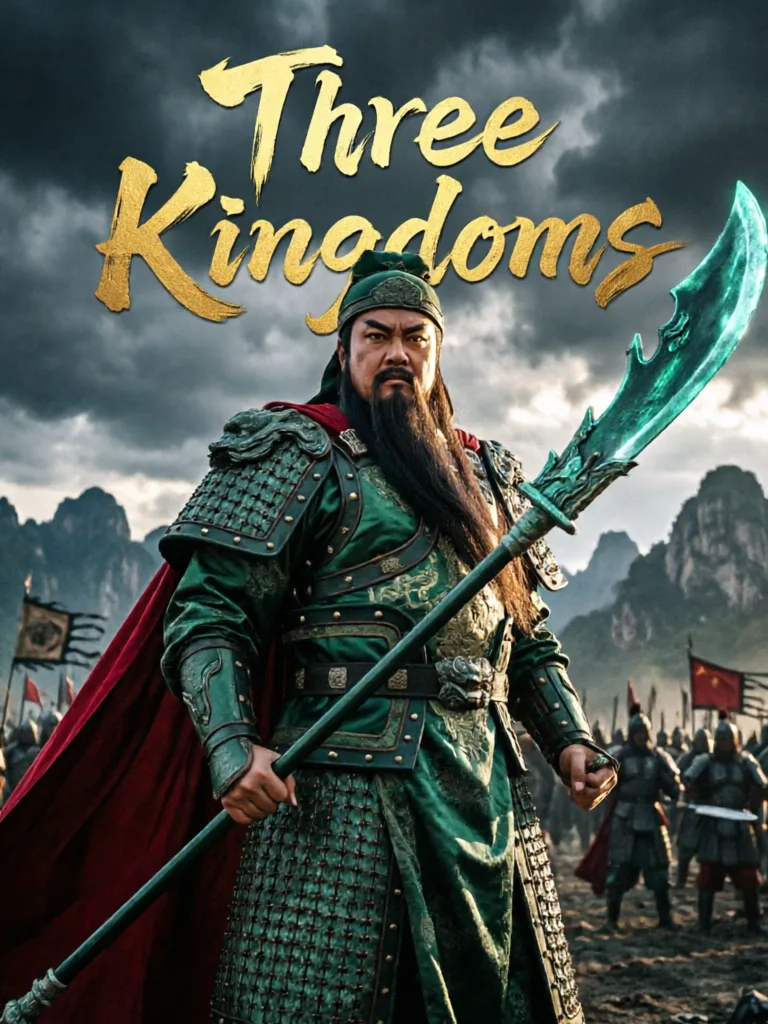
When Han Dang and Zhou Tai discovered that the former emperor, Liu Bei, had moved his camps closer to the cool streams, they rushed to report this to Lu Xun. Lu Xun was overjoyed and immediately led his troops to observe the situation firsthand. He saw a single camp on the flat ground, with no more than ten thousand men, most of them elderly and weak, flying a banner that read "Vanguard Wu Ban." Zhou Tai said, "I see these troops as mere child's play. I wish to join General Han in a two-pronged attack. If I fail, I will accept military punishment." Lu Xun observed for a long time, then pointed with his whip and said, "In the valley ahead, a killing aura is faintly rising. There must be an ambush hidden there. They have placed these weak troops on the flat ground to lure us in. You must not attack." All the generals heard this and thought him a coward.
The next day, Wu Ban led his troops to the pass to provoke a battle, flaunting their might and hurling endless insults. Many of Liu Bei's soldiers removed their armor, bared their bodies, and lay down or sat around. Xu Sheng and Ding Feng entered Lu Xun's tent and reported, "The Shu troops insult us too greatly! We wish to attack them!" Lu Xun smiled and said, "You rely only on your hot-blooded courage, but you do not understand the subtle arts of Sun Tzu and Wu Qi. This is their trap to lure us in. In three days, their deception will be revealed." Xu Sheng said, "In three days, they will have finished moving their camps. How can we attack them then?" Lu Xun replied, "I want them to move their camps." The generals sneered and withdrew. After three days, Lu Xun gathered all the generals at the pass to observe. They saw that Wu Ban's troops had already withdrawn. Lu Xun pointed and said, "The killing aura is rising. Liu Bei must be emerging from the valley." Before he finished speaking, they saw the Shu troops, fully armed and in formation, escorting the former emperor past. The Wu troops were terrified at the sight. Lu Xun said, "The reason I did not let you attack Wu Ban was precisely this. Now that the ambush has been revealed, within ten days, I will surely defeat Shu." All the generals said, "Defeating Shu should have been done at the beginning. Now their camps are linked for five or six hundred li, and we have been holding our positions for seven or eight months. All their strategic points are strongly defended. How can we break them?" Lu Xun said, "You do not understand the art of war. Liu Bei is a cunning hero of the age, with great wisdom and strategy. When his army first gathered, its discipline was precise. Now, after holding out for so long, they have not found an advantage. Their troops are weary and their spirit is broken. The time to take them is today." Only then did the generals sigh in admiration.
A poet of the time praised Lu Xun, writing: "In his tiger-skin tent, he discussed war according to the Six Secret Teachings, arranging a fragrant bait to hook a giant whale. The Three Kingdoms were indeed full of heroes, but here the brilliance of Jiangnan's Lu Xun shone forth anew."
Having settled on a plan to break Shu, Lu Xun wrote a memorial and sent a messenger to report to Sun Quan, stating his intention to defeat Shu very soon. When Sun Quan read it, he was overjoyed and said, "That Jiangdong has produced another such extraordinary man—why should I worry? All the generals submitted reports calling him a coward, but I alone did not believe them. Now, seeing his words, he is no coward indeed." He then raised a great army from Wu to come to Lu Xun's support.
Meanwhile, the former emperor, Liu Bei, had driven his entire navy downstream from Xiaoting, establishing a water camp along the river and pushing deep into Wu territory. Huang Quan advised him, "If the navy goes downstream, advancing is easy, but retreating will be difficult. I wish to lead the vanguard. Your Majesty should remain in the rear to ensure absolute safety." Liu Bei replied, "The Wu rebels have lost their nerve. I will drive forward with a great advance—what obstacle can there be?" The officials pleaded earnestly, but Liu Bei refused to listen. He divided his forces into two: he ordered Huang Quan to command the troops north of the river to guard against a possible attack from Wei, while he himself led the southern forces, establishing camps on both sides of the river to press the attack.
Spies learned of this and reported it that very night to the Wei emperor, Cao Pi, saying that the Shu army was attacking Wu, building stockades and linking camps that stretched over seven hundred li in all directions, divided into more than forty camps, all nestled among the forests and hills. Huang Quan was commanding troops on the north bank, sending out patrols over a hundred li each day—no one knew his purpose. When the Wei emperor heard this, he looked up and laughed, saying, "Liu Bei is about to be defeated!" His ministers asked why. The Wei emperor said, "Liu Xuande does not understand the art of war. How can one link camps for seven hundred li and still hope to resist an enemy? Encamping on open plains, in marshes, or in dangerous terrain is a great taboo in the art of war. Xuande will surely be defeated at the hands of Lu Xun of Eastern Wu. Within ten days, word will arrive." The ministers still did not believe him and all requested troops to prepare for an attack. The Wei emperor said, "If Lu Xun wins, he will surely lead all of Wu's forces to take Western Sichuan. If the Wu army goes far away, their homeland will be empty. I will pretend to send troops to help them fight, but instead, I will launch a three-pronged attack, and Eastern Wu will fall into my hands like a ripe fruit." All bowed in admiration. The Wei emperor then issued an order: Cao Ren was to lead an army to Ruxu, Cao Xiu to lead an army to Dongkou, and Cao Zhen to lead an army to Nan Commandery. "These three armies will coordinate their attack on a set date to secretly strike Eastern Wu. I will follow with reinforcements." His deployment was settled.
But we will not speak of the Wei army's plan to attack Wu. Instead, let us speak of Ma Liang, who had arrived in Sichuan and entered the presence of Zhuge Liang, presenting a map and saying, "The former emperor has now moved his camps to both sides of the river, occupying seven hundred li of territory with over forty camps, all placed near streams and in dense forests. His Majesty ordered me to bring this map for you to see, Chancellor." Zhuge Liang looked at it, then slammed the table in dismay and cried out, "Who told His Majesty to set up camp like this? That man deserves to be executed!" Ma Liang replied, "His Majesty did it all himself, on no one else's advice." Zhuge Liang sighed and said, "The fate of the Han dynasty is finished!" Ma Liang asked why. Zhuge Liang said, "Encamping on open plains, in marshes, or in dangerous terrain is a great taboo in the art of war. If the enemy uses fire, how will they be saved? And how can one link camps for seven hundred li and still hope to resist an enemy? Disaster is near! The reason Lu Xun has refused to give battle is precisely for this. You must go quickly to see the Son of Heaven and have him change the positions of all the camps. He must not remain like this." Ma Liang said, "What if the Wu army has already won?" Zhuge Liang replied, "Lu Xun will not dare to pursue. Chengdu will be safe." Ma Liang asked, "Why won't Lu Xun pursue?" Zhuge Liang said, "He fears a Wei attack on his rear. If His Majesty is in danger, he should flee to White Emperor City to take refuge. When I entered Sichuan, I already hid one hundred thousand troops at Yufu Ford." Ma Liang was astonished and said, "I have passed through Yufu Ford many times and never saw a single soldier. Why does the Chancellor speak such falsehoods?" Zhuge Liang replied, "You will see them later. Do not trouble yourself with further questions." Ma Liang obtained a memorial and rushed back to the imperial camp. Zhuge Liang himself returned to Chengdu to deploy troops for the rescue.
Meanwhile, Lu Xun saw that the Shu troops had grown lax and were no longer on guard. He assembled his officers and issued orders: "Since receiving my command, I have not yet fought a battle. Now, observing the Shu army, I know their every move. I intend to first take one of their camps on the south bank. Who dares to go?" Before he finished speaking, Han Dang, Zhou Tai, and Ling Tong stepped forward and said, "We are willing to go." Lu Xun dismissed them all and instead summoned a low-ranking officer named Chunyu Dan, saying, "I will give you five thousand troops to take the fourth camp on the south bank, which is defended by the Shu general Fu Tong. You must succeed tonight. I will personally lead reinforcements." Chunyu Dan led his troops away. Then Lu Xun summoned Xu Sheng and Ding Feng and said, "Each of you take three thousand troops and station yourselves five li outside the camp. If Chunyu Dan returns in defeat and the enemy pursues, you must go to his rescue, but do not pursue the enemy yourselves." The two generals led their troops away.
As dusk fell, Chunyu Dan led his troops forward. By the time they reached the Shu camp, it was already past the third watch. Chunyu Dan ordered his men to charge in with a great shout. Inside the Shu camp, Fu Tong led his troops out to meet them, leveling his spear and charging straight at Chunyu Dan. Chunyu Dan could not withstand him and turned his horse to flee. Suddenly, a great shout arose, and another force blocked his path, led by the general Zhao Rong. Chunyu Dan fought his way through, losing half his men. As he fled, a force of tribal troops from behind the hills blocked his way, led by the chieftain Shamoke. Chunyu Dan fought desperately and broke free, but three pursuing forces were closing in from behind. When he was about five li from his own camp, the Wu generals Xu Sheng and Ding Feng attacked from both sides, driving back the Shu troops and rescuing Chunyu Dan, who returned to camp with an arrow wound. He went before Lu Xun to apologize. Lu Xun said, "This is not your fault. I wanted to test the enemy's strength. My plan to break Shu is already set." Xu Sheng and Ding Feng said, "The Shu army is too strong to defeat. We have only wasted troops and lost a general." Lu Xun smiled and said, "My plan cannot deceive Zhuge Liang alone. Fortunately, that man is not here, allowing me to achieve this great success."
He then assembled all his officers and issued orders: Zhu Ran was to advance by water. The next day, when the southeast wind rose strong in the afternoon, he was to load boats with reeds and straw and proceed according to the plan. Han Dang was to lead a force to attack the north bank, and Zhou Tai a force to attack the south bank. Each man was to carry a bundle of reeds and straw, with sulfur and saltpeter hidden inside, along with fire-starting materials, and their weapons. They were to advance together and, upon reaching the Shu camps, set fire with the wind. Of the forty Shu camps, they were to burn only twenty, skipping every other one. Each unit was to carry dry rations and was not permitted to retreat at any time. They were to pursue day and night until Liu Bei himself was captured. The generals received their orders and departed.
Meanwhile, the former emperor, Liu Bei, was in his imperial tent pondering a strategy to break Wu, when suddenly he saw the banners before his tent collapse without any wind. He asked Cheng Ji, "What omen is this?" Cheng Ji replied, "Could the Wu army be coming to raid the camp tonight?" Liu Bei said, "We slaughtered them all last night—how dare they come again?" Cheng Ji said, "What if Lu Xun is testing us?" As they spoke, a report came that from the mountaintop, the Wu army could be seen moving eastward along the hills. Liu Bei said, "This is a feint to confuse us." He ordered everyone to stay still and sent Guan Xing and Zhang Bao each with five hundred cavalry to scout. At dusk, Guan Xing returned and reported, "A fire has broken out in the camp on the north bank." Liu Bei urgently ordered Guan Xing to the north bank and Zhang Bao to the south bank to investigate. "If the Wu army arrives, report back at once." The two generals departed with their orders.
At the first watch, a strong southeast wind suddenly arose. Then fire broke out in the camp to the left of the imperial tent. Just as Liu Bei was about to order the fire fought, the camp to the right also burst into flames. The wind drove the fire fiercely, and the trees caught fire. A great shout arose. The troops from both camps rushed out, fleeing from the imperial camp, trampling each other to death in countless numbers. Then the Wu army attacked from behind, with no one knowing how many troops there were. Liu Bei hurriedly mounted his horse and galloped toward Feng Xi's camp, but that camp too was ablaze, the flames lighting up the sky. The south and north banks were illuminated as bright as day. Feng Xi, panicked, mounted his horse and fled with a few dozen riders, only to run straight into the Wu general Xu Sheng's force. They engaged in battle. When Liu Bei saw this, he turned his horse and fled westward. Xu Sheng abandoned Feng Xi and pursued Liu Bei. Liu Bei was in a panic when another force blocked his path—the Wu general Ding Feng, attacking from both sides. Liu Bei was terrified, seeing no escape in any direction. Suddenly, a great shout arose, and a force broke through the encirclement—it was Zhang Bao, who rescued Liu Bei and led the imperial guard in flight. As they fled, another force appeared ahead—the Shu general Fu Tong, who joined them. But the Wu army pursued from behind. Liu Bei reached a mountain called Saddle Mountain. Zhang Bao and Fu Tong urged Liu Bei to ascend it, but then shouts arose from below: Lu Xun's main force had surrounded Saddle Mountain. Zhang Bao and Fu Tong held the mountain pass with their lives. Liu Bei looked out and saw endless flames across the fields, with corpses piled high, floating down the river.
The next day, the Wu army set fire to the mountain from all sides. The soldiers scattered in panic, and Liu Bei was terrified. Suddenly, through the flames, a general led a few riders up the mountain. It was Guan Xing. Guan Xing knelt and pleaded, "The flames are closing in from all sides. We cannot stay here long. Your Majesty must flee quickly to White Emperor City to regroup our forces." Liu Bei said, "Who will hold the rear?" Fu Tong replied, "I will hold them off with my life!" That evening, with Guan Xing in the lead, Zhang Bao in the middle, and Fu Tong holding the rear, they protected Liu Bei as they fought their way down the mountain. When the Wu army saw Liu Bei fleeing, they all sought glory, each leading their forces in a sky-darkening pursuit westward. Liu Bei ordered his troops to strip off their armor and burn it on the road to block the pursuers. As they fled, a great shout arose, and the Wu general Zhu Ran led a force from the riverbank, cutting off their path. Liu Bei cried out, "I will die here!" Guan Xing and Zhang Bao charged forward on their horses, but were driven back by a hail of arrows, both wounded, unable to break through. Shouts arose again from behind as Lu Xun led his main force from the valley.
Just as Liu Bei was in the depths of despair, the sky began to lighten. Then, ahead, a thunderous shout arose, and Zhu Ran's troops began falling into ravines and rolling down cliffs. A force broke through to rescue the emperor. Liu Bei was overjoyed to see it was Zhao Zilong of Changshan. Zhao Yun had been in Jiangzhou in Sichuan when he heard of the war between Wu and Shu. He had led his troops out and saw a pillar of fire lighting the southeastern sky. His heart alarmed, he had scouted ahead and discovered Liu Bei surrounded. Now he charged in with all his might. When Lu Xun heard it was Zhao Yun, he ordered an immediate retreat. As Zhao Yun fought, he encountered Zhu Ran. They exchanged barely one pass before Zhao Yun ran his spear through Zhu Ran, unhorsing him. He scattered the Wu troops, rescued Liu Bei, and headed for White Emperor City. Liu Bei said, "Though I have escaped, what of my officers and men?" Zhao Yun replied, "The enemy is close behind; we cannot delay. Your Majesty should rest at White Emperor City. I will lead troops to rescue the others." At this point, only about a hundred men accompanied Liu Bei into White Emperor City.
A poet of the time praised Lu Xun, writing: "Spear in hand, he set fire to break the linked camps, while Xuande fled in desperation to White Emperor City. In one day, his fame shook Shu and Wei; how could the King of Wu not respect a scholar?"
As for Fu Tong, who was holding the rear, he was surrounded on all sides by the Wu army. Ding Feng shouted, "Countless Sichuan troops are dead, and many have surrendered. Your master Liu Bei has been captured. Your strength is exhausted and your position is hopeless. Why not surrender quickly?" Fu Tong cursed him, saying, "I am a general of Han. How could I surrender to a Wu dog?" He leveled his spear, spurred his horse, and led his Shu troops in a desperate fight. They fought over a hundred bouts, charging back and forth, but could not break free. Fu Tong sighed deeply and said, "I am finished!" As he spoke, blood gushed from his mouth, and he died among the Wu troops.
A poet of the time praised Fu Tong, writing: "At Yiling, Wu and Shu fought a great battle; Lu Xun used his cunning plan and fire. Even in death, he still cursed the Wu dogs; Fu Tong was a true general of Han."
The Shu libationer, Cheng Ji, rode alone to the riverbank, calling for the navy to join the fight. But the Wu army pursued him, and the navy scattered in all directions. One of Cheng Ji's officers called out, "The Wu army is here! Libationer Cheng, flee quickly!" Cheng Ji angrily replied, "Since I followed my lord on this campaign, I have never fled from battle!" Before he finished speaking, the Wu troops swarmed in, surrounding him with no escape. Cheng Ji drew his sword and cut his own throat.
A poet of the time praised him, writing: "The noble Libationer Cheng of Shu, with a single sword, repaid his lord. In the face of death, he never abandoned his lifelong resolve, winning a name that would be fragrant for ten thousand years."
Meanwhile, Wu Ban and Zhang Nan had been besieging Yiling city for a long time. Suddenly, Feng Xi arrived and reported that the Shu army had been defeated. They then led their troops to rescue Liu Bei, and Sun Huan was finally able to break out. As Zhang Nan and Feng Xi were marching, the Wu army attacked from ahead, and Sun Huan struck from behind Yiling city, attacking them from both sides. Zhang Nan and Feng Xi fought desperately but could not break free, dying in the chaos of battle.
A poet of the time praised them, writing: "Feng Xi's loyalty was without equal; Zhang Nan's righteousness had no peer. On the battlefield, they willingly died; their names will be fragrant through the ages."
Wu Ban fought his way out of the encirclement, but was again pursued by the Wu army. Fortunately, Zhao Yun met him and rescued him, bringing him back to White Emperor City. The King Shamoke of the Southern Tribes, riding alone, ran into Zhou Tai. They fought for over twenty bouts before Shamoke was killed by Zhou Tai. The Shu generals Du Lu and Liu Ning all surrendered to Wu. All the Shu army's grain, supplies, and equipment were lost without a trace. Countless Shu generals and Sichuan troops surrendered. At this time, Lady Sun was in Wu. When she heard of the defeat at Xiaoting and the false rumor that Liu Bei had died in battle, she drove her carriage to the riverbank, wept toward the west, and threw herself into the river to drown. Later generations built a temple by the river, calling it the Shrine of the Heroic Lady. A commentator wrote a poem lamenting her, saying: "The former emperor's army returned to White Emperor City; the lady, hearing of his peril, gave her life alone. To this day, a stele stands by the river, recording the name of a chaste woman through a thousand autumns."
Having achieved a great victory, Lu Xun led his triumphant army westward in pursuit. When they were not far from Kuiguan Pass, Lu Xun, from horseback, saw ahead, where the mountains met the river, a killing aura rising to the heavens. He reined in his horse and said to his generals, "There must be an ambush ahead. The army must not advance recklessly." He ordered a retreat of over ten li, where he formed his troops into battle array on open ground to guard against the enemy. He sent scouts ahead to investigate. They returned and reported that there were no troops stationed there. Lu Xun did not believe them. He dismounted and climbed a height to observe—the killing aura rose again. Lu Xun sent men to investigate more carefully. The scouts returned and reported that there was not a single man or horse ahead. Seeing the sun setting and the killing aura growing stronger, Lu Xun was hesitant. He sent his most trusted men to investigate again. They returned and reported that there were only eighty or ninety piles of scattered stones by the river, with no troops or horses. Lu Xun was greatly puzzled and ordered local people to be found and questioned. Soon, several men arrived. Lu Xun asked them, "Who piled these stones? And how can a killing aura rise from among them?" The locals replied, "This place is called Yufu Ford. When Zhuge Liang entered Sichuan, he drove his troops here, took stones, and arranged them into a formation on the sandbank. Since then, a mist like clouds has often risen from within it."
Hearing this, Lu Xun mounted his horse and led a few dozen riders to examine the stone formation. He stopped his horse on the hillside and saw that from every direction, there were gates and passages. Lu Xun laughed and said, "This is just a trick to confuse people. What use is it?" He then led a few riders down the hillside and directly into the stone formation to examine it. His officers said, "It is getting dark. Please return to camp, Commander." Just as Lu Xun was about to leave the formation, a sudden fierce wind arose. In an instant, sand and stones flew, blotting out the sky and the earth. Strange rocks rose up like jagged swords; sand and earth piled up like overlapping mountains; the sound of the river's waves surged like the beating of war drums. Lu Xun was terrified and cried out, "I have fallen into Zhuge Liang's trap!" He tried to turn back, but found no way out. As he stood there in shock and doubt, an old man suddenly appeared before his horse, smiling, and said, "General, do you wish to leave this formation?" Lu Xun replied, "I beg you, elder, to lead me out." The old man, leaning on a staff, walked slowly and led him straight out of the stone formation without any obstacle, escorting him to the hillside. Lu Xun asked, "Who are you, elder?" The old man replied, "I am Huang Chengyan, the father-in-law of Zhuge Liang. When my son-in-law entered Sichuan, he set up this stone formation here, called the Eightfold Maze Formation. It has eight gates that cycle endlessly, according to the principles of the Hidden Period, with the Gates of Rest, Life, Wound, Block, View, Death, Surprise, and Open. Every day and every hour, it changes without end, equal to one hundred thousand elite troops. When he left, he instructed me, saying, 'If a great general of Eastern Wu is lost in this formation, do not lead him out.' I happened to be on the mountain ridge and saw you enter from the Gate of Death. I thought you would not recognize this formation and would surely be trapped. I have always loved goodness and could not bear to see you perish here, so I led you out through the Gate of Life." Lu Xun asked, "Have you studied this formation?" Huang Chengyan replied, "Its changes are infinite—it cannot be learned." Lu Xun hastily dismounted, bowed in thanks, and returned. The poet Du Fu later wrote of this: "His merit overshadowed the three kingdoms; his fame was sealed by the Eightfold Maze. The river flows, but the stones do not move; the eternal regret is the failure to swallow Wu."
Lu Xun returned to his camp and sighed, saying, "Zhuge Liang is truly the Crouching Dragon! I cannot match him!" He then ordered the army to withdraw. His officers said, "Liu Bei's army is broken and his position is desperate. He is trapped in a single city. This is the perfect time to press the attack. Why retreat after seeing the stone formation?" Lu Xun replied, "I do not retreat out of fear of the stone formation. I anticipate that the Wei emperor, Cao Pi, whose treachery and cunning match his father's, will now know that we are pursuing the Shu army and will attack our undefended homeland. If I push deep into Western Sichuan, it will be difficult to retreat." He ordered a general to hold the rear and led his main force back. Within two days of the retreat, three messengers arrived in rapid succession, reporting: "Cao Ren of Wei is advancing from Ruxu, Cao Xiu from Dongkou, and Cao Zhen from Nan Commandery. Three armies, hundreds of thousands strong, are racing day and night to our borders. Their intentions are unknown." Lu Xun smiled and said, "This is exactly as I expected. I have already deployed troops to resist them."
Truly, "His ambition was to swallow Western Shu, but his victorious plan must also guard against the northern dynasty." What would become of this retreat? Let us see in the next chapter.