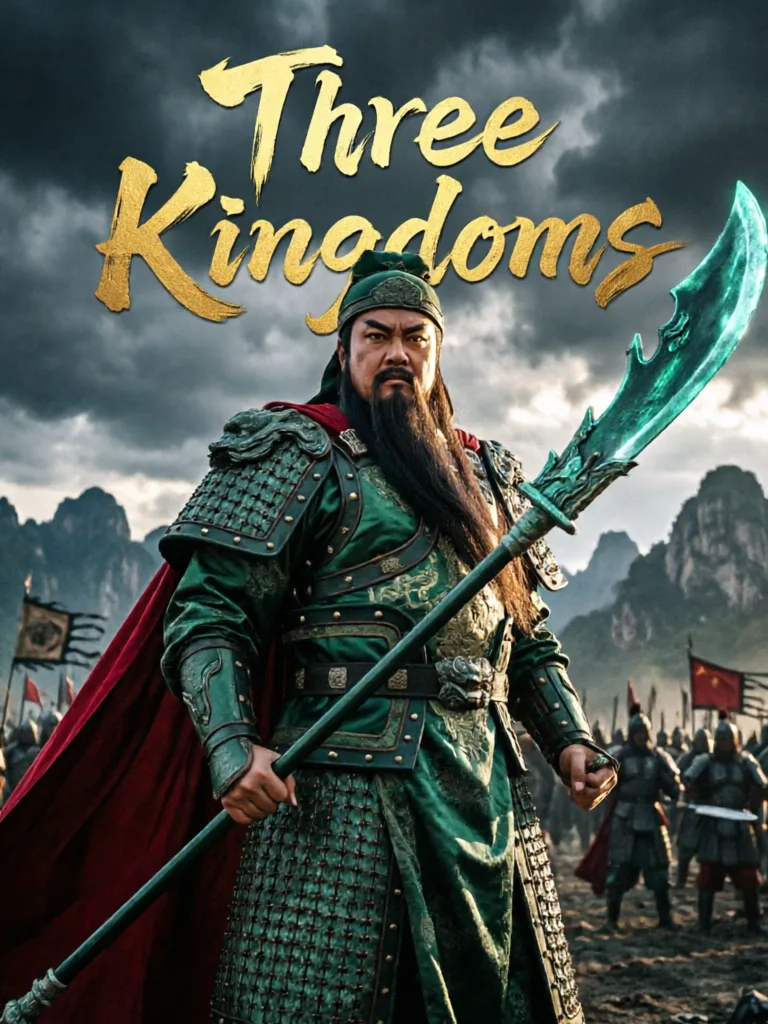
The night's chaotic battle raged until dawn, when both sides finally withdrew their forces. Ma Chao stationed his army at the mouth of the Wei River, dividing his troops day and night to launch attacks from front and rear. On the river, Cao Cao linked boats and rafts together with chains to form three pontoon bridges, connecting the southern bank. Cao Ren led troops to establish a camp along the riverbank, stringing together wagons of grain and fodder as a defensive barrier. When Ma Chao learned of this, he ordered his soldiers to each carry a bundle of grass and bring fire-starting materials. Together with Han Sui, he led a concentrated assault on the camp, piling up the grass bundles and setting them ablaze. Cao Cao's troops, unable to withstand the onslaught, abandoned the camp and fled. The wagons and pontoon bridges were all burned to ashes. The Xiliang forces won a great victory, cutting off the Wei River crossing. Unable to establish a stockade, Cao Cao grew anxious and fearful. Xun You said, "We can take sand from the Wei River and build an earthen wall—it will hold for defense." Cao Cao dispatched thirty thousand men to carry sand and build the wall. But Ma Chao sent Pang De and Ma Dai, each leading five hundred cavalry, to charge back and forth, disrupting the work. Moreover, the sandy soil was unstable; the wall collapsed as soon as it was built. Cao Cao was at his wit's end.
It was now late in the ninth month, and the weather turned bitterly cold. Dark clouds gathered thickly, covering the sky for days without clearing. Cao Cao sat in his camp, brooding. Suddenly, a guard reported, "An old man has come to see the Chancellor, wishing to offer a strategy." Cao Cao invited him in. The man had a crane-like bone structure and the bearing of a pine tree—ancient and dignified in appearance. Upon questioning, Cao Cao learned he was from the capital region and had been living in seclusion in the Zhongnan Mountains. His surname was Lou, his given name Zibo, and his Daoist title was Plum-Dreaming Recluse. Cao Cao received him with the courtesy due a guest. Lou Zibo said, "Chancellor, you have long wished to establish a camp across the Wei River. Why not seize the moment and build it now?" Cao Cao replied, "This sandy soil is impossible to fortify. What wise counsel can the hermit offer?" Lou Zibo answered, "Chancellor, your military genius is divine—surely you recognize the signs of the season? For days, the clouds have been heavy. Once the north wind rises, a great freeze is certain. After the wind comes, drive your men to carry earth and pour water on it. By dawn, the earthen wall will be complete." Cao Cao suddenly understood and rewarded Lou Zibo generously, but the hermit refused the gift and departed.
That night, the north wind howled with fury. Cao Cao drove all his soldiers to carry earth and pour water. Lacking proper vessels, they used silk bags to hold water and drenched the earth, building as they went, and the water froze instantly. By dawn, the sand and water had frozen solid, and the earthen wall was complete. Spies reported this to Ma Chao. He led his troops to inspect it and was astonished, suspecting divine intervention. The next day, Ma Chao assembled his army and advanced with drums beating. Cao Cao rode out of camp on horseback, accompanied only by Xu Chu behind him. Cao Cao raised his whip and shouted, "I, Mengde, have come alone on horseback. Let Ma Chao come out and speak with me!" Ma Chao rode out, spear raised. Cao Cao said, "You mocked me for failing to build a camp, but in a single night, Heaven has made it complete for me. Why don't you surrender now?" Ma Chao was furious and wanted to charge forward and capture him, but he saw behind Cao Cao a man with round, glaring eyes, holding a steel blade, reining in his horse. Ma Chao suspected it was Xu Chu and called out, "I hear there is a 'Tiger Marquis' in your army—where is he?" Xu Chu raised his blade and roared, "I am Xu Chu of Qiao Commandery!" His eyes blazed with divine light, and his presence was awe-inspiring. Ma Chao dared not move and reined his horse back. Cao Cao also led Xu Chu back to camp. The soldiers on both sides watched, all struck with fear. Cao Cao said to his generals, "That rebel knows that Zhong Kang is the Tiger Marquis!" From then on, the army called Xu Chu the "Tiger Marquis." Xu Chu said, "Tomorrow, I will capture Ma Chao for certain." Cao Cao warned, "Ma Chao is fierce and brave—do not underestimate him." Xu Chu replied, "I swear to fight to the death!" He immediately sent a challenge to Ma Chao's camp, declaring that the Tiger Marquis would duel him alone the next day. Ma Chao received the letter and raged, "How dare he insult me like this!" He replied that he would kill the Tiger Fool the next day.
The following day, both armies formed their battle lines. Ma Chao placed Pang De on the left wing, Ma Dai on the right, and Han Sui commanded the center. Ma Chao, spear in hand, rode to the front and shouted, "Tiger Fool, come out quickly!" From beneath his camp gate, Cao Cao turned to his generals and said, "Ma Chao's prowess rivals that of Lü Bu!" Before he finished speaking, Xu Chu spurred his horse and charged out, blade dancing. Ma Chao met him with his spear. They fought over a hundred rounds, neither gaining the upper hand. Their horses grew exhausted, and each returned to his own lines to exchange mounts, then rode out again. Another hundred rounds passed, still undecided. Xu Chu, enraged, galloped back to his camp, stripped off his armor, revealing his bulging muscles, and mounted his horse bare-chested, blade in hand, to resume the duel with Ma Chao. Both armies were stunned. They fought another thirty-plus rounds. Xu Chu, with all his might, raised his blade to strike Ma Chao. Ma Chao dodged and thrust his spear toward Xu Chu's heart. Xu Chu dropped his blade and grabbed the spear. The two wrestled for it on horseback. Xu Chu, with immense strength, snapped the shaft with a loud crack, and each held a broken half, striking wildly. Fearing for Xu Chu's safety, Cao Cao ordered Xiahou Yuan and Cao Hong to charge out and assist. When Pang De and Ma Dai saw Cao Cao's generals joining the fray, they waved their wings of iron cavalry forward, charging and smashing into the chaos. Cao Cao's army fell into disarray. Xu Chu took two arrows in the arm. The generals panicked and retreated into the camp. Ma Chao pursued all the way to the moat, and Cao Cao's forces suffered heavy losses—more than half were wounded or killed. Cao Cao ordered the gates shut and forbade any sortie. Ma Chao returned to the mouth of the Wei River and said to Han Sui, "I have never seen such a fierce fighter as Xu Chu—truly a Tiger Fool!"
Cao Cao, realizing that Ma Chao could be defeated by strategy, secretly ordered Xu Huang and Zhu Ling to cross the Wei River to the west and establish a camp, setting up a pincer attack from both sides. One day, from atop the wall, Cao Cao saw Ma Chao leading several hundred horsemen, galloping back and forth before his camp like the wind. After watching for a long time, Cao Cao threw his helmet to the ground and said, "If that Ma boy lives, I will have no place to be buried!" Xiahou Yuan, hearing this, burned with indignation and shouted, "I would rather die here than let this Ma rebel live!" He led his own thousand men, threw open the camp gate, and charged straight out. Cao Cao tried to stop him but couldn't. Fearing disaster, he mounted his horse and rushed to reinforce him. When Ma Chao saw Cao Cao's troops approaching, he reorganized his forces, turning the vanguard into the rearguard and the rearguard into the vanguard, spreading them in a single line. Xiahou Yuan arrived, and Ma Chao engaged him. Amidst the chaos, Ma Chao caught sight of Cao Cao in the distance. Abandoning Xiahou Yuan, he charged straight for Cao Cao. Cao Cao was terrified and turned his horse to flee. Cao Cao's army fell into complete disorder.
Just as Ma Chao was in pursuit, a report arrived that one of Cao Cao's forces had already established a camp west of the river. Ma Chao was shocked. He lost all desire to continue the chase and hastily withdrew his troops back to camp. He conferred with Han Sui, saying, "Cao Cao's troops have crossed the river while our guard was down. We are now caught between two enemies. What can we do?" A subordinate general, Li Kan, said, "Better to sue for peace by offering territory. Let both sides cease hostilities for now. Weather the winter, and when spring comes, we can make new plans." Han Sui said, "Li Kan's words are most wise. We should follow his advice."
Ma Chao hesitated, undecided. Yang Qiu and Hou Xuan also urged peace. So Han Sui sent Yang Qiu as an envoy to Cao Cao's camp with a letter proposing a truce and the cession of territory. Cao Cao said, "Return to your camp. I will send a reply tomorrow." Yang Qiu departed. Jia Xu entered to see Cao Cao and asked, "What is the Chancellor's intention?" Cao Cao replied, "What do you think, Wen He?" Jia Xu said, "In war, deception is paramount. We can pretend to agree. Then, use a stratagem of sowing discord to make Han Sui and Ma Chao turn against each other. With one drumbeat, we can break them." Cao Cao clapped his hands in delight and said, "Great minds think alike. Your plan, Wen He, is exactly what I had in mind." He then sent a reply letter, saying, "I will slowly withdraw my troops and return the lands west of the river to you." At the same time, he ordered the construction of pontoon bridges to give the appearance of retreating. When Ma Chao received the letter, he said to Han Sui, "Although Cao Cao has agreed to peace, this treacherous villain is hard to predict. If we are not prepared, we will fall into his trap. Uncle and I should take turns commanding the troops. Today, you face Cao Cao, and I will face Xu Huang; tomorrow, I will face Cao Cao, and you will face Xu Huang. We will guard separately to prevent his deceit." Han Sui followed the plan.
Soon, word of this reached Cao Cao. He turned to Jia Xu and said, "Our plan is working!" He asked, "Who will be facing me tomorrow?" The messenger replied, "Han Sui." The next day, Cao Cao led his generals out of camp, surrounded by his guards, with Cao Cao alone on horseback in the center. Many of Han Sui's soldiers had never seen Cao Cao before and came out to look. Cao Cao called out, "Do you soldiers want to see Lord Cao? I am just like any other man—I don't have four eyes or two mouths, only a bit more cunning." The soldiers all showed fear. Cao Cao sent a messenger across the lines to Han Sui, saying, "The Chancellor respectfully invites General Han for a conversation." Han Sui rode out. Seeing Cao Cao without armor or weapons, he also discarded his own armor and rode out lightly clad, on a single horse. The two horses stood head to head, and they spoke, each holding his reins. Cao Cao said, "Your father and I were both recommended as Filial and Incorrupt (Xiàolián, a Han-dynasty civil service recommendation based on filial piety and incorrupt conduct) officials. I always treated him as an uncle. You and I also entered official service together, and the years have passed unnoticed. How old are you now, General?" Han Sui replied, "Forty years." Cao Cao said, "In the old days in the capital, we were all young and green. Who would have thought we would now be past our prime? When will the realm be at peace so we can enjoy it together?" He spoke only of old times, never mentioning military matters. After finishing, he laughed heartily. They talked for about two hours before turning their horses and parting, each returning to his own camp. Word of this soon reached Ma Chao. He hurried to Han Sui and asked, "What did Cao Cao speak to you about today on the battlefield?" Han Sui replied, "Only about old times in the capital." Ma Chao pressed, "Surely he must have mentioned military affairs?" Han Sui answered, "Cao Cao didn't speak of them, so why should I?" Ma Chao grew deeply suspicious and left without a word.
Back in his camp, Cao Cao said to Jia Xu, "Do you know the meaning of my conversation on the battlefield?" Jia Xu replied, "The idea is clever, but it is not enough to drive a wedge between them. I have another plan that will make Han Sui and Ma Chao kill each other." Cao Cao asked what it was. Jia Xu said, "Ma Chao is a man of brute courage, blind to subtle schemes. Write a letter in your own hand, addressed only to Han Sui. In the middle, leave ambiguous passages, and deliberately smear and alter the crucial parts. Then seal it and send it to Han Sui, making sure Ma Chao finds out about it. Ma Chao will surely demand to see the letter. When he sees the key parts have been altered, he will suspect that Han Sui changed them to hide some secret from him. This will confirm the suspicion from your private conversation. Doubt will breed chaos. Meanwhile, I will secretly win over Han Sui's subordinates, sowing further discord. Then Ma Chao can be dealt with." Cao Cao said, "An excellent plan." He immediately wrote a letter, altering all the important parts, sealed it carefully, and deliberately sent many attendants to deliver it across the lines, then returned. As expected, someone reported it to Ma Chao. His suspicion deepened, and he went straight to Han Sui to demand the letter. Han Sui gave it to him. Ma Chao saw the smudged and altered characters and asked, "Why is the letter all blurred and changed?" Han Sui said, "It came that way. I don't know why." Ma Chao said, "Would anyone send a draft as the final letter? Uncle must have altered it to hide the details from me." Han Sui said, "Perhaps Cao Cao mistakenly sent a draft by accident." Ma Chao replied, "I don't believe it. Cao Cao is a meticulous man—how could he make such a mistake? We are supposed to be united in killing the enemy. Why have you suddenly turned against me?" Han Sui said, "If you don't trust me, then tomorrow I will lure Cao Cao into conversation on the battlefield, and you can charge out from the formation and kill him with one thrust of your spear. That will prove my loyalty." Ma Chao said, "If you do that, I will see your true heart." And so they agreed.
The next day, Han Sui led the five generals—Hou Xuan, Li Kan, Liang Xing, Ma Wan, and Yang Qiu—out to the battlefield. Ma Chao hid behind the camp gate. Han Sui sent a messenger to Cao Cao's camp, calling out, "General Han invites the Chancellor for a talk." Cao Cao ordered Cao Hong to lead a few dozen horsemen straight out to meet Han Sui. When they were a few horse-lengths apart, Cao Hong bowed from his horse and said, "Last night, the Chancellor sent his regards to the General. Please do not forget his words." He then turned his horse and rode back. Ma Chao heard this and flew into a rage. He spurred his horse, raised his spear, and charged at Han Sui. The five generals blocked him and persuaded him back to camp. Han Sui said, "Nephew, do not suspect me. I have no ill intentions." But Ma Chao would not believe him and left, burning with resentment. Han Sui discussed the matter with the five generals: "How can I clear this up?" Yang Qiu said, "Ma Chao relies on his martial prowess and has always looked down on you, my lord. Even if we defeat Cao Cao, would he ever yield to you? In my humble opinion, it would be better to secretly surrender to Lord Cao. In time, you will not lose your rank as a marquis." Han Sui said, "I swore brotherhood with Ma Teng—how can I bear to betray him?" Yang Qiu replied, "Matters have come to this. There is no other choice." Han Sui asked, "Who can deliver the message?" Yang Qiu said, "I am willing to go." Han Sui wrote a secret letter and sent Yang Qiu to Cao Cao's camp to propose surrender. Cao Cao was overjoyed and promised to enfeoff Han Sui as the Marquis of Xiliang and Yang Qiu as the Grand Administrator of Xiliang. The others also received official titles. They agreed to use a fire signal to coordinate the attack on Ma Chao. Yang Qiu took his leave and returned to Han Sui, reporting everything. "We have agreed to set a fire tonight and attack from within and without." Han Sui was delighted. He ordered his soldiers to pile dry brush behind the central command tent. The five generals stood by with swords drawn. Han Sui planned to invite Ma Chao to a banquet, trap him there, and kill him, but he hesitated and did not act.
Unbeknownst to them, Ma Chao had already learned the full details. He took a few trusted followers, drew his sword, and went ahead, ordering Pang De and Ma Dai to follow as reinforcements. Ma Chao stealthily entered Han Sui's tent and saw the five generals whispering with Han Sui. He heard Yang Qiu say, "There is no time to lose—we must act quickly!" Ma Chao erupted in fury. Sword in hand, he charged in, shouting, "How dare you traitors plot against me!" Everyone was shocked. Ma Chao swung his sword at Han Sui's face. Han Sui, panicked, raised his hand to block, and his left hand was cut clean off. The five generals drew their swords and charged. Ma Chao leaped out of the tent, and the five generals surrounded him, fighting wildly. Ma Chao, wielding his sword alone, fought all five. Where the sword light flashed, blood sprayed: he cut down Ma Wan and hacked Liang Xing to death. The other three fled for their lives. Ma Chao re-entered the tent to kill Han Sui, but his attendants had already rescued him. A fire broke out behind the tent, and all the camps stirred into action. Ma Chao hurriedly mounted his horse. Pang De and Ma Dai arrived, and a chaotic melee ensued. As Ma Chao fought his way out, Cao Cao's troops surrounded him from all sides: Xu Chu in front, Xu Huang behind, Xiahou Yuan on the left, Cao Hong on the right. The Xiliang troops began killing each other. Ma Chao lost sight of Pang De and Ma Dai. He led a hundred or so horsemen and blocked the Wei River bridge. As dawn broke, he saw Li Kan leading a force under the bridge. Ma Chao spurred his horse and gave chase, spear raised. Li Kan fled, dragging his spear. Just then, Yu Jin came up behind Ma Chao and drew his bow to shoot. Ma Chao heard the twang of the bowstring, dodged quickly, and the arrow struck Li Kan in front, killing him as he fell from his horse.
Ma Chao turned to kill Yu Jin, but Yu Jin spurred his horse and fled. Ma Chao returned to the bridge and held his position. Cao Cao's troops arrived in force from front and rear. The Tiger Guard led the charge, and a hail of arrows rained down on Ma Chao. He deflected them with his spear, and the arrows fell harmlessly to the ground. He ordered his horsemen to charge and break through, but Cao Cao's encirclement was too tight. Ma Chao let out a great roar and charged into the river north of the bridge, but his horsemen were cut off. Alone in the midst of the enemy, he was struck by a hidden crossbow bolt that felled his horse. Ma Chao crashed to the ground, and Cao Cao's troops closed in. At the critical moment, a troop of soldiers charged in from the northwest corner—it was Pang De and Ma Dai. They rescued Ma Chao, gave him a warhorse from their own ranks, and fought their way through a bloody path, fleeing northwest. When Cao Cao heard that Ma Chao had escaped, he issued orders to all his generals: "Pursue him day and night without rest. Whoever brings me his head will receive a thousand pieces of gold and the title of a lord of ten thousand households. Whoever captures him alive will be made a Grand General." The generals, eager for glory, each vied to be first, pursuing relentlessly. Ma Chao, ignoring the exhaustion of his men and horses, fled without stopping. His horsemen gradually scattered. Those on foot who could not keep up were mostly captured. Only thirty or so horsemen remained, and with Pang De and Ma Dai, they fled toward Lintao in Longxi.
Cao Cao personally pursued them to Anding. Knowing that Ma Chao was far away, he withdrew his troops and returned to Chang'an. All the generals assembled. Han Sui, now missing his left hand and crippled, was ordered by Cao Cao to rest in Chang'an and was given the title of Marquis of Xiliang. Yang Qiu and Hou Xuan were both enfeoffed as marquises and ordered to guard the mouth of the Wei River. Cao Cao then ordered the army to return to Xuchang. Yang Fu, a military advisor from Liang Province, styled Yishan, came to Chang'an to see Cao Cao. Cao Cao asked his purpose. Yang Fu said, "Ma Chao has the bravery of Lü Bu and has won the hearts of the Qiang people. If the Chancellor does not seize this opportunity to annihilate him, when he regains his strength, the commanderies west of Long will no longer belong to the state. I beg you, Chancellor, do not return just yet." Cao Cao replied, "I would like to leave troops to campaign against him, but the Central Plains are troubled, and the south is not yet pacified. I cannot stay long. You must protect the region for me." Yang Fu accepted the charge and recommended Wei Kang as the Provincial Inspector of Liangzhou, to lead troops and garrison Ji City to guard against Ma Chao. Before departing, Yang Fu asked Cao Cao, "Chang'an must have a heavy garrison as a rear support." Cao Cao said, "I have already made arrangements. Rest assured." Yang Fu took his leave and departed.
The generals then asked, "When the rebels first held Tong Pass, the road north of the Wei was open. Why did the Chancellor not attack from Hedong to Fengyi, but instead held Tong Pass, delayed for so long, then crossed to the north and established a fortified camp?" Cao Cao replied, "When the rebels first held Tong Pass, if I had attacked Hedong immediately, they would have deployed troops to guard all the river crossings, and I could never have crossed to the west. So I massed all my troops before Tong Pass, making them concentrate their defenses in the south, leaving the west unguarded. That is how Xu Huang and Zhu Ling were able to cross. I then led my troops north across the river, linked the wagons and erected palisades to form a covered passage, and built the frozen wall. I wanted the rebels to think I was weak, to make them arrogant and unprepared. Then I used the stratagem of sowing discord, conserved my soldiers' strength, and broke them in a single strike. This is what is meant by 'a thunderbolt that gives no time to cover the ears.' The changes of war are not limited to one method." The generals then asked, "Why did the Chancellor always show joy whenever the rebels increased their forces?" Cao Cao said, "The land within the passes is remote. If the rebels had each held their own strongholds, it would have taken years to subdue them. But now they have all gathered in one place. Though their numbers are great, their hearts are divided, easy to sow discord among them, and easy to destroy in one blow. That is why I was joyful." The generals bowed and said, "The Chancellor's divine strategies are beyond our reach." Cao Cao replied, "I also rely on the strength of you all, civil and military." He then rewarded the army generously. He left Xiahou Yuan to garrison Chang'an and divided the captured troops among the various units. Xiahou Yuan recommended Zhang Ji, styled Derong, from Gaoling in Fengyi, to serve as the Governor of the Capital Region, to jointly defend Chang'an with him.
Cao Cao led the army back to the capital. Emperor Xian, with his imperial carriage, came out of the city to welcome him. He issued an edict allowing Cao Cao to "be praised without using his name, enter the court without hurrying, and wear his sword and shoes in the imperial presence"—the same honors granted to Xiao He, the founding Han chancellor. From then on, Cao Cao's prestige shook the realm. When news of this reached Hanzhong, it alarmed Zhang Lu, the Grand Administrator of Hanning. Zhang Lu was originally from Feng County in Pei Commandery. His grandfather, Zhang Ling, had created Daoist scriptures in the Crow-Cry Mountains of western Sichuan to delude the people, who revered him. After Zhang Ling died, his son Zhang Heng continued the practice. Anyone who wished to learn the Way had to contribute five bushels of rice, so they were known as the "Rice Bandits." When Zhang Heng died, Zhang Lu carried on the tradition. In Hanzhong, Zhang Lu styled himself "Master Teacher." Those who came to learn the Way were called "Ghost Soldiers." Their leaders were called "Libationers," and those who led many followers were called "Great Libationers of the Head of Governance." They emphasized sincerity and forbade deception. If someone fell ill, an altar was set up, and the patient was placed in a quiet room to reflect on their own faults, confess them, and then prayers were offered.
The one who conducted the prayers was called the "Evil-Commanding Libationer." The method of prayer involved writing the patient's name and a confession of sins on three copies of a document, called the "Three Officials' Handwritten Letter": one was placed on a mountaintop to be presented to Heaven, one was buried in the earth to be presented to the Earth, and one was sunk in water to be presented to the Water Official. After this, if the patient recovered, they offered five bushels of rice in thanks. They also built "Righteous Lodges," stocked with rice, firewood, and meat, allowing travelers to take as much as they needed; those who took more than their share would be punished by Heaven. Within their territory, offenders were forgiven three times; only after the fourth offense were they punished. There were no government officials; everything was managed by the Libationers. In this way, they had ruled Hanzhong for thirty years. The central government, unable to campaign against them due to the region's remoteness, had appointed Zhang Lu as General of the Southern Pacification and Grand Administrator of Hanning, merely to receive tribute. That year, when Zhang Lu heard that Cao Cao had crushed the Xiliang forces and his fame shook the realm, he assembled his followers and said, "Ma Teng was executed, and Ma Chao has just been defeated. Cao Cao will surely invade our Hanzhong. I wish to proclaim myself the King of Hanning and lead troops to resist Cao Cao. What do you all think?" Yan Pu said, "The people of Hanchuan number over a hundred thousand households. We have abundant wealth and grain, and the terrain is defensible on all sides.
Now that Ma Chao has been defeated, no fewer than tens of thousands of refugees from Xiliang have fled through the Ziwu Valley into Hanzhong. In my humble opinion, Liu Zhang of Yizhou is weak and dim-witted. It would be better to first seize the forty-one commanderies of western Sichuan as our base, and then proclaim yourself king." Zhang Lu was delighted and immediately began discussing raising an army with his brother Zhang Wei. Spies soon reported this into Sichuan.
Liu Zhang, styled Jiyu, was the son of Liu Yan and a descendant of Liu Yu, the Prince of Gong of the Han Dynasty. During the Yuanhe era of Emperor Zhang, his branch of the family was enfeoffed at Jingling, and his ancestors had settled there. Later, Liu Yan rose to become the Provincial Governor of Yizhou. He died of an illness in the first year of the Xingping era, and the senior officials of the province, including Zhao Wei, jointly supported Liu Zhang as the new Provincial Governor. Liu Zhang had once killed Zhang Lu's mother and brother, so there was a blood feud between them. Liu Zhang appointed Pang Xi as the Grand Administrator of Baxi to resist Zhang Lu. When Pang Xi learned that Zhang Lu was planning to raise an army and invade Sichuan, he urgently reported it to Liu Zhang. Liu Zhang, timid by nature, was greatly alarmed by this news. He hastily assembled his officials to discuss the matter. Suddenly, a man stepped forward boldly and said, "Rest assured, my lord. Though I am unworthy, with my three inches of silver tongue, I will make sure Zhang Lu dares not even glance at western Sichuan."
Truly, it was because a strategist from Shu stepped forward that a hero from Jing Province was drawn in. Who was this man? Let the next chapter reveal.