Just as Chen Gong was about to strike Cao Cao dead, a sudden thought stayed his hand. "I followed this man here for the sake of the nation," he reasoned. "To kill him now would be an act of treachery. It is better to abandon him and go my own way." He sheathed his sword, mounted his horse, and before dawn broke, rode off toward Dong Commandery. When Cao Cao awoke and found Chen Gong gone, he reflected: "He heard those two words from me and suspected I was without honor, so he left. I must press on quickly; there is no time to linger." That very night, he reached Chenliu and sought out his father, to whom he recounted everything. He proposed to sell the family estate to raise an army of volunteers. His father replied, "Our resources are too meager to accomplish much. But there is a filial and incorrupt scholar here named Wei Hong, a man of great wealth who is generous with his fortune and upholds righteousness. If we can win his aid, our plans may succeed." Cao Cao prepared a feast and invited Wei Hong to his home with the deepest respect. "The Han dynasty has no true ruler," Cao Cao told him. "Dong Zhuo has seized power, deceiving the emperor and harming the people, drawing the hatred of all under Heaven. I wish to restore the state, but my strength is insufficient. You, sir, are a man of loyalty and honor—I dare to beg for your assistance!" Wei Hong replied, "I have long harbored this desire, but I never met a hero worthy of my support. Since Mengde has such great ambition, I am willing to dedicate my entire fortune to your cause." Overjoyed, Cao Cao first issued a forged imperial edict, sending riders to every province, and then began to recruit volunteers. He raised a white banner inscribed with the two characters "Loyalty and Righteousness." Within days, men flocked to enlist like rain pouring from the heavens.
One day, a man from Yangping Commandery named Yue Jin, styled Wenqian, came to join Cao Cao. Another, from Shanyang Commandery named Li Dian, styled Mancheng, also arrived. Cao Cao retained them both as officers in his camp. Then came Xiahou Dun, styled Yuanrang, a descendant of Xiahou Ying from Pei Commandery in the State of Qiao. From childhood, he had practiced with spear and staff; at fourteen, he followed a master to learn martial arts. When someone insulted his teacher, Xiahou Dun killed the man and fled to distant lands. Hearing that Cao Cao was raising an army, he and his cousin Xiahou Yuan each led a thousand strong warriors to join the cause. These two were actually Cao Cao's own kin: Cao Cao's father, Cao Song, was originally a son of the Xiahou clan, adopted into the Cao family, so they shared the same bloodline. Within days, Cao Cao's cousins Cao Ren (Cao Ren (曹仁, a fierce general of Wei, cousin of Cao Cao, known for tenacious defense)), styled Zixiao, and Cao Hong (Cao Hong (曹洪, a loyal general of Wei, fought alongside Cao Cao since the earliest campaigns)), styled Zilian, each arrived with over a thousand troops. Both were skilled horsemen and archers, masters of the martial arts. Cao Cao was overjoyed and drilled his forces in the village. Wei Hong emptied his coffers to provide armor, robes, and banners. Countless provisions were sent from every direction.
When Yuan Shao received Cao Cao's forged edict, he gathered his civil and military officers and led thirty thousand troops from Bohai to join Cao Cao's alliance. Cao Cao then composed a proclamation to be sent to all commanderies. It read: "Cao Cao and his allies, in the name of righteousness, declare to all under Heaven: Dong Zhuo has defied Heaven and earth, destroyed the state, and murdered the sovereign. He has defiled the imperial palace, slaughtered the innocent, and committed every crime imaginable. Now, in obedience to the emperor's secret decree, we have assembled a great army of righteousness, sworn to purge the realm and exterminate the wicked. We call upon all righteous forces to join us in avenging the public outrage, to support the royal house, and to rescue the common people. Upon receipt of this proclamation, act swiftly!"
After Cao Cao sent out the proclamation, the warlords of every province rose in response:
First, Yuan Shu, General of the Rear and Grand Administrator of Nanyang. Second, Han Fu, Provincial Inspector of Ji Province. Third, Kong Zhou, Provincial Inspector of Yu Province. Fourth, Liu Dai, Provincial Inspector of Yan Province. Fifth, Wang Kuang, Grand Administrator of Henei Commandery. Sixth, Zhang Miao, Grand Administrator of Chenliu. Seventh, Qiao Mao, Grand Administrator of Dong Commandery. Eighth, Yuan Yi, Grand Administrator of Shanyang. Ninth, Bao Xin, Chancellor of Jibei. Tenth, Kong Rong, Grand Administrator of Beihai. Eleventh, Zhang Chao, Grand Administrator of Guangling. Twelfth, Tao Qian, Provincial Inspector of Xu Province. Thirteenth, Ma Teng, Grand Administrator of Xiliang. Fourteenth, Gongsun Zan, Grand Administrator of Beiping. Fifteenth, Zhang Yang, Grand Administrator of Shangdang. Sixteenth, Sun Jian, Marquis of Wucheng and Grand Administrator of Changsha. Seventeenth, Yuan Shao, Marquis of Qixiang and Grand Administrator of Bohai.
Each army was of different size—some thirty thousand, others ten or twenty thousand—and each was led by civil and military officers as they marched toward Luoyang.
Now, Gongsun Zan, Grand Administrator of Beiping, led fifteen thousand elite troops past Pingyuan County in De Province. As they traveled, they saw a yellow banner among the mulberry trees, and several riders came to greet them. Gongsun Zan looked closely and saw it was Liu Bei. "Worthy brother, why are you here?" asked Gongsun Zan. "In the past, you recommended me to be the magistrate of Pingyuan County," Liu Bei replied. "Now that I hear your great army is passing through, I have come to welcome you and invite you into the city to rest." Gongsun Zan pointed at Guan Yu and Zhang Fei and asked, "Who are these men?" "These are Guan Yu and Zhang Fei, my sworn brothers," Liu Bei answered. "Are they the ones who helped you defeat the Yellow Turbans?" asked Gongsun Zan. "All that was accomplished through their strength," Liu Bei said. "What offices do they hold now?" Gongsun Zan inquired. "Guan Yu is a mounted archer, and Zhang Fei a foot archer," Liu Bei replied. Gongsun Zan sighed. "What a waste of heroes! Now that Dong Zhuo is causing chaos, all the warlords of the realm are gathering to destroy him. Worthy brother, abandon this lowly post and join us in punishing the traitor, to support the Han dynasty. What do you say?" "I am willing to go," Liu Bei said. Zhang Fei growled, "If you had let me kill that villain back then, none of this would be happening today!" Guan Yu said calmly, "Since things have come to this, we should prepare and set out at once."
Liu Bei, Guan Yu, and Zhang Fei, with a few riders, followed Gongsun Zan to meet Cao Cao. The other warlords arrived one after another, each pitching their camps, which stretched for over two hundred li. Cao Cao slaughtered cattle and horses and hosted a grand assembly of the warlords to discuss their advance. Wang Kuang, Grand Administrator of Henei, spoke up: "Now that we have taken up the cause of righteousness, we must elect an alliance leader. All must obey his commands before we march." Cao Cao said, "Yuan Shao, styled Benchu, comes from a family that has produced three Excellencies for four generations. He has many former subordinates in office and is a descendant of the Han dynasty's famous ministers. He should be the alliance leader." Yuan Shao declined repeatedly, but the others insisted that no one else would do, and finally he accepted. The next day, they built a three-tiered altar, arrayed the five-directional banners, and placed the white yak-tail standard and golden battle-axe, along with the military tally and general's seal. They invited Yuan Shao to ascend the altar. Yuan Shao straightened his robes, fastened his sword, and mounted the platform with a determined air. He burned incense, bowed twice, and recited the oath: "The Han dynasty is unfortunate; the imperial authority has collapsed. The traitorous minister Dong Zhuo has seized the opportunity to wreak havoc, bringing calamity to the sovereign and suffering to the people. We, Yuan Shao and the others, fearing the ruin of the state, have gathered an army of righteousness to face the nation's peril. All of us who swear this oath shall unite our hearts and strength to fulfill our duty as subjects, and shall have no second thoughts. If any violate this oath, may they lose their lives and leave no descendants. Heaven and earth, and the spirits of our ancestors, bear witness!"
After the oath was read, they smeared blood on their lips. The assembly, moved by the passionate words, wept openly. The blood ritual completed, they descended the altar. The others helped Yuan Shao to the main seat of the tent, and the rest took their places according to rank and age. Cao Cao offered several rounds of wine and said, "Now that we have established an alliance leader, let each one follow his commands, work together to support the nation, and not quarrel over strength or weakness." Yuan Shao declared, "Though I am unworthy, since you have honored me as your leader, I will reward merit and punish transgression. The state has its laws, and the army its discipline. Each of you must abide by these rules and not violate them." All replied, "We obey your commands." Yuan Shao then said, "My younger brother, Yuan Shu, will oversee the supply of grain and fodder, ensuring that every camp is provided for without shortage. We also need a vanguard commander to march directly to Sishui Pass and challenge the enemy. The rest of you shall hold strategic positions and be ready to reinforce."
Sun Jian, Grand Administrator of Changsha, stepped forward and said, "I am willing to lead the vanguard." Yuan Shao replied, "Wentai is brave and fierce; you are fit for this task." Sun Jian thus led his own forces toward Sishui Pass. The defending officers at the pass sent a fast rider to the Chancellor's residence in Luoyang with an urgent report. Since seizing power, Dong Zhuo had spent his days feasting and drinking. When Li Ru received the emergency dispatch, he went straight to inform Dong Zhuo. Dong Zhuo was greatly alarmed and hastily summoned his generals for counsel. Lü Bu, the Marquis of Wen, stepped forward and declared, "Father, do not worry. The warlords beyond the pass are like weeds to me. I wish to lead my fierce troops and cut off their heads, hanging them at the capital gates." Dong Zhuo was overjoyed. "With Fengxian by my side, I can rest easy!" he said. Before he had finished speaking, a man behind Lü Bu shouted, "Why use an ox-cleaver to kill a chicken? There is no need to trouble the Marquis of Wen. I will take the heads of those warlords as easily as reaching into my pocket!" Dong Zhuo looked at the man. He was nine feet tall, with a tiger's body, a wolf's waist, a leopard's head, and ape-like arms. He was from the lands west of the pass, and his name was Hua Xiong (Hua Xiong (华雄, a formidable general under Dong Zhuo, known for his strength in battle)). Delighted by his words, Dong Zhuo appointed him Colonel of the Swift Cavalry and gave him fifty thousand infantry and cavalry, along with Li Su, Hu Zhen, and Zhao Cen. They marched day and night to the pass to meet the enemy.
Among the warlords, Bao Xin, Chancellor of Jibei, thought to himself, "Sun Jian is the vanguard; I fear he will take all the glory." So he secretly ordered his younger brother, Bao Zhong, to take three thousand troops by a shortcut straight to the pass to challenge the enemy. Hua Xiong led five hundred iron cavalry down from the pass like a whirlwind, shouting, "Rebel, do not flee!" Bao Zhong tried to retreat, but Hua Xiong's blade fell, cutting him down from his horse. Many officers were captured alive. Hua Xiong sent Bao Zhong's head to the Chancellor's residence to report his victory, and Dong Zhuo promoted him to Commander-in-Chief.
Now Sun Jian led four generals straight to the pass. Who were these four? The first was Cheng Pu, styled Demou, from Tuyin in Right Beiping, who wielded an iron-backed serpent spear. The second was Huang Gai, styled Gongfu, from Lingling, who used an iron mace. The third was Han Dang, styled Yigong, from Lingzhi in Liaoxi, who fought with a great sword. The fourth was Zu Mao, styled Darong, from Fuchun in Wu Commandery, who carried twin blades. Sun Jian wore gleaming silver armor, a red turban on his head, and carried his ancient-pattern sword. Mounted on a piebald horse, he pointed at the pass and shouted, "You who aid the evil one, why do you not surrender?" Hua Xiong's lieutenant, Hu Zhen, led five thousand troops out of the pass to meet him. Cheng Pu galloped forward, his spear leveled, and engaged Hu Zhen. After only a few exchanges, Cheng Pu drove his spear through Hu Zhen's throat, killing him instantly. Sun Jian waved his army forward, driving straight to the foot of the pass, but arrows and stones rained down from the walls like a storm. Sun Jian withdrew his forces to camp east of Liang and sent word of his victory to Yuan Shao, while also pressing Yuan Shu for grain.
Someone whispered to Yuan Shu, "Sun Jian is a fierce tiger of Jiangdong. If he breaks through Luoyang and kills Dong Zhuo, it will be like removing a wolf only to gain a tiger. If you withhold his grain now, his army will scatter." Yuan Shu heeded this advice and refused to send provisions. Sun Jian's soldiers began to starve, and disorder spread through the camp. Spies reported this to the pass. Li Su advised Hua Xiong, "Tonight, I will lead a force down a secret path to attack Sun Jian's rear camp, while you strike his front. We can capture him." Hua Xiong agreed and ordered his men to eat their fill before descending the pass under cover of darkness. That night, the moon was bright and the wind clear. By the time they reached Sun Jian's camp, it was midnight. With a great clamor, they charged. Sun Jian hastily donned his armor and mounted his horse, only to come face to face with Hua Xiong. Their horses clashed, and after a few exchanges, Li Su's troops arrived, setting fires that lit up the sky. Sun Jian's army scattered in panic. His generals fought in the chaos, and only Zu Mao stayed by Sun Jian's side, fighting their way out of the encirclement. Hua Xiong pursued them from behind. Sun Jian grabbed his bow and loosed two arrows, but Hua Xiong dodged both. When he drew a third arrow, he pulled so hard that his magpie-patterned bow snapped. He had to abandon it and spur his horse to flee. Zu Mao said, "My lord, your red turban is too conspicuous—the enemy can recognize you by it. Let me wear it instead." Sun Jian exchanged his turban for Zu Mao's helmet, and they split up, fleeing in different directions. Hua Xiong's men chased after the red turban, allowing Sun Jian to escape through a side path. Zu Mao, hard pressed by Hua Xiong, hung the red turban on a charred pillar of a burned-out house and hid in the forest. Hua Xiong's soldiers saw the turban in the moonlight and surrounded it from all sides, afraid to approach. They shot arrows at it before realizing it was a trick, then advanced and took the turban. Zu Mao burst from the forest, swinging his twin blades at Hua Xiong. With a mighty roar, Hua Xiong cut Zu Mao down with a single stroke. The fighting continued until dawn, when Hua Xiong led his men back up the pass.
Cheng Pu, Huang Gai, and Han Dang found Sun Jian and regrouped their forces. Sun Jian was deeply grieved at the loss of Zu Mao and sent a rider that very night to inform Yuan Shao. Yuan Shao was shocked. "I never thought Sun Wentai would be defeated by Hua Xiong!" he exclaimed. He summoned all the warlords for a council. Everyone came except Gongsun Zan, who arrived late. Yuan Shao invited him into the tent and gave him a seat. "The other day," Yuan Shao began, "General Bao's younger brother disobeyed orders and attacked on his own, losing his life and many soldiers. Now Sun Wentai has also been defeated by Hua Xiong. Our morale is broken. What are we to do?" The warlords sat in silence. Yuan Shao looked around and noticed three men standing behind Gongsun Zan, of unusual appearance, smirking coldly. "Who are those men behind you, Grand Administrator Gongsun?" Yuan Shao asked. Gongsun Zan called Liu Bei forward. "This is my childhood friend and fellow student, Liu Bei, the magistrate of Pingyuan," he said. Cao Cao interjected, "Is this the Liu Xuande who defeated the Yellow Turbans?" "Indeed," replied Gongsun Zan. He then ordered Liu Bei to pay his respects. Gongsun Zan recounted Liu Bei's achievements and his lineage in detail. Yuan Shao said, "Since you are of the imperial clan, take a seat." He ordered a chair brought. Liu Bei declined modestly. "I do not honor you for your rank or title," Yuan Shao said, "but because you are a descendant of the imperial house." Liu Bei then sat at the lowest seat, while Guan Yu and Zhang Fei stood behind him with their arms folded in respect.
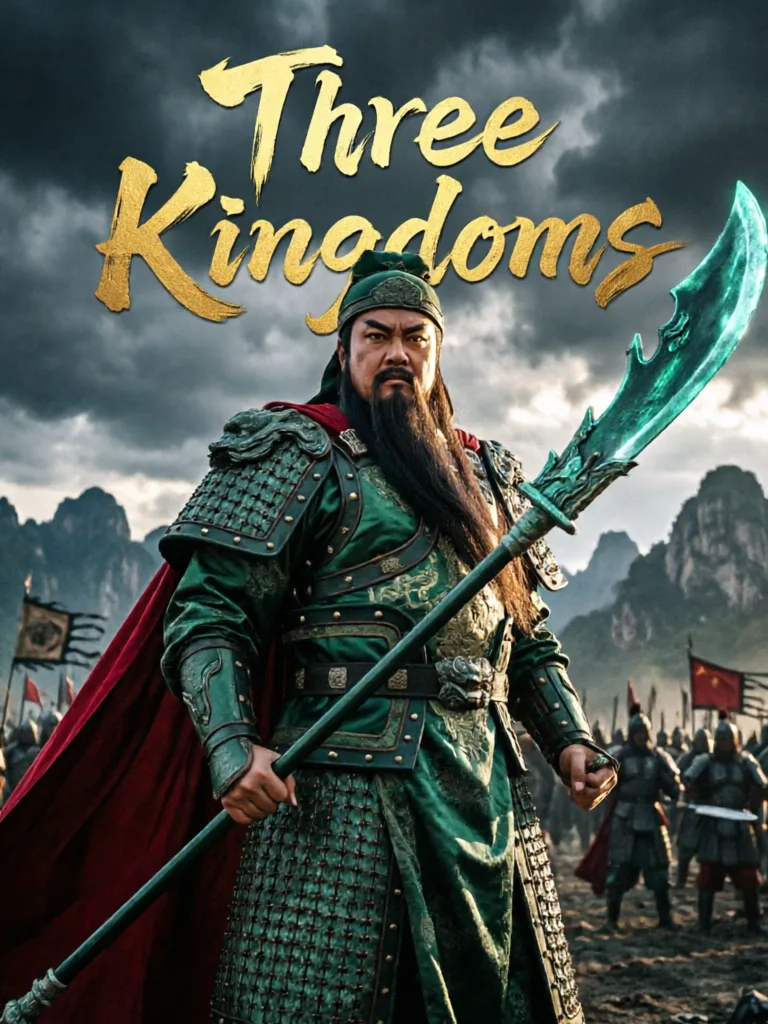
Suddenly, a scout reported: "Hua Xiong has led his iron cavalry down from the pass. He carries Grand Administrator Sun's red turban on a long pole and is at the camp gate, hurling insults and demanding battle." Yuan Shao asked, "Who dares to fight him?" A fierce general named Yu She stepped out from behind Yuan Shu and said, "I am willing to go." Yuan Shao was pleased and sent Yu She out. Soon, a messenger reported: "Yu She fought Hua Xiong for less than three exchanges and was slain." The assembly was stunned. Han Fu, Grand Administrator of Ji Province, said, "I have a general named Pan Feng who can kill Hua Xiong." Yuan Shao urgently ordered him into battle. Pan Feng mounted his horse, wielding a great axe. He had not been gone long when a rider came flying back with the news: "Pan Feng has also been killed by Hua Xiong!" The faces of all present turned pale. Yuan Shao lamented, "If only my great generals Yan Liang (Yan Liang (颜良, a mighty general under Yuan Shao, renowned for his martial prowess)) and Wen Chou (Wen Chou (文丑, a fierce general under Yuan Shao, frequently paired with Yan Liang)) were here! With just one of them, we would have nothing to fear from Hua Xiong!" Before he finished speaking, a voice thundered from below the platform: "I am willing to go and present Hua Xiong's head before this tent!" All eyes turned to see a man nine feet tall, with a beard two feet long, phoenix eyes, and brows like silkworms. His face was the color of a ripe jujube, and his voice boomed like a great bell. He stood before the tent. Yuan Shao asked who he was. Gongsun Zan replied, "This is Guan Yu, the sworn brother of Liu Xuande." Yuan Shao asked what office he held. "He serves as a mounted archer under Liu Xuande," Gongsun Zan said.
Yuan Shu shouted angrily from his seat, "Do you think we warlords have no generals? A mere archer dares to speak so wildly? Throw him out!" Cao Cao quickly intervened. "Gonglu, calm your anger. Since this man boasts so boldly, he must have courage and skill. Let him try. If he fails, you can punish him then." Yuan Shao said, "Sending an archer to fight will only make us a laughingstock to Hua Xiong." Cao Cao replied, "This man's bearing is extraordinary. How would Hua Xiong know he is an archer?" Guan Yu declared, "If I fail, you may take my head." Cao Cao ordered a cup of hot wine to be poured for Guan Yu to drink before mounting his horse. Guan Yu said, "Set the wine aside. I will return shortly." He left the tent, grasped his blade, and leaped onto his horse. The warlords heard the drums thunder beyond the camp, followed by a great roar of battle cries, as if the heavens were collapsing and the earth shattering. Before they could send someone to investigate, the sound of a bridle bell rang out, and Guan Yu's horse arrived at the center of the camp. Guan Yu held Hua Xiong's head in his hand and threw it to the ground. The wine was still warm.
A poet of the time recorded a verse: "The first great feat to shake the realm—the painted drums thundered at the camp gate. Yunchang set down his cup and displayed his valor; before the wine grew cold, he had slain Hua Xiong."
Cao Cao was overjoyed. But then Zhang Fei stepped out from behind Liu Bei and shouted at the top of his voice, "My brother has killed Hua Xiong! Why don't we charge the pass now and capture Dong Zhuo alive? What are we waiting for?" Yuan Shu flew into a rage. "We ministers are still showing restraint," he bellowed, "and yet a common soldier under a county magistrate dares to strut and swagger here! Throw them all out!" Cao Cao said, "Those who achieve merit should be rewarded. Why should we care about rank?" Yuan Shu retorted, "Since you gentlemen only value a county magistrate, I will take my leave." Cao Cao replied, "How can we let one word ruin such a great enterprise?" He ordered Gongsun Zan to take Liu Bei, Guan Yu, and Zhang Fei back to their camp. The other officers dispersed. Cao Cao secretly sent cattle and wine to comfort the three men.
The defeated soldiers of Hua Xiong reported back to the pass. Li Shu hastily wrote an urgent dispatch to inform Dong Zhuo. Dong Zhuo urgently summoned Li Ru, Lü Bu, and others for counsel. Li Ru said, "We have lost our great general Hua Xiong, and the rebel forces are powerful. Yuan Shao is the alliance leader, and his uncle Yuan Wei is the Grand Tutor. If they coordinate from within and without, it will be disastrous. We should eliminate Yuan Wei first. I suggest you lead the main army yourself to divide and destroy them." Dong Zhuo agreed and ordered Li Jue and Guo Si to lead five hundred troops to surround the Grand Tutor Yuan Wei's residence. They killed everyone, young and old, without mercy, and displayed Yuan Wei's head before the pass as a warning.
Dong Zhuo then raised an army of two hundred thousand, divided into two columns. One column, under Li Jue and Guo Si, with fifty thousand men, was to hold Sishui Pass without engaging. Dong Zhuo himself led one hundred and fifty thousand troops, along with Li Ru, Lü Bu, Fan Chou, and Zhang Ji, to defend Hulao Pass. This pass was fifty li from Luoyang. When the army reached the pass, Dong Zhuo ordered Lü Bu to take thirty thousand troops and pitch a large camp before the pass, while he himself garrisoned the pass.
Fast riders reported this to Yuan Shao's camp. Yuan Shao gathered his forces for discussion. Cao Cao said, "Dong Zhuo has stationed his army at Hulao Pass, cutting off our path in the middle. We should send half our forces to confront him." Yuan Shao then divided the eight armies of Wang Kuang, Qiao Mao, Bao Xin, Yuan Yi, Kong Rong, Zhang Yang, Tao Qian, and Gongsun Zan to march on Hulao Pass. Cao Cao would lead a force to support them. The eight armies set out. Wang Kuang, Grand Administrator of Henei, arrived first with his troops. Lü Bu led three thousand iron cavalry to meet him. Wang Kuang arrayed his forces and reined in his horse beneath his banner to observe. He saw Lü Bu emerge: a purple-gold crown with three prongs bound his hair; he wore a red brocade battle robe from Western Sichuan, a suit of linked armor with a beast-face buckle at the waist, and a lion-and-elephant belt. A bow and arrows hung at his side, and he carried his Sky-Piercing Halberd. Beneath him was Red Hare, the legendary steed that could gallop a thousand li in a day.
Truly, "Among men, Lü Bu; among horses, Red Hare!" Wang Kuang turned and asked, "Who dares to fight?" A general behind him named Fang Yue, a famous warrior from Henei, spurred his horse forward with leveled spear. Their mounts clashed, and before five exchanges, Lü Bu drove his halberd through Fang Yue, killing him. Then, wielding his halberd, Lü Bu charged straight into Wang Kuang's lines. Wang Kuang's army was routed, scattering in all directions. Lü Bu charged east and west, as if entering an empty land. Fortunately, the armies of Qiao Mao and Yuan Yi arrived to rescue Wang Kuang, and Lü Bu withdrew. Each of the three armies had suffered losses and retreated thirty li to pitch camp. The other five armies soon arrived, and they held a council, lamenting that Lü Bu was a hero no one could match.
As they worried, a scout reported: "Lü Bu is challenging us to battle." The eight warlords all mounted their horses. Their armies formed eight divisions, arrayed on a high ridge. In the distance, they saw Lü Bu's troops, their embroidered banners fluttering, charging to break their formation. Mu Shun, a general under Zhang Yang, Grand Administrator of Shangdang, rode out with leveled spear to meet him. With a single stroke of his halberd, Lü Bu cut Mu Shun down. The assembly was stunned. Wu Anguo, a general under Kong Rong, Grand Administrator of Beihai, charged out on horseback, swinging his iron mace. Lü Bu spurred his horse to meet him. After more than ten exchanges, Lü Bu's halberd sliced through Wu Anguo's wrist, and he dropped his mace and fled. The eight armies rushed forward to rescue Wu Anguo, and Lü Bu withdrew. The warlords returned to camp to discuss. Cao Cao said, "Lü Bu is invincible in valor. We should convene all eighteen armies to devise a plan. If we capture Lü Bu, Dong Zhuo will be easy to kill."
As they spoke, Lü Bu returned with his troops to challenge them again. The eight armies rode out together. Gongsun Zan, wielding his spear, engaged Lü Bu himself. After only a few exchanges, Gongsun Zan was defeated and fled. Lü Bu urged Red Hare in pursuit. The horse, which could travel a thousand li in a day, flew like the wind. As he was about to overtake him, Lü Bu raised his halberd to strike Gongsun Zan in the back. But from the side, a general with bulging round eyes and bristling tiger whiskers, wielding an eighteen-foot serpent spear, galloped forward, shouting, "Slave with three surnames, do not flee! I, Zhang Fei of Yan, am here!" Lü Bu abandoned Gongsun Zan and turned to face Zhang Fei. Zhang Fei, his spirit blazing, fought Lü Bu with all his might. They clashed for over fifty exchanges without either gaining the upper hand. Seeing this, Guan Yu slapped his horse and joined the fray, his eighty-two-pound Green Dragon Crescent Blade flashing as he attacked Lü Bu from the flank. The three horses formed a triangular battle, their riders exchanging blow after blow. After thirty more exchanges, they still could not bring Lü Bu down. Liu Bei drew his Twin Swords and spurred his yellow-maned horse, charging in from an angle to help. The three of them surrounded Lü Bu, their weapons whirling like a lantern in the wind. The eight armies watched in stunned silence. Lü Bu could no longer parry and block. Feigning a thrust at Liu Bei's face, he made him dodge, then broke through the encirclement, dragging his halberd behind him as he galloped away. The three brothers gave chase, unwilling to let him escape. The eight armies raised a thunderous shout and charged forward together.
Lü Bu's troops fled toward the pass, with Liu Bei, Guan Yu, and Zhang Fei in hot pursuit. A poet of old composed a verse on this battle of the three brothers against Lü Bu: "The fate of Han was sealed under Emperors Huan and Ling; the blazing red sun was about to set in the west. The traitor Dong Zhuo deposed the young emperor; the weak Liu Xie trembled in his dreams. Cao Cao spread his proclamation to all under Heaven; the warlords, enraged, raised their armies. They made Yuan Shao their leader, swearing to restore the royal house and bring peace. The Marquis of Wen, Lü Bu, was unmatched in the world; his heroic talent was praised across the seas. His silver armor was carved with dragon scales; his golden crown was adorned with pheasant tails. His jeweled belt was clasped with a beast's head; his embroidered robe bore flying phoenixes. His dragon-steed leaped, stirring the wind; his halberd gleamed like autumn waters. He came out of the pass to challenge—who dared to face him? The warlords' courage failed, their hearts trembled. Then burst forth Zhang Yide of Yan, wielding his eighteen-foot serpent spear. His tiger whiskers bristled like golden threads; his round eyes flashed like lightning. The battle was undecided when Guan Yunchang, angered, joined the fray. His Green Dragon Blade shone like frost and snow; his parrot-green battle robe fluttered like butterflies. Where his horse trod, ghosts and spirits wailed; his fury brought bloodshed. The heroic Liu Bei drew his twin blades, summoning his heavenly might. The three surrounded him and fought for long hours; parry and block came without rest. The war cries shook heaven and earth; the murderous aura chilled the stars.
Lü Bu, his strength exhausted, sought a way out; he looked toward his home and turned his horse back. He dragged his halberd behind him, his golden banners scattered. He cut his reins and rode Red Hare, turning to flee up Hulao Pass."
The three brothers chased Lü Bu all the way to the foot of the pass, where they saw a blue silk canopy fluttering in the wind atop the walls. Zhang Fei shouted, "That must be Dong Zhuo! Why chase Lü Bu? Let's capture the head traitor and root out the evil!" He spurred his horse up the pass to seize Dong Zhuo.
Truly, to capture the bandits, one must capture their chief; extraordinary deeds await extraordinary men.
Whether they succeeded or failed, let the next chapter reveal.