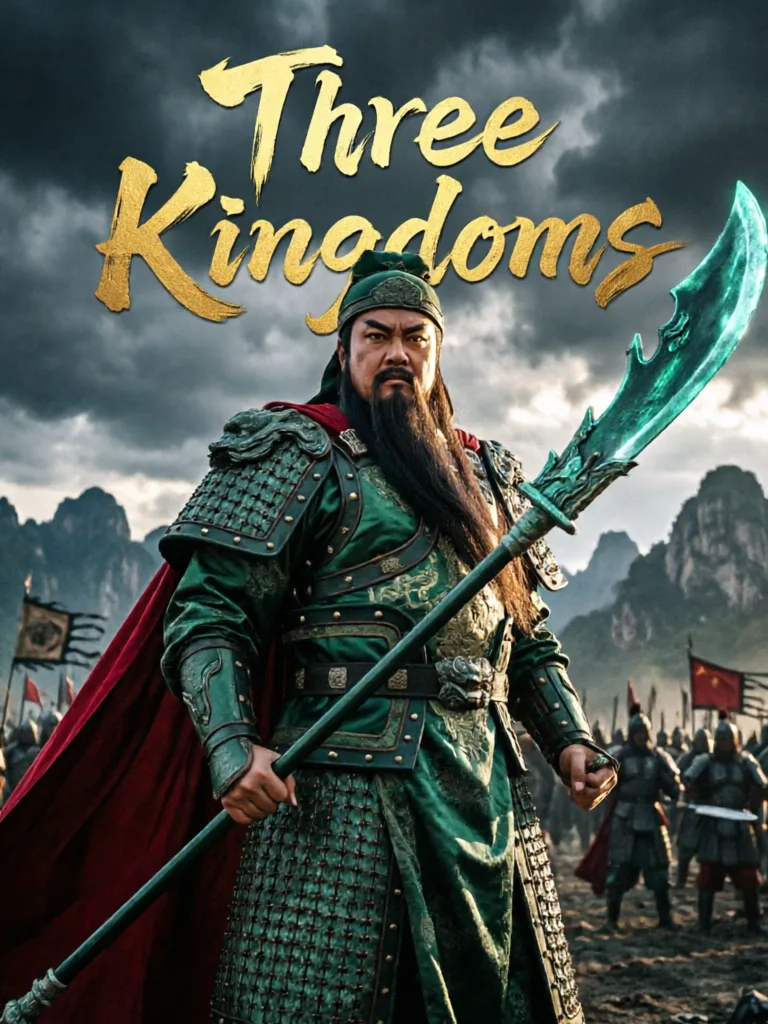
Now Yuan Shu, based in Huainan, commanded vast territories and abundant grain supplies. He also held the Imperial Jade Seal, which Sun Ce had left as a pledge. These possessions stirred within him the ambition to claim the imperial title. He summoned all his officials and declared, "In the past, Liu Bang, the founder of the Han, was merely a village constable on the Si River, yet he came to possess the realm. Now, after four hundred years, the dynasty's allotted span is exhausted. All under Heaven churns like a boiling cauldron. My family has produced the Three Excellencies for four generations, and the people look to us. I should follow the will of Heaven and the desires of men, and ascend to the throne. What say you all?" The Recorder, Ge Xiang, stepped forward and said, "This cannot be done. In ancient times, Hou Ji of Zhou accumulated virtue and merit, and by the time of King Wen, the Zhou held two-thirds of the realm, yet they still served the Yin dynasty. Your Excellency's family, though noble, is not as great as the Zhou. The Han court, though weakened, is not as tyrannical as King Zhou of Yin. This course must not be taken." Yuan Shu's face darkened with rage. "Our Yuan clan descends from the Chen lineage. Chen is the descendant of the great Shun. Earth succeeds Fire, and this aligns with the cosmic cycles. Furthermore, the prophecy states: 'He who will succeed the Han is the one on the road.' My style name, Gonglu, signifies 'the public road,' fulfilling this omen. I also possess the Imperial Seal of state. If I do not take the throne, I would be defying the Mandate of Heaven. My mind is made up.
Anyone who speaks against it will be executed!" He then proclaimed himself Emperor of the Zhong dynasty, established a court with all its ministries, rode in the imperial dragon and phoenix chariot, performed the suburban sacrifices to Heaven and Earth, made Lady Feng his Empress, and appointed his son as the Crown Prince. He sent an envoy to demand Lü Bu's daughter as a bride for the Crown Prince. But when he learned that Lü Bu had sent Han Yin to Xuchang, where Cao Cao had him beheaded, Yuan Shu flew into a fury. He appointed Zhang Xun as Grand General, commanding over two hundred thousand troops, and divided them into seven armies to attack Xu Province. The first army, under Zhang Xun himself, would strike the center. The second, under Qiao Rui, would attack the left flank. The third, under Chen Ji, the right. The fourth, under Lei Bo, the left auxiliary. The fifth, under Chen Lan, the right auxiliary. The sixth, under the surrendered general Han Xian, and the seventh, under the surrendered general Yang Feng, would attack from the flanks. Each led their own elite forces, and a date was set for the march. Yuan Shu appointed Jin Shang, the Inspector of Yan Province, as Grand Commandant, to oversee the supply lines for all seven armies. When Jin Shang refused, Yuan Shu had him killed. Ji Ling was appointed as the overall commander of reinforcements for the seven armies. Yuan Shu himself led thirty thousand troops, with Li Feng, Liang Gang, and Le Jiu as advance coordinators to support the seven-pronged assault.
Lü Bu's scouts reported that Zhang Xun's army was marching directly on Xu Province via the main road. Qiao Rui was heading for Xiaopei, Chen Ji for Yidu, Lei Bo for Langya, Chen Lan for Jieshi, Han Xian for Xiapi, and Yang Feng for Junshan. All seven armies advanced fifty li a day, plundering everything in their path. Lü Bu urgently summoned his advisors. Chen Gong arrived along with Chen Gui and his son, Chen Deng. Chen Gong said, "This disaster upon Xu Province was brought about by the Chen family, father and son. They curried favor with the court to gain rank and office, and now they have brought this calamity upon you, General. Cut off their heads and send them to Yuan Shu, and his armies will withdraw." Lü Bu, swayed by this counsel, ordered Chen Gui and Chen Deng seized. Chen Deng laughed loudly. "How can you be so cowardly? I see these seven armies as nothing more than seven piles of rotting weeds. Why should we be concerned?" Lü Bu said, "If you have a plan to defeat the enemy, I will spare your lives." Chen Deng replied, "If you, General, will follow my advice, Xu Province will be safe." Lü Bu said, "Speak, then." Chen Deng explained, "Yuan Shu's forces are numerous, but they are a rabble, lacking trust and discipline. If we hold our ground with a proper defense and strike with a surprise attack, we cannot fail. I have another plan that will not only secure Xu Province but also capture Yuan Shu alive." Lü Bu leaned forward. "What is your plan?" Chen Deng said, "Han Xian and Yang Feng were once officers of the Han. They fled to Yuan Shu for shelter because they feared Cao Cao, having no other home. Yuan Shu will surely treat them lightly, and they will not be loyal to him. If you send a secret letter to them, making them your allies from within, and also coordinate with Liu Bei as an ally from without, you will surely capture Yuan Shu." Lü Bu said, "You must personally deliver the letters to Han Xian and Yang Feng." Chen Deng agreed.
Lü Bu sent a memorial to Xuchang and a letter to Liu Bei in Yu Province. Then he ordered Chen Deng to take a few riders and wait on the road to Xiapi for Han Xian. When Han Xian's army arrived and set up camp, Chen Deng entered to see him. Han Xian asked, "You are one of Lü Bu's men. What business have you here?" Chen Deng smiled. "I am a minister of the great Han. Why do you call me one of Lü Bu's men? You, General, were once a Han officer. Now you have become a subject of a rebel. You have thrown away your past merit of protecting the Emperor at Chang'an. I cannot approve of this course. Furthermore, Yuan Shu is deeply suspicious by nature. He will surely destroy you in the end. If you do not act now, it will be too late to regret." Han Xian sighed. "I wish to return to the Han, but I see no way." Chen Deng then produced Lü Bu's letter. After reading it, Han Xian said, "I understand. Return first. I will coordinate with General Yang Feng to turn our forces against Yuan Shu. Watch for a fire as our signal. Then let the Marquis of Wen (Lü Bu) strike with his army." Chen Deng took his leave and rushed back to inform Lü Bu.
Lü Bu then divided his forces into five columns. Gao Shun led one army to Xiaopei to confront Qiao Rui. Chen Gong led another to Yidu to confront Chen Ji. Zhang Liao and Zang Ba led a force to Langya to confront Lei Bo. Song Xian and Wei Xu led a force to Jieshi to confront Chen Lan. Lü Bu himself led the main army along the main road to confront Zhang Xun. Each column had ten thousand men; the remainder guarded the city. Lü Bu marched thirty li out of the city and set up camp. When Zhang Xun's forces arrived, he calculated that he was no match for Lü Bu and withdrew twenty li to await reinforcements from the other columns.
That night, during the second watch, Han Xian and Yang Feng ordered their troops to set fires everywhere, signaling for Lü Bu's men to enter their camp. Zhang Xun's army fell into chaos. Lü Bu seized the moment and attacked, routing Zhang Xun. Lü Bu pursued until dawn, when he encountered Ji Ling's relief force. The two armies were about to clash when Han Xian and Yang Feng struck from both sides. Ji Ling was utterly defeated and fled. Lü Bu pressed the pursuit. Suddenly, from behind a hill, a fresh army appeared. As its banners parted, a formation of troops bearing dragon and phoenix flags, and all manner of imperial standards, came into view. Beneath a golden silk canopy, Yuan Shu himself stood in golden armor, with two swords hanging from his wrists. He cursed Lü Bu, "You faithless slave and traitor to your master!" Enraged, Lü Bu leveled his halberd and charged. Yuan Shu's general, Li Feng, raised his spear to meet him. Before three exchanges, Lü Bu wounded Li Feng in the hand, and Li Feng dropped his spear and fled. Lü Bu ordered his men to charge, and Yuan Shu's army collapsed. Lü Bu pursued, seizing countless horses and armor. Yuan Shu, leading his shattered forces, had not fled more than a few li when another army emerged from behind a hill, blocking his path. At its head was Guan Yu, who shouted, "Rebel! Prepare to die!" Yuan Shu fled in panic, his remaining soldiers scattering in all directions. Guan Yu cut them down mercilessly. Yuan Shu gathered his broken army and fled back to Huainan.
Lü Bu, victorious, invited Guan Yu, Yang Feng, and Han Xian to Xu Province for a grand feast. The troops were all rewarded. The next day, Guan Yu took his leave. Lü Bu recommended Han Xian as Governor of Yidu and Yang Feng as Governor of Langya. He discussed keeping them both in Xu Province. Chen Gui advised against it. "If Han Xian and Yang Feng hold Shandong, within a year all the cities of Shandong will be yours, General." Lü Bu agreed and sent the two generals to station their troops at Yidu and Langya temporarily, pending further imperial orders. Chen Deng privately asked his father, "Why not keep them here in Xu Province as a root for killing Lü Bu?" Chen Gui replied, "If they helped Lü Bu, it would be like adding claws and teeth to a tiger." Chen Deng admired his father's far-sighted wisdom.
Yuan Shu, defeated and back in Huainan, sent a messenger to Sun Ce in Jiangdong, asking to borrow troops for revenge. Sun Ce was furious. "You relied on the Imperial Jade Seal I gave you to falsely claim the imperial title and rebel against the Han. You are utterly treasonous! I was about to send an army to punish you. Why would I help a rebel?" He wrote a letter severing all ties. The messenger returned with the letter. After reading it, Yuan Shu raged, "That beardless boy! How dare he speak to me like this! I will attack him first!" His senior advisor, Yang Dajiang, strenuously argued against it, and Yuan Shu relented.
After sending his letter, Sun Ce prepared for an attack from Yuan Shu by stationing troops at the river mouth. Then a messenger arrived from Cao Cao, appointing Sun Ce as Grand Administrator of Kuaiji and ordering him to raise an army to attack Yuan Shu. Sun Ce discussed the matter with his advisors. He was about to march when his senior advisor, Zhang Zhao, said, "Though Yuan Shu has just been defeated, he still has many troops and ample grain. He should not be taken lightly. It would be better to write to Cao Cao, urging him to march south while we support him from the rear. With our two armies working together, Yuan Shu will surely be defeated. If something goes wrong, we can rely on Cao Cao for reinforcements." Sun Ce agreed and sent a messenger to Cao Cao with this proposal.
Back in Xuchang, Cao Cao, still mourning Dian Wei, held a memorial ceremony for him and enfeoffed his son, Dian Man, as a General of the Household, adopting him into his own household. A report arrived that Sun Ce had sent a letter. After reading it, another report came that Yuan Shu, running low on grain, was plundering Chenliu. Cao Cao decided to exploit Yuan Shu's weakness and launched a southern campaign. He left Cao Ren to guard Xuchang and took all other officers with him, commanding one hundred and seventy thousand infantry and cavalry, with over a thousand carts of supplies. He first sent word to coordinate with Sun Ce, Liu Bei, and Lü Bu. When his army reached the border of Yu Province, Liu Bei came to greet him. Cao Cao invited him into his camp. After their greetings, Liu Bei presented two severed heads. Cao Cao was startled. "Whose heads are these?" Liu Bei replied, "These are the heads of Han Xian and Yang Feng." Cao Cao asked, "How did you get them?" Liu Bei explained, "Lü Bu had them stationed temporarily at Yidu and Langya. But they let their troops plunder the people, and everyone was complaining. So I held a banquet, pretending to discuss matters with them. During the drinking, I dropped my cup as a signal, and my brothers Guan Yu and Zhang Fei killed them both. I have taken command of their troops. I have come now to confess my crime." Cao Cao said, "You have removed a scourge from the state. This is a great achievement. Why speak of a crime?" He richly rewarded Liu Bei, and their combined armies marched to the border of Xu Province. Lü Bu came out to greet them. Cao Cao spoke kindly to him, enfeoffed him as General of the Left, and promised to exchange his seal and seal-ribbon upon returning to the capital. Lü Bu was overjoyed. Cao Cao positioned Lü Bu's army on the left, Liu Bei's on the right, and took the center with his own main force, sending Xiahou Dun and Yu Jin as the vanguard.
When Yuan Shu learned of Cao Cao's approach, he ordered his general Qiao Rui to lead fifty thousand troops as the vanguard. The two armies met at the border of Shouchun. Qiao Rui rode out first. He fought Xiahou Dun for less than three exchanges before Xiahou Dun ran him through with his spear. Yuan Shu's army was routed and fled back to the city. Then came reports that Sun Ce had launched boats to attack the western riverbank, Lü Bu was attacking from the east, Liu Bei, Guan Yu, and Zhang Fei from the south, and Cao Cao himself was attacking from the north with one hundred and seventy thousand men. Yuan Shu was terrified. He urgently summoned his civil and military officials. Yang Dajiang said, "Shouchun has suffered from floods and droughts for years, and the people are starving. Now we are disturbing them with war. The people are already resentful. When the enemy army arrives, it will be hard to resist. It would be better to leave a garrison in Shouchun and not engage in battle. Wait until the enemy's grain runs out, and there will surely be trouble in their camp. Your Majesty should take the Imperial Guard and cross the Huai River. This will both lead us to more fertile lands and let us temporarily avoid the enemy's sharp edge." Yuan Shu took his advice. He left Li Feng, Le Jiu, Liang Gang, and Chen Ji to defend Shouchun with one hundred thousand troops, while he packed up all the remaining generals, soldiers, and the treasures of his treasury and crossed the Huai River.
Cao Cao's army of one hundred and seventy thousand men consumed vast amounts of grain daily. The various commanderies were also suffering from drought and famine, and supplies could not keep up. Cao Cao urged a quick assault, but Li Feng and the others held the city and refused to come out. After more than a month of stalemate, Cao Cao's grain was nearly exhausted. He wrote to Sun Ce and borrowed one hundred thousand hu of grain, but it was still insufficient for the troops. The granary official, Wang Hou, under the supervision of the supply officer Ren Jun, reported to Cao Cao, "The army is large and the grain is scarce. What should we do?" Cao Cao said, "Issue the grain using smaller measures. This will tide us over for a while." Wang Hou asked, "What if the soldiers complain?" Cao Cao replied, "I have a plan." Wang Hou followed the order and issued grain with smaller measures. Cao Cao secretly sent men to every camp to listen. Everywhere, soldiers were grumbling, saying that the Chancellor was cheating them. Cao Cao then secretly summoned Wang Hou. "I need to borrow something from you to calm the army. You must not be stingy." Wang Hou asked, "What does the Chancellor need?" Cao Cao said, "I need to borrow your head to display to the troops." Wang Hou was horrified. "I am truly innocent!" Cao Cao said, "I know you are innocent. But if I do not kill you, the army will mutiny. After you die, I will take care of your wife and children. Do not worry." Before Wang Hou could speak again, Cao Cao called for the executioners, who dragged him out and beheaded him. His head was hung on a high pole, and a notice was posted: "Wang Hou deliberately issued grain with smaller measures and stole from the army's rations. He has been executed according to military law." This quelled the soldiers' anger.
The next day, Cao Cao issued an order to all camp commanders: "If the city is not taken within three days, all commanders will be executed!" Cao Cao himself went to the city walls, supervising the troops as they carried earth and stones to fill the moat. Arrows and rocks rained down from the walls. Two junior officers, overcome with fear, tried to retreat. Cao Cao drew his sword and personally beheaded them at the foot of the wall. Then he dismounted and joined the men in carrying earth to fill the moat. Seeing this, every officer and soldier pushed forward with renewed vigor. The defenders on the wall could not hold out. Cao Cao's soldiers vied to be the first to scale the walls, broke through the gates, and the main force poured into the city. Li Feng, Chen Ji, Le Jiu, and Liang Gang were all captured alive. Cao Cao ordered them publicly executed in the marketplace. He burned all the illegally built palaces, halls, and other forbidden structures. The city of Shouchun was completely plundered. Cao Cao discussed advancing across the Huai River to pursue Yuan Shu. Xun Yu advised against it. "This year has been one of drought and famine. Grain is hard to come by. If we advance further, we will exhaust our army and harm the people, with little chance of gain. It would be better to return to Xuchang for now. Next spring, when the wheat is ripe and our army has enough grain, we can plan our next move." Cao Cao hesitated. Then a scout arrived with urgent news: "Zhang Xiu, relying on Liu Biao, has grown bold again. The counties of Nanyang and Jiangling have rebelled. Cao Hong cannot hold them back and has lost several battles. He begs for reinforcements." Cao Cao quickly wrote to Sun Ce, ordering him to deploy his boats across the river to pin down Liu Biao and prevent him from moving. He then ordered an immediate return to the capital, to discuss a campaign against Zhang Xiu. Before departing, he ordered Liu Bei to remain stationed at Xiaopei, to treat Lü Bu as a brother, and to aid each other, with no further aggression. Lü Bu led his army back to Xu Province. Cao Cao secretly said to Liu Bei, "I have stationed you at Xiaopei as a trap for the tiger. Consult with Chen Gui and his son on all matters. Do not let anything go wrong. I will be your support from without." With these words, they parted.
Cao Cao led his army back to Xuchang. A report arrived that Duan Wei had killed Li Jue, and Wu Xi had killed Guo Si, and they had brought their heads to present to the court. Duan Wei also delivered Li Jue's entire clan, over two hundred men, women, and children, alive to Xuchang. Cao Cao ordered them all executed at the various city gates, and their heads displayed. The people rejoiced. The Emperor held court, gathered his civil and military officials, and held a feast of peace. Duan Wei was enfeoffed as General of Bandit Suppression, and Wu Xi as General of Southern Pacification. They were each given troops to guard Chang'an. They thanked the Emperor and departed. Cao Cao then memorialized the throne that Zhang Xiu had rebelled and must be punished. The Emperor personally prepared the imperial chariot to see Cao Cao off on his campaign. It was now the summer of the fourth month of the third year of Jian'an (198 AD).
Cao Cao left Xun Yu in Xuchang to manage affairs and led the main army forth. Along the march, he saw that the wheat in the fields was ripe, but the people, fearing the army, had fled and dared not harvest it. Cao Cao sent messengers throughout the region to announce to the villagers and local officials: "I have received the Emperor's sacred decree to lead an army against rebels, to rid the people of harm. The wheat is ripe now, but I am forced to march. All officers and soldiers are ordered: anyone who tramples the wheat fields will be beheaded. This military law is strict. Do not be alarmed." The people, hearing this, were overjoyed and praised him, kneeling by the roadside and bowing as the dust rose. When the army passed through the wheat fields, the soldiers dismounted and carefully pushed the wheat aside with their hands, passing it along, not daring to trample a single stalk. As Cao Cao himself was riding, a pheasant suddenly flew up from the field. His horse, startled, bolted into the wheat, trampling a large patch. Cao Cao immediately summoned the Registrar to discuss the punishment for his own crime of trampling the wheat. The Registrar said, "How can the Chancellor be punished?" Cao Cao replied, "I made the law myself, and I have broken it. How can I command obedience?" He drew his sword and prepared to cut his own throat. His officers rushed to stop him. Guo Jia said, "According to the ancient principle of the Spring and Autumn Annals, the law does not apply to the highest authority. You, Chancellor, command the entire army. How can you harm yourself?" Cao Cao pondered for a long time. "Since the Spring and Autumn Annals says the law does not apply to the highest, I will spare my life for now." He then used his sword to cut off his own hair and threw it to the ground. "I cut off my hair as a substitute for my head." He had the hair displayed to the three armies, saying, "The Chancellor trampled the wheat and should have been beheaded as a warning. Now he has cut off his hair as a substitute." The entire army was awestruck, and no one dared disobey the military orders.
A poet of the time reflected on this incident: An army of a hundred thousand men has a hundred thousand wills, and the command of one man alone can hardly restrain them all. By drawing his sword and cutting off his hair as a substitute for his head, one could truly see the depth of Cao Cao's deceitful cunning.
When Zhang Xiu learned of Cao Cao's approach, he urgently sent a letter to Liu Biao, requesting support from the rear. Meanwhile, he led his generals Lei Xu and Zhang Xian out of the city to meet the enemy. The two armies drew up in battle formation. Zhang Xiu rode out and cursed Cao Cao, "You hypocrite, you have no shame! You are no better than a beast!" Cao Cao, enraged, ordered Xu Chu to engage. Zhang Xiu sent Zhang Xian to meet him. In three exchanges, Xu Chu cut down Zhang Xian, and Zhang Xiu's army was routed. Cao Cao pursued them to the walls of Nanyang. Zhang Xiu withdrew into the city and closed the gates. Cao Cao besieged the city. The moat was wide and deep, making it difficult to approach the walls. He ordered his men to fill the moat with earth and to build ramps from a mixture of earth, sandbags, firewood, and straw. He also set up scaling ladders to peer into the city. Cao Cao himself rode around the city, surveying it. After three days of this, he issued an order for the troops to pile firewood at the western corner of the city walls and gather all the officers there, as if that was where they would launch the assault. Inside the city, Jia Xu, seeing this, said to Zhang Xiu, "I now understand Cao Cao's intention. We can turn his own scheme against him." Indeed: Among the strong, there is always one who is stronger; and those who use deceit will meet those who can see through it. What was Jia Xu's plan? Listen to the next chapter to find out.