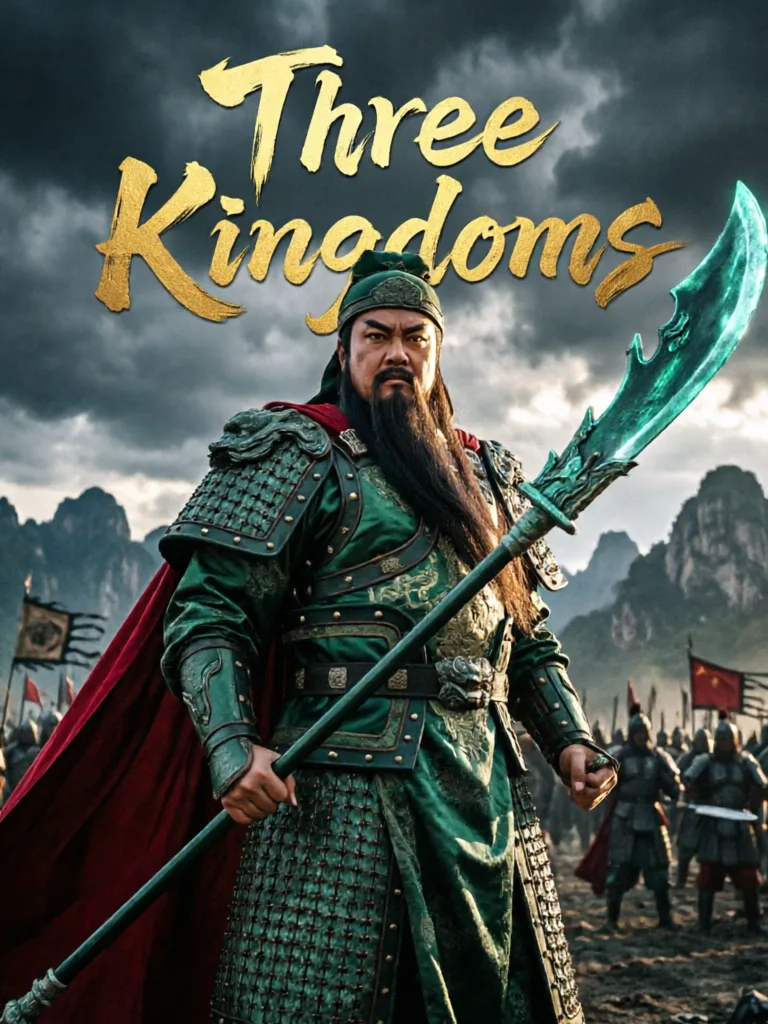
Kan Ze, whose style name was Derun, was a man of Shanyin in Kuaiji Commandery. Born into poverty, he was nonetheless devoted to learning, working as a hired laborer and often borrowing books to read—he never forgot a single passage after a single reading. He possessed a sharp tongue and bold spirit from his youth. Sun Quan had appointed him as an advisor, and he was closest in friendship to Huang Gai. Recognizing Kan Ze’s eloquence and courage, Huang Gai decided to entrust him with delivering the feigned surrender letter. Kan Ze accepted with enthusiasm, declaring: “A man of ambition who cannot achieve merit and establish a legacy is no better than grass or wood rotting in the earth! Since you are willing to sacrifice yourself for your lord, why should I begrudge my own insignificant life?” Huang Gai, still weak from his wounds, rolled off his bed and knelt to thank him. Kan Ze said: “There is no time to delay—I must go at once.” Huang Gai replied: “The letter is already prepared.” Taking the letter, Kan Ze disguised himself as a fisherman that very night, rowed a small skiff, and headed for the northern shore of the Yangtze.
That night, the sky was filled with cold stars. By the third watch, he had reached Cao Cao’s naval camp. Patrol boats seized him and reported the capture to Cao Cao immediately. Cao Cao asked: “Could he be a spy?” The soldiers replied: “He is only a fisherman, who claims to be Kan Ze, an advisor from Eastern Wu, bearing secret intelligence.” Cao Cao ordered him brought in. The soldiers led Kan Ze into the tent, where lamps and candles blazed brightly. Cao Cao sat upright behind a table and demanded: “If you are indeed an advisor from Eastern Wu, what business brings you here?” Kan Ze replied: “Men say that Chancellor Cao thirsts for worthy men like a thirsty man for water, but this question hardly matches that reputation. Huang Gai has misjudged you!” Cao Cao said: “Wu and I are on the verge of war. Why should I not question you for coming here in secret?” Kan Ze answered: “Huang Gai is a veteran minister who has served the Sun family for three generations. Just now, Zhou Yu had him brutally beaten before all the generals for no reason. In his fury, he wishes to surrender to you, Chancellor, to seek vengeance, and he consulted me. Huang Gai and I are as close as flesh and blood, so I came directly to deliver his secret letter. I do not know if you, Chancellor, will accept it.” Cao Cao said: “Where is the letter?” Kan Ze produced it and presented it.
Cao Cao tore open the seal and read by lamplight. The letter read roughly: “I, Huang Gai, have received deep favor from the Sun family, and it would be improper for me to harbor divided loyalties. Yet considering the current situation: using the troops of six commanderies east of the Yangtze to oppose a million-strong army from the Central Plains—the disparity is clear for all the realm to see. Every officer and soldier of Wu, wise or foolish, knows this cannot succeed. That boy Zhou Yu, narrow-minded and reckless, overestimates his own abilities and insists on smashing an egg against a rock. Moreover, he abuses his power, punishing the innocent and rewarding not the meritorious. I, an old minister, have been humiliated by him for no cause, and my heart burns with hatred! I have heard that you, Chancellor, treat men with sincerity and welcome talent with an open mind. I wish to lead my men in surrender, to achieve merit and wash away this shame. Grain, forage, and military supplies will be delivered with my ships. I write this with tears of blood; I beg you not to doubt me.”
Cao Cao turned the letter over and over on his table, reading it more than ten times. Suddenly, he slammed the table, his eyes blazing with fury, and roared: “Huang Gai is using the bitter-flesh trick! He sent you with this feigned surrender letter to exploit the situation—and you dare to mock me!” He ordered his attendants to drag Kan Ze out and behead him. As the guards seized him, Kan Ze’s face did not change color; instead, he threw back his head and laughed uproariously. Cao Cao had him brought back and shouted: “I have seen through your deceitful scheme! Why do you laugh?” Kan Ze replied: “I do not laugh at you. I laugh at Huang Gai for not knowing men.” Cao Cao demanded: “What do you mean by that?” Kan Ze said: “If you are going to kill me, then kill me—why all these questions?” Cao Cao said: “I have studied the art of war from my youth and know every trick of deception. Your scheme might fool others, but it cannot fool me!” Kan Ze retorted: “Then tell me—what part of the letter reveals a trick?” Cao Cao said: “I will show you the flaw so you die without complaint: if you were truly surrendering in good faith, why did you not specify a time? What do you have to say now?” Kan Ze laughed heartily and said: “For shame! You boast of knowing the art of war, yet you are not embarrassed! You had better withdraw your army at once! If you give battle, you will surely be captured by Zhou Yu! An ignorant fool!
What a pity that I must die at your hands!” Cao Cao said: “What do you mean by calling me ignorant?” Kan Ze replied: “You do not understand strategy, you do not grasp principles—is that not ignorance?” Cao Cao said: “Tell me—what are my mistakes?” Kan Ze said: “You lack the courtesy to treat a worthy man. Why should I say more? I am ready to die.” Cao Cao said: “If your words are reasonable, I shall naturally respect them.” Kan Ze said: “Have you not heard that a man betraying his lord to steal secrets cannot fix a date? If we set a time and cannot act swiftly, your forces would come to meet us, and the plan would be exposed. One must act when the opportunity arises—how can it be scheduled in advance? You do not understand this simple truth and would wrongfully kill an honest man—truly, you are ignorant!” Hearing this, Cao Cao’s expression softened. He rose from his seat, descended the mat, and bowed in apology: “I failed to see the truth and offended your dignity. Pray do not hold it against me.” Kan Ze said: “Huang Gai and I surrender with all our hearts, like infants yearning for their parents—how could there be deceit?” Cao Cao was overjoyed and said: “If you two achieve great merit, your future ranks and rewards shall surpass all others.” Kan Ze replied: “We do not come for rank or reward, but to follow Heaven’s will and the people’s desire.” Cao Cao ordered wine to be served.
Soon, a man entered the tent and whispered in Cao Cao’s ear. Cao Cao said: “Bring the letter for me to see.” The man presented a secret letter. Cao Cao read it, and his face showed great pleasure. Kan Ze thought to himself: “This must be Cai Zhong and Cai He reporting Huang Gai’s flogging—that is why Cao Cao is delighted that my surrender is genuine.” Cao Cao said: “I ask you, sir, to return to Jiangdong and agree with Huang Gai on a signal to send word across the river, so that I may send troops to meet him.” Kan Ze said: “I have already left Jiangdong and cannot return. I hope you, Chancellor, will send another trusted man.” Cao Cao said: “If I send someone else, the plan may be exposed.” Kan Ze declined repeatedly; after a long delay, he finally said: “If I must go, I dare not linger—I will leave at once.” Cao Cao offered him gold and silk, but Kan Ze refused them. He took his leave, left the camp, boarded his small boat, and returned to Jiangdong to see Huang Gai, recounting everything in detail. Huang Gai said: “If not for your eloquence, my suffering would have been in vain.” Kan Ze said: “I will now go to Gan Ning’s camp to investigate Cai Zhong and Cai He.” Huang Gai said: “Excellent.” Kan Ze went to Gan Ning’s camp. Gan Ning welcomed him in. Kan Ze said: “General, yesterday you were humiliated by Zhou Yu for trying to save Huang Gai—I am deeply indignant.” Gan Ning smiled but did not answer. Just then, Cai He and Cai Zhong arrived. Kan Ze glanced meaningfully at Gan Ning, who understood. Gan Ning said: “Zhou Yu relies only on his own ability and completely disregards us.
Now that I have been humiliated, I am ashamed to face the men of Jiangdong!” He ground his teeth, slammed the table, and shouted. Kan Ze then whispered in Gan Ning’s ear. Gan Ning bowed his head in silence and sighed heavily. Cai He and Cai Zhong, seeing that both Gan Ning and Kan Ze harbored rebellious thoughts, probed them: “General, why are you so troubled? And you, sir, what grievance do you have?” Kan Ze said: “The bitterness in our hearts—how could you understand?” Cai He said: “Could it be that you wish to abandon Wu and join Cao?” Kan Ze feigned alarm. Gan Ning sprang to his feet and drew his sword, shouting: “Our secret is discovered—we must kill them to silence their tongues!” Cai He and Cai Zhong cried out in panic: “Do not worry, both of you—we also have a secret to share.” Gan Ning said: “Speak quickly!” Cai He said: “We two were sent by Lord Cao to feign surrender. If you both have a mind to submit, we can arrange an introduction.” Gan Ning said: “Do you speak the truth?” Both answered in unison: “How dare we deceive you?” Gan Ning pretended to be overjoyed and said: “If so, Heaven has granted us this opportunity!” The two Cai brothers said: “We have already reported to the Chancellor about Huang Gai’s and your humiliation.” Kan Ze said: “I have already delivered Huang Gai’s surrender letter to the Chancellor. Now I have come to see Xingba (Gan Ning) to arrange our joint defection.” Gan Ning said: “When a man of ambition meets an enlightened lord, he should give his whole heart.” The four of them then drank together and discussed their plans.
The Cai brothers immediately wrote a secret letter to Cao Cao, stating: “Gan Ning and we will serve as your inside agents.” Kan Ze also wrote a separate letter and secretly sent it to Cao Cao, saying: “Huang Gai wishes to come but has not yet found the opportunity. Watch for a boat with a black-tipped banner—that will be him.”
Meanwhile, Cao Cao received both letters but remained uncertain. He gathered his advisors and said: “Gan Ning of Jiangdong, humiliated by Zhou Yu, wishes to be an inside agent; Huang Gai, flogged, sent Kan Ze to offer surrender. Neither can be fully trusted. Who dares to go directly into Zhou Yu’s camp to ascertain the truth?” Jiang Gan stepped forward and said: “My last mission to Eastern Wu failed, and I am deeply ashamed. Now I am willing to risk my life and go again, this time to bring back certain intelligence.” Cao Cao was delighted and immediately ordered Jiang Gan to set sail. Jiang Gan took a small boat straight to the southern shore’s naval camp and sent a message announcing his arrival. When Zhou Yu heard that Jiang Gan had come again, he was overjoyed and said: “My success depends entirely on this man!” He then instructed Lu Su: “Invite Pang Shiyuan (Pang Tong) to come, and tell him to act according to my plan.”
Pang Tong, whose style name was Shiyuan, was a native of Xiangyang. Having fled the chaos to live in Jiangdong, Lu Su had once recommended him to Zhou Yu. Before Pang Tong could visit, Zhou Yu sent Lu Su to ask his advice: “What strategy should we use to defeat Cao Cao?” Pang Tong said secretly to Lu Su: “To defeat Cao’s army, we must use fire. But on the broad river, if one ship catches fire, the others will scatter. Unless we can use the chain-link scheme—make him nail his ships together—then the fire attack can succeed.” Lu Su reported this to Zhou Yu, who deeply admired the plan and said to Lu Su: “The man to execute this scheme is none other than Pang Tong. But I fear Cao Cao is too cunning—how can Pang Tong get across?” Zhou Yu pondered but could not decide. Just as he was searching for an opportunity, news came that Jiang Gan had arrived again. Zhou Yu was overjoyed. He instructed Pang Tong on the plan while he himself sat in his tent and sent for Jiang Gan.
Seeing that Zhou Yu did not come to greet him, Jiang Gan grew suspicious. He had his boat moored at a secluded spot on the shore and then entered the camp to see Zhou Yu. Zhou Yu’s face darkened as he said: “Ziyi (Jiang Gan), why do you deceive me so cruelly?” Jiang Gan smiled and replied: “I thought of you as an old brother and came to speak from my heart—how is that deception?” Zhou Yu said: “You want me to surrender? Only when the seas run dry and the rocks crumble! Last time, out of our old friendship, I invited you to drink until you were drunk and shared my bed with you—yet you stole my private letters and left without a word, reporting to Cao Cao and causing the deaths of Cai Mao and Zhang Yun, ruining my plans. Now you come again for no reason—you must harbor ill intent! If not for our old friendship, I would cut you in two! I was going to send you across, but I am about to attack Cao Cao within a day or two. If I keep you here, you will surely leak my plans.” He then ordered his attendants: “Escort Ziyi to the hut on the western mountain to rest. After I have defeated Cao Cao, I will ferry you across the river.” Before Jiang Gan could speak again, Zhou Yu had already gone behind the tent.
The attendants brought a horse for Jiang Gan and took him to a small hut behind the western mountain, where two soldiers were assigned to attend him. Inside the hut, Jiang Gan was deeply troubled, unable to eat or sleep. That night, the stars shone brightly. He walked out alone behind the hut and heard the sound of someone reading. Following the sound, he found a thatched cottage by the mountain slope, with lamplight shining from within. Jiang Gan peered in and saw a man with a sword hanging before the lamp, reciting Sunzi and Wu Qi’s military classics. Jiang Gan thought: “This must be no ordinary man.” He knocked on the door and asked to see him. The man opened the door and came out—his bearing was extraordinary. Jiang Gan asked his name. The man replied: “My surname is Pang, my given name Tong, and my style name Shiyuan.” Jiang Gan said: “Are you not Master Fengchu (Young Phoenix)?” Pang Tong replied: “I am.” Jiang Gan was overjoyed and said: “I have long heard of your great name. Why are you living in such a remote place?” Pang Tong replied: “Zhou Yu thinks too highly of his own talent and cannot tolerate others, so I have hidden myself here. Who are you, sir?” Jiang Gan said: “I am Jiang Gan.” Pang Tong then invited him into the cottage, where they sat and talked. Jiang Gan said: “With your talents, sir, you could succeed anywhere. If you are willing to serve Cao Cao, I can arrange an introduction.” Pang Tong said: “I have long wished to leave Jiangdong. Since you are willing to introduce me, let us go at once. If we delay, Zhou Yu will hear of it and harm me.” So they went down the mountain that very night, found their boat at the riverbank, and rowed swiftly toward the northern shore.
When they reached Cao Cao’s camp, Jiang Gan went in first and reported everything. Hearing that Master Fengchu had arrived, Cao Cao came out of his tent personally to welcome him. They took their seats as host and guest. Cao Cao asked: “Zhou Yu is young and arrogant, bullying others and rejecting good counsel. I have long heard of your great name, sir. Now that you honor me with your presence, I beg you not to withhold your instruction.” Pang Tong said: “I have long heard that you, Chancellor, are skilled in military affairs. I would like to see your army’s disposition.” Cao Cao ordered horses to be prepared and first invited Pang Tong to view the land camp. They rode side by side to a high vantage point. Pang Tong observed and said: “Nestled against the hills and forests, with clear views forward and back, gates for entry and exit, and winding paths for advance and retreat—even if Sunzi and Wu Qi were reborn, or Sima Rangju returned, they could not surpass this.” Cao Cao said: “Sir, do not overpraise me—I still seek your guidance.” Then they went to view the naval camp. There, facing south, were twenty-four gates, each lined with towering warships arranged like a city wall, with smaller boats hidden within, passages for movement, and orderly rising and falling. Pang Tong smiled and said: “With such military skill, Chancellor, your reputation is well deserved!” Pointing south across the river, he added: “Zhou Yu, Zhou Yu—your doom is sealed!” Cao Cao was overjoyed. Returning to the camp, he invited Pang Tong into his tent, where they feasted and discussed military strategy. Pang Tong spoke eloquently and answered every question with ease. Cao Cao was deeply impressed and treated him with great courtesy.
Feigning drunkenness, Pang Tong asked: “May I ask if you have any good physicians in the army?” Cao Cao asked why. Pang Tong replied: “Your naval forces suffer from many illnesses and need good physicians to treat them.” At that time, Cao Cao’s soldiers, unaccustomed to the climate, were suffering from vomiting and many were dying. Cao Cao was already worried about this. Hearing Pang Tong’s question, he naturally asked for advice. Pang Tong said: “Your method of training the navy is excellent, but it is incomplete, unfortunately.” Cao Cao pressed him repeatedly. Pang Tong said: “I have a plan that will keep all your naval forces, large and small, free from illness and ensure a stable victory.” Cao Cao was overjoyed and begged to hear the plan. Pang Tong said: “On the great river, the tides rise and fall, and the wind and waves never cease. Northern troops are not used to boats; they suffer from this rocking and become ill. If you pair large ships with small ones, grouping them in rows of thirty or fifty, linking them head to tail with iron chains, and laying broad planks across them, then not only men but horses can cross. With this arrangement, no matter how the wind and waves toss them, what is there to fear?” Cao Cao rose from his seat and bowed in thanks: “Without your excellent plan, sir, how could I defeat Eastern Wu?” Pang Tong said: “This is but a humble suggestion—you, Chancellor, must decide.” Cao Cao immediately gave orders for the army’s blacksmiths to forge large iron nails that very night and chain the ships together. When the soldiers heard this, they were all delighted.
A poet of the time recorded: “At Red Cliffs, the great battle used fire; every strategist’s plan agreed on this. But without Pang Tong’s chain-link scheme, how could Zhou Yu have achieved his great victory?”
Pang Tong then said to Cao Cao: “I have observed that many of the heroes of Jiangdong resent Zhou Yu. With my tongue, I can persuade them to surrender to you. Zhou Yu, isolated and without support, will surely be captured by you. Once Zhou Yu is defeated, Liu Bei will be of no consequence.” Cao Cao said: “If you, sir, can achieve this great merit, I will petition the Emperor to grant you a position among the Three Excellencies.” Pang Tong replied: “I do not seek wealth or rank—I only wish to save the people. When you cross the river, Chancellor, be careful not to slaughter them.” Cao Cao said: “I act in Heaven’s name—how could I bear to kill the people?” Pang Tong then asked for an official proclamation to protect his family. Cao Cao asked: “Where does your family live, sir?” Pang Tong replied: “Only by the river. With such a proclamation, they can be saved.” Cao Cao ordered the proclamation written and sealed, then handed it to Pang Tong. Pang Tong bowed in thanks and said: “After I leave, you must advance quickly—do not wait for Zhou Yu to learn of this.” Cao Cao agreed.
Pang Tong took his leave and went to the riverbank. Just as he was about to board his boat, a man on the shore, dressed in a Daoist robe and bamboo hat, grabbed him and said: “What audacity! Huang Gai used the bitter-flesh trick, Kan Ze delivered the feigned surrender letter, and now you come to offer the chain-link scheme—I fear the fire will not burn thoroughly enough! You have played such a vicious hand, and it might fool Cao Cao, but it cannot fool me!” Pang Tong was terrified, his soul nearly fleeing his body. Truly: “Do not think only the southeast can win; who says the northwest has no men of its own?” Who was this man, and what happened next? The following chapter will reveal all.