Now, Sun Quan sought a plan from Lü Meng. Lü Meng said: “I calculate that Guan Yu has few troops and will surely not flee by the main road. Due north of Maicheng, there is a treacherous, narrow path—he will certainly take this route. Let Zhu Ran lead five thousand elite troops to ambush twenty li north of Maicheng. When his army arrives, do not engage them directly, only fall upon them from behind. Their soldiers will have no will to fight and will surely flee toward Linju. Then let Pan Zhang lead five hundred elite troops to ambush the secluded mountain paths of Linju, and Guan Yu can be captured. Now, send soldiers to attack each gate, leaving only the north gate open, waiting for him to sally forth.” Sun Quan, hearing this plan, ordered Lü Fan to cast the divination blocks once more. When the hexagram was formed, Lü Fan reported: “This hexagram indicates the enemy will flee to the northwest and will surely be captured at the hour of the Boar tonight.” Sun Quan, greatly delighted, then ordered Zhu Ran and Pan Zhang to lead two elite forces, each following the military orders to set their ambushes.
Meanwhile, Guan Yu, inside Maicheng, counted his remaining cavalry and infantry—only a little over three hundred men remained, and his grain supplies were exhausted. That night, outside the city, Wu soldiers called out the names of various officers in his army, and many climbed over the walls to desert. No relief force arrived. With no plan in his heart, he said to Wang Fu: “I regret not heeding your advice earlier! Now, in this crisis, what can I do?” Wang Fu wept and replied: “In this situation, even if Jiang Ziya were reborn, he could find no stratagem.” Zhao Lei said: “The relief force from Shangyong has not come—this is because Liu Feng and Meng Da have held their troops back. Why not abandon this isolated city, flee into Western Sichuan, regroup our forces, and return to seek recovery?” Guan Yu said: “I was also thinking of this.” He then ascended the wall to observe. Seeing that the enemy forces outside the north gate were few, he asked the local residents: “Heading north from here, what is the terrain like?” They replied: “From here, it is all rugged mountain paths that can lead to Western Sichuan.” Guan Yu said: “Tonight we will take this route.” Wang Fu advised: “The narrow path may have an ambush; we should take the main road.” Guan Yu said: “Even if there is an ambush, what do I fear?” He then ordered his cavalry and infantry officers to prepare their gear and get ready to leave the city. Wang Fu wept and said: “My lord, be careful on the road and take care of yourself! I, along with a hundred of my men, will hold this city to the death. Though the city may fall, I will not surrender! I only hope you will return quickly with relief!”
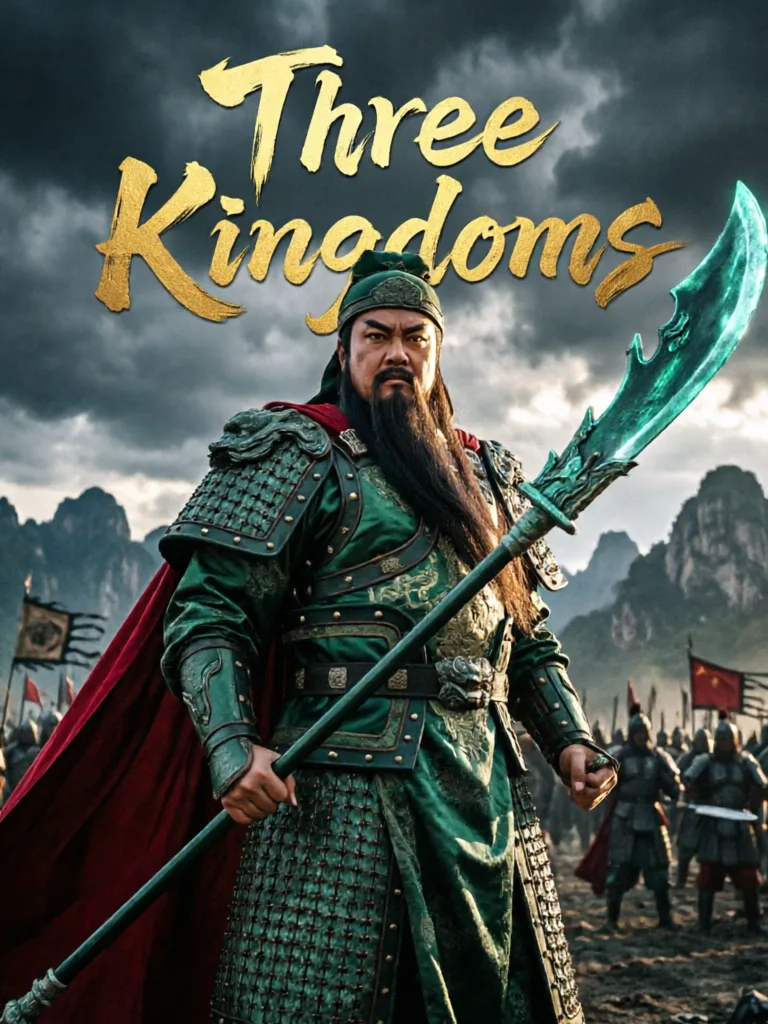
Guan Yu also wept as he bid him farewell. He left Zhou Cang to guard Maicheng with Wang Fu, while Guan Yu himself, along with Guan Ping and Zhao Lei, led a little over two hundred remnant troops, charging out of the north gate. Guan Yu, wielding his blade, advanced. After the first watch, they had traveled about twenty li when, from a hollow in the mountains, they heard the clamor of gongs and drums and a great shout—a troop of soldiers arrived, led by the general Zhu Ran, who spurred his horse and leveled his spear, crying: “Yunchang, do not flee! Surrender early and avoid death!” Guan Yu, enraged, whipped his horse and whirled his blade to engage. Zhu Ran immediately fled, and Guan Yu pressed the pursuit. At the sound of a drumbeat, ambush troops rose from all sides. Guan Yu, not daring to fight, fled toward the narrow path to Linju, while Zhu Ran led his men in pursuit. Guan Yu’s followers grew fewer and fewer. After traveling no more than four or five li, another shout arose ahead, and torches blazed as Pan Zhang, spurring his horse and brandishing his blade, came charging. Guan Yu, furious, whirled his blade to meet him. After only three exchanges, Pan Zhang fled in defeat. Guan Yu, not daring to linger in battle, hurried toward the mountain path. Behind him, Guan Ping caught up, reporting that Zhao Lei had died in the chaos of battle. Overcome with grief and alarm, Guan Yu ordered Guan Ping to guard the rear while he himself cleared the path ahead. Only about ten men remained with them. They arrived at Jueshi, where mountains rose on both sides, the slopes covered with reeds, withered grass, and tangled woods. It was nearly the end of the fifth watch. As they hurried along, a shout rang out, and ambush troops sprang up from both sides. Hooks and lassos were cast together, first tripping Guan Yu’s horse. Guan Yu was thrown from his saddle and was captured by Ma Zhong, a subordinate of Pan Zhang. Guan Ping, learning that his father had been taken, rushed to rescue him, but Pan Zhang and Zhu Ran arrived with their troops from behind, surrounding Guan Ping on all sides. Fighting alone, Ping exhausted his strength and was also taken. At dawn, when Sun Quan learned that Guan Yu and his son had been captured, he was overjoyed and assembled all his generals in his tent.
Soon, Ma Zhong escorted Guan Yu before him. Sun Quan said: “I have long admired the general’s noble virtue and wished to form a marital alliance with you—why did you reject me? In the past, you considered yourself unmatched under heaven; how is it that today you have fallen into my hands? Does the general now submit to Sun Quan?” Guan Yu, with a fierce voice, cursed: “Blue-eyed boy! Purple-bearded rat! I swore an oath in the Peach Garden with Imperial Uncle Liu to uphold the House of Han—how could I ever be allied with a traitor to Han like you? I have only fallen into a treacherous scheme today. Death is all I seek—why speak further?” Sun Quan, turning to his assembled officials, said: “Yunchang is a hero of the age, and I hold him deeply dear. Now, I wish to treat him with courtesy and persuade him to surrender. What do you think?” Chief Clerk Zuo Xian said: “This cannot be. In the past, when Cao Cao had this man, he enfeoffed him as a marquis, granted him titles, feasted him every three days with a small banquet and every five days with a grand one, gave him gold when he mounted his horse and silver when he dismounted—such grace and favor, yet in the end, he could not keep him. He listened as Guan Yu cut down his guards and killed his generals to escape, and today, that very man nearly forced Cao Cao to move his capital to avoid his blade. Now that you, my lord, have captured him, if you do not eliminate him immediately, I fear he will leave a disaster for the future.” Sun Quan pondered for a long moment, then said: “Your words are correct.” He then ordered Guan Yu to be taken out. And so, Guan Yu and his son were both put to death. It was the winter of the twenty-fourth year of the Jian’an era, in the twelfth month. Guan Yu was fifty-eight years old at his death. A poet of later times lamented: “In the final days of Han, his talent was unmatched; Yunchang stood alone above the crowd. His divine might could stir martial valor, yet he was also refined and knew the classics. His heart mirrored the sun and sky; his righteousness rivaled the clouds of the Spring and Autumn Annals. His glory shines through ten thousand ages, surpassing even the heroes of the Three Kingdoms.”
Another poet wrote: “A hero of men, only tracing back to ancient Jieliang, the common people vied to worship the Han Yunchang. In the Peach Garden, one day, he became a brother; through the ages, offerings have been made to him as an emperor and a king. His spirit rode the wind and thunder, peerless; his ambition shone like the sun and moon with radiance. To this day, his temples fill the realm, with ancient trees and cold crows under the setting sun.”
After Guan Yu’s death, his steed Red Hare was captured by Ma Zhong and presented to Sun Quan. Sun Quan immediately granted the horse to Ma Zhong to ride. But the horse refused to eat grass or fodder for several days and died.
Now, Wang Fu, inside Maicheng, felt his bones tremble and his flesh quiver. He asked Zhou Cang: “Last night, I dreamed I saw our lord, his body covered in blood, standing before me. I urgently asked him what had happened, then suddenly awoke in alarm. I do not know what good or ill this portends.” As they were speaking, a report came that Wu soldiers were below the city walls, displaying the severed heads of Guan Yu and his son to demand surrender. Wang Fu and Zhou Cang, greatly alarmed, hurried up the wall to look. There, indeed, were the heads of Guan Yu and his son. Wang Fu let out a great cry, fell from the wall, and died. Zhou Cang cut his own throat and perished. Thus, Maicheng also fell to Eastern Wu.
Now, Guan Yu’s spirit, refusing to dissipate, drifted aimlessly until it reached a certain place—a mountain in Dangyang County, Jingmen Prefecture, called Mount Yuquan. On the mountain lived an old monk, whose dharma name was Pu Jing. He had formerly been the abbot of the Zhenguo Temple at Sishui Pass. Later, while wandering the realm, he came to this place. Seeing the beauty of the mountains and rivers, he built a thatched hut here and spent his days in meditation and studying the Way. He had only a young attendant with him, who begged for food to sustain them. That night, under a bright moon and clear breeze, after the third watch, Pu Jing was sitting in silent meditation in his hut when he suddenly heard a voice in the sky crying out: “Return my head to me!” Pu Jing looked up and gazed intently. He saw a figure in the sky, riding Red Hare and bearing the Green Dragon Crescent Blade, flanked by a white-faced general on the left and a dark-faced man with a curly beard on the right. Together, they descended from the clouds to the peak of Mount Yuquan. Pu Jing recognized Guan Yu. He struck the door of his hut with his fly-whisk and said: “Where is Yunchang?” Guan Yu’s heroic spirit suddenly awakened. He dismounted, rode the wind down, and stood before the hut. Clasping his hands, he asked: “Master, who are you? I beg to know your dharma name.” Pu Jing said: “I am the old monk Pu Jing. In the past, at the Zhenguo Temple before Sishui Pass, I once met you, my lord. How could you have forgotten me today?” Guan Yu said: “I am forever grateful for the help you gave me then. Now, I have met with disaster and died. I seek your pure instruction to guide me from this confusion.” Pu Jing said: “The past is wrong, the present is right—let all discussion cease. The effects follow the causes; neither fails the other. Now, the general was killed by Lü Meng and cries out for his head to be returned, but then the heads of Yan Liang, Wen Chou, and the five generals at the six passes—from whom will you demand them?” At this, Guan Yu was suddenly enlightened. He bowed his head in homage and departed. From then on, he often manifested his spirit on Mount Yuquan to protect the people. The locals, moved by his virtue, built a temple on the mountain peak and offered sacrifices in all four seasons. Later generations inscribed a couplet on his temple: “A red face with a red heart, riding Red Hare that chases the wind—when galloping, never forgetting the Red Emperor. A green lamp shining on the green history, wielding the Green Dragon Crescent Blade—in the hidden places, not ashamed before the blue sky.”
Now, Sun Quan, having killed Guan Yu, took full possession of the lands of Jing and Xiang. He feasted and rewarded his three armies and held a great banquet for all his generals to celebrate the victory. He placed Lü Meng in the seat of honor and said to his assembled generals: “For so long, I could not gain Jing Province, but now I have taken it as easily as reaching into my pocket—all of this is the achievement of Ziming.” Lü Meng repeatedly declined the praise. Sun Quan said: “In the past, Zhou Yu had extraordinary talent and strategy, defeating Cao Cao at Red Cliffs, but unfortunately, he died young, and Lu Su replaced him. When Lu Su first met me, he spoke of the grand strategy of an emperor—that was the first satisfaction. When Cao Cao marched east, everyone urged me to surrender; only Lu Su advised me to summon Gongjin to oppose and attack him—that was the second satisfaction. Only his advice to lend Jing Province to Liu Bei was a shortcoming. Now, Ziming has devised a plan and immediately captured Jing Province—far surpassing Lu Su and Zhou Yu!” Then, he personally poured a cup of wine and offered it to Lü Meng. Lü Meng took the cup and was about to drink when he suddenly threw the cup to the ground, seized Sun Quan with one hand, and cursed in a fierce voice: “Blue-eyed boy! Purple-bearded rat! Do you still recognize me?” All the generals were greatly alarmed. As they rushed to help, Lü Meng pushed Sun Quan to the ground, strode forward, and sat down in Sun Quan’s seat. His brows were raised in anger, and his eyes were wide open. He shouted: “Since I defeated the Yellow Turbans, I have roamed the realm for more than thirty years. Today, you have trapped me with a treacherous scheme! While I live, I cannot devour your flesh; in death, I will pursue the soul of that Lü villain! I am Guan Yunchang, the Lord of Hanshou!” Sun Quan, terrified, hastily led all his officers and soldiers in bowing down. Then, they saw Lü Meng fall to the ground, blood flowing from his seven orifices, and he died. All the generals who saw this were filled with fear. Sun Quan had Lü Meng’s body placed in a coffin and buried with honor, granting him the posthumous titles of Grand Administrator of Nan Commandery and Marquis of Chanling. He ordered Lü Meng’s son, Lü Ba, to inherit his title. From this time on, Sun Quan was deeply affected by the matter of Guan Yu, shaken and unable to understand it.
Suddenly, a report came that Zhang Zhao had arrived from Jianye. Sun Quan called him in and asked for his counsel. Zhang Zhao said: “Now that you, my lord, have killed Guan Yu and his son, disaster for Jiangdong is not far off! This man swore an oath in the Peach Garden with Liu Bei to live and die together. Now, Liu Bei already commands the armies of the Two Sichuan regions, coupled with the strategies of Zhuge Liang and the valor of Zhang Fei, Huang Zhong, Ma Chao, and Zhao Yun. If Liu Bei learns that Yunchang and his son have been killed, he will surely raise the entire forces of his kingdom to seek vengeance with all his might. I fear Eastern Wu will be hard-pressed to oppose him.” Sun Quan, hearing this, was greatly alarmed. He stamped his foot and said: “I have lost all judgment! What can be done about this?” Zhang Zhao said: “My lord, do not worry. I have a plan that will prevent the armies of Western Shu from invading Eastern Wu and keep Jing Province as secure as a rock.” Sun Quan asked what the plan was. Zhang Zhao said: “Now, Cao Cao commands a million men and glares at the Central Plains like a tiger. Liu Bei, eager for revenge, will surely make peace with Cao Cao. If these two forces join and come against us, Eastern Wu will be in peril. It would be better to send someone first to deliver Guan Yu’s head to Cao Cao, making Liu Bei believe that Cao Cao was behind the killing. Liu Bei will then hate Cao Cao bitterly, and the armies of Western Shu will turn against Wei, not Wu. We can then watch the outcome of their struggle and act accordingly. This is the best strategy.”
Sun Quan followed his advice and immediately sent an envoy with Guan Yu’s head sealed in a wooden box, traveling day and night to deliver it to Cao Cao. At that time, Cao Cao had just returned from Mopi to Luoyang. Hearing that Eastern Wu had sent Guan Yu’s head, he said with joy: “Yunchang is dead—now I can sleep peacefully at night!” A man stepped forward from below the dais and said: “This is Eastern Wu’s scheme to shift the blame.” Cao Cao looked and saw it was his Chief Clerk, Sima Yi. Cao Cao asked him the reason. Sima Yi said: “In the past, when Liu Bei, Guan Yu, and Zhang Fei swore the oath in the Peach Garden, they vowed to live and die together. Now, Eastern Wu has killed Guan Yu, and fearing his revenge, they have presented his head to you, Your Majesty, so that Liu Bei will transfer his anger to you and attack Wei instead of Wu, while they seize the opportunity to act.” Cao Cao said: “Zhongda’s words are correct. What strategy can I use to resolve this?” Sima Yi said: “This is very easy. You, Your Majesty, should take Guan Yu’s head, carve a body from fragrant wood to match it, and bury him with the rites due a great minister. When Liu Bei learns of this, he will hate Sun Quan deeply and will exhaust his strength in a southern campaign. We can then watch the outcome. If Shu wins, we attack Wu; if Wu wins, we attack Shu. If we can take one of them, the other will not last long.” Cao Cao, greatly pleased, followed his plan. He summoned the Wu envoy. The envoy presented the wooden box. Cao Cao opened the box and looked inside. He saw Guan Yu’s face looking as it had in life. Cao Cao smiled and said: “Lord Yunchang, you are well since we last met!” Before he finished speaking, Guan Yu’s mouth opened, his eyes moved, and his beard and hair bristled. Cao Cao fell backward in shock. All his officials rushed to revive him. It was a long time before he regained consciousness. He turned to his officials and said: “General Guan is truly a divine being!” The Wu envoy then told Cao Cao of how Guan Yu’s spirit had manifested, possessed Lü Meng, cursed Sun Quan, and pursued him to his death. Cao Cao became even more fearful. He then prepared sacrifices of livestock and wine, carved a body from aloeswood, and buried Guan Yu with the rites of a prince outside the south gate of Luoyang. He ordered all officials, high and low, to attend the funeral procession. Cao Cao himself performed the funeral rites, granted Guan Yu the posthumous title of King of Jing, and appointed officials to guard his tomb. He then sent the Wu envoy back to Jiangdong.
Now, the King of Hanzhong had returned from Eastern Sichuan to Chengdu. Fa Zheng memorialized: “Your Majesty’s first wife has passed away, and Lady Sun has returned south. She is unlikely to return. The way of human relations cannot be neglected. You must take a royal consort to assist in the internal affairs of the court.” The King of Hanzhong agreed. Fa Zheng further memorialized: “Wu Yi has a younger sister who is both beautiful and virtuous. I have heard that a physiognomist once predicted that this woman would later achieve great nobility. She was previously betrothed to Liu Mao, the son of Liu Yan, but Liu Mao died young. The woman has remained widowed to this day. Your Majesty could take her as your consort.” The King of Hanzhong said: “Liu Mao is of the same clan as I. According to propriety, this cannot be done.” Fa Zheng said: “If we consider the closeness or distance of the relationship, how is this different from Duke Wen of Jin marrying Huai Ying?” The King of Hanzhong then agreed and took Lady Wu as his consort. She later bore him two sons: the elder, Liu Yong, styled Gongshou; the younger, Liu Li, styled Fengxiao.
Meanwhile, in the two regions of Eastern and Western Sichuan, the people were prosperous, the state was secure, and the harvests were abundant. Suddenly, someone arrived from Jing Province, reporting that Eastern Wu had sought a marriage alliance with Guan Yu, but Guan Yu had firmly refused. Zhuge Liang said: “Jing Province is in danger! We should send someone to replace Guan Yu and bring him back.” As they were deliberating, messengers bearing reports of victories from Jing Province arrived in a continuous stream. Within a day, Guan Xing arrived and gave a full account of the flooding of the Seven Armies. Suddenly, another mounted messenger arrived, reporting that Guan Yu had established numerous beacon towers along the river and that his defenses were extremely tight—there was not the slightest risk. Thus, Liu Bei’s mind was set at ease.
One day, Liu Bei suddenly felt his entire body trembling with unease; he could neither sit nor stand still. By night, he could not sleep. He rose and sat in his private chamber, lit a candle, and tried to read. He felt his spirit and thoughts grow hazy, and he fell asleep leaning on his desk. A cold wind arose in the room, extinguishing the candle, which then relit. He looked up and saw a figure standing in the lamplight. Liu Bei asked: “Who are you, to come into my private chamber in the dead of night?” The figure did not answer. Liu Bei, puzzled and suspicious, rose to look more closely. It was Guan Yu, moving back and forth in the lamplight, avoiding him. Liu Bei said: “My brother, you are well since we last met! To come here in the deep night, there must be some great reason. I am as close to you as bone and flesh—why do you avoid me?” Guan Yu, weeping, said: “I beg you, my brother, to raise an army to avenge my wrongs!” As he finished speaking, a cold wind suddenly arose, and Guan Yu vanished. Liu Bei awoke with a start—it was a dream. It was then the third watch. Liu Bei, filled with doubt, hurried to the front hall and sent someone to summon Zhuge Liang.
Zhuge Liang entered and saw him. Liu Bei recounted the dream in detail. Zhuge Liang said: “This is merely because you, Your Majesty, have been thinking of Guan Yu. Hence, this dream. Why be overly suspicious?” Liu Bei remained deeply troubled, but Zhuge Liang used kind words to soothe him. Zhuge Liang took his leave and went out. When he reached the middle gate, he met Xu Jing. Xu Jing said: “I was just on my way to the military strategist’s office to report a secret piece of news. Learning that you had entered the palace, I came here specially.” Zhuge Liang asked: “What secret news?” Xu Jing said: “I have just heard from outsiders that Lü Meng of Eastern Wu has attacked Jing Province and that Guan Yu has been killed! Therefore, I have come to report this in secret.” Zhuge Liang said: “I observed the stars last night and saw that a general’s star had fallen in the region of Jing and Chu. I already knew that Yunchang must have met with disaster, but I feared it would distress the king, so I dared not speak of it.”
As the two were speaking, a figure suddenly emerged from within the hall, seized Zhuge Liang by the sleeve, and said: “Such terrible news—why have you hidden it from me?” Zhuge Liang looked and saw it was Liu Bei. Zhuge Liang and Xu Jing memorialized: “What we have just said are all rumors and not yet to be fully believed. We beg Your Majesty to relax your mind and not give way to worry.” Liu Bei said: “I swore with Yunchang to live and die together. If he has met with misfortune, how can I live on alone?” As Zhuge Liang and Xu Jing were trying to console him, a eunuch announced that Ma Liang and Yi Ji had arrived. Liu Bei urgently summoned them and asked for news. The two men gave a full account of the loss of Jing Province and of Guan Yu’s defeat and plea for help, presenting his memorial. Before he could open and read it, another eunuch announced the arrival of Liao Hua from Jing Province. Liu Bei urgently summoned him in. Liao Hua, weeping, prostrated himself on the ground and gave a detailed account of how Liu Feng and Meng Da had refused to send relief forces. Liu Bei was greatly alarmed and said: “If this is so, my brother is lost!” Zhuge Liang said: “Liu Feng and Meng Da have behaved with such insolence that their crime deserves death ten thousand times over! Your Majesty, calm your heart. I, Liang, will personally lead a force to relieve the crisis at Jing and Xiang.” Liu Bei, weeping, said: “If Yunchang has been lost, I will certainly not live on alone! Tomorrow, I will personally lead an army to rescue Yunchang!” He then sent someone to Langzhong to inform Zhang Fei and another to assemble his forces.
Before dawn, report after report arrived, saying that Guan Yu had fled by night to Linju, had been captured by Wu generals, had refused to submit in righteousness, and that he and his son had perished. When Liu Bei heard this, he let out a great cry and fell to the ground in a faint. Truly: “For the memory of the oath to die together in that year, how could he bear to let his brother perish alone?”
Whether Liu Bei lived or died, read on to find out.