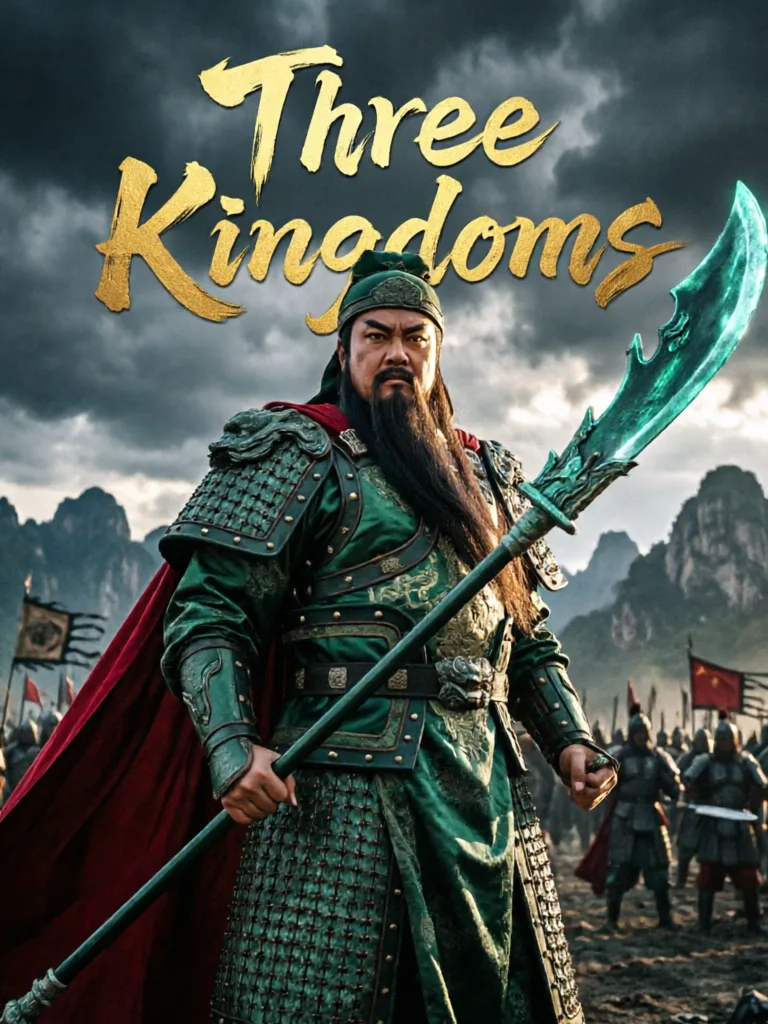
In the autumn of the first year of the Zhangwu era (221 AD), in the eighth month, the Former Lord Liu Bei led his great army to the Kui Pass, establishing his imperial camp at Baidi City. The vanguard forces had already advanced beyond the mouth of the Sichuan gorges. A close attendant reported: "A Wu envoy, Zhuge Jin, has arrived." The Former Lord issued an order forbidding his entry. Huang Quan stepped forward and advised: "Your Majesty, Zhuge Jin's younger brother serves as our Chancellor in Shu. He must have come on some important business. Why would Your Majesty refuse to see him? You should summon him and hear what he has to say. If his proposal is acceptable, accept it; if not, you can use his own words to send a message back to Sun Quan, letting him know the grounds for our righteous condemnation." The Former Lord agreed and summoned Zhuge Jin into the city. Zhuge Jin prostrated himself on the ground. The Former Lord asked: "Ziyu, you have come from afar. What business brings you here?" Zhuge Jin replied: "My younger brother has long served Your Majesty, so I dared not avoid the axe and the halberd to come and speak of the matter of Jing Province. Previously, when Lord Guan was in Jing Province, the Marquis of Wu repeatedly sought a marriage alliance, but Lord Guan would not consent. Later, when Lord Guan attacked Xiangyang, Cao Cao sent many letters to the Marquis of Wu, urging him to attack Jing Province. The Marquis of Wu was unwilling at first, but because Lü Meng bore a grudge against Lord Guan, he took it upon himself to raise an army, mistakenly bringing about this great calamity. Now the Marquis of Wu regrets it beyond measure. This was Lü Meng's crime, not the Marquis of Wu's fault. Lü Meng is now dead, and the grievance should be settled. Lady Sun has long wished to return. The Marquis of Wu has sent me as his envoy, willing to return Lady Sun, bind and hand over the surrendered generals, and also restore Jing Province to its former state, to forge a lasting alliance, and together destroy Cao Pi, to punish his crime of usurpation and rebellion."
The Former Lord erupted in fury: "Your Eastern Wu murdered my brother, and now you dare to come with glib words to deceive me!" Zhuge Jin said: "Let me speak to Your Majesty of matters of weight and consequence. Your Majesty is the Imperial Uncle of the Han Dynasty. Now the Han Emperor has been usurped by Cao Pi, yet you do not think of exterminating him. Instead, you would humiliate the dignity of an emperor for the sake of a bond of a different surname, abandoning great righteousness for a small one. The Central Plains are the heart of the realm; both capitals are the foundations of the great Han enterprise. Your Majesty does not seize them but contends only for Jing Province—this is to cast aside the weighty and grasp the trivial. All under Heaven know that Your Majesty, having ascended the throne, must restore the Han House and recover the rivers and mountains. Yet now Your Majesty ignores Wei and instead desires to attack Wu. I humbly believe Your Majesty should not do this." The Former Lord was enraged: "The vengeance for my brother's murder is an enmity that cannot be shared under the same sky! If you want me to halt the army, nothing short of death will stop me! If not for the sake of your brother the Chancellor, I would cut off your head here and now! For now, I let you return and tell Sun Quan: let him wash his neck and await the blade!" Seeing that the Former Lord would not listen, Zhuge Jin had no choice but to return to the south of the Yangtze.
Now, Zhang Zhao said to Sun Quan: "Zhuge Ziyu knows that the Shu army is powerful, so he has used the pretext of seeking peace, intending to abandon Wu and join Shu. He will surely not return this time." Sun Quan replied: "I have an unbreakable oath of life and death with Ziyu. I will not betray Ziyu, and Ziyu will not betray me. In the past, when Ziyu was at Chaisang, Kongming came to Wu, and I wanted Ziyu to detain him. Ziyu said: 'My younger brother has already pledged himself to Xuande; in righteousness, he cannot have two minds. That my brother would not stay is the same as my not going to him.' His words could pierce the gods. How could he now be willing to surrender to Shu? My bond with Ziyu is one of spiritual friendship, not to be broken by outside words." As he spoke, a report came that Zhuge Jin had returned. Sun Quan said: "What did I tell you?" Zhang Zhao, deeply ashamed, withdrew. Zhuge Jin met Sun Quan and explained that the Former Lord would not agree to peace. Sun Quan was greatly alarmed: "If this is the case, then the lands south of the Yangtze are in danger!" A man stepped forward from the ranks and said: "I have a plan to relieve this crisis." It was the Palace Counselor Zhao Zi. Sun Quan asked: "Dedu, what good strategy do you have?" Zhao Zi replied: "My lord, you should compose a memorial. I am willing to go as envoy to see the Wei Emperor Cao Pi, to explain the situation and its consequences, and to persuade him to attack Hanzhong. Then the Shu army will be in danger themselves." Sun Quan said: "This is an excellent plan. But when you go, do not lose the dignity of Eastern Wu." Zhao Zi said: "If there is even the slightest failure, I will throw myself into the Yangtze and die. How could I have the face to see the people of the south of the Yangtze again!"
Sun Quan was greatly pleased. He immediately composed a memorial declaring himself a vassal and appointed Zhao Zi as his envoy. Traveling day and night, Zhao Zi reached Xuchang. He first met with the Grand Commandant Jia Xu and other high and low officials. The next day at the morning court, Jia Xu stepped forward and reported: "Eastern Wu has sent the Palace Counselor Zhao Zi to present a memorial." Cao Pi smiled and said: "This is to try to repel the Shu army." He ordered Zhao Zi to be summoned. Zhao Zi prostrated himself on the vermilion steps of the palace. After reading the memorial, Cao Pi asked Zhao Zi: "What kind of ruler is the Marquis of Wu?" Zhao Zi replied: "He is a ruler of intelligence, benevolence, wisdom, and strategic might." Cao Pi laughed: "Your praise is perhaps too excessive." Zhao Zi said: "I do not overpraise him. The Marquis of Wu accepted Lu Su from among common men—that is his intelligence; he promoted Lü Meng from the ranks—that is his wisdom; he captured Yu Jin but did not harm him—that is his benevolence; he took Jing Province without bloodying a blade—that is his wisdom; he commands the Three Rivers and glares like a tiger at all under Heaven—that is his might; he humbles himself before Your Majesty—that is his strategy. Judging by these, how can he not be a ruler of intelligence, benevolence, wisdom, and strategic might?" Cao Pi then asked: "Does the Lord of Wu study much?" Zhao Zi replied: "The Lord of Wu commands ten thousand ships on the river, leads a million armored men, appoints the worthy and employs the capable, and his ambition is to manage the realm. In his rare moments of leisure, he widely reads books and histories, examining their great principles. He does not imitate those bookish scholars who merely pick out phrases and sentences." Cao Pi said: "I wish to attack Wu. Is it permissible?" Zhao Zi replied: "A great state has the army to launch expeditions; a small state has the strategies to defend itself." Cao Pi said: "Does Wu fear Wei?" Zhao Zi replied: "With a million armored men and the Yangtze and Han Rivers as its moat, what is there to fear?" Cao Pi said: "How many men of your caliber does Eastern Wu have?" Zhao Zi replied: "There are eighty or ninety who are exceptionally intelligent and distinguished. As for men like myself, they can be measured by the cartload and weighed by the bushel—countless in number." Cao Pi sighed and said: "To be sent as an envoy to the four quarters and not disgrace one's lord's command—you are worthy of this praise." He then issued an imperial decree, ordering the Grand Master of Ceremonies, Xing Zhen, to present the documents and confer upon Sun Quan the title of King of Wu, along with the Nine Dignities. Zhao Zi thanked the emperor and left the city.
The Counselor Liu Ye admonished: "Now Sun Quan, fearing the pressure of the Shu army, has come to surrender. In my humble opinion, the war between Shu and Wu is Heaven's way of destroying them. If Your Majesty would now send a top general with tens of thousands of troops to cross the Yangtze and attack them, with Shu attacking from without and Wei from within, the fall of Wu would not take ten days. With Wu destroyed, Shu would be isolated. Why does Your Majesty not plan this early?" Cao Pi replied: "Since Sun Quan has submitted to me with proper ceremony, if I were to attack him, it would discourage all those under Heaven who wish to surrender. It is better to accept him." Liu Ye argued further: "Though Sun Quan has great talent, his former rank was merely that of General of the Agile Cavalry and Marquis of Nanchang—positions of the fallen Han. When a man's office is low, his influence is weak, and he still fears the Central Plains. But if you grant him a royal title, he will be only one step below Your Majesty. If Your Majesty trusts his feigned surrender and exalts his rank and title, you will be enriching him, like adding wings to a tiger." Cao Pi said: "Not so. I will not help Wu, nor will I help Shu. I will watch the war between Wu and Shu. If one kingdom is destroyed and only one remains, then I will eliminate it. What difficulty will there be? My mind is made up. Do not speak of it again." He then ordered the Grand Master of Ceremonies, Xing Zhen, to accompany Zhao Zi, bearing the documents and the Nine Dignities, and go directly to Eastern Wu.
Now Sun Quan assembled his officials to discuss the strategy for resisting the Shu army. Suddenly, a report came that the Wei Emperor had enfeoffed him as king, and protocol demanded a distant welcome. Gu Yong admonished: "My lord should call himself Supreme General and Lord of the Nine Provinces. You should not accept the title conferred by the Wei Emperor." Sun Quan replied: "In his day, the Duke of Pei accepted the title conferred by Xiang Yu, for he adapted to the times. Why should I refuse it?" He then led his officials out of the city to welcome the envoy. Xing Zhen, prideful of being an envoy from the superior state, refused to dismount from his carriage at the gate. Zhang Zhao was enraged and shouted sternly: "In ritual, there is nothing that is not reverent; in law, there is nothing that is not strict. How dare you act so arrogantly? Do you think there is not a single inch of steel in the south of the Yangtze?" Xing Zhen, startled, hastily dismounted from his carriage, met Sun Quan, and they entered the city together in the same carriage. Suddenly, a man behind the carriage wept loudly and cried out: "We cannot exert ourselves and risk our lives to help our lord annex Wei and swallow Shu, but instead we allow our lord to receive a title from another! Is this not a disgrace?" Everyone looked and saw it was Xu Sheng. When Xing Zhen heard this, he sighed: "With generals and ministers like these, the lands south of the Yangtze will not long remain subordinate to others!"
After Sun Quan had received his title, and all the civil and military officials had paid their respects, he ordered the preparation of fine jade, pearls, and other treasures, and sent someone to present them as thanks to the Wei court. Soon, scouts reported that the Shu ruler was leading his main army, along with the King Shamoke of the Southern Tribes and tens of thousands of tribal troops, and also the Han generals Du Lu and Liu Ning from the mountain valleys, advancing by both land and water with a momentum that shook the heavens. The water force had already passed the mouth of the Wu Gorge, and the land force had reached Zigui. Though Sun Quan had now ascended the throne of a king, the Wei lord would not provide support. He asked his civil and military officials: "The Shu army is powerful. What should we do?" They all remained silent. Sun Quan sighed: "After Zhou Yu came Lu Su; after Lu Su came Lü Meng. Now Lü Meng is dead, and there is no one to share my burdens!" Before he finished speaking, a young general suddenly stepped forward from the ranks, prostrated himself, and said: "Though I am young, I have studied the art of war. I beg for tens of thousands of troops to break the Shu army." Sun Quan looked at him—it was Sun Huan. Sun Huan, styled Shuwu, was the son of Sun He, who was originally surnamed Yu. Sun Ce had favored him and granted him the surname Sun, making him part of the royal clan. Sun He had four sons, and Sun Huan was the eldest. Skilled in archery and horsemanship, he had often accompanied the King of Wu on campaigns, achieving many remarkable feats. He held the rank of Commandant of Military Guards and was now twenty-five years old. Sun Quan asked: "What strategy do you have to defeat them?" Sun Huan replied: "I have two great generals: one named Li Yi, the other named Xie Jing. Both have the strength to withstand ten thousand men. I beg for tens of thousands of troops to go and capture Liu Bei." Sun Quan said: "Though you are brave, nephew, you are still young. You must have someone to assist you." The Tiger Might General Zhu Ran stepped forward and said: "I am willing to go with the young general to capture Liu Bei." Sun Quan agreed and deployed fifty thousand troops from both land and water. He appointed Sun Huan as Left Commander-in-Chief and Zhu Ran as Right Commander-in-Chief, ordering them to set out that very day. Scouts reported that the Shu army had already reached Yidu and established a camp. Sun Huan led twenty-five thousand troops and camped at the border of Yidu, dividing his force into three camps to resist the Shu army.
Now, the Shu general Wu Ban, holding the seal of Vanguard Commander, had advanced from Sichuan. Everywhere he went, the enemy surrendered at the sight of him, and he had not bloodied a single blade until he reached Yidu. Upon learning that Sun Huan was camped there, he sent a swift report to the Former Lord. The Former Lord had already reached Zigui. Enraged by the news, he said: "This mere child dares to oppose me?" Guan Xing stepped forward and said: "Since Sun Quan has sent this boy as a general, Your Majesty need not dispatch a great commander. I am willing to go and capture him." The Former Lord said: "I wish to see your youthful spirit." He ordered Guan Xing to go. As Guan Xing bowed and was about to leave, Zhang Bao stepped forward and said: "Since Guan Xing is going to punish the rebels, I wish to accompany him." The Former Lord said: "It is excellent that the two nephews go together, but you must be cautious and not act rashly."
The two young men took their leave of the Former Lord, joined forces with the vanguard, and advanced together, drawing up their battle lines. When Sun Huan learned that the main Shu army had arrived, he roused all his camps. The two armies faced each other. Sun Huan, with Li Yi and Xie Jing, reined in their horses beneath the command banners. From the Shu camp, two great generals emerged, both in silver helmets and silver armor, on white horses with white banners. The first was Zhang Bao, gripping his eighteen-foot steel-tipped spear; the second was Guan Xing, wielding a large broadsword. Zhang Bao roared: "Sun Huan, you little brat! On the brink of death, you still dare to resist the Heaven-sent army!" Sun Huan retorted: "Your father is already a headless ghost, and now you come seeking death. How foolish!" Zhang Bao, enraged, thrust his spear and charged straight at Sun Huan. Xie Jing, behind Sun Huan, spurred his horse forward to meet him. The two generals fought for over thirty exchanges, and Xie Jing, defeated, fled. Zhang Bao pressed his advantage and gave chase. Seeing Xie Jing defeated, Li Yi hastily whipped his horse, raised his gold-inlaid axe, and engaged Zhang Bao. They fought for another twenty exchanges, neither gaining the upper hand. A Wu lieutenant general, Tan Xiong, seeing Zhang Bao's ferocity and that Li Yi could not prevail, loosed a hidden arrow, striking Zhang Bao's horse. The wounded beast, in pain, galloped back toward its own lines. Before it reached the camp gate, it collapsed, throwing Zhang Bao to the ground. Li Yi rushed forward, raised his axe, and aimed at Zhang Bao's head. Suddenly, a flash of red light streaked through the air, and Li Yi's head fell to the ground. It was Guan Xing, who had seen Zhang Bao's horse returning and was preparing to support him. Seeing Zhang Bao's horse fall and Li Yi closing in, Guan Xing let out a great shout and cleaved Li Yi from his horse, saving Zhang Bao. Taking advantage of the momentum, they attacked fiercely, and Sun Huan suffered a great defeat. Both sides sounded the gongs to recall their troops.
The next day, Sun Huan led his army out again. Zhang Bao and Guan Xing advanced together. Guan Xing reined in his horse before the battle line and challenged Sun Huan to single combat. Sun Huan, furious, whipped his horse, raised his blade, and fought Guan Xing for over thirty exchanges. His strength failing, he was thoroughly defeated and fled back to his lines. The two young generals pursued him into the camp. Wu Ban, leading Zhang Nan and Feng Xi, drove their forces forward in a devastating attack. Zhang Bao, charging with all his might, broke into the Wu army and encountered Xie Jing, whom he killed with a single thrust of his spear. The Wu soldiers scattered in all directions. The Shu generals, victorious, recalled their troops, but Guan Xing was missing. Zhang Bao was greatly alarmed: "If Anguo is lost, I will not live alone!" So saying, he seized his spear and mounted his horse. After searching for less than a few li, he saw Guan Xing, holding a sword in his left hand and carrying a general alive under his right arm. Zhang Bao asked: "Who is this?" Guan Xing laughed and replied: "In the chaos, I met our enemy from yesterday, so I captured him alive." Zhang Bao looked—it was Tan Xiong, who had loosed the hidden arrow. Overjoyed, they returned together to their camp, beheaded Tan Xiong, and let his blood drip as a sacrifice for Zhang Bao's dead horse. They then wrote a report and sent a messenger to the Former Lord to announce their victory.
Sun Huan had lost many officers, including Li Yi, Xie Jing, and Tan Xiong. His strength was exhausted and his position isolated, unable to resist further. He sent a man back to Wu to request reinforcements. The Shu generals Zhang Nan and Feng Xi said to Wu Ban: "Now the Wu army is defeated. This is the perfect time to raid their camp while they are off guard." Wu Ban replied: "Though Sun Huan has lost many officers, Zhu Ran's water force is still encamped on the river and has not suffered any loss. If we raid their camp today and the water force comes ashore to cut off our retreat, what then?" Zhang Nan said: "This is easily handled. Order Generals Guan and Zhang to each lead five thousand troops and lie in ambush in the mountain valleys. If Zhu Ran comes to the rescue, both flanks can attack him simultaneously, and we are sure to win." Wu Ban said: "It would be better to first send some common soldiers disguised as defectors to inform Zhu Ran of our plan to raid the camp. When he sees the signal fires, he will surely come to the rescue. Then we can spring the ambush and attack him. That will get the job done." Feng Xi and the others were delighted and followed this plan.
Now Zhu Ran, hearing that Sun Huan had suffered heavy losses, was about to go to his aid when the patrol brought several common soldiers to his ship, claiming they wished to surrender. Zhu Ran questioned them. The soldiers said: "We are soldiers under Feng Xi. Because rewards and punishments have been unfair, we have come to surrender and report a secret." Zhu Ran asked: "What secret do you have to report?" The soldiers replied: "Tonight, Feng Xi plans to take advantage of your weakness and raid General Sun Huan's camp. They have agreed to light signal fires as the sign." After hearing this, Zhu Ran sent a man to inform Sun Huan. The messenger was killed by Guan Xing before he reached his destination. Zhu Ran then discussed plans to lead his troops to rescue Sun Huan. His subordinate general Cui Yu said: "The words of these common soldiers cannot be fully trusted. If there is a mistake, both our land and water forces will be lost. General, you should hold the water camp securely. I am willing to go in your place." Zhu Ran agreed and ordered Cui Yu to lead ten thousand troops forward. That night, Feng Xi, Zhang Nan, and Wu Ban divided their forces into three columns and charged straight into Sun Huan's camp. Fires broke out on all sides, and the Wu army was thrown into chaos, fleeing in all directions.
As Cui Yu was advancing, he suddenly saw the fires. He urgently urged his troops forward. Just as they rounded a mountain, a thunderous drum roll erupted from the valleys. On the left was Guan Xing, on the right was Zhang Bao, attacking from both sides. Cui Yu, terrified, was about to flee when he ran straight into Zhang Bao. After a single exchange, Zhang Bao captured him alive and returned. Upon hearing of the critical situation, Zhu Ran retreated his ships some fifty or sixty li downstream. Sun Huan led his defeated army in flight and asked his officers: "Where ahead is there a city with strong walls and ample supplies?" An officer replied: "Straight north is the city of Yiling. We can garrison there." Sun Huan led his beaten army hastily toward Yiling. No sooner had he entered the city than Wu Ban and the others arrived and surrounded it on all sides. Guan Xing and Zhang Bao escorted the captive Cui Yu to Zigui. The Former Lord was overjoyed and ordered Cui Yu beheaded. He then richly rewarded the three armies. From that point on, his might and prestige shook the land, and none of the generals south of the Yangtze dared to feel anything but terror.
Now Sun Huan sent a man to beg the King of Wu for reinforcements. The King of Wu was greatly alarmed and summoned his civil and military officials for counsel: "Sun Huan is besieged in Yiling, and Zhu Ran has been defeated on the river. The Shu army is powerful. What can be done?" Zhang Zhao memorialized: "Though many of our generals have been lost, there are still over a dozen. Why should we fear Liu Bei? You should appoint Han Dang as the main general, Zhou Tai as his deputy, Pan Zhang as the vanguard, Ling Tong as the rear guard, and Gan Ning as the relief force. Raise an army of one hundred thousand to resist them." Sun Quan followed this advice and ordered the generals to set out immediately. At this time, Gan Ning was already suffering from dysentery but joined the campaign despite his illness.
Now the Former Lord, from the Jianping Gorge all the way to the borders of Yiling, had established a continuous line of over forty camps, stretching more than seventy li. Seeing that Guan Xing and Zhang Bao had repeatedly achieved great feats, he sighed: "In the past, the generals who followed me have all grown old and useless. But with two such heroic nephews as these, why should I fear Sun Quan!" As he spoke, a report arrived that Han Dang and Zhou Tai had arrived with their troops. The Former Lord was about to dispatch generals to meet the enemy when a close attendant reported: "The veteran general Huang Zhong has taken five or six men and defected to Eastern Wu!" The Former Lord laughed and said: "Huang Hansheng is not a man to rebel. It is because I carelessly said that the old are useless. He refuses to accept his age and has gone to fight with all his might." He immediately summoned Guan Xing and Zhang Bao and said: "Huang Hansheng will surely be in danger when he goes. Nephews, do not refuse the hardship. Go and assist him. As soon as he has achieved some small merit, bring him back. Do not let him come to harm." The two young generals took their leave of the Former Lord and led their own troops to aid Huang Zhong. Truly: The old minister had always held firm to his loyalty to his lord; The young man could achieve deeds of service to his country.
What would become of Huang Zhong on this mission? It must be left for the following chapter to explain.