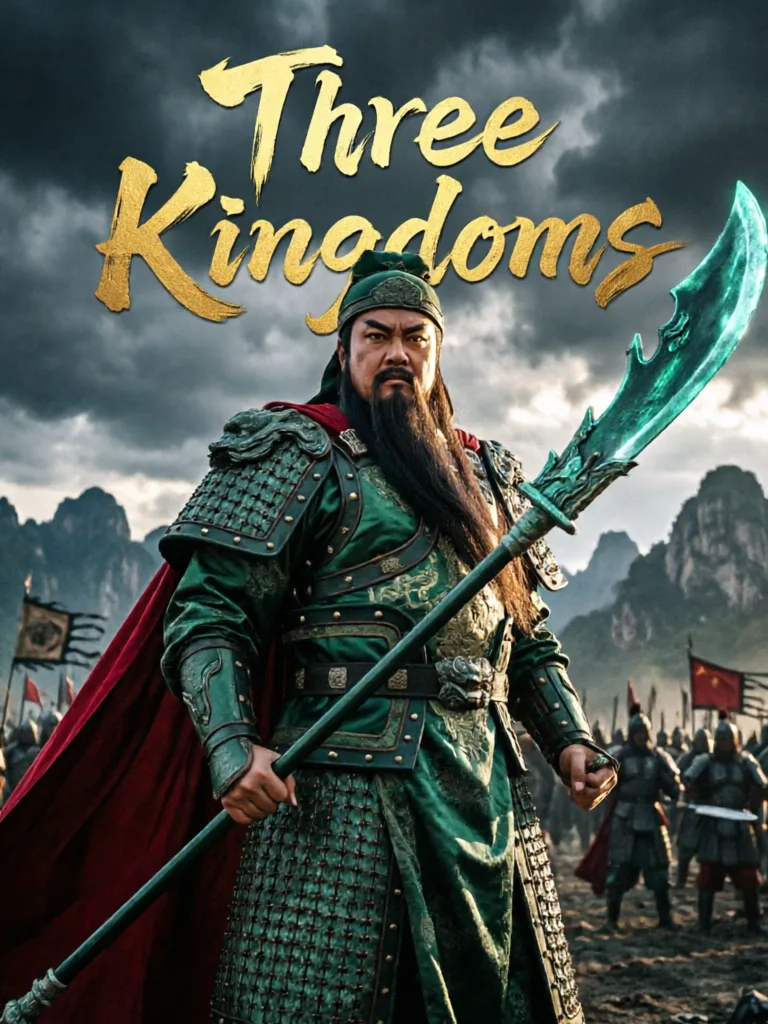
Zhuge Liang turned to Zhang Fei and said, “When Zilong captured Guiyang Commandery, he first signed a pledge of responsibility. Now, if you, Yide, wish to take Wuling, you must also sign such a pledge before leading the troops.” Zhang Fei agreed, signed the pledge, and cheerfully took three thousand men, marching day and night toward the border of Wuling Commandery. When Jin Xuan, the Grand Administrator of Wuling, heard that Zhang Fei was approaching with an army, he assembled his officers and troops, selected his finest soldiers and weapons, and rode out of the city to meet the enemy. His aide, Gong Zhi, advised him, saying, “Liu Xuande is the Imperial Uncle of the Great Han, and his benevolence and righteousness are known throughout the realm. Moreover, Zhang Yide is exceptionally brave. You cannot face him in battle. It is better to surrender.” Jin Xuan flew into a rage and shouted, “Are you trying to collude with the rebels and create internal chaos?” He ordered the guards to drag Gong Zhi out and behead him. All the officials pleaded, saying, “Killing your own man before battle brings bad luck to the army.” Jin Xuan then dismissed Gong Zhi with a shout and led his troops out himself. Twenty li from the city, he encountered Zhang Fei. Zhang Fei, holding his serpent spear and mounted on his horse, let out a great shout at Jin Xuan. Jin Xuan asked his officers, “Who dares to fight?” All were afraid, and none stepped forward. Jin Xuan himself spurred his horse and charged with his blade. Zhang Fei let out a roar like a clap of thunder. Jin Xuan’s face lost color; he dared not engage and turned his horse to flee. Zhang Fei led his men in pursuit, cutting down the fleeing soldiers. As Jin Xuan reached the city walls, arrows rained down from the battlements. Startled, he looked up and saw Gong Zhi standing atop the wall, shouting, “You ignored the will of Heaven and brought about your own ruin. The people and I have already surrendered to Lord Liu!” Before he finished speaking, an arrow struck Jin Xuan in the face, and he fell from his horse. Soldiers cut off his head and presented it to Zhang Fei. Gong Zhi came out of the city to surrender, and Zhang Fei ordered him to take the seal and credentials to Guiyang to present to Liu Bei. Liu Bei was overjoyed and appointed Gong Zhi to replace Jin Xuan as Grand Administrator.
After personally pacifying the people of Wuling, Liu Bei sent a swift messenger to Guan Yu, informing him that both Yide and Zilong had each captured a commandery. Guan Yu wrote back, saying, “I hear that Changsha has not yet been taken. If my elder brother does not consider me unworthy, let me undertake this task.” Liu Bei was delighted and ordered Zhang Fei to travel day and night to replace Guan Yu in guarding Jing Province, while Guan Yu was to march on Changsha.
When Guan Yu arrived, he entered to see Liu Bei and Zhuge Liang. Zhuge Liang said, “Zilong captured Guiyang with three thousand men, and Yide took Wuling with the same number. Now, the Grand Administrator of Changsha, Han Xuan, is not worth mentioning. But he has a general under his command, a man from Nanyang named Huang Zhong, styled Hansheng. He was a General of the Household under Liu Biao and once guarded Changsha with Liu Biao’s nephew, Liu Pan. Now he serves Han Xuan. Though he is nearly sixty years old, he has the strength to overcome ten thousand men. You must not take him lightly. If you go, you must take more troops.” Guan Yu replied, “Why does the Military Strategist boost the enemy’s morale and diminish our own? What is an old soldier worth? I don’t need three thousand men. Just give me five hundred of my own axemen, and I swear I will cut off the heads of Huang Zhong and Han Xuan and present them before your tent.” Liu Bei tried to dissuade him, but Guan Yu would not listen and departed with only five hundred axemen. Zhuge Liang said to Liu Bei, “Guan Yu underestimates Huang Zhong. I fear he may fail. You should go to support him.” Liu Bei agreed and followed with more troops toward Changsha.
Now, the Grand Administrator of Changsha, Han Xuan, was by nature hot-tempered and quick to kill, and everyone despised him. When he heard that Guan Yu’s army had arrived, he summoned the veteran general Huang Zhong for counsel. Huang Zhong said, “Do not worry, my lord. With this blade of mine and this bow, even if a thousand come, a thousand will die!” Huang Zhong could draw a bow of two hundred pounds and never missed his target. Before he finished speaking, a man stepped forward from below the hall and said, “There is no need for the old general to fight. I will capture Guan Yu alive with my own hands.” Han Xuan looked and saw it was Yang Ling, a Commandant of the garrison. Han Xuan was overjoyed and ordered Yang Ling to lead a thousand men and ride out of the city. After traveling about fifty li, he saw dust rising in the distance as Guan Yu’s army approached. Yang Ling raised his spear and rode out, positioning himself before the battle line to hurl insults. Guan Yu, enraged, did not bother to reply. He spurred his horse and charged, his blade raised, straight at Yang Ling. Yang Ling met him with his spear. Before three exchanges, Guan Yu’s blade flashed down, cutting Yang Ling from his horse. He pursued the fleeing soldiers all the way to the city walls.
When Han Xuan heard the news, he was greatly alarmed and ordered Huang Zhong to ride out. Han Xuan himself went to the city walls to watch. Huang Zhong, gripping his blade and urging his horse, led five hundred cavalry across the drawbridge. Guan Yu saw an old general emerge and knew it was Huang Zhong. He arranged his five hundred axemen in a single line, reined in his horse, and asked, “The general coming forward—are you not Huang Zhong?” Huang Zhong replied, “If you know my name, how dare you invade my territory!” Guan Yu said, “I have come specifically to take your head!” With that, the two horses met. They fought for over a hundred exchanges, neither gaining the upper hand. Fearing that Huang Zhong might falter, Han Xuan sounded the gong to withdraw the troops. Huang Zhong led his men back into the city. Guan Yu also withdrew and set up camp ten li from the city. He thought to himself, “The old general Huang Zhong lives up to his reputation. After a hundred exchanges, he showed no weakness. Tomorrow, I will use the ‘drag-blade’ technique and strike him from behind to win.”
The next morning, after breakfast, Guan Yu rode to the city walls again to challenge the enemy. Han Xuan sat on the wall and ordered Huang Zhong to ride out. Huang Zhong led several hundred cavalry across the drawbridge and engaged Guan Yu once more. They fought another fifty or sixty exchanges, still without a victor, and both armies cheered loudly. Just as the drums were beating fiercely, Guan Yu turned his horse and fled. Huang Zhong gave chase. Guan Yu was about to strike with his blade when he heard a sound behind him. He turned quickly and saw Huang Zhong’s horse stumble, throwing the old general to the ground. Guan Yu immediately wheeled his horse around, raised his blade with both hands, and shouted, “I will spare your life! Quickly, get a fresh horse and we will fight again!” Huang Zhong hastily pulled his horse to its feet, leaped into the saddle, and retreated into the city. Han Xuan asked him in surprise what had happened. Huang Zhong said, “This horse has not been ridden in battle for a long time, so it stumbled.” Han Xuan said, “Your arrows never miss. Why didn’t you shoot him?” Huang Zhong replied, “Tomorrow, when we fight again, I will feign defeat and lure him to the drawbridge, where I will shoot him.” Han Xuan gave Huang Zhong his own fine green horse. Huang Zhong thanked him and withdrew, but he thought to himself, “It is rare to find such righteousness in Guan Yu. He could not bear to kill me, so how can I bear to shoot him? But if I don’t, I will be disobeying orders.” That night, he was torn and could not decide.
At dawn the next day, a messenger reported that Guan Yu was challenging them again. Huang Zhong led his troops out of the city. After two days of failing to defeat Huang Zhong, Guan Yu was growing anxious. He summoned all his might and engaged Huang Zhong. They fought for less than thirty exchanges when Huang Zhong feigned defeat and fled. Guan Yu gave chase. Remembering Guan Yu’s mercy from the previous day, Huang Zhong could not bring himself to shoot. He sheathed his blade and drew his bow, but only plucked the string, making it sound. Guan Yu dodged, but no arrow came. He chased again. Huang Zhong plucked the string a second time, and again Guan Yu dodged, but still no arrow. Guan Yu thought Huang Zhong could not shoot and pursued him without caution. As they neared the drawbridge, Huang Zhong nocked an arrow, drew the bow to its full, and let fly. The arrow struck the tassel at the base of Guan Yu’s helmet. The front ranks of Guan Yu’s army cried out in alarm. Startled, Guan Yu retreated to his camp with the arrow still in his helmet. Only then did he realize that Huang Zhong could hit a willow leaf at a hundred paces. That day, Huang Zhong had aimed only at the helmet tassel, a repayment for Guan Yu’s mercy the day before. Guan Yu withdrew his troops.
When Huang Zhong returned to the city to see Han Xuan, Han Xuan ordered his guards to seize him. Huang Zhong cried out, “I am innocent!” Han Xuan roared, “I have watched you for three days, and you dare to deceive me! The day before, you did not fight with full force—you must have had a secret motive. Yesterday, when your horse stumbled, he did not kill you—there must be collusion. Today, you plucked the string twice without shooting, and on the third shot, you only struck his helmet tassel. How is this not a sign of conspiracy? If I do not execute you, you will become a future threat!” He ordered the executioners to drag Huang Zhong outside the city gates and behead him. The other generals tried to plead for him, but Han Xuan said, “Anyone who begs for Huang Zhong’s life is an accomplice!” Just as they were about to strike, a general suddenly burst in, swinging his blade. He cut down the executioner, rescued Huang Zhong, and shouted, “Huang Hansheng is the pillar of Changsha! If you kill him, you kill the people of Changsha! Han Xuan is cruel and unjust, despising the worthy and slighting the wise. Let us all strike him down together! Anyone who follows me, come forward!” The crowd looked at the man. His face was the color of a ripe jujube, and his eyes shone like stars. He was Wei Yan of Yiyang. He had once tried to join Liu Bei at Xiangyang but missed him, so he came to serve Han Xuan. Han Xuan, however, resented Wei Yan’s pride and lack of ceremony and would not give him an important post, leaving him to languish in obscurity. That day, after rescuing Huang Zhong, Wei Yan called on the people to join him in killing Han Xuan. He raised his arm and shouted, and several hundred answered his call. Huang Zhong tried to stop them, but it was too late. Wei Yan charged straight up to the city wall and, with one stroke of his blade, cut Han Xuan in two. He took the head, mounted his horse, and led the people out of the city to surrender to Guan Yu. Guan Yu was overjoyed and entered the city. After pacifying the populace, he asked to meet Huang Zhong, but Huang Zhong pleaded illness and would not come out. Guan Yu immediately sent messengers to invite Liu Bei and Zhuge Liang.
Now, after Guan Yu had set out to take Changsha, Liu Bei and Zhuge Liang followed with reinforcements. As they marched, a black banner fluttered and rolled, and a crow flew from north to south, cawing three times before disappearing. Liu Bei asked, “Does this portend good or ill fortune?” Zhuge Liang performed a quick divination in the saddle and said, “Changsha Commandery has been taken, and we have also gained a great general. We will know the outcome after noon.” Shortly afterward, a young scout galloped up and reported, “General Guan has captured Changsha Commandery. The surrendered generals are Huang Zhong and Wei Yan. They await your arrival, my lord.” Liu Bei was overjoyed and entered Changsha. Guan Yu welcomed him into the hall and recounted the story of Huang Zhong. Liu Bei then personally visited Huang Zhong’s home to invite him. Only then did Huang Zhong come out to surrender, but he requested that Han Xuan’s body be buried east of Changsha. A poet of later times wrote of Huang Zhong: “The general’s spirit rivaled the heavens, yet in his white-haired years, he was trapped in the south. To his death, he harbored no resentment, and even in surrender, he bowed his head in shame. His treasured blade flashed like snow, revealing his divine might; his iron steed rode the wind, recalling his battles. His high name will never fade through the ages, accompanying the lonely moon over the Xiang River.”
Liu Bei treated Huang Zhong with great kindness. When Guan Yu brought Wei Yan to meet him, Zhuge Liang ordered the guards to drag Wei Yan away and behead him. Startled, Liu Bei asked, “Wei Yan has rendered meritorious service and is innocent. Why does the Military Strategist want to kill him?” Zhuge Liang replied, “He ate the lord’s grain yet killed his master—that is disloyalty. He dwelled in the land yet surrendered it—that is unrighteousness. I see a rebellious bone at the back of Wei Yan’s head. In time, he will surely rebel. Therefore, I wish to cut off the root of future trouble.” Liu Bei said, “If we kill him, every other surrendered officer will fear for his life. I beg you, Military Strategist, to spare him.” Zhuge Liang pointed at Wei Yan and said, “I will spare your life today. You must serve your lord with utmost loyalty and never harbor treacherous thoughts. If you do, I will take your head, no matter what.” Wei Yan bowed repeatedly and withdrew. Huang Zhong then recommended Liu Pan, Liu Biao’s nephew, who was living in retirement in You County. Liu Bei summoned him and put him in charge of Changsha Commandery. With the four commanderies pacified, Liu Bei led his army back to Jing Province and renamed the mouth of the You River as Gong’an. From then on, his grain and resources flourished, and worthy men flocked to him. He dispersed his troops to guard various strategic passes.
Meanwhile, Zhou Yu had returned to Chaisang to recover from his illness. He ordered Gan Ning to guard Baling Commandery and Ling Tong to guard Hanyang Commandery, stationing warships at both places and awaiting orders. Cheng Pu led the remaining officers to Hefei County. Since the great battle at Red Cliffs, Sun Quan had been camped near Hefei for a long time, fighting more than ten skirmishes with Cao Cao’s forces without a decisive result. He dared not press his camp close to the city walls and had stationed his troops fifty li away. When he heard that Cheng Pu’s army had arrived, Sun Quan was overjoyed and personally went out of camp to welcome them. A messenger reported that Lu Su was arriving first, so Sun Quan dismounted and stood waiting. Lu Su quickly scrambled off his horse and bowed. The other generals were astonished to see Sun Quan treat Lu Su with such respect. Sun Quan invited Lu Su to mount and ride beside him. He said in a low voice, “Did dismounting to welcome you show you enough honor?” Lu Su replied, “Not yet.” Sun Quan asked, “Then what would be enough?” Lu Su said, “I hope that your majesty’s prestige and virtue will spread across the four seas, that you will unite the nine provinces, and achieve the imperial enterprise. Only then, when my name is recorded in the annals of history, will I have been truly honored.” Sun Quan clapped his hands and laughed heartily. They entered the tent together, where a great feast was laid to reward the soldiers who had fought so fiercely. They discussed plans to break Hefei.
Suddenly, a messenger arrived from Zhang Liao bearing a challenge. Sun Quan opened the letter, read it, and flew into a rage. “Zhang Liao insults me too much! He heard that Cheng Pu’s army had arrived and deliberately sent this challenge. Tomorrow, I will not use the new troops. I will fight him myself and show him a real battle!” He ordered that at the fifth watch that night, the entire army would march out of camp toward Hefei. Around the hour of the dragon, when the army was halfway there, Cao’s troops arrived. Both sides formed their battle lines. Sun Quan, in a golden helmet and golden armor, rode out. On his left was Song Qian, on his right Jia Hua, both wielding sky-piercing halberds to guard him. After three rolls of the drum, the gate of Cao’s formation opened, and three generals, fully armed, stood before the lines: Zhang Liao in the center, Li Dian on the left, and Yue Jin on the right. Zhang Liao spurred his horse forward, specifically challenging Sun Quan to single combat. Sun Quan grasped his spear and was about to ride out himself when a general from his own formation charged forward, spear raised—it was Taishi Ci. Zhang Liao swung his blade to meet him. The two fought for seventy or eighty exchanges without a victor. On Cao’s side, Li Dian said to Yue Jin, “The one in the golden helmet is Sun Quan. If we can capture him, it will avenge the 830,000 men lost at Red Cliffs.” No sooner had he spoken than Yue Jin, with a single horse and a single blade, charged diagonally straight at Sun Quan like a bolt of lightning. He arrived in an instant and swung his blade down. Song Qian and Jia Hua quickly raised their halberds to block. The blade struck, and both halberds snapped in half, leaving only the shafts, which they used to strike at the horse’s head. Yue Jin turned back, and Song Qian grabbed a spear from a soldier and gave chase. Li Dian nocked an arrow and shot Song Qian straight through the heart. He fell from his horse. Taishi Ci, seeing someone fall behind him, abandoned his fight with Zhang Liao and turned back to his own formation. Zhang Liao seized the moment and charged, throwing the Wu army into chaos as they scattered in all directions. Zhang Liao spotted Sun Quan and spurred his horse in pursuit. Just as he was about to catch up, a force suddenly emerged from a side path. At its head was Cheng Pu. He intercepted Zhang Liao, fought a short engagement, and rescued Sun Quan. Zhang Liao withdrew his troops and returned to Hefei.
Cheng Pu escorted Sun Quan back to the main camp, where the defeated soldiers trickled in one by one. When Sun Quan learned that Song Qian had been killed, he wept bitterly. The Chief Clerk Zhang Hong said, “My lord, relying on your youthful vigor, you have underestimated a powerful enemy. All the soldiers in the army are chilled with fear. Even if you cut down enemy generals and capture their banners, that is the duty of a subordinate commander, not something that befits a lord. I beg you to restrain your bold courage and adopt the strategies of a true king or hegemon. Today, Song Qian died under the blade because of your recklessness. From now on, you must be more careful.” Sun Quan said, “It is my fault. From today, I will change.” Shortly afterward, Taishi Ci entered the tent and said, “One of my men, named Ge Ding, is a sworn brother of a stable hand in Zhang Liao’s service. The stable hand has been beaten and bears a grudge. Tonight, he sent word that he will start a fire as a signal, and we can assassinate Zhang Liao to avenge Song Qian. I ask to lead troops as backup.” Sun Quan asked, “Where is Ge Ding?” Taishi Ci replied, “He has already infiltrated Hefei. I request five thousand men.” Zhuge Jin said, “Zhang Liao is full of schemes. He may be prepared. Do not act rashly.” But Taishi Ci insisted. Still grieving for Song Qian and eager for revenge, Sun Quan ordered Taishi Ci to take five thousand men as backup.
Now, Ge Ding was a fellow villager of Taishi Ci. That day, he mingled with the troops, entered Hefei, found the stable hand, and they conferred. Ge Ding said, “I have already sent word to General Taishi Ci. Tonight, he will come to support us. What is your plan?” The stable hand said, “This place is far from the main camp. The troops cannot reach us quickly at night. I will set fire to a haystack, and you will shout ‘Rebellion!’ to create chaos in the city. In the confusion, we can assassinate Zhang Liao, and the rest of the army will scatter.” Ge Ding said, “An excellent plan!” That night, after his victorious return to the city, Zhang Liao rewarded his troops and ordered them not to remove their armor or sleep. His aides said, “Today, we won a complete victory, and the Wu army has fled far away. Why not remove your armor and rest?” Zhang Liao replied, “No. The way of a general is this: do not rejoice in victory, do not despair in defeat. If the Wu army thinks we are unprepared and attacks us in our weakness, how will we respond? Tonight, we must be even more vigilant than usual.” Before he finished speaking, a fire broke out in the rear camp, and shouts of “Rebellion!” rang out. Messengers came in thick and fast. Zhang Liao went out of his tent, mounted his horse, and summoned a dozen of his trusted officers to stand in the middle of the road. His aides said, “The shouting is urgent. We should go and see.” Zhang Liao said, “Would an entire city rebel at once? This is the work of a few traitors trying to frighten the troops.
Anyone who panics will be executed first!” In no time, Li Dian captured Ge Ding and the stable hand and brought them before Zhang Liao. After questioning them, Zhang Liao had them beheaded on the spot. Just then, they heard the beating of gongs and drums outside the city gates and a great clamor. Zhang Liao said, “This is the Wu army’s backup. We can use their own plan against them.” He ordered a fire to be set inside the city gates, and many shouted “Rebellion!” Then he opened the gates wide and lowered the drawbridge. Seeing the gates wide open, Taishi Ci thought the internal revolt had begun. He raised his spear and charged in. But at the sound of a cannon shot from the city walls, arrows rained down. Taishi Ci hastily retreated, but he was struck by several arrows. Behind him, Li Dian and Yue Jin burst out, cutting down more than half of the Wu army. They pursued the fleeing troops all the way to their camp. Lu Xun and Dong Xi fought a rearguard action and rescued Taishi Ci. The Cao army returned to Hefei. When Sun Quan saw that Taishi Ci was seriously wounded, his grief deepened. Zhang Zhao urged Sun Quan to end the campaign. Sun Quan agreed, withdrew his troops, boarded the ships, and returned to Nanxu and Runzhou. By the time they had settled the troops, Taishi Ci’s condition had worsened. Sun Quan sent Zhang Zhao and others to inquire after him. Taishi Ci cried out, “A great man born into troubled times should wield his three-foot sword and achieve deeds that will never be forgotten! But now, before my ambition is fulfilled, I must die!” With these words, he died at the age of forty-one.
A poet of later times praised him: “With unwavering loyalty and filial piety, Taishi Ci of Donglai. His name shone across distant frontiers; his bow and horse shook the mightiest armies. He repaid his debt at Beihai, and fought fiercely at Shenting. His dying words of ambition will be mourned for a thousand ages.”
When Sun Quan heard of Taishi Ci’s death, he was overcome with grief. He ordered a lavish burial for him at the foot of Beigu Mountain in Nanxu and raised his son, Taishi Heng, in his own household.
Meanwhile, Liu Bei was reorganizing his army in Jing Province. When he heard that Sun Quan had been defeated at Hefei and had returned to Nanxu, he consulted with Zhuge Liang. Zhuge Liang said, “Last night, I observed the stars. I saw a star fall in the northwest, which must mean the death of a member of the imperial clan.” Just then, a messenger reported that Liu Qi, the son of Liu Biao, had died of illness. Liu Bei wept bitterly. Zhuge Liang consoled him, saying, “Life and death are predetermined. Do not grieve too much, my lord, lest you harm your health. We must attend to the important matters: send someone quickly to guard the city and arrange the funeral.” Liu Bei asked, “Who should go?” Zhuge Liang replied, “None other than Yun Chang.” He immediately ordered Guan Yu to go to Xiangyang to hold the defense. Liu Bei said, “Now that Liu Qi is dead, the Eastern Wu will surely come to demand Jing Province. How shall we answer them?” Zhuge Liang said, “If anyone comes, I will have a reply ready.” Half a month later, a messenger reported that Lu Su of Eastern Wu had come specifically to offer condolences. And so it was that: “The plan was already laid, awaiting only the arrival of the Eastern Wu envoy.” What reply Zhuge Liang would give, the next chapter will reveal.