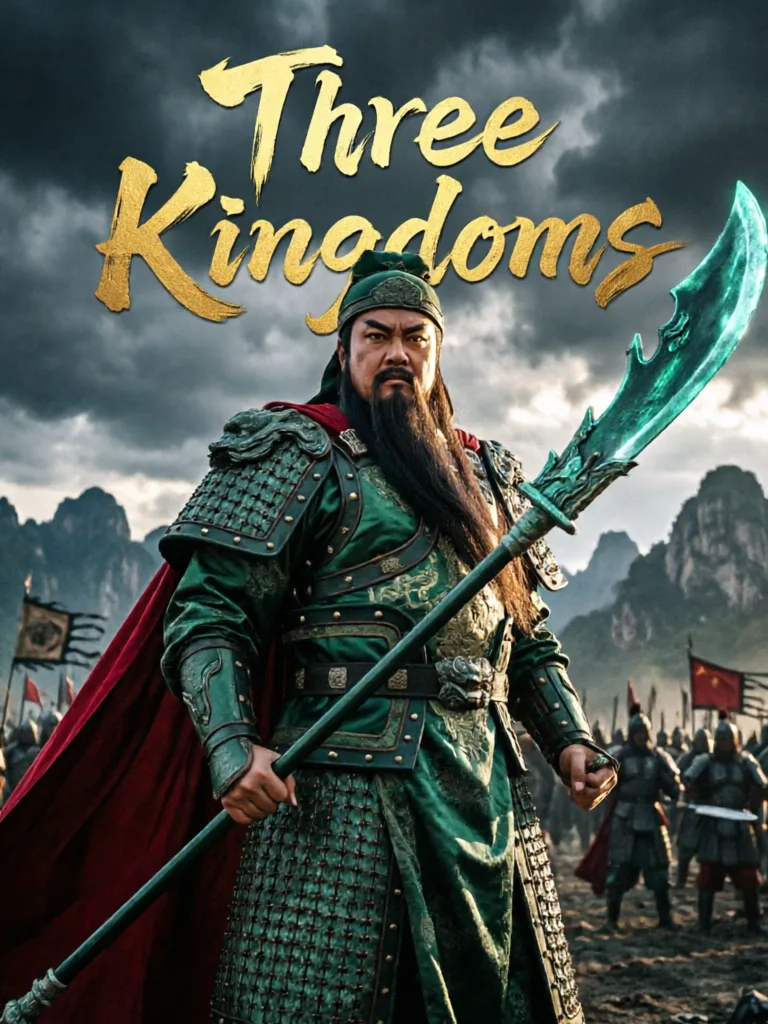
As Cao Ren saw Guan Yu fall from his horse, he immediately led his troops charging out of the city. But Guan Ping drove them back in a fierce counterattack, rescued his father, and brought him back to camp, where he extracted the arrow from Guan Yu’s arm. The arrowhead had been poisoned, and the venom had already seeped into the bone. Guan Yu’s right arm was swollen and discolored, completely immobile. Alarmed, Guan Ping gathered the other officers and said, “If my father loses the use of this arm, how can he face the enemy? We should return to Jing Province for treatment.” Thus, they entered Guan Yu’s tent together. Guan Yu asked, “Why have you all come?” They replied, “We see that your right arm is injured, Lord. We fear that in battle, anger or exertion might worsen the wound. We propose a temporary withdrawal to Jing Province for your recovery.” Guan Yu angrily retorted, “I am on the verge of taking Fan Castle! Once I have it, I will drive straight to Xuchang, annihilate the traitor Cao Cao, and restore the Han Dynasty. How can a minor wound derail such a great enterprise? Do you dare to demoralize my army?” Guan Ping and the others withdrew in silence.
Seeing that Guan Yu refused to retreat and that his wound was not healing, the officers searched far and wide for a renowned physician. One day, a man arrived from Jiangdong in a small boat, coming directly to the camp gate. The guards brought him to Guan Ping. Guan Ping observed the man: he wore a square cap and loose robes, with a blue medicine bag slung over his arm. He introduced himself as Hua Tuo, courtesy name Yuanhua, from the Qiao Commandery in Pei State. Hearing that General Guan was a hero of the realm and had been struck by a poisoned arrow, he had come specifically to treat him. Guan Ping asked, “Are you not the one who once treated Zhou Tai of Eastern Wu?” Hua Tuo replied, “Indeed.” Overjoyed, Guan Ping led Hua Tuo into the tent to see Guan Yu. At that time, Guan Yu’s arm was aching, but to avoid unsettling his troops, he was distracting himself by playing a game of Go with Ma Liang. Hearing that a physician had arrived, he summoned him in. After the formal greetings, Hua Tuo was offered a seat. When tea was finished, Hua Tuo asked to see the arm. Guan Yu removed his robe and extended his arm for examination. Hua Tuo said, “This is a wound from a crossbow bolt, and the poison—aconite—has penetrated to the bone. If not treated soon, the arm will be useless.” Guan Yu asked, “What treatment do you propose?” Hua Tuo replied, “I have a method, but I fear you may not have the courage for it.” Guan Yu laughed and said, “I regard death as a return home. What is there to fear?” Hua Tuo explained, “I would set up a post in a quiet place, with a large ring nailed to it. I would ask you to thread your arm through the ring, bind it with rope, and cover your face with a cloth. Then, with a sharp knife, I would cut open the flesh to the bone, scrape away the poison, apply medicine, and stitch the wound. Only then would you be safe. But I fear you may shrink from the procedure.” Guan Yu laughed again, “Such a simple thing! Why bother with posts and rings?” He ordered a feast to be prepared.
After drinking several cups of wine, Guan Yu continued his game of Go with Ma Liang, extending his arm for Hua Tuo to operate. Hua Tuo took a sharp knife and ordered a soldier to hold a large basin beneath the arm to catch the blood. “I am about to begin, Lord. Do not be alarmed,” Hua Tuo said. “Proceed as you will,” Guan Yu replied. “Do you take me for one of those common men who fear pain?” Hua Tuo then made his incision, cutting through the flesh to the bone, which had turned a sickly green. He scraped the bone with his knife, making a harsh, grating sound. All present, both inside and outside the tent, covered their faces, pale with horror. Guan Yu, however, continued to drink, eat, and laugh, chatting and playing Go without the slightest sign of pain. Soon, the basin was filled with blood. Hua Tuo scraped away every trace of poison, applied the medicine, and stitched the wound closed. Guan Yu rose with a great laugh and said to his officers, “My arm moves as freely as before, without any pain. Master, you are truly a divine physician!” Hua Tuo replied, “In all my years of practice, I have never seen the like. Lord, you are a god among men!”
A poet of the time recorded: In medicine, there are internal and external arts, but rare are the wondrous skills in this world. None could match the divine might of General Guan, and only Hua Tuo possessed the healer’s sacred hands.
After his arrow wound had healed, Guan Yu held a feast to thank Hua Tuo. Hua Tuo advised, “Although the wound is treated, you must be careful. Do not let anger or exertion harm it. After a hundred days, you will be fully recovered.” Guan Yu offered him a hundred taels of gold as a reward. Hua Tuo declined, saying, “I came because I heard of your noble character, Lord. I did not come for reward.” He firmly refused the gold, left a packet of medicine for the wound, and took his leave.
Meanwhile, Guan Yu’s capture of Yu Jin and execution of Pang De had spread his fame far and wide, shaking the entire realm. When the news reached Xuchang, Cao Cao was greatly alarmed. He assembled his civil and military officials for counsel. “I have long known that Yunchang is unmatched in both wisdom and courage,” he said. “Now that he holds Jing and Xiang Provinces, it is as if a tiger has grown wings. Yu Jin is captured, Pang De is dead, and our Wei forces are demoralized. If he leads his army straight to Xuchang, what shall we do? I am considering moving the capital to avoid him.” Sima Yi advised against it. “No, Your Majesty. Yu Jin’s defeat was due to flooding, not a failure of arms. It does no real harm to our grand strategy. Now that Sun Quan and Liu Bei are at odds, and Yunchang is triumphant, Sun Quan will certainly be displeased. Your Majesty should send an envoy to Eastern Wu to explain the situation and persuade Sun Quan to secretly raise an army to strike at Yunchang’s rear. Promise that once the matter is settled, we will cede the lands south of the Yangtze to Sun Quan. Then the siege of Fan Castle will be lifted on its own.” Chief Clerk Jiang Ji added, “Zhongda’s words are correct. We should dispatch an envoy to Eastern Wu immediately. There is no need to move the capital and cause upheaval.” Cao Cao agreed and abandoned the idea of relocating. He sighed to his generals, “Yu Jin served me for thirty years. Who would have thought that in his moment of crisis, he would prove less loyal than Pang De?” He then sent an envoy with a letter to Eastern Wu and sought a general to face Guan Yu’s advance. Before he finished speaking, a general stepped forward from the ranks. “I will go,” he declared. Cao Cao looked and saw it was Xu Huang. Delighted, he assigned fifty thousand elite troops to Xu Huang, with Lü Jian as his second-in-command. They were to march immediately and establish a camp at Yangling Slope, waiting for a signal from the southeast before advancing.
When Sun Quan received Cao Cao’s letter, he read it with satisfaction and agreed readily. He sent the envoy back with a reply and then assembled his own officials for counsel. Zhang Zhao said, “I have heard that Yunchang has captured Yu Jin and executed Pang De, shaking the entire realm. Cao Cao wants to move the capital to avoid him. Now that Fan Castle is in danger, he sends for help. But once the matter is settled, he may go back on his word.” Before Sun Quan could respond, a report arrived that Lü Meng had come by small boat from Lukou and requested an audience on urgent business. Sun Quan summoned him and asked, “Now that Yunchang has led his army to besiege Fan Castle, we can take advantage of his absence to attack Jing Province.” Sun Quan said, “I was thinking of attacking Xuzhou to the north. What do you think?” Lü Meng replied, “Cao Cao is far away north of the Yellow River and has no time to look east. Xuzhou’s defenses are thin, and we could take it easily. But the terrain there favors land battles, not naval warfare. Even if we take it, it will be hard to hold. Better to seize Jing Province first, secure the entire Yangtze River, and then plan further.” Sun Quan said, “I intended to take Jing Province all along. I was just testing you. Go quickly and plan for it. I will raise the army soon after.”
Lü Meng took his leave and returned to Lukou. Scouts reported that along both banks of the Yangtze, at intervals of twenty or thirty li, beacon towers had been erected on high ground. They also said that the Jing Province forces were well-organized and prepared. Lü Meng was shocked. “If this is the case, it will be very difficult to attack,” he thought. “I urged the Lord of Wu to take Jing Province, but now how am I to manage this?” Unable to devise a plan, he feigned illness and sent word to Sun Quan. When Sun Quan heard that Lü Meng was ill, he was greatly distressed. Lu Xun then said, “Lü Meng’s illness is a pretense, not real.” Sun Quan said, “Since you know it is a pretense, go and see him.”
Lu Xun traveled day and night to the camp at Lukou to see Lü Meng. He found him without any sign of sickness. “I have come on the Lord of Wu’s orders to inquire about your esteemed health,” Lu Xun said. “I have a minor ailment, nothing to trouble you with,” Lü Meng replied. “The Lord of Wu has entrusted you with a great responsibility,” Lu Xun continued. “Why do you sit idle, brooding in vain, instead of seizing the moment?” Lü Meng looked at Lu Xun for a long time without speaking. Lu Xun added, “I have a small remedy that might cure your illness, General. I wonder if it would be acceptable?” Lü Meng dismissed his attendants and asked, “Please, Boyan, share your excellent plan.” Lu Xun laughed. “Your illness, Ziming, stems from the fact that Jing Province’s forces are well-organized and the river is guarded by beacon towers. I have a plan that will prevent the guards along the river from lighting their fires and cause the troops of Jing Province to surrender without a fight. Would that work?” Lü Meng was astonished and thanked him. “Your words, Boyan, have seen into my very heart. Please, tell me your plan.” Lu Xun said, “Yunchang relies on his own heroism and believes himself unmatched. The only one he fears is you, General. Take this opportunity to feign illness and resign your post. Let someone else take command at Lukou. Have that man send humble letters praising Guan Yu to puff up his pride. He will then withdraw most of his forces from Jing Province to reinforce Fan Castle. Once Jing Province is undefended, you can use a single division to launch a surprise attack with a clever stratagem, and Jing Province will be in your grasp.” Lü Meng was overjoyed. “A truly excellent plan!” he exclaimed.
Thus, Lü Meng claimed to be too ill to rise and submitted his resignation. Lu Xun returned to Sun Quan and reported the plan. Sun Quan then recalled Lü Meng to Jianye to recuperate. When Lü Meng arrived, he was summoned to an audience. Sun Quan asked, “The post at Lukou was once held by Zhou Yu, who recommended Lu Su to succeed him. Later, Lu Su recommended you. Now you must recommend someone of equal talent and reputation to take your place.” Lü Meng replied, “If we appoint someone of great renown, Yunchang will surely be on his guard. Lu Xun has deep insight but lacks a wide reputation, so Yunchang will not fear him. If you appoint him to succeed me, it will surely succeed.” Sun Quan was delighted and immediately appointed Lu Xun as a Lieutenant General and Right Commander-in-Chief, ordering him to replace Lü Meng at Lukou. Lu Xun declined, saying, “I am young and inexperienced. I fear I am not worthy of such a heavy responsibility.” Sun Quan insisted, “Ziming has recommended you, so there can be no mistake. Do not refuse.” Lu Xun accepted the seal of office and traveled day and night to Lukou. After taking command of the cavalry, infantry, and navy, he wrote a letter and prepared gifts of famous horses, fine silks, and wine. He sent an envoy to Fan Castle to present them to Guan Yu.
At that time, Guan Yu was resting and recovering from his arrow wound, keeping his army inactive. Suddenly, a report arrived: “The commander at Lukou, Lü Meng, is critically ill. Sun Quan has recalled him to Jianye and appointed Lu Xun to replace him. Lu Xun has sent an envoy with a letter and gifts to pay his respects.” Guan Yu summoned the envoy and said, pointing at him, “Zhongmou has such poor judgment that he uses this mere boy as a general!” The envoy prostrated himself and said, “General Lu presents this letter and gifts: first, to congratulate you, Lord; second, to seek harmonious relations between our two houses. Please condescend to accept them.” Guan Yu opened the letter and read it. The words were extremely humble and respectful. After reading it, Guan Yu laughed heartily and ordered his attendants to accept the gifts and send the envoy away. The envoy returned to Lu Xun and reported, “Lord Guan is very pleased and no longer has any concerns about Eastern Wu.”
Lu Xun was overjoyed. He secretly sent spies and learned that Guan Yu had indeed withdrawn most of his forces from Jing Province to Fan Castle, waiting only for his wound to heal before advancing. After confirming the details, Lu Xun sent an urgent report to Sun Quan. Sun Quan summoned Lü Meng for discussion. “Now Yunchang has indeed withdrawn his troops from Jing Province to attack Fan Castle,” he said. “We can devise a plan to take Jing Province. Should you and my younger brother Sun Jiao lead the main army together?” Sun Jiao, courtesy name Shuming, was the second son of Sun Jing, Sun Quan’s uncle. Lü Meng replied, “My lord, if you think I am capable, then use me alone. If you think Shuming is capable, then use him alone. Have you not heard how in the old days, Zhou Yu and Cheng Pu served as Left and Right Commanders-in-Chief? Matters were decided by Zhou Yu, but Cheng Pu, as a senior official, resented being under his command and they did not get along. It was only later, when he saw Zhou Yu’s talent, that he came to respect him. My talent is inferior to Zhou Yu’s, but Sun Jiao’s closeness to you exceeds Cheng Pu’s. I fear they may not work well together.”
Sun Quan saw the wisdom in this and appointed Lü Meng as Grand Commander-in-Chief, with supreme command over all the forces of Jiangdong. Sun Jiao was ordered to oversee the supply of provisions. Lü Meng thanked him and mustered thirty thousand troops and over eighty swift boats. He selected men skilled in swimming to disguise themselves as merchants, all dressed in white, to row the boats. The elite soldiers were hidden in the holds of the larger vessels. He then ordered seven generals—Han Dang, Jiang Qin, Zhu Ran, Pan Zhang, Zhou Tai, Xu Sheng, and Ding Feng—to advance in succession. The remaining forces followed Sun Quan as the rear guard and reserve. He sent an envoy to Cao Cao, urging him to attack Guan Yu’s rear, and also sent word to Lu Xun. Then, he dispatched the men in white, piloting the swift boats up the Xunyang River. They traveled day and night until they reached the northern bank. When the guards on the beacon towers questioned them, the men from Wu replied, “We are merchants who were delayed by wind on the river and have come here to take shelter.” They then offered gifts of money and goods to the guards. The guards believed them and allowed them to anchor along the shore. Around the second watch, the elite soldiers hidden in the holds emerged, seized the guards on the beacon towers, and bound them. At a prearranged signal, the soldiers from all eighty boats rose up, capturing the men from every key watchtower and taking them aboard the ships without letting a single one escape. Thus, they advanced unimpeded, heading straight for Jing Province, completely undetected. As they neared Jing Province, Lü Meng treated the captured guards from the watchtowers kindly, rewarded them generously, and ordered them to trick the city into opening its gates, using a fire signal. The men obeyed, and Lü Meng sent them ahead as guides. By midnight, they reached the city walls and called out to open the gates. The gatekeepers, recognizing them as soldiers from Jing Province, opened the gates. With a shout, the Wu forces lit the signal fire at the gate and poured into the city, seizing Jing Province. Lü Meng immediately issued an order to his army: “Anyone who kills a single person without cause or takes a single item from the people will be executed according to military law.” He kept all the former officials in their posts. Guan Yu’s family was placed in a separate residence and forbidden from being disturbed. He then sent word to Sun Quan.
One day, during a heavy rain, Lü Meng mounted his horse and led a few riders to inspect the four gates. He saw a man taking a bamboo hat from a commoner to cover his armor. Lü Meng ordered his attendants to seize him and interrogate him. The man was from Lü Meng’s own hometown. Lü Meng said, “Although you are my fellow villager, I have issued my orders, and you have deliberately violated them. You must be punished according to military law.” The man wept and pleaded, “I feared the rain would damage my official armor, so I took the hat to cover it. It was not for personal use. I beg you, General, to consider our shared hometown!” Lü Meng replied, “I know you covered your armor, but that does not give you the right to take property from the people.” He ordered his attendants to drag the man away and behead him. After the execution, the head was displayed as a warning. Then Lü Meng collected the body and buried it with tears. From that day on, the entire army was awed into strict discipline.
Before long, Sun Quan arrived with his main force. Lü Meng went outside the city to welcome him and escorted him to the official residence. After Sun Quan had expressed his thanks and praise, he appointed Pan Jun as the Administrator of Jing Province. Yu Jin was released from prison and sent back to Cao Cao. The people were pacified, the army rewarded, and a feast was held to celebrate. Sun Quan said to Lü Meng, “Now that Jing Province is ours, what about the two cities of Gong’an, held by Fu Shiren, and Nan Commandery, held by Mi Fang? How shall we take them?” Before he finished, a man stepped forward and said, “Without using a single bow or arrow, I can persuade Fu Shiren of Gong’an to surrender with nothing more than my tongue. Is that acceptable?” All eyes turned to Yu Fan. Sun Quan asked, “Zhongxiang, what plan do you have to make Fu Shiren surrender?” Yu Fan replied, “I have been friends with Fu Shiren since childhood. If I explain the situation to him, he will surely come over.” Sun Quan was delighted and ordered Yu Fan to lead five hundred troops to Gong’an.
When Fu Shiren heard that Jing Province had fallen, he hurriedly ordered the city gates closed and prepared to defend. Yu Fan arrived and found the gates shut. He wrote a letter, tied it to an arrow, and shot it into the city. A soldier picked it up and presented it to Fu Shiren. Fu Shiren opened the letter and read it. It was an invitation to surrender. After reading it, he thought, “Lord Guan resented me deeply when he left. It would be better to surrender early.” He immediately ordered the gates opened wide and invited Yu Fan into the city. After the formal greetings, they reminisced about old times. Yu Fan spoke of Sun Quan’s magnanimity and his respect for talent. Fu Shiren was delighted and went with Yu Fan, carrying his seal of office, to surrender at Jing Province. Sun Quan was overjoyed and ordered him to continue guarding Gong’an. But Lü Meng secretly said to Sun Quan, “We have not yet captured Yunchang. If we leave Fu Shiren in Gong’an, there may be trouble. Better to send him to Nan Commandery to persuade Mi Fang to surrender.” Sun Quan summoned Fu Shiren and said, “You are close friends with Mi Fang. Go and persuade him to surrender, and I will reward you handsomely.” Fu Shiren readily agreed and led a dozen riders straight to Nan Commandery to persuade Mi Fang to submit. Truly: On this day, the defender of Gong’an had no will to resist, proving the wisdom of Wang Fu’s earlier counsel. What would come of this mission? The next chapter will reveal.