Pinyin: Luobumaye
Aliases
Jijima, Honghuacao, Xiaohua Luobuma
Source
1. For pneumonia: Renshen 6 g, decoct in water and take orally.Apocynum venetumDried leaf of L.
Botanical Description
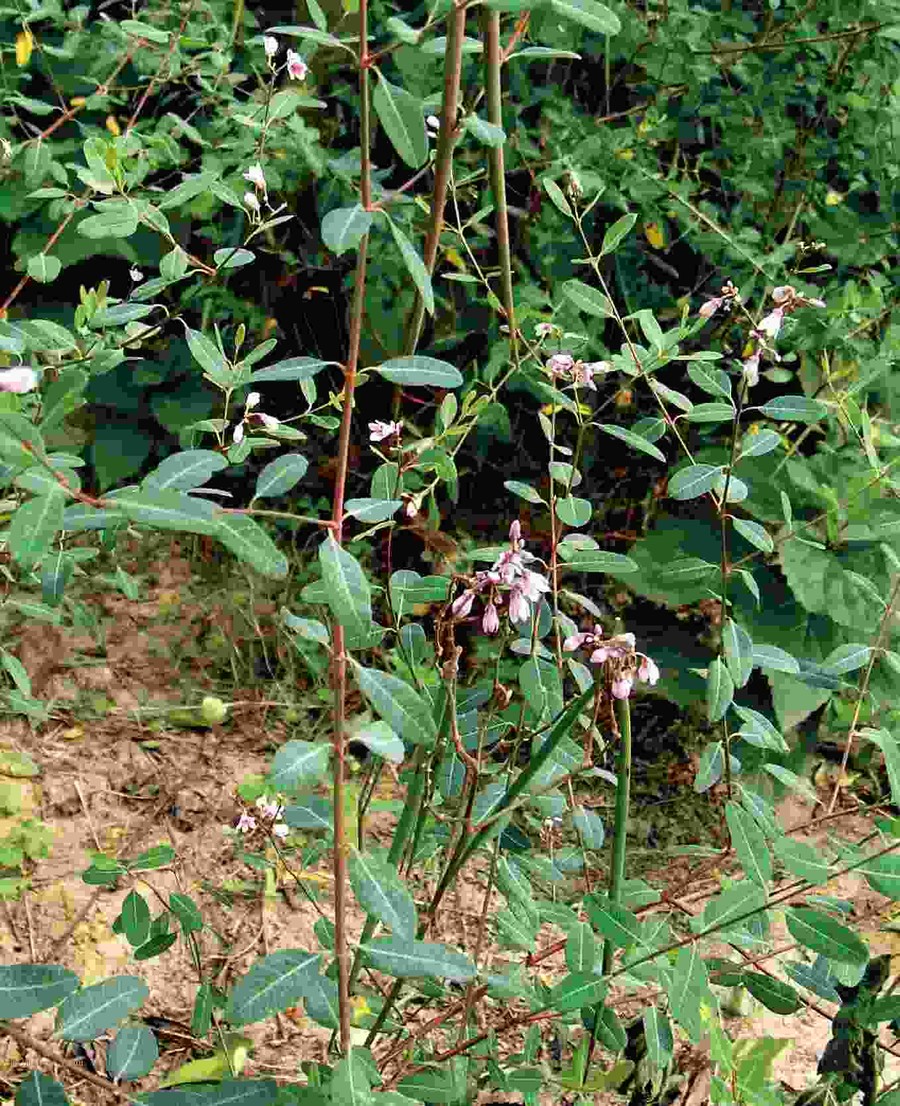
Erect subshrub, 1.5-3 m tall. Entire plant with milky sap; branches cylindrical, glabrous (hairless), purple-red or pale red. Leaves opposite, petiole 3-6 mm long; leaf blade elliptic-lanceolate to ovate-oblong, 1-5 cm long, 0.5-1.5 cm wide. Leaf margin finely toothed, both surfaces glabrous. Paniculate cymes 1 to many branched, usually terminal, sometimes axillary; bracts membranous, lanceolate, about 4 mm long, about 1 mm wide; flowers 5-merous; corolla tube campanulate, purple-red or pink, 6-8 mm long, 2-3 mm in diameter. Corolla lobes ovate-oblong, nearly as long as the tube; ovary composed of 2 separate carpels; nectary ring-like, fleshy, attached to the receptacle. Follicles 2, parallel or divergent, pendulous, 8-20 cm long, 2-8 mm in diameter. Seeds numerous, ovate-oblong, yellowish-brown, 2-3 mm long, 0.5-0.7 mm in diameter, apex with a tuft of white silky hairs, 1.5-2.5 cm long. Flowering period April to September, fruiting period July to December.
Habitat and Distribution
Grows in saline-alkaline wastelands, desert margins, riverbanks, alluvial plains, lake surroundings, and Gobi desert wastelands. Distributed in North China, Northwest China, and Jilin, Liaoning, Shandong, Jiangsu, Anhui, Henan, and other regions.
Harvesting and Processing
Harvested in summer, remove impurities and dry.
Medicinal Properties
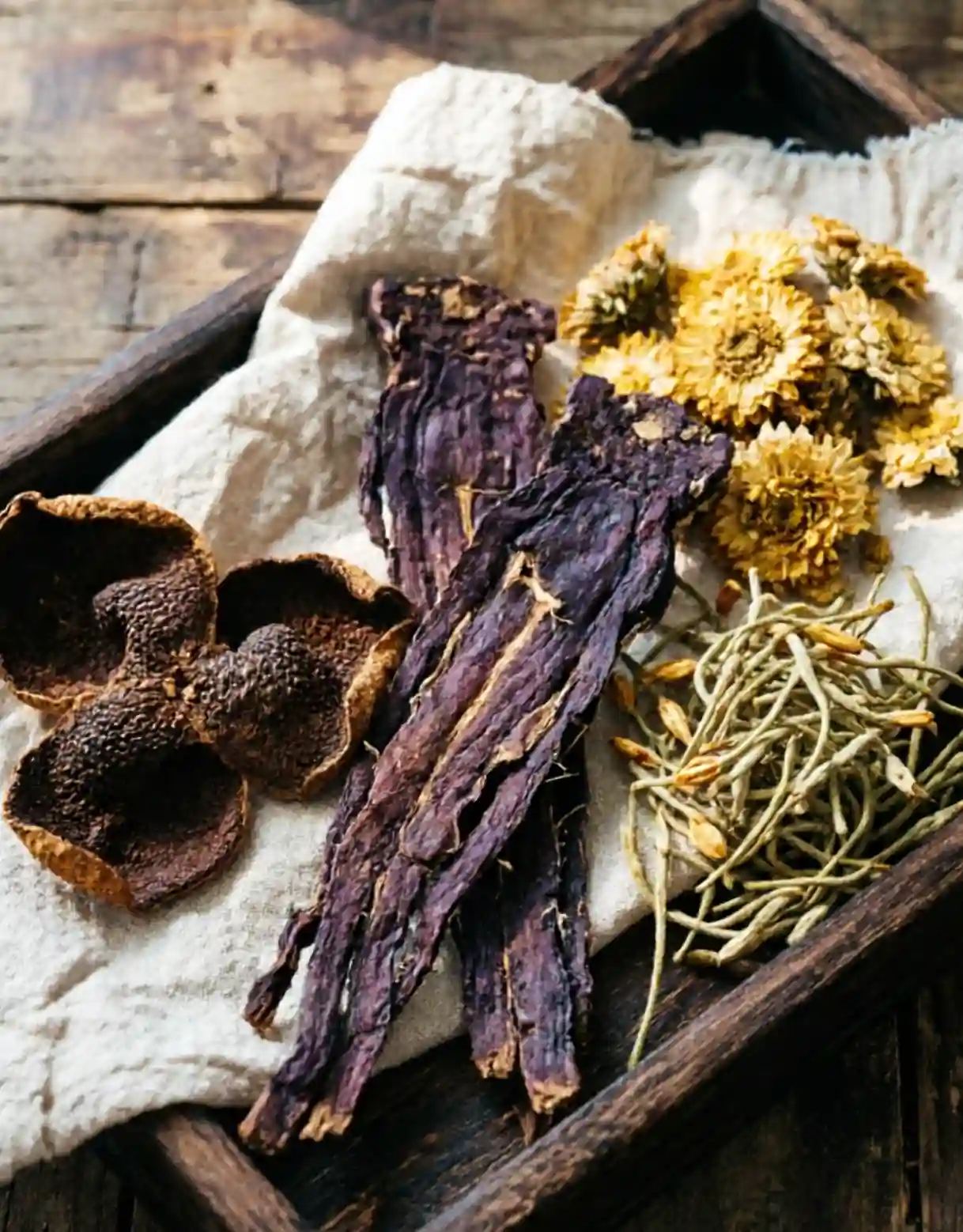
Leaves are mostly wrinkled and curled, some broken; after flattening, intact leaves are elliptic-lanceolate or ovate-lanceolate, 2-5 cm long, 0.5-2 cm wide. Pale green or grayish-green, apex obtuse with a small mucronate tip, base obtuse-rounded or cuneate, margin finely serrate and often revolute, both surfaces glabrous, veins prominent on the lower surface; petiole slender, approximately 4 mm long. Texture brittle. Odor faint; taste bland.
Chemical Constituents
This product contains quercetin, rutin, isoquercitrin, (+)-catechin, hyperoside, lupeol palmitate, melissyl palmitate, scopoletin, and other constituents.
Properties and Channel Entry
Sweet and bitter, cool. Enters the Liver channel.
Functions and Indications
Calms the Liver and calms the Spirit, clears Heat and promotes urination. Used for dizziness due to Liver Yang rising, palpitations and insomnia, edema with scanty urine.
Dosage and Administration
Oral: decoct 5-10 g in water or steep in tea.
Prescriptions
1. Treatment of hypertension, headache, and insomnia: a. 3-6 g each of *Apocynum venetum* leaf and *Uncaria rhynchophylla*, 4 red dates. Decoct in water and take orally, 2 times daily. (From "Food Chinese Medicine and Prescriptions") b. 9 g of *Apocynum venetum* leaf (soaked in boiling water) and 9 g of *Polygonatum odoratum*. Decoct the juice, mix together, and take orally 3 times daily. (From "Inner Mongolia Chinese Herbal Medicine") 2. Treatment of hepatitis with abdominal distension: 6 g each of *Apocynum venetum* leaf and *Corydalis yanhusuo*, 4.5 g of *Cucumis melo* fruit stalk, 3 g of *Syzygium aromaticum*, 9 g of *Aucklandia lappa*. Grind together into powder, take 1.5 g each time, 2 times daily, with boiling water. (From "Xinjiang Chinese Herbal Medicine Manual")