Pinyin: Aiye
Aliases
Ai Hao, Wu Yue Ai.
Source
1Artemisia argyiDried leaves of *Lévl.et Vant*.
Botanical Description
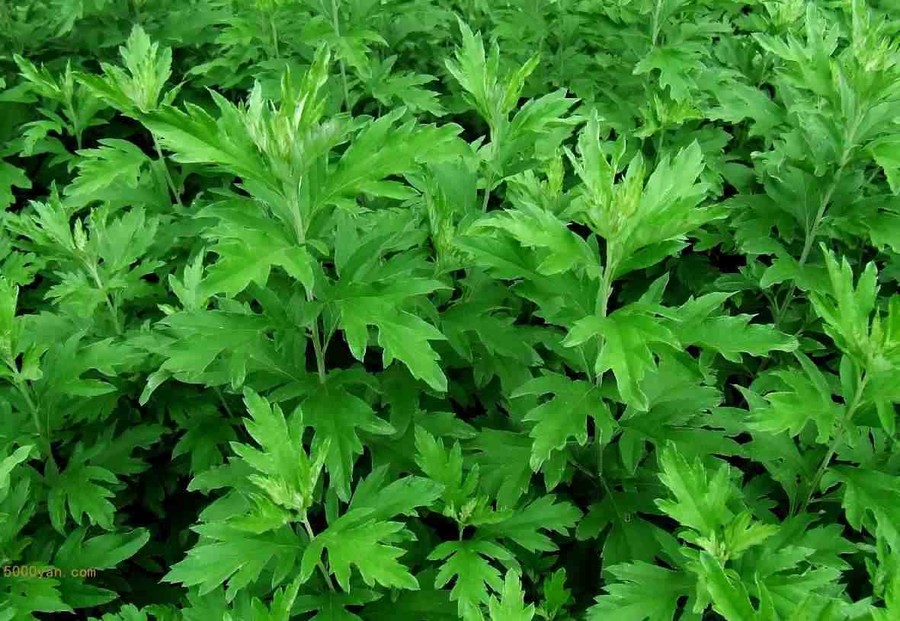
Perennial herb, 50-120 cm tall. Entire plant densely covered with white pubescence, with spreading and ascending inflorescence branches from the middle upward or only in the upper part. Leaves alternate, lower leaves withered at flowering; middle leaves ovate-triangular or elliptic, 6-9 cm long, 4-8 cm wide; leaves pinnately lobed or shallowly lobed, lateral lobes about 2 pairs, often cuneate, middle lobe often further three-lobed, lobe margins toothed, upper surface with arachnoid hairs and dense or sparse white glands, lower surface with dense white or gray pubescence; upper leaves gradually smaller, three-lobed or unlobed, sessile. Numerous capitula arranged in compound racemes, about 3 mm long, 2-3 mm in diameter, nodding after flowering; involucre ovoid; phyllaries in 4-5 layers, margins membranous, back pubescent; flowers mostly reddish, outer flowers female, inner flowers bisexual. Achenes, glabrous. Flowering period July to October.
Habitat and Distribution
It grows in wastelands and forest edges. Distributed across most regions of the country.
Harvesting and Processing
Summer is the season before the flowers bloom for harvesting, remove impurities, and dry in the sun.
Medicinal Properties
This product is often wrinkled, broken, and has short petioles. When flattened, the intact leaf is ovate-elliptic, pinnately deeply lobed, with lobes elliptic-lanceolate and irregular coarse serrations on the margin; the upper surface is gray-green or dark yellowish-green, sparsely covered with soft hairs and glandular dots; the lower surface is densely covered with gray-white pubescence. The texture is soft. Odor: fragrant; Taste: bitter.
Chemical Constituents
This product contains 2-methylbutanol, artemisia alcohol, borneol, cis-carveol, eucarvone,α- Thujopsene, methyl eugenol, and artemisolide and other constituents.
Pharmacology
It has antibacterial effects; can significantly enhance the phagocytic function of reticuloendothelial cells; exhibits anti-asthmatic, antitussive, and expectorant effects; resists anaphylactic shock; inhibits myocardial contraction, anticoagulates, and strongly inhibits platelet aggregation; can significantly prolong pentobarbital sodium-induced sleep time. It also has cholagogic and uterine-stimulating effects.
Properties and Channel Entry
Acrid, bitter, warm; slightly toxic. Enters the Liver, Spleen, and Kidney channels.
Functions and Indications
Warms the channels to stop bleeding, disperses Cold to alleviate pain; for external use, eliminates Dampness and relieves itching. Used for hematemesis, epistaxis, hemoptysis, hematochezia, metrorrhagia and metrostaxis, menorrhagia, dysmenorrhea, vaginal bleeding during pregnancy, cold pain in the lower abdomen, irregular menstruation due to Cold, infertility due to Cold uterus; externally for skin itching. Vinegar-prepared Ai Ye (Carbonized Mugwort) warms the channels to stop bleeding, used for deficiency-cold bleeding.
Dosage and Administration
Oral: decocted in water, 3-10 g; or made into pills or powder; or pounded to extract juice. External use: appropriate amount, pounded into moxa cones or made into moxa sticks for moxibustion; or pounded for topical application; or decocted in water for fumigation and washing; or stir-fried and applied warm.
Precautions and Contraindications
Those with Yin deficiency and Blood Heat should use with caution.
Prescriptions
1. For postpartum persistent bloody diarrhea: Dried Aiye (Folium Artemisiae Argyi) 15 g (roasted until cooked), old Shengjiang (Rhizoma Zingiberis Recens) 15 g. Decoct in concentrated decoction. One dose stops the condition. (Shi Liao Ben Cao) 2. For threatened abortion during pregnancy, or low back pain, or fetal distress, or persistent vaginal bleeding: Aiye (Folium Artemisiae Argyi) the size of one chicken egg, boil with 4 sheng of wine, reduce to 2 sheng, divide into two doses. (Zhou Hou Fang) 3. For epigastric pain during pregnancy: Aiye (Folium Artemisiae Argyi), Huixiang (Fructus Foeniculi), and Chuanlianzi (Fructus Toosendan) (all stir-fried) in equal parts. Take with vinegar decoction. (Wei Sheng Yi Jian Fang) 4. For cramping and vomiting with diarrhea: Aiye (Folium Artemisiae Argyi) and Mugua (Fructus Chaenomelis) 15 g each, salt 6 g. Add 1.5 cups of water, decoct to 1 cup, allow to cool before drinking. (Wei Sheng Yi Jian Fang) 5. For tinea (ringworm): Apply vinegar-decocted Aiye (Folium Artemisiae Argyi) topically. (Qian Jin Yao Fang)