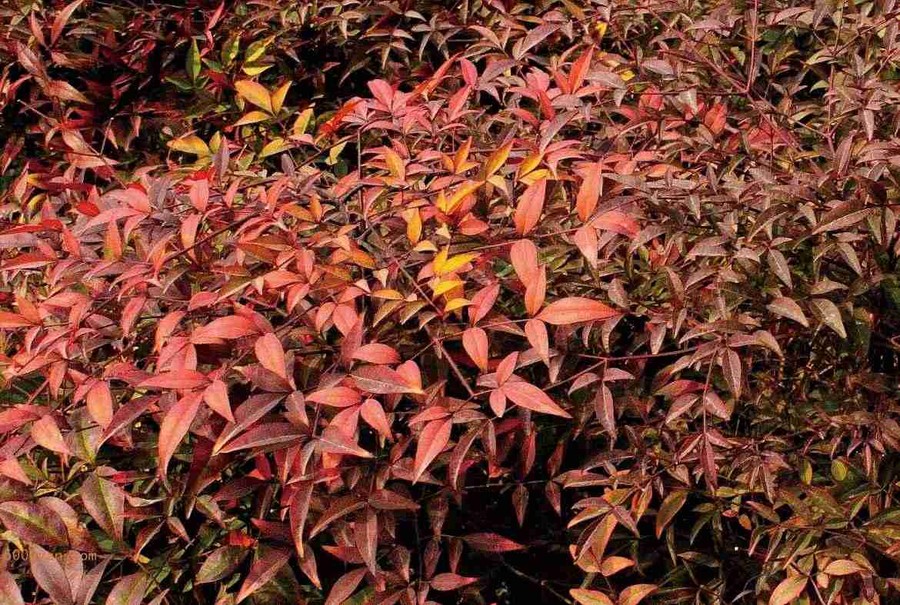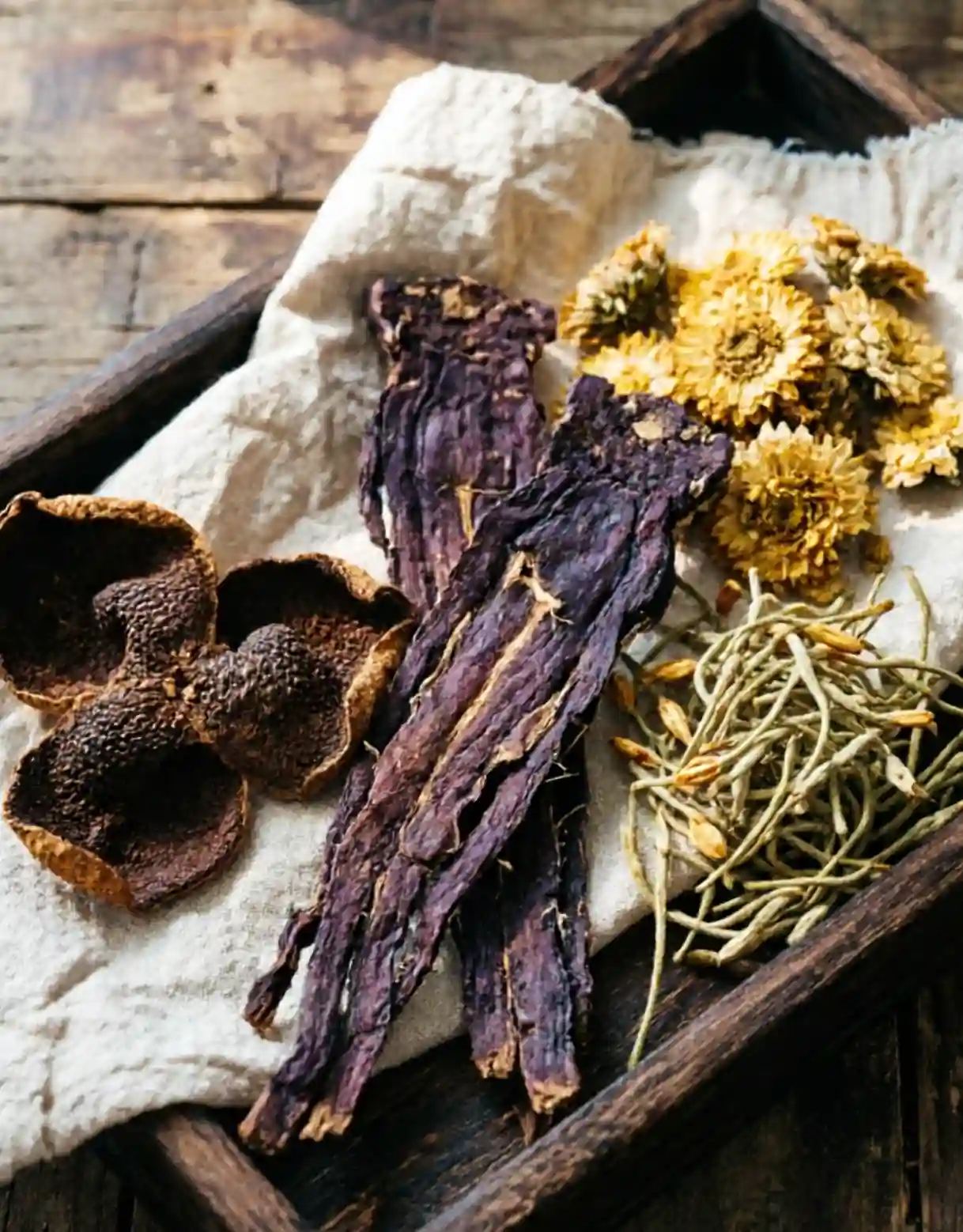
Pinyin: Nantianzhuye
Aliases
Nanzhuye, Tianzhuye
Source
Berberidaceae plant Nandina domesticaNandina domesticaDried leaf of Thunb.
Botanical Description
An evergreen shrub, approximately 2 m tall. Stem erect, cylindrical, cespitose, with few branches, young parts often red. Leaves alternate, leathery and glossy; petiole base swollen and sheathed; leaves usually tripinnately compound, 30-50 cm long, with 3-5 leaflets, leaflets elliptic-lanceolate, 3-7 cm long, 1-1.2 cm wide, apex acuminate, base cuneate, margin entire, both surfaces dark green, often turning red in winter. Flowers in large panicles, 13-25 cm long, flower diameter about 6 mm. Sepals numerous, 3 per whorl, inner two whorls white and petal-like; stamens 6, free, anthers dehiscing longitudinally; ovary 1-locular, with 2 ovules, style short. Berry globose, red or sometimes yellow when ripe, 6-7 mm in diameter, containing 2 seeds, seeds oblate. Flowering period May to July, fruiting period August to October.
Habitat and Distribution
Growing in sparse forests and shrublands, often cultivated in gardens and courtyards. Distributed in Shaanxi, Jiangsu, Anhui, Zhejiang, Jiangxi, Fujian, Hubei, Hunan, Guangdong, Guangxi, Sichuan, Guizhou, and other regions.
Harvesting and Processing
Leaves can be harvested in all four seasons, washed clean, remove branches and impurities, and sun-dried.
Medicinal Properties
Leaves are bi- to tripinnately compound, with the ultimate pinnae bearing 3-5 leaflets; leaflets elliptic-lanceolate, 3-10 cm long, 0.5-1 cm wide, apex acuminate, base cuneate, margin entire, surface dark green or red, leathery; odor faint, taste bitter.
Chemical Constituents
This product primarily contains magnoflorine, vitamin C, nantenine cyanide glycoside, amentoflavone, and nantenoside A, among other components.
Properties and Channel Entry
Bitter, cold.
Functions and Indications
Clears Heat and drains Dampness, drains Fire, and resolves toxicity
Dosage and Administration
Internal: decoct in water, 9-15 g. External: apply appropriate amount, mashed for topical application; or wash with decoction.
Prescriptions
1. For urinary tract infection: Nandina leaves, Plantago asiatica 15 g each, Akebia caulis, Polygonum aviculare 9 g each. Decoction for oral administration. (Wanxian Chinese Herbal Medicine) 2. For hematuria: Nandina leaves 9-15 g. Decoction for oral administration. (Zhejiang Medicinal Flora) 3. For wind-heat swelling, redness, and excessive tearing: Nandina leaves decoction for eye washing. (Compendium of Materia Medica Supplement) 4. For sores and toxins: Nandina leaves, pounded and applied externally. (Hunan Materia Medica) 5. For early-stage scrofula: Nandina leaves, Clematis chinensis, Prunella vulgaris, Lonicera japonica 120 g each, four jars of aged wine. Boil thoroughly in water, take three times daily. Each dose of medicated wine should be taken with pills. (Baicao Jing) 6. For wind-fire toothache: Nandina leaves 15 g, Eleusine indica, Desmodium caudatum 12 g each. Decoction for oral administration. (Wanxian Chinese Herbal Medicine) 7. For pediatric malnutrition: Nandina leaves, decoction taken as tea. (Compendium of Materia Medica Supplement)