Pinyin: Jiulixiang
Aliases
Manshanxiang, Wulixiang, Guoshanxiang, Qianzhiye
Source
Rutaceae plant Murraya paniculata (L.) Jack.Murraya exoticaL of the dried leaves and tender branches with leaves.
Botanical Description
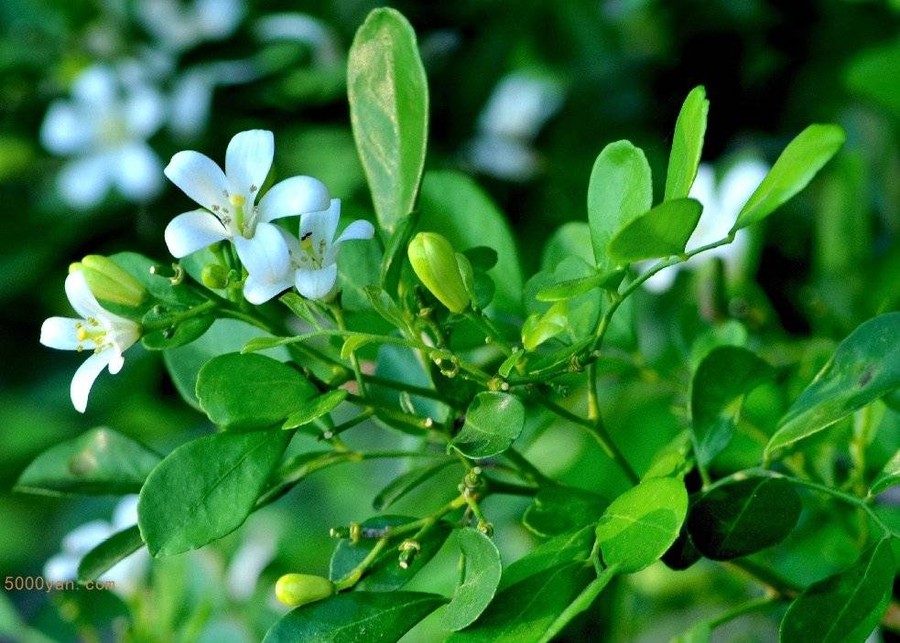
Small tree, up to 8 m tall. Branches white-gray or pale yellow-gray, but current year branches green. Leaves with 3-5 (-7) leaflets, leaflets obovate to obovate-elliptic, often asymmetrical on both sides, 1-6 cm long, 0.5-3 cm wide, apex rounded or obtuse, sometimes slightly emarginate, base cuneate, slightly oblique on one side, margin entire, flat; petiolules very short. Inflorescence usually terminal, or terminal and axillary, many flowers clustered in umbels, forming short conical thyrses; flowers white, fragrant; sepals ovate, about 1.5 mm long; petals 5, oblong, 10-15 mm long, reflexed at full bloom; stamens 10, unequal in length, slightly shorter than petals, filaments white, anthers with 2 fine oil dots on the back; style slightly more slender than ovary, with no clear boundary between them, both pale green, stigma yellow, thick. Fruit orange-yellow to vermilion, broadly ovate or elliptic, apex shortly pointed, slightly oblique, sometimes globose, 8-12 mm long, 6-10 mm in diameter, pulp with mucilaginous fluid, seeds with short cottony hairs. Flowering period April to August, also after autumn; fruiting period September to December.
Habitat and Distribution
It grows in arid open fields or sparse forests. It is also cultivated. It is distributed in Fujian, Taiwan, Hunan, Guangdong, Hainan, Guangxi, Guizhou, and Yunnan.
Harvesting and Processing
It can be harvested year-round, remove the old branches, and dry in the shade.
Medicinal Properties
The tender branches are cylindrical, with a diameter of 1-5 mm. The surface is gray-brown with longitudinal wrinkles. The texture is tough and firm, not easily broken, with an uneven fracture surface. The pinnately compound leaves have 3-7 leaflets, most of which have fallen off; the leaflets are obovate or nearly rhomboid, widest above the middle, about 3 cm long and 1.5 cm wide; the apex is obtuse, acute, or emarginate, the base is slightly oblique, and the margin is entire; they are yellow-green, thinly leathery, with transparent glandular dots on the upper surface, the petiolules are short or nearly absent, and the lower part is sometimes pubescent. Odor: aromatic; Taste: bitter and acrid, with a numbing sensation on the tongue.
Chemical Constituents
This product contains murrayacine, murrayanine, murrayazoline, murrangatin, murralongin, and murrayacoumarin among other components.
Pharmacology
Has anti-fertility effects, stimulating both pregnant and non-pregnant isolated uterus; can be used for local infiltration anesthesia and also for surface anesthesia; has significant antispasmodic effects on isolated intestine and bronchi. Also has certain anti-inflammatory effects, promotes fresh red blood cell agglutination, and has anticoagulant effects.
Properties and Channel Entry
Acrid, slightly bitter, warm; mildly toxic. Enters the Liver and Stomach channels.
Functions and Indications
Promotes Qi circulation and alleviates pain, activates Blood and disperses stasis. Used for stomach pain, rheumatic pain; externally for toothache, traumatic swelling and pain, insect and snake bites.
Dosage and Administration
Oral: decoct in water, 6-12 g; or as powder; or steep in wine. External use: appropriate amount, mash and apply or decoct in water for washing.
Precautions and Contraindications
Patients with Yin deficiency should use with caution.
Prescriptions
1. For ulcer disease: Jiulixiang leaf (Murraya paniculata) and Liangmianzhen (Zanthoxylum nitidum) 2 parts each, Haipiaoxiao (cuttlefish bone) 5 parts, Ganjiang (dried ginger) and Gancao (licorice root) 1 part each. Grind together into a fine powder. Take 3 g each time with warm boiled water, 3 times daily. (From "Fujian Materia Medica") 2. For stomach pain: Jiulixiang leaf 9 g, calcined Walengzi (Ark shell) 30 g. Grind together into powder. Take 3 g each time, 3 times daily. (From "Hong Kong Chinese Herbal Medicine") 3. For fractures and abscesses: Pound fresh Jiulixiang leaves or roots into a paste, mix with egg white, and apply to the affected area. (From "Yunnan Chinese Herbal Medicine") 4. For snake bites: Pound Jiulixiang leaves and apply externally. (From Southern Herbal Medicine "Chinese Herbal Medicine") 5. For eczema: Decoction of fresh Jiulixiang stems and branches in water. Use the decoction to wash the affected area. (From "Fujian Chinese Herbal Medicine")