Pinyin: Shinanye
Aliases
Fengyao, Luancha.
Source
Rosaceae plant Photinia serrulataPhotinia serrulataDried leaf of Lindl.
Botanical Description
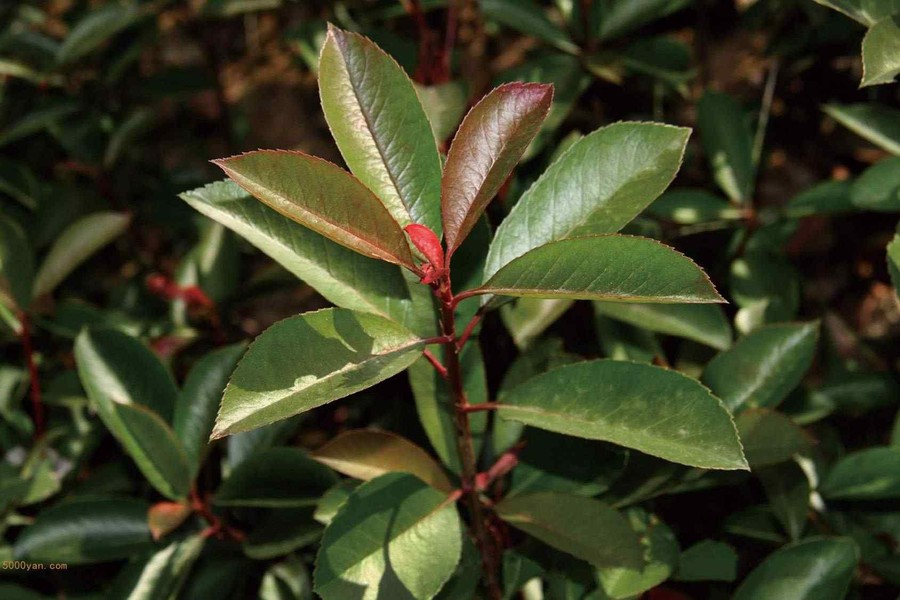
Evergreen shrub or small tree, 4-6 m tall, sometimes up to 12 m. Branchlets brown-gray, glabrous. Leaves alternate; petiole stout, 2-4 cm long, glabrous when mature; leaf blade leathery, oblong, obovate-oblong, or obovate-elliptic, 9-22 cm long, 3-6.5 cm wide, apex caudate-acuminate, base rounded or broadly cuneate, margin sparsely serrulate with glandular teeth, entire near base, upper surface shiny, midvein pubescent when young, both surfaces glabrous when mature. Leaf blade shape varies greatly, with spinose teeth on serrations in seedlings. Flowers bisexual; compound corymb terminal, peduncle and pedicels glabrous; pedicel 3-5 mm long; flowers dense, 6-8 mm in diameter; calyx tube cup-shaped, about 1 mm long; sepals 5, broadly triangular, about 1 mm long, apex acute; petals 5, white, suborbicular, 3-4 mm in diameter; stamens 20, outer whorl longer than petals, inner whorl shorter than petals, anthers purplish; styles 2, sometimes 3, connate at base, stigma capitate, ovary apex pubescent. Pome globose, 5-6 mm in diameter, red, bright, later turning brown-purple. Seed 1, ovoid, 2 mm long, brown, smooth. Flowering April-May, fruiting October.
Habitat and Distribution
This text is NOT a prescription or formula. It is a habitat and distribution description. Here is the accurate translation: Native to mixed forests at elevations of 1000-2500 m. Distributed in Shaanxi, Gansu, Jiangsu, Anhui, Zhejiang, Jiangxi, Fujian, Taiwan, Henan, Hubei, Hunan, Guangdong, Guangxi, Sichuan, Guizhou, and Yunnan.
Harvesting and Processing
It may be harvested year-round, but those collected in summer and autumn are considered best; after harvesting, they are dried in the sun.
Properties
This herb is oblong-elliptic or obovate-elliptic in shape, 8-15 cm long and 2-6 cm wide; the apex is acute or abruptly acute, the base is nearly rounded or cuneate, the margin has fine and dense serrations with brown tips, but on young leaves and leaves of sprouting branches the margin has awn-like serrations; the upper surface is brown or brownish-green, glabrous, with pinnate veins and a sunken midrib. The lower surface has a prominently raised midrib. The leaf blade is leathery and brittle. Odor: faint; Taste: slightly astringent.
Chemical Constituents
This product primarily contains tannins, sakuranin, sorbitol, n-alkanes, benzaldehyde, and hydrocyanic acid, among other components.
Pharmacology
It has an excitatory effect on isolated and in situ frog and rabbit hearts; inhibits frog heart, constricts rabbit ear blood vessels, and reduces blood pressure in anesthetized dogs; can kill the cercariae of Schistosoma japonicum, and also has molluscicidal effects against Oncomelania snails.
Properties and Channel Entry
Acrid, bitter, neutral. Slightly toxic. Enters the Liver and Kidney channels.
Functions and Indications
Expels Wind and Dampness, relieves itching, strengthens sinews and bones, and benefits the Liver and Kidneys. Indications: Bi syndrome (rheumatic pain), Wind-type headache, rubella (wind rash), weak and atrophied lower limbs, Kidney-deficiency lower back pain, impotence, and seminal emission (nocturnal emission).
Usage
Oral: decoct in water, 3-10 g; or prepared as pills or powder. External: appropriate amount, grind into powder and apply or insufflate into the nose.
Precautions and Contraindications
Contraindicated in patients with Yin deficiency and Fire hyperactivity.
Prescriptions
1. For soreness and weakness of the lower back and knees: *Shinanye* (Photinia leaf) 9 g, *Niuxi* (Achyranthes root) 9 g, *Luoshiteng* (Confederate jasmine stem) 9 g, *Gouqi* (Goji berry) 6 g, *Gouji* (Cibotium rhizome) 12 g. Decoct in water and take orally. (From *Qingdao Handbook of Chinese Herbal Medicine*) 2. For wind-type headache: *Shinanye* (Photinia leaf) 4.5 g, *Chuanxiong* (Szechuan lovage root) 4.5 g, *Baizhi* (Angelica dahurica root) 4.5 g. Decoct in water and take orally. (From *Zhejiang Flora of Medicinal Plants*) 3. For migraine: *Shinanye* (Photinia leaf) 9 g, *Manjingzi* (Vitex fruit) 9 g, *Nvzhenzi* (Glossy privet fruit) 9 g, *Baizhi* (Angelica dahurica root) 6 g, *Chuanxiong* (Szechuan lovage root) 4.5 g. Decoct and take orally. (From *Anhui Chinese Herbal Medicine*) 4. For common cold with cough: *Shinanye* (Photinia leaf) 9 g, *Jiegeng* (Platycodon root) 9 g, *Ziwan* (Aster root) 9 g, *Sangbaipi* (Mulberry root bark) 9 g. Decoct and take orally. (From *Anhui Chinese Herbal Medicine*) 5. For cough with excessive phlegm and wheezing: Grind *Shinanye* (Photinia leaf) into powder. Load into a tobacco pipe and smoke. (From *Anhui Chinese Herbal Medicine*)