Pinyin: Cebaiye
Aliases
Baiye, Bianbaiye, Congbaiye
Source
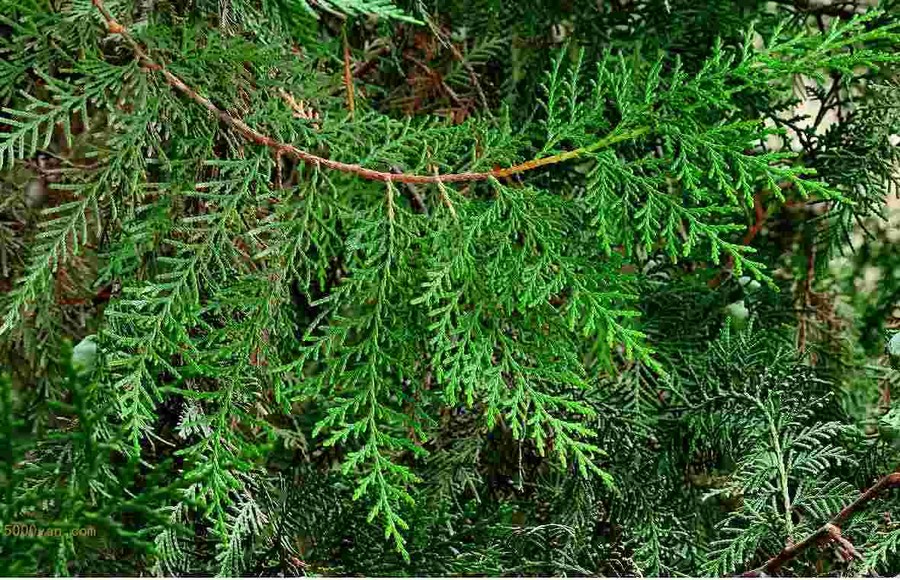
Cupressaceae family plant Platycladus orientalisPlatycladus orientalis(L.) Franco's dried branch tips and leaves.
Botanical Description
See the entry for "Baiziren" (Platycladi Semen).
Harvesting and Processing
Mostly harvested in summer and autumn, dried in the shade.
Medicinal Properties
Multiple branches, branchlets flat. Leaves small, scale-like, decussate, appressed to branches, dark green or yellow-green. Texture brittle, easily broken. Odor faintly aromatic; taste bitter, astringent, and slightly acrid.
Chemical Constituents
This product primarily contains chemical components such as flavonoids, fatty acids, and volatile substances. Among these areα- Thujone, thujene, fenchone, pinene, cupressuflavone and other constituents.
Pharmacology
It significantly shortens bleeding time and blood clotting time in rabbits; its effects on the respiratory system include antitussive, expectorant, and antiasthmatic actions; it is antimicrobial; it has a sedative effect; it can cause a mild decrease in blood pressure and has a dilating effect on isolated rabbit ear blood vessels. It can also relax isolated intestinal segments.
Properties and Channel Entry
Bitter, astringent, and cold. Enters the Lung, Liver, and Spleen channels.
Functions and Indications
Cools the Blood to stop bleeding, transforms Phlegm to stop coughing, promotes hair growth and darkens the hair. Used for hematemesis, epistaxis, hemoptysis, hematochezia, metrorrhagia and metrostaxis, lung Heat cough, hair loss due to Blood Heat, and premature graying of the hair.
Dosage and Administration
Internal use: decoct 6-15 g, or prepared as pills or powder. External use: appropriate amount, decoct for washing; or mash for application, or grind into powder for mixing and applying.
Precautions and Contraindications
Prolonged or excessive use may easily cause epigastric discomfort and decreased appetite.
Prescriptions
① Whooping cough: 15-21 g of Platycladus orientalis leaves, 9 g each of Stemona sessilifolia and Glehnia littoralis, stewed with rock sugar for oral administration. (Fujian Materia Medica) ② Wind-bi with joint pain: Extract juice from Platycladus orientalis leaves, ferment with distiller's yeast and rice to make wine for drinking. (Compendium of Materia Medica, Baiye Wine) ③ Breast abscess: Platycladus orientalis leaves mixed with sugar residue, pounded and applied to the abscess, more effective than Taraxacum mongolicum. (Essentials of Herbal Medicine) ④ Epidemic parotitis (mumps): Appropriate amount of Platycladus orientalis leaves, washed and pounded into a paste, mixed with egg white to form a mud-like consistency for external application, changing the dressing twice daily. (Compilation of Simple and Effective TCM Herbal Prescriptions) ⑤ Persistent hematemesis: 90 g each of Platycladus orientalis leaves and Zingiber officinale (dried), three bundles of Artemisia argyi. Boil the three ingredients in five sheng of water mixed with one sheng of horse manure juice, reduce to one sheng, and take warm in divided doses. (Synopsis of the Golden Chamber, Baiye Decoction) ⑥ Pyelonephritis with hematuria: 9 g of Platycladus orientalis leaves, 24 g of Capsella bursa-pastoris, 15 g of Agrimonia pilosa, 9 g of Lophatherum gracile. Decoct in water for oral administration. (Fujian Materia Medica) ⑦ Blood stranguria: Equal parts of Platycladus orientalis leaves, Nelumbo nucifera nodes, and Plantago asiatica. Pound the three ingredients together to extract juice, mix with Yiyuan Powder (a formula for clearing heat and promoting diuresis), with remarkable efficacy. (Orthodox Medical Record)