Pinyin: Sangye
Aliases
Tieshanzi, Canye.
Source
Moraceae plant mulberryMorus albaL. is the dried leaf.
Botanical Description
See the entry under "Sangshen" (Mulberry).
Harvesting and Processing
Harvested after the first frost, remove impurities, and dry in the sun.
Medicinal Properties
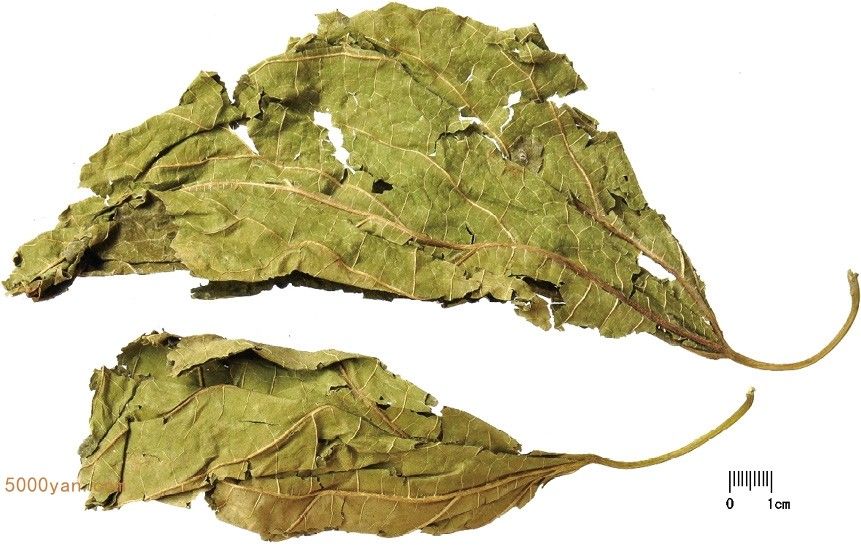
The leaves are often wrinkled and broken. Intact specimens have petioles; when spread flat, the leaf blades are ovate or broadly ovate, 8-15 cm long and 7-13 cm wide. The apex is acuminate, the base is truncate, rounded, or cordate, and the margin is serrate or bluntly serrate, sometimes irregularly lobed. The upper surface is yellowish-green or light yellowish-brown, sometimes with small verrucose protrusions; the lower surface is slightly lighter in color, with prominent veins, reticulate veinlets, sparse hairs along the veins, and tufted hairs at the vein bases. The texture is brittle. The odor is faint, and the taste is mild, slightly bitter and astringent.
Chemical Constituents
This product contains components such as cyasterone, ecdysterone, rutin, quercetin, and chlorogenic acid.
Pharmacology
Has hypoglycemic effects; antibacterial effects; promotes cell growth, stimulates dermal cell division, generates new epidermis and promotes insect molting; in humans, it promotes protein synthesis, eliminates cholesterol from the body, and lowers blood lipids.
Properties and Channel Entry
Sweet, bitter, cold. Enters the Lung and Liver channels.
Functions and Indications
Disperses Wind-Heat, clears the Lungs and moistens dryness, clears the Liver and brightens the eyes
Dosage and Administration
Decoct and take orally, 5-9 g; or prepare as pills or powder. For external use, decoct in water for washing.
Prescriptions
1. For persistent sweating over the entire body: Fresh mulberry leaves (Sangye), picked while still bearing dew. Sun-dry and grind into powder. Take 6 g each time, on an empty stomach, mixed with rice soup. (From Zhongxing Xianfang) 2. For pediatric thirst: Mulberry leaves (Sangye), in any amount, coat each leaf with raw honey, dry in the shade, and finely cut. Decoct in water and take the juice orally. (From Shengjin Fang) 3. For unremitting vexation and thirst after vomiting and diarrhea in cholera: One handful of mulberry leaves (Sangye). Cut, decoct with one large cup of water until reduced to five-tenths, strain, and take warm regardless of mealtime. (From Shenghui Fang) 4. For numbness of hands and feet, unaware of pain or itching: After frost, decoct mulberry leaves (Sangye) in water and frequently wash the affected areas. (From Jijiu Fang) 5. For hard, painful breast lumps: Tender mulberry leaves (Sangye), freshly picked, grind. Mix with rice drink, spread on paper, and apply to the affected area. (From Furen Liangfang) 6. For rectal prolapse: Three sheng of mulberry leaves (Sangye), decoct in water, apply warm to the area and gently push back. (From Zhizhi Fang) 7. For non-healing sores: Frosted yellow mulberry leaves (Sangye), grind into powder and apply topically. (From Zhizhi Fang) 8. For burns and scalds: Frosted mulberry leaves (Sangye), dry-bake, burn to preserve the nature, and grind into fine powder. Mix with sesame oil for application or apply dry. (From Yixue Zhengzhuan)