Pinyin: Mufurongye
Aliases
Jushuangye, Furonghuaye, Tiegusan.
Source
1. For pneumonia: Renshen 6 g, decoct in water and take orally.Hibiscus mutabilisL. leaf.
Botanical Description
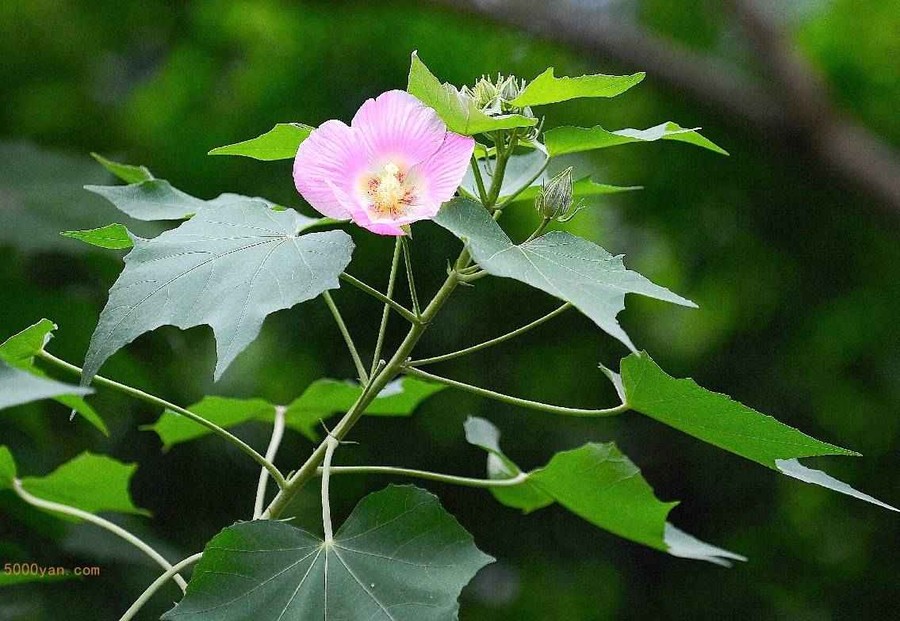
Deciduous shrub or small tree, 2-5 m tall. Branchlets, petioles, pedicels, and calyx are densely covered with fine woolly hairs mixed with stellate and straight hairs. Leaves alternate; petiole 5-20 cm long; stipules lanceolate, 5-8 mm long, often caducous; leaf blade broadly ovate to ovate-orbicular or cordate, 10-15 cm in diameter, often 5-7-lobed, lobes triangular, apex acuminate, margin with obtuse and rounded serrations, sparsely covered with fine stellate hairs and spots above, densely covered with fine stellate tomentum below, with 7-11 main veins. Flowers solitary, axillary at the tip of branchlets; pedicel 5-8 mm long, with a node near the apex; bracteoles 8, linear, 10-16 mm long, about 2 mm wide, densely covered with stellate woolly hairs, fused at base; calyx campanulate, 2.5-3 cm long, 5-lobed, lobes ovate, acuminate; flowers initially white or pale red, turning deep red, about 9 cm in diameter; petals suborbicular, 4-5 cm in diameter, hairy on the outside, with a tuft of hairs at the base. Capsule oblate-spherical, about 0.5 cm in diameter, covered with pale yellow bristles and woolly hairs, with 5 segments. Seeds reniform, with long soft hairs on the back. Flowering period August to October.
Habitat and Distribution
Originally produced in Hunan, China, and now cultivated in East China, Central South China, Southwest China, as well as Liaoning, Hebei, Shaanxi, Taiwan, and other regions.
Harvesting and Processing
Harvest leaves in summer and autumn. Dry in the shade or sun-dry, then grind into powder for storage.
Medicinal Properties
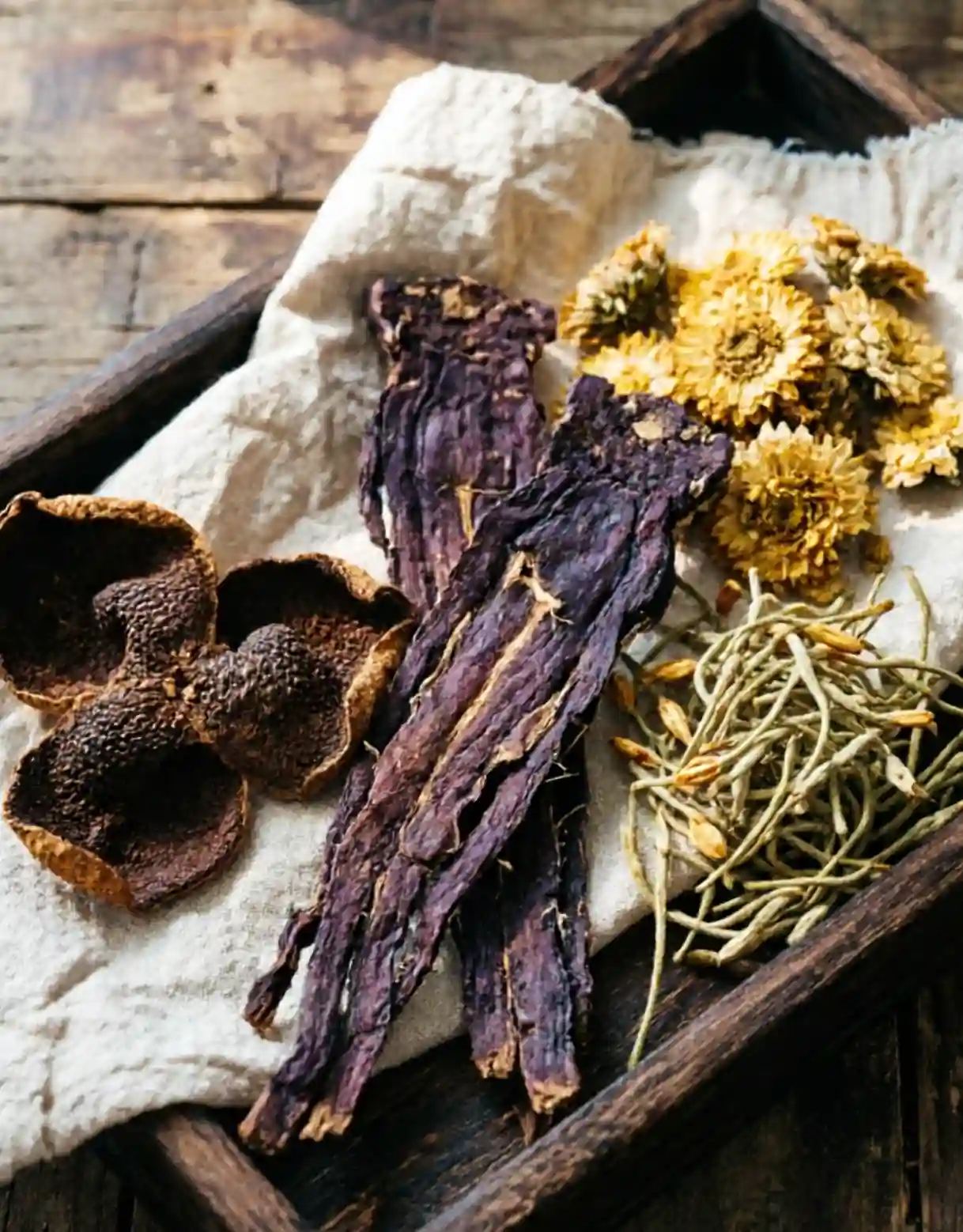
The whole plant is covered with gray-white stellate hairs. The leaves are large, mostly wrinkled and broken; when intact and flattened, they are ovate-cordate in shape, 10-20 cm in diameter, palmately 3-7 lobed, with triangular lobes, acuminate apex, cordate base, and obtuse teeth on the margins; the upper leaf surface is dark green, the lower surface is gray-green, with 7-11 veins raised on both sides. The petiole is cylindrical, 5-20 cm long, approximately 0.3 mm in diameter, and yellowish-brown in color. The texture is brittle and easily broken; the odor is faint, and the taste is slightly pungent.
Chemical Constituents
This product contains quercitrin, isoquercitrin, emodin, and kaempferol-3-O-β-Contains rutinoside, fumaric acid, and other components.
Properties and Channel Entry
Acrid, slightly bitter, cool. Enters the Lung and Liver channels.
Functions and Indications
Clears Lung Heat, cools Blood, resolves toxicity, and reduces swelling. Mainly indicated for Lung Heat cough, red and swollen eyes, carbuncles and furuncles with swelling and toxicity, malignant sores, herpes zoster, pustular sores, pyelonephritis, scalds and burns, venomous snake bites, and traumatic injuries.
Dosage and Administration
External use: appropriate amount; grind into powder for topical application or mash for poultice. Internal use: decoct in water, 10-30 g.
Precautions and Contraindications
Contraindicated during pregnancy.
Prescriptions
1. For abscesses and carbuncles: Collect Hibiscus leaves before Chongyang Festival (grind into powder), collect Xanthium before Dragon Boat Festival (burn to preserve the properties, grind into powder), equal parts. Mix with honey water and apply around the affected area to prevent the toxin from spreading. (From "Ancient and Modern Medical Compendium," Tie Jing Lan formula) 2. For herpes zoster (shingles): Take fresh Hibiscus leaves, dry in the shade, grind into powder, mix with rice water, and apply to the affected area. (From "Fujian Chinese Herbal Medicine") 3. For parotid gland swelling and pain, or ulcerated sores: Take an appropriate amount of Hibiscus leaves. Mash into a paste, apply to the affected area, secure with a cloth, and change daily. (From "Miraculous Effective Formulas," Hibiscus Application Formula) 4. For venomous snake bites: Take an appropriate amount of fresh Hibiscus leaves and flowers. Wash, add a small amount of salt, mash, and apply to the swollen area around the wound. Change twice daily. (From "Zhejiang Medicinal Flora") 5. For falls, sprains, and contusions: Take an appropriate amount of fresh Hibiscus leaves and flowers, mash and apply externally; or dry in the sun, grind into powder, and mix with wine, vinegar, or tea juice for application. (From "Binjiang Medicinal Flora") 6. For red and swollen eyes: Take Hibiscus leaf powder, mix with water, and apply to the temple area. (From "Feihong Collection," Qing Liang Gao formula) 7. For lung abscess: Take 15 g of Hibiscus leaves (or 60 g of the root), decoct in water, add an appropriate amount of honey, and take orally. (From "Anhui Chinese Herbal Medicine")