Pinyin: Manshanhong
Aliases
Yingshanhong, Jindalai, Dongbei Manshanhong
Source
1. For pneumonia: Renshen 6 g, decoct in water and take orally. Internal use: decoct 3-10 g, large dose 10-30 g.Rhododendron dauricumL. is the dried leaf.
Botanical Description
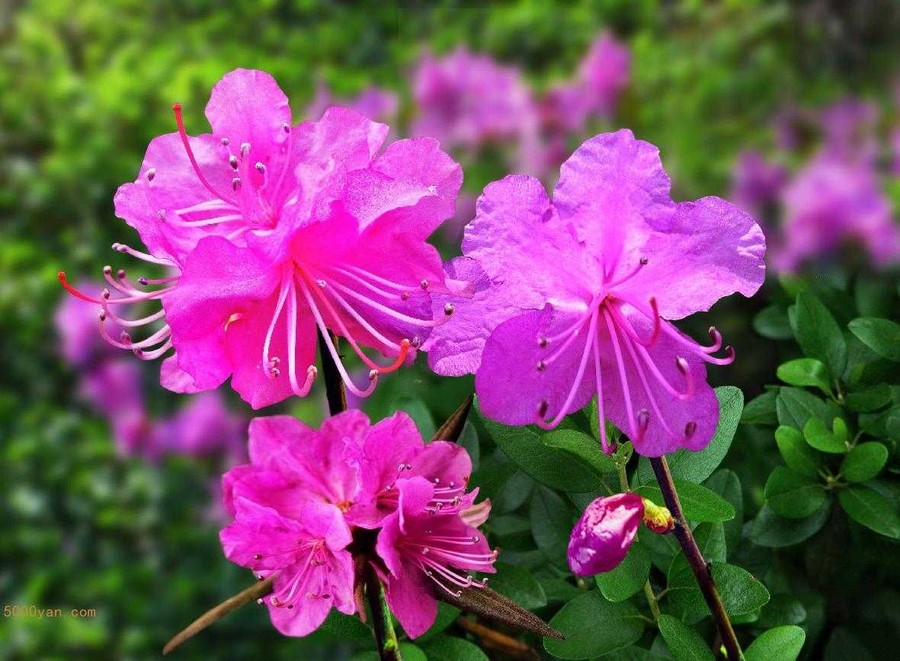
Semi-evergreen shrub, 1-2 m tall. Bark pale gray. Much branched, branchlets slender and curved, dark gray, with scales and pubescence. Buds ovate, scales broadly ovate. Leaves alternate; petiole 2-5 mm long, slightly pubescent; leaf blades nearly leathery, clustered at the apex of branchlets, elliptic or ovate-oblong, 1-7 cm long, 1-3 cm wide, apex obtuse with a short mucro, base cuneate, margin entire, upper surface dark green with scattered white glandular scales, lower surface pale green, densely glandular-scaly. In winter, leaves roll into a tube shape, aromatic when rubbed. Flowers 1-4, terminal, opening before leaves, pink or purplish-red; calyx short, lobed, densely scaly outside; corolla funnelform, about 1.8 cm long, 5-lobed, pubescent outside; stamens 10, exserted, filaments pubescent at base; ovary 1, densely glandular-scaly on the wall, style longer than petals, persistent. Capsule oblong, about 1.2 cm long, dehiscent at apex. Flowering period May to June, fruiting period July to August.
Habitat and Distribution
It grows on mountain ridges, slopes, and under forests in acidic soil. It is distributed in Heilongjiang, Jilin, Inner Mongolia, and other regions.
Harvesting and Processing
Harvested in summer and autumn, dried in the shade.
Medicinal Properties
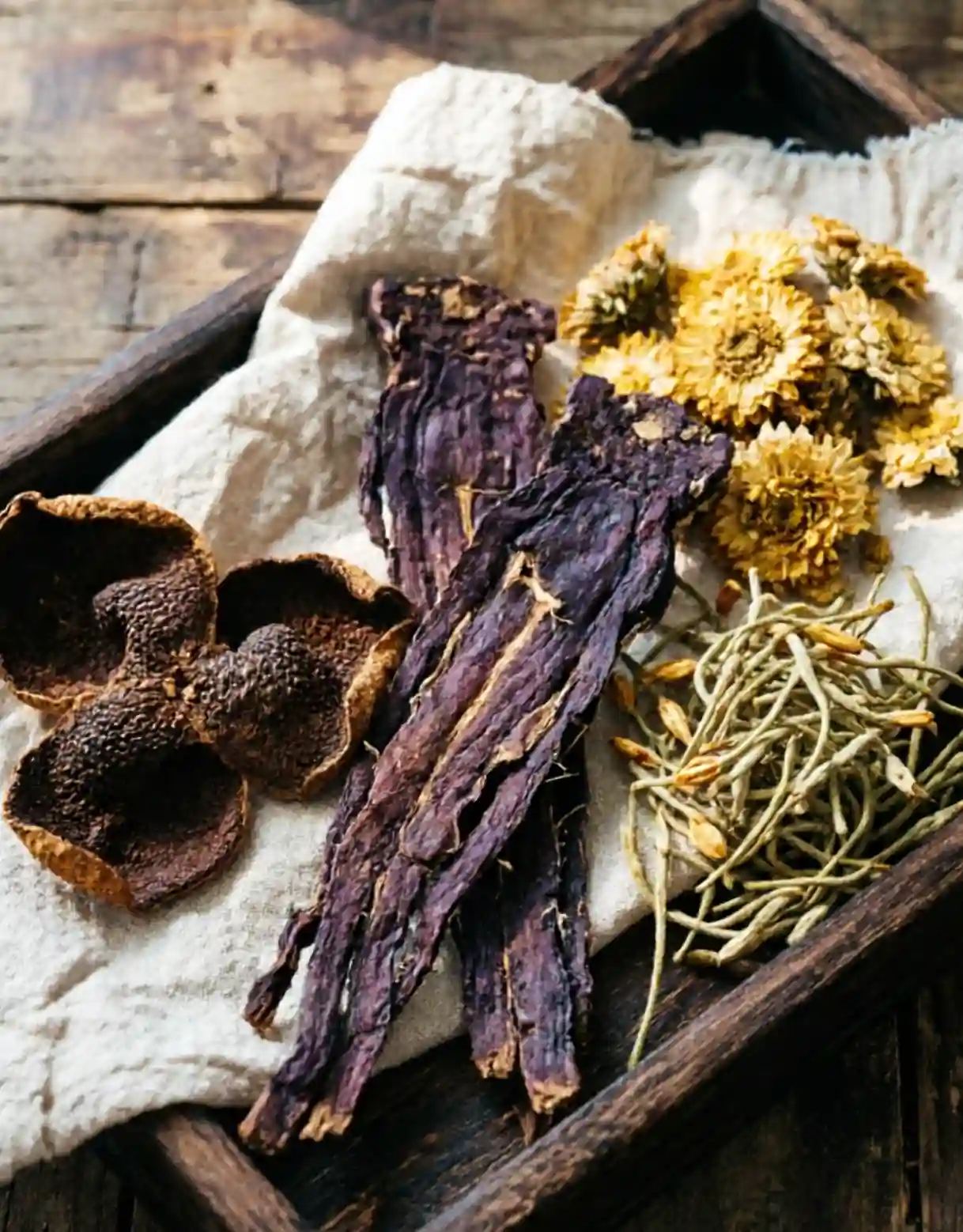
This product is often rolled into a tubular shape, some are wrinkled and broken. When fully flattened, the intact leaves are elliptical or oblong-obovate, 2-7.5 cm long and 1-3 cm wide. The apex is obtuse, the base is nearly rounded or broadly cuneate, with entire margins; the upper surface is dark green to brownish-green, scattered with light yellow glandular scales; the lower surface is grayish-green, with numerous glandular scales; the petiole is 3-10 mm long. It is nearly leathery. The odor is characteristically aromatic, and the taste is quite bitter and slightly acrid.
Chemical Constituents
This product contains hyperoside, isohyperoside, farrerol, azaleatin, gossypetin, kaempferol, myricetin, quercetin, caryophyllene oxide, grayanotoxin I, and other constituents.
Pharmacology
It has antitussive, expectorant, and antiasthmatic effects on the respiratory system. In vitro experiments show it inhibits respiration in rat tracheal-lung tissue, reducing oxygen consumption; it also affects the cardiovascular system and has certain anti-inflammatory effects.
Properties and Channel Entry
Pungent, bitter, and cold. Enters the Lung and Spleen channels.
Functions and Indications
Stops cough and resolves phlegm. Used for cough, wheezing, and excessive phlegm.
Dosage and Administration
Oral: decoct 15-20 g; or steep in wine.
Prescriptions
Treating chronic bronchitis: a. 60 g of coarse powder of *Rhododendron dauricum* leaves, 500 ml of white spirit, steep for 7 days and filter, take 15-20 ml each time, 3 times daily. (From *Heilongjiang Commonly Used Chinese Herbal Medicine Manual*) b. 12-24 g of *Rhododendron dauricum*, 9 g each of *Berberis* and *Syringa reticulata* var. *mandshurica*. Decoct in water, take in 2 divided doses. [From Institute of Materia Medica, Chinese Academy of Medical Sciences, *Clinical and Experimental Research Data on *Rhododendron dauricum* in Treating Chronic Bronchitis* 1971, (11): 30]