Pinyin: Yinxinye
Aliases
Baiguoye
Source
Family: Ginkgoaceae, plant: *Ginkgo biloba* L.Ginkgo bilobaL. is the dried leaf.
Botanical Description
See the entry under "Baiguo" (Ginkgo semen).
Harvesting and Processing
Harvest in autumn when the leaves are still green and dry promptly.
Medicinal Properties
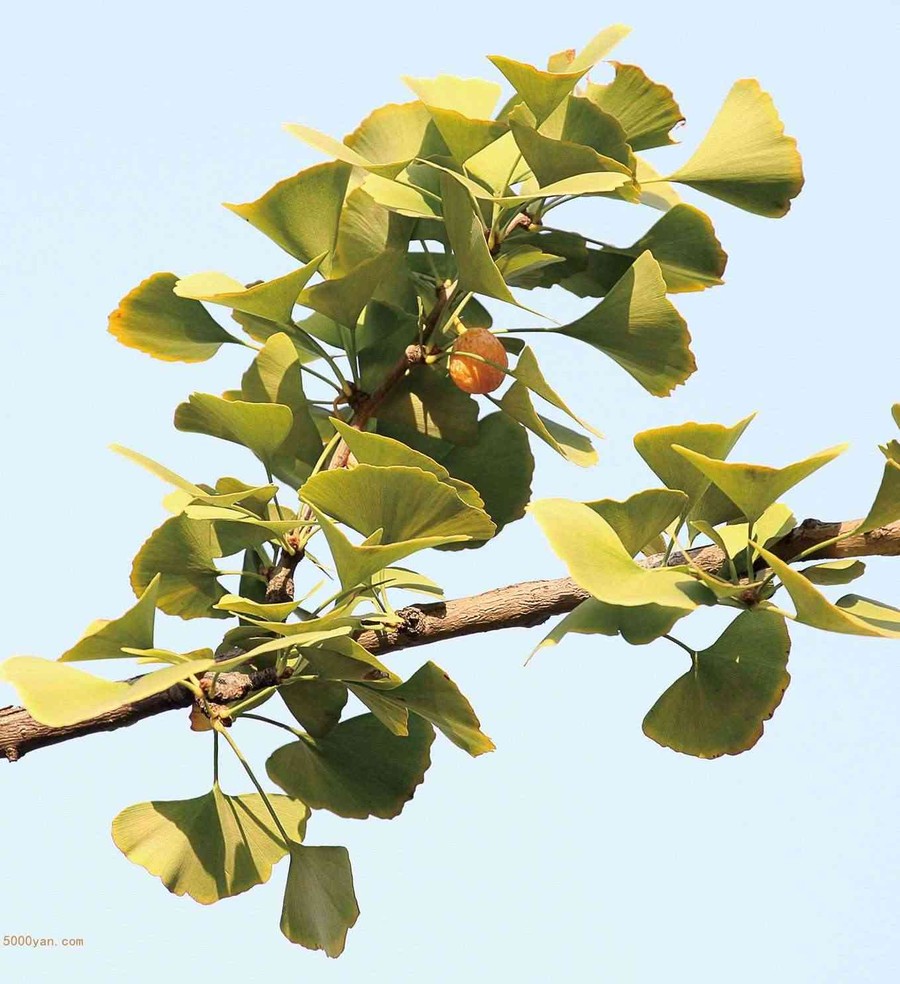
Leaves are mostly wrinkled or broken; intact leaves are fan-shaped, 3-12 cm long, 5-15 cm wide. Yellow-green or light brownish-yellow, the upper margin is irregularly undulate, some with a concave middle that can reach up to 4/5 of the leaf length. Characterized by dichotomous parallel veins, fine and dense, glabrous (hairless), and easily torn longitudinally. Leaf base is cuneate; petiole is 2-8 cm long. Texture is light. Odor: faint; Taste: slightly bitter.
Chemical Constituents
This product contains isoginkgetin, amentoflavone, kaempferol, myricetin, syringetin-3-rutinoside, 6-hydroxykynurenic acid, trans-linalool oxide, ginkgolic acid, ginkgol, ginkgol, and other components.
Pharmacology
Can improve cerebral circulation and has a protective effect on brain cells and the blood-brain barrier; can enhance learning and memory, protect nerves, reduce hearing nerve damage, and significantly improve aging, dementia, and brain dysfunction; for the cardiovascular system, it can reduce myocardial oxygen consumption, protect ischemic myocardium, decrease the occurrence of arrhythmias, dilate blood vessels, and inhibit angiotensin-converting enzyme (ACE); it scavenges free radicals and resists lipid peroxidation; it antagonizes platelet-activating factor and inhibits platelets; it has the effect of enhancing biological membrane stability. It has a direct relaxing effect on tracheal smooth muscle and a spasmolytic effect on gastrointestinal smooth muscle; it has a lipid-lowering effect; it has antimicrobial effects; it can increase sebaceous gland secretion, adding redness and luster to dry or aging skin.
Properties and Channel Entry
Sweet, bitter, and astringent, neutral. Enters the Heart and Lung channels.
Functions and Indications
Activates Blood and resolves stasis, unblocks collaterals and alleviates pain, astringes the Lung and calms wheezing, transforms turbidity and reduces lipids. Used for Blood stasis obstructing the collaterals, chest Bi (impediment) and heart pain, Wind-strike (stroke) with hemiplegia, Lung deficiency with cough and wheezing, and hyperlipidemia.
Dosage and Administration
Oral: decoction, 3-9 g; or use extract in tablet form; or in pills or powder. External use: appropriate amount, mashed for application or rubbing; or decocted for washing.
Prescriptions
1. For hypercholesterolemia: Extract the main component flavonoids from Ginkgo biloba leaves, make into sugar-coated tablets, each tablet containing 1.14 mg of flavonoids, take 4 tablets each time, 3 times daily. (National Chinese Herbal Medicine Compilation) 2. For diarrhea: Grind Ginkgo biloba leaves into powder, mix with flour to make cakes, roast and eat. (Pin Hui Jing Yao) 3. For infantile enteritis: 3-9 g of Ginkgo biloba leaves, decoct in water and use to scrub the patient's soles, palms, and chest (around the Juque acupoint); for severe cases, scrub the top of the head, 2 times daily. (National Chinese Herbal Medicine Compilation) 4. For freckles: Mash Ginkgo biloba leaves and apply topically, very effective. (Dian Nan Ben Cao) 5. For onychomycosis: Decoct Ginkgo biloba leaves in water and wash the affected area. (Southern Herbal Medicine) 6. For corns: 10 fresh Ginkgo biloba leaves, mash, wrap and apply to the affected area; after 2 days, the corn will turn white and rot, then use a small knife to remove the hard core. (Southern Herbal Medicine) 7. For lacquer sore swelling and itching: Decoct Ginkgo biloba leaves and honeysuckle stems in water and wash, or use Ginkgo biloba leaves alone. (Southern Herbal Medicine)