Pinyin: Sijiqingye
Aliases
Sijiqing, Dongqingye.
Source
1. Plant of the Aquifoliaceae family: Ilex chinensis Sims.I1ex chinensisDried leaf of Sims.
Plant
Botanical Description
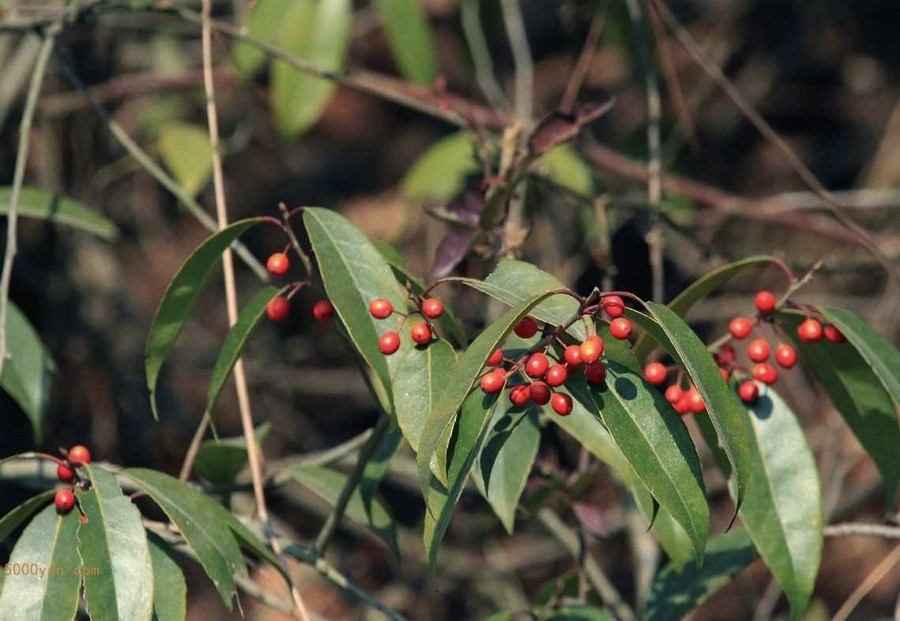
Evergreen tree, up to 12 m tall. Bark gray or light gray, glabrous. Leaves alternate; petiole 5-15 cm long; leaf blade leathery, usually narrowly elliptic, 6-10 cm long, 2-3.5 cm wide, apex acuminate, base cuneate, rarely rounded, margin sparsely shallowly serrate, upper surface dark green and glossy, turning purplish-red in winter, midvein raised on the lower surface. Flowers unisexual, dioecious, cymes axillary or extra-axillary; calyx 4-lobed, petals 4, pale purple; stamens 4; ovary superior. Drupe ellipsoid, 6-10 mm long, red when ripe, containing 4 pyrenes, fruit stalk about 5 mm long. Flowering in May, fruiting in October.
Habitat and Distribution
Often grows in sparse forests. Distributed throughout regions south of the Yangtze River in China.
Harvesting and Processing
Harvested in autumn and winter, used fresh or dried in the sun.
Medicinal Properties
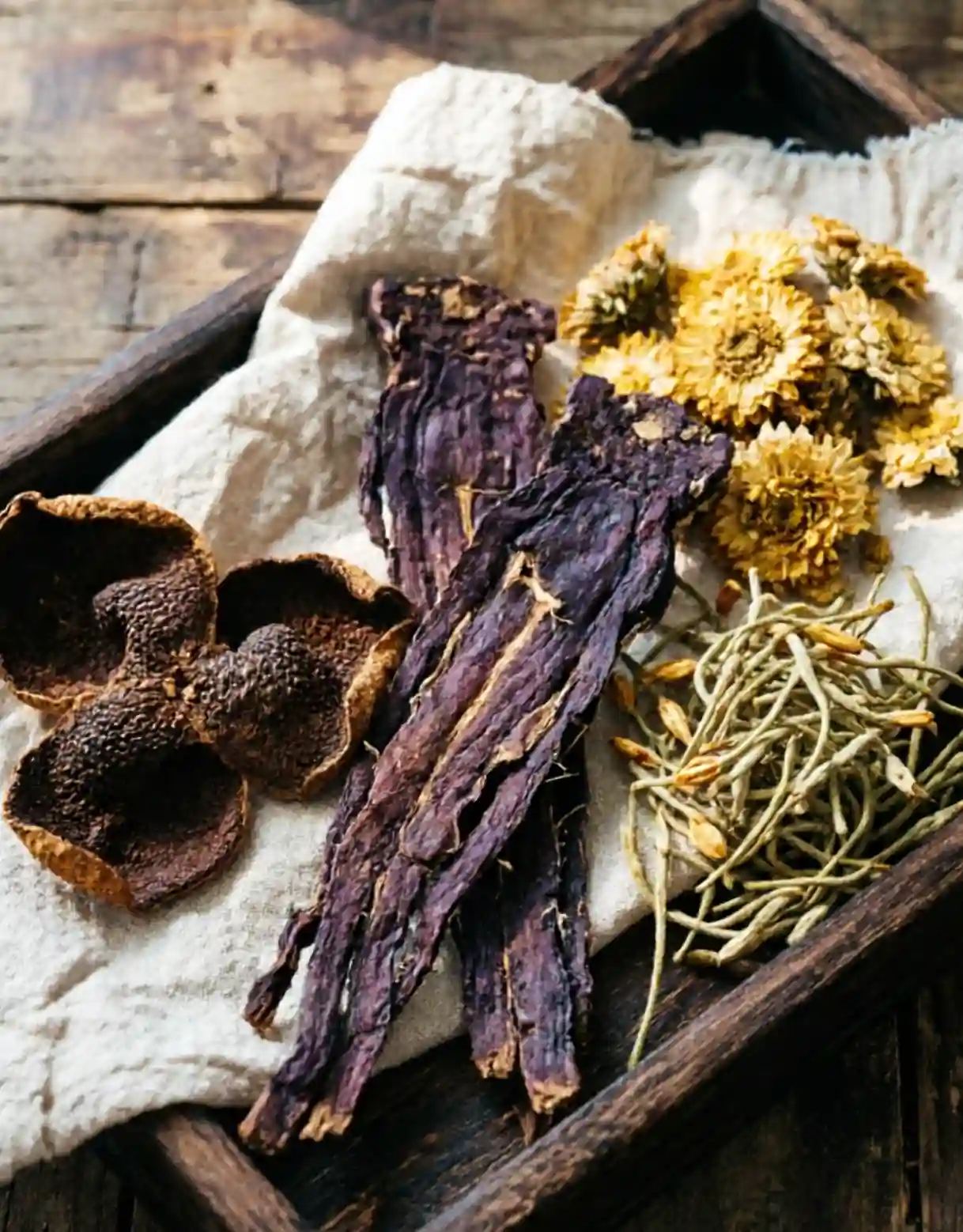
Leaves oblong-elliptic or lanceolate, rarely ovate, 5-11 cm long, 2-4 cm wide, apex shortly acuminate, base cuneate, margin with sparse shallow rounded teeth, upper surface yellowish-green to greenish-brown, lustrous, lower surface greyish-green to yellowish-green, both surfaces glabrous, midrib raised on the lower surface, lateral veins 8-9 on each side. Coriaceous. Odor: faint; Taste: bitter and astringent. Those with dry texture, green color, and free from branch stems are considered superior.
Chemical Constituents
This product mainly contains ilex triterpenoid glycoside A, ilex triterpenoid glycoside B, methyl ester, protocatechuic acid, protocatechuic aldehyde, ursolic acid, tannins, flavonoid glycosides, and sugars, among other components.
Pharmacology
Can be used to treat experimental scalding; for the cardiovascular system, it can dilate coronary blood vessels and reduce myocardial oxygen consumption; has antibacterial and anti-inflammatory effects; has a mild inhibitory effect on experimental HF sarcoma in mice.
Properties and Channel Entry
Bitter, astringent, and cool. Enters the Lung, Large Intestine, and Bladder channels.
Functions and Indications
Clears Heat and resolves toxicity, reduces swelling and removes stasis. Used for lung heat cough, sore throat, dysentery, rib pain, and heat stranguria; external treatment for burns and skin ulcers.
Dosage and Administration
Internal: decoct 15-30 g in water for oral administration. External: apply an appropriate amount of fresh product, crushed, or wash and apply as a decoction.
Prescriptions
1. For cold, tonsillitis, and acute/chronic bronchitis: Sijiqing Ye (Ilex chinensis leaf) 30 g and Sanmaiye Malan (Aster ageratoides leaf) 30 g, decoct to make 90 ml of decoction, take in 3 divided doses daily. [Source: New Medical Data, 1972, (1): 37] 2. For mastitis: Sijiqing Ye 60 g, Xiakucao (Prunella vulgaris) 45 g, and Mufurong (Hibiscus mutabilis) 45 g, mash into a paste and apply to the affected area; when dry, mix with water to re-moisten and reapply. (Source: National Compendium of Chinese Herbal Medicine) 3. For scalds and burns: Decoct Sijiqing Ye in water and concentrate to a 1:1 solution. After cleaning the wound, repeatedly apply the solution with a cotton ball. If exudate appears under the eschar, remove the eschar and reapply until healed. (Source: Zhejiang Medicinal Flora) 4. For skin chapping and scars: Burn an appropriate amount of Sijiqing Ye to ash, mix with appropriate amounts of Vaseline and wheat flour to form an ointment, and apply externally 3-5 times daily. (Source: Qingdao Handbook of Chinese Herbal Medicine) 5. For female genital swelling: Equal parts of Sijiqing Ye, Xiaomai (wheat), and Gancao (Glycyrrhiza uralensis). Decoct in water and wash the affected area. (Source: Gujin Yitong, Dongqingye Jian) 6. For traumatic bleeding: An appropriate amount of fresh Sijiqing Ye, chew and apply externally. (Source: Jiangxi Herbal Medicine)