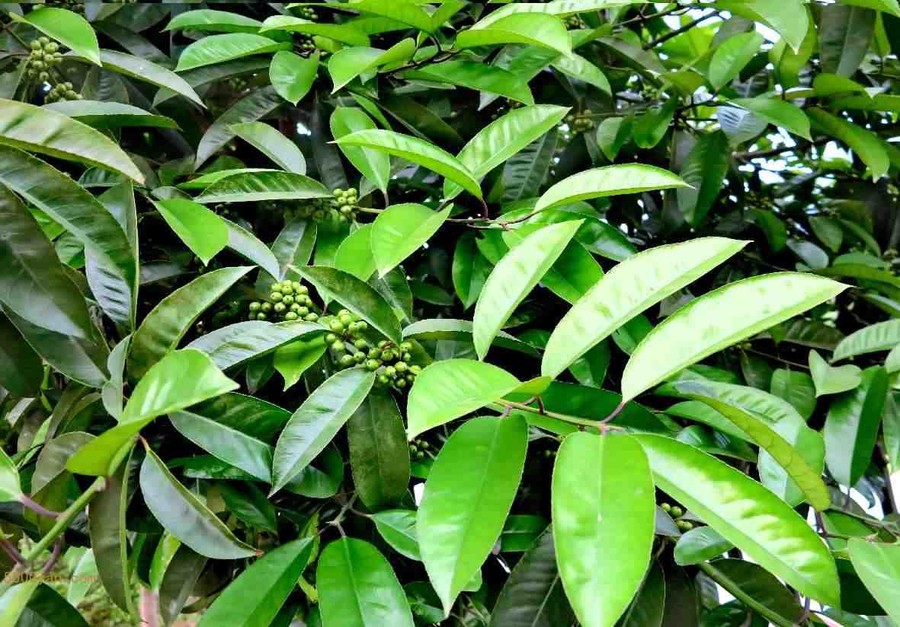
Pinyin: Kudingcha
Source
Plant of the Aquifoliaceae family, Kudingcha Holly (Ilex kudingcha)Ilex kudingchaYoung leaves of C.J. Tseng.
Botanical Description
Evergreen large tree, up to 20 m tall, approximately 60 cm in diameter. Young branches without small protuberances, glabrous; leaves thickly leathery, oblong-elliptic, apex shortly acuminate or obtuse, base cuneate, margin sparsely serrate, midrib impressed above, raised below, lateral veins distinct above, upper surface dark green and glossy, lower surface pale green. Inflorescences fascicled in leaf axils, paniculate; flowers 4-merous; male inflorescence with 3-9 flowers per branch, pedicel 7-8 mm long, calyx approximately 2.5 mm in diameter, lobes rounded, without cilia, corolla reflexed, approximately 9 mm in diameter, petals oblong to obovate, slightly connate at base, stamens shorter than petals; female inflorescence with 1-3 flowers per branch, pedicel 5-8 mm long, calyx approximately 2.5 mm in diameter, corolla approximately 5 mm in diameter, petals oblong to obovate, ovary ovoid. Fruit spherical, 1-1.2 cm in diameter, red, exocarp thick, smooth, persistent stigma discoid; pyrenes 4, oblong-elliptic, back with 3 longitudinal ridges, endocarp bony. Flowering period April-May, fruiting period June-November.
Habitat and Distribution
Born in valleys or on sparse forest slopes of hillsides, also cultivated. Distributed in Hubei, Hunan, Guangdong, and Guangxi.
Harvesting and Processing
For the Chenglin Kudingcha tea tree, tender leaves are picked around the Qingming Festival, with more harvested from the first flush, less from the second flush, more from long shoots, and less from short shoots. After picking, the leaves are placed on bamboo sieves for air drying, then dried in the shade or sun-dried.
Medicinal Properties
Leaf blades oblong-elliptic, 10-16 cm long, 4-8 cm wide, margins serrate, main vein impressed on the upper surface and raised on the lower surface, lateral veins 10-14 on each side, petiole diameter 2-3 mm. Surface olive green or light brown. Leaves thick, hard, and leathery. Odor: faint; Taste: bitter and slightly sweet.
Chemical Constituents
This product mainly containsα- Kuding lactone, ursolic acid,β-α-Amyrin, taraxerol, and other components.
Pharmacology
Significantly increases coronary blood flow and cerebral blood flow, protects against acute myocardial ischemia, reduces cerebrovascular resistance and blood pressure, and enhances hypoxia tolerance in mice. It also exhibits lipid-lowering, antifertility, and uterine smooth muscle stimulating effects.
Properties and Channel Entry
Sweet, bitter, cold. Enters the Liver, Lung, and Stomach channels.
Functions and Indications
Dispels Wind, clears Heat, brightens the eyes, and generates body fluids
Dosage and Administration
Oral: decoct 3-9 g; or prepare as pills. External: appropriate amount, decoct for steaming and washing, or apply as a liniment.
Prescriptions
1. For stomatitis: Kudingcha 30 g, decoct in water and swallow. (Zhejiang Medicinal Flora) 2. For burns: Kudingcha in appropriate amount, decoct in water for external washing, and also grind the leaves into powder, mix with tea oil for topical application. (Zhejiang Medicinal Flora) 3. For traumatic bleeding: Fresh Kudingcha, mash and squeeze the juice for application; or grind dried leaves into fine powder, mix with sesame oil for topical application. (Anhui Chinese Herbal Medicine)