Pinyin: Chaye
Aliases
Chaya, Xicha, Lacha.
Source
Plant of the Theaceae family, Camellia sinensis (L.) O. Ktze.Camellia sinensisDried young leaves or young buds of (L.) O. Kuntze.
Botanical Description
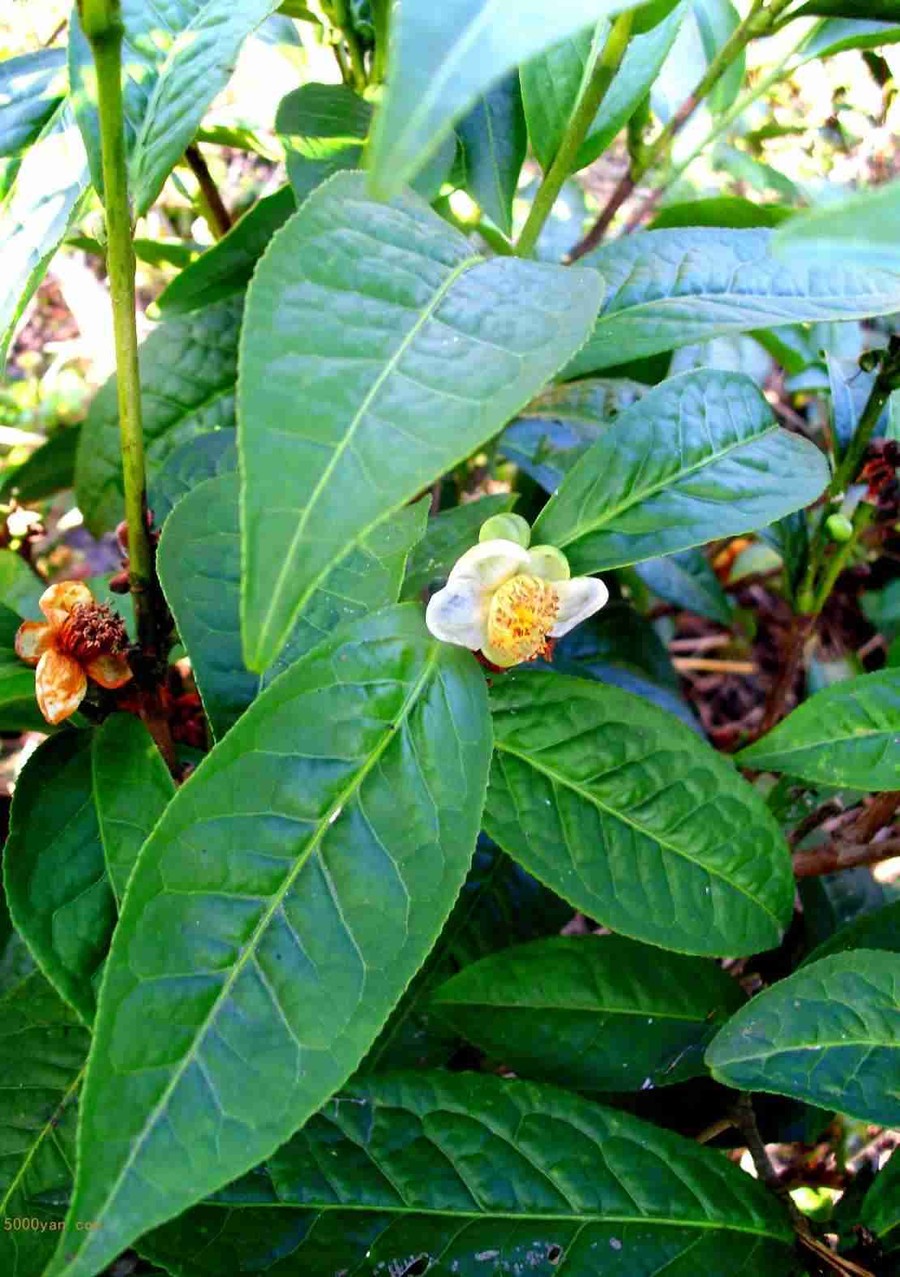
Evergreen shrub, 1-3 m tall; young branches and leaves with fine soft hairs. Leaves simple, alternate; petiole 3-7 mm long; leaf blade thinly leathery, elliptic or obovate-elliptic, 5-12 cm long, 1.8-4.5 cm wide, apex shortly acute or obtuse-acute, base cuneate, margin serrate, lower surface glabrous or slightly hairy, lateral veins about 8 pairs, prominent. Flowers bisexual, white, fragrant, usually solitary or 2 in leaf axils; sepals 5-6, rounded, minutely hairy, margin membranous, ciliate, persistent; petals 5-8, broadly obovate; stamens numerous, outer filaments fused into a short tube; ovary superior, tomentose, 3-locular, style 1, apex 3-lobed. Capsule subglobose or flattened triangular, pericarp leathery, thin. Seeds usually 1 or 2-3, subglobose or slightly angled. Flowering October-November, fruiting October-November of the following year.
Habitat and Distribution
Originally cultivated in southern China, now widely cultivated in the Yangtze River basin and areas to its south.
Harvesting and Processing
Cultivation for 3 years before leaves can be harvested. Harvest spring tea and summer tea from April to June.
Medicinal Properties
Leaves often curled into strips, thin sheets, or wrinkled. When fully spread, the complete leaf is lanceolate to oblong-elliptic, 1.5-4 cm long, 0.5-1 cm wide, with an acute or blunt-acute apex, a cuneate base decurrent into the petiole, and serrate margins. The serrations have brownish-red claw-like tips, sometimes falling off; both surfaces bear soft hairs; the pinnate reticulate venation has 4-10 pairs of lateral veins, with the midvein more prominent on the lower surface; the leaf is relatively thick and papery, with a short petiole covered in white soft hairs; older leaves are leathery, larger, and nearly glabrous (hairless); the odor is faint and fragrant, and the taste is bitter and astringent.
Chemical Constituents
This product contains caffeine, gallic acid,γ- Heptenol, nerolidol, vitexin, rutin, camelliasapogenol A, and other constituents.
Pharmacology
It has a strong excitatory effect on the central nervous system; it stimulates the heart, increasing heart rate and enhancing myocardial contractility; it has a significant antihypertensive effect; it relaxes various smooth muscles, especially bronchial smooth muscle, with a more pronounced effect when the bronchi are in a constricted state; it also increases the resting tension of denervated muscles; it inhibits renal tubule reabsorption, producing a diuretic effect and enhancing the action of potent diuretics. It has a significant lipid-lowering effect, inhibiting the rise of serum cholesterol, serum lipid peroxides, and cholesterol levels in the liver and aorta; it inhibits platelet aggregation and antithrombosis; it exerts an inhibitory effect on the mutagenicity of certain fungal toxins; it shows significant anticancer effects against multiple tumors both in vitro and in vivo. It has anti-inflammatory and anti-allergic properties, as well as antimicrobial effects. It promotes the secretion of gastric acid and pepsin, delays aging, and helps maintain normal thyroid function.
Properties and Channel Entry
Bitter, sweet, and cool. Enters the Heart, Lung, Stomach, and Kidney channels.
Functions and Indications
Clears the head and eyes, relieves restlessness and thirst, promotes digestion, transforms phlegm, promotes urination, and resolves toxicity. Mainly indicated for headache, blurred vision, red eyes, excessive sleepiness and drowsiness, common cold, vexation and thirst, food accumulation, halitosis, phlegm-induced wheezing, epilepsy, dysuria, diarrhea and dysentery, throat swelling, sores, boils, and carbuncles, as well as scalds and burns.
Dosage and Administration
Oral: decoct in water, 3-10 g; or made into pills or powder, steep in boiling water. External use: appropriate amount, grind into powder and mix for application, or mash fresh product for application.
Precautions and Contraindications
Patients with Spleen and Stomach deficiency-cold should use with caution. Those with insomnia and habitual constipation are contraindicated. It is contraindicated when taking Renshen, Tufuling, or iron-containing medications. Taking Shijunzi with tea may easily cause hiccups. Overdose may easily cause vomiting, insomnia, etc.
Prescriptions
1. For headache: Tea leaves, Cyperus rotundus, and Ligusticum chuanxiong 3 g each, one cup of water, decoct until 80% remains, take before bed for immediate relief. (Zhong Miao Xian Fang) 2. For dizziness and red eyes: Tea leaves and white Chrysanthemum 3 g each. Steep in water and drink. (Qingdao Zhong Cao Yao Shou Ce) 3. For fiery eyes with redness and pain: Tea leaves and fresh ginger, mix with rice to form a paste, apply to the eyelids, and secure with a bandage. (Hunan Yao Wu Zhi) 4. For common cold: Dried young tea leaves and fresh ginger slices, steep in boiling water and take. (Fujian Zhong Cao Yao) 5. For halitosis, dry mouth, and phlegm-heat conditions: Tea leaves 60 g, Moschus 0.3 g, Borax 0.6 g, Catechu powder 30 g, Terminalia chebula pulp 7.5 g. Grind together into a fine powder, form into pills or tablets with Licorice decoction, take as needed. (Chuan Ya Wai Bian Xiang Cha) 6. For food stagnation: Dried young tea leaves 9 g. Steep in water and take. (Fujian Zhong Cao Yao) 7. For phlegm-heat causing mania: Fresh young tea leaves 120-240 g. Decoct in water and take. (Fujian Zhong Cao Yao) 8. For red and white dysentery and heat-toxic dysentery: Strongly decoct tea leaves, take two bowls. (Shi Yi Xin Jian)