Pinyin: Zonglü
Aliases
Zonglü pi, Binlü mupi, Zongmao, Zongpi.
Source
1. For hematochezia and metrorrhagia: Zonglu (Petiolus Trachycarpi) 6-9 g, decoct in water and take orally. 2. For hypertension: Zonglu 9-15 g, decoct in water and take orally.Trachycarpus fortuneiDry petiole of *Trachycarpus fortunei* (Hook.f.) H.Wendl.
Botanical Description
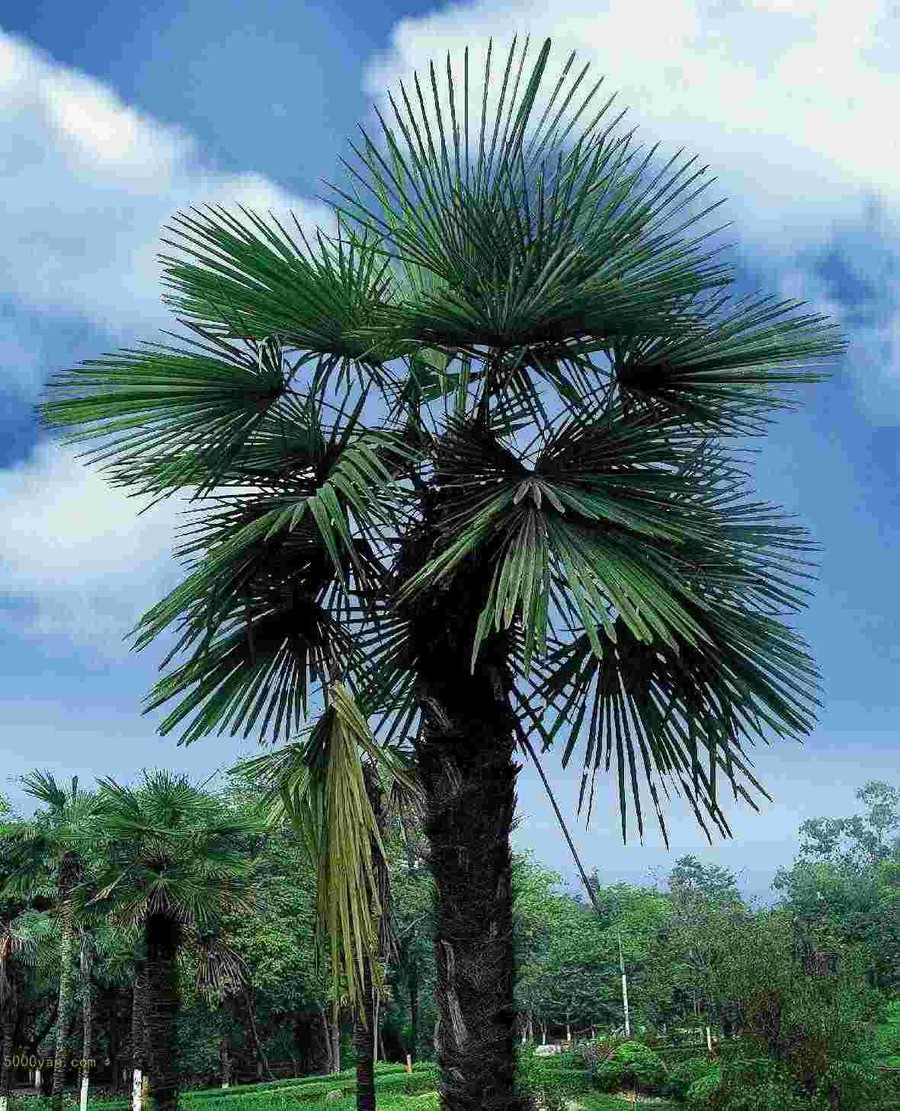
Evergreen tree, reaching over 10 m in height. Stem cylindrical, stout and erect, unbranched, approximately 20 cm in diameter, with residual brown fibrous old leaf sheaths layered and enveloping the stem, leaving ring-like nodes after shedding. Leaves clustered at stem apex, spreading outward; petiole rigid, about 1 m long, nearly triangular in cross-section, margin with small teeth, base with brown fibrous leaf sheaths, new petioles erect, old petioles often drooping; leaf blade nearly round-fan-shaped, 60-100 cm in diameter, with numerous folds, palmately divided to the middle, with 30-50 lobes, each lobe shallowly 2-cleft at apex, upper surface green, lower surface with waxy bloom, leathery. Spadix inflorescence emerging from leaf axils at stem apex, base with several large sheath-like bracts, pale yellow, pubescent. Dioecious; male flowers small, numerous, pale yellow, perianth 6, in 2 whorls, broadly ovate, stamens 6, filaments short, free; female flowers with perianth similar to male, ovary superior, densely white pubescent, style 3-lobed. Drupe spherical or nearly reniform, about 1 cm in diameter, exocarp gray-blue when ripe, covered with waxy bloom. Flowering period April to May, fruiting period October to December.
Habitat and Distribution
Cultivated or wild; grows near villages, courtyards, fields, hills, or mountainous areas. Widely distributed throughout regions south of the Yangtze River.
Harvesting and Processing
During harvesting, cut off the extending parts of old petioles and sheath pieces, remove the fibrous palm hairs, and dry in the sun.
Medicinal Properties
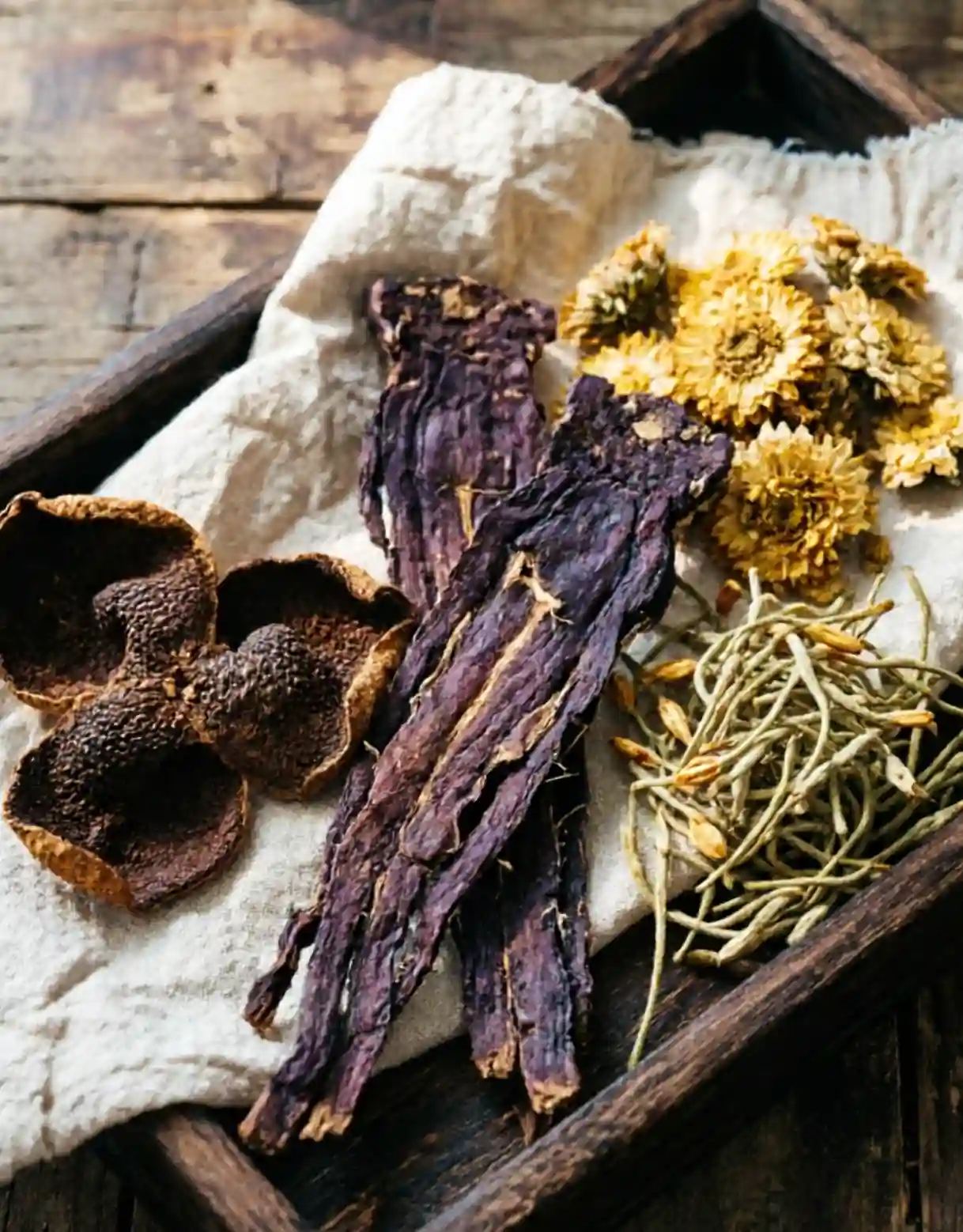
This product is in the form of long, board-like strips, with one end narrower and thicker and the other end wider and slightly thinner, varying in size. The surface is reddish-brown, rough, with longitudinal wrinkles; one side has distinctly protruding fibers, with numerous brown fuzz attached to both sides of the fibers. The texture is hard and tough, not easily broken, with a fibrous fracture. Odor: faint; Taste: bland.
Chemical Constituents
This product mainly contains glucoluteolin and luteolin-7-O- Yunxiangtanggan (rutin), methyl protopalmoside B, p-hydroxybenzoic acid, (+)-catechin, protocatechuic acid, gallic acid, and other constituents.
Pharmacology
Can shorten clotting time and has hemostatic effects.
Properties and Channel Entry
Bitter, astringent, and neutral. Enters the Lung, Liver, and Large Intestine channels.
Functions and Indications
Converges and stops bleeding. Used for hematemesis, epistaxis, hematuria, hemafecia, and metrorrhagia and metrostaxis.
Dosage and Administration
Internal: decoct in water, 10-15 g. External: appropriate amount, grind into powder for external application. Use after processing.
Precautions and Contraindications
For blood disorders with unresolved stasis and stagnation, it should not be used alone.
Prescriptions
1. For incessant uterine bleeding in women: Zonglvpi (charred palm bark) 30 g, Baivei (roasted arborvitae leaves) 30 g. Grind the two ingredients into a powder, take 6 g with wine. (From *Shengji Zonglu*, Zonglvpi Powder). 2. For persistent epistaxis: Zonglv (palm bark), Ciji (thistle), Huapi (birch bark), Longgu (dragon bone), equal parts. Grind into a fine powder, take 6 g each time with rice water. (From *Jifeng Puji Fang*, Zonglv Powder). 3. For urinary retention: Zonglv (palm bark fibers), burn to retain the nature, take with a small amount of wine for immediate relief; repeatedly tested with good results. (From *Shesheng Zhongmiao Fang*). 4. For hypertension: fresh Zonglvpi (palm bark) 18 g, fresh Xiangrikui Huapan (sunflower disc) 60 g. Decoct in water and take orally, one dose daily. (From *Jiangxi Herbal Medicine*).