Pinyin: Heye
Source
Plant of the Nymphaeaceae family, Nelumbo nucifera.Nelumbo nuciferaThe dried leaves of Gaertn.
Botanical Description
See the entry under "Oujie" (Lotus Rhizome Node).
Harvesting and Processing
Harvested in summer and autumn, dried to 70-80% dryness, remove the petioles, fold into a semicircle or fan shape, and dry thoroughly.
Medicinal Properties
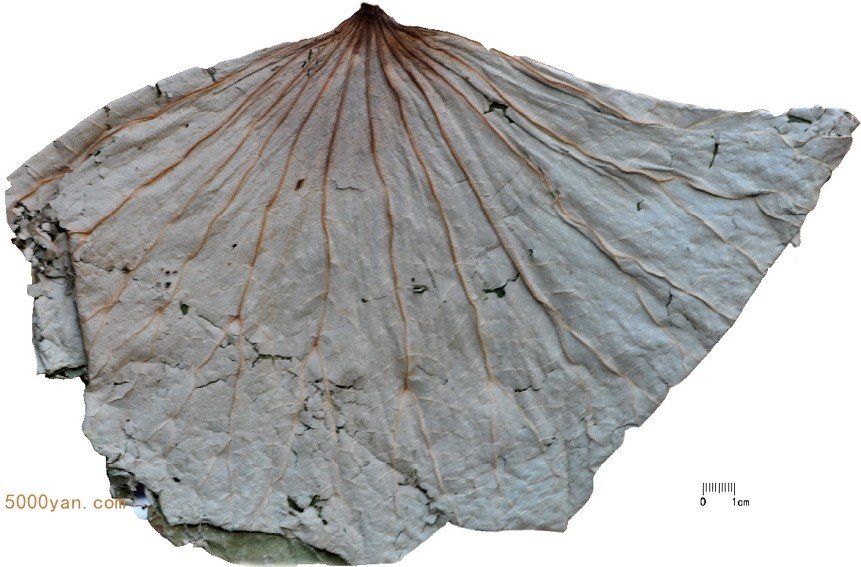
Leaves are semicircular or folded fan-shaped, becoming nearly round when spread out, entire or slightly undulate, with a diameter of 20-50 cm. The upper surface is dark green or yellow-green and relatively rough; the lower surface is pale grayish-brown, relatively smooth, with 21-22 thick veins radiating from the center outward; the center has a raised petiole base. The texture is brittle and easily broken. There is a slight, clear aroma, and the taste is slightly bitter.
Chemical Constituents
This product contains components such as roemerine, nuciferine, pronuciferine, dl-armepavine, anonaine, citric acid, and malic acid.
Properties and Channel Entry
Bitter, neutral. Enters the Liver, Spleen, and Stomach channels.
Functions and Indications
Clears Summerheat and transforms Dampness, raises and disperses Clear Yang, cools Blood and stops bleeding. Used for Summerheat-heat with vexation and thirst, Summerheat-dampness diarrhea, Spleen deficiency diarrhea, Blood-Heat vomiting and epistaxis, bloody stools and metrorrhagia. Heye Charcoal (carbonized lotus leaf) astringes, transforms stasis, and stops bleeding; used for bleeding disorders and postpartum blood collapse.
Dosage and Administration
Internal use: decoct 3-10 g (fresh product 15-30 g); lotus leaf charcoal 3-6 g, or made into pills or powder. External use: appropriate amount, mashed for application or decocted for washing.
Prescriptions
1. For Yang edema with swelling: Lotus leaf calcined until charred but retains its properties, grind into powder. Take 6 g each time, mixed with rice water, three times daily. (Zhengzhi Yaojue) 2. For thunder-head wind (severe headache with swelling): Shengma 30 g, Cangzhu 30 g, one piece of lotus leaf. Grind into powder. Take 15 g each time, decoct in water, take after meals. Alternatively, burn one whole lotus leaf, grind finely, and mix into the decoction before taking. (Weisheng Baojian, Qingzhen Tang) 3. For persistent hematemesis: a. Frosted old lotus leaf, calcined until charred but retains its properties, grind into powder. Take 6 g with fresh water. (Zhouhou Fang) b. Seven young lotus leaves, pound and take with water. (Gangmu) 4. For hematemesis and hemoptysis: Lotus leaf, any amount, dry over fire, pound into powder, mix with rice water and take 6 g. (Shengji Zonglu, Qingjin San) 5. For Yang invading Yin causing hematemesis and epistaxis: Fresh lotus leaf, fresh Aiye, fresh Baive, fresh Shengdihuang, equal parts. Grind and form into pills the size of chicken eggs. Take one pill each time, decoct in water and take orally. (Furen Liangfang, Sisheng Wan) 6. For postpartum metrorrhagia (persistent uterine bleeding): Lotus leaf 30 g (collected on the seventh day of the seventh lunar month), Lujiaojiao 60 g, pound and stir-fry until yellow and dry. Grind the above drugs into fine powder, take 6 g with warm wine before meals. (Shenghui Fang) 7. For rectal prolapse that does not retract: Lotus leaf, dry over fire, grind, take 6 g with wine, also sit on a pad of lotus leaf powder. (Jingyan Liangfang) 8. For wandering erysipelas (red, spreading skin infection): Fresh lotus leaf, pound into a paste, add salt and apply topically. (Zhai Xuan Fang)