Pinyin: Zisuye
Aliases
Su Ye, Zi Cai, Su.
Source
Plant of the Lamiaceae family, *Perilla frutescens* (L.) Britt.Perilla frutescensDried leaves (or tender branches with leaves) of (L.) Britt.
Botanical Description
See entry under "Zisuzi".
Harvesting and Processing
Harvest in summer when the branches and leaves are lush, remove impurities, and dry in the sun.
Medicinal Properties
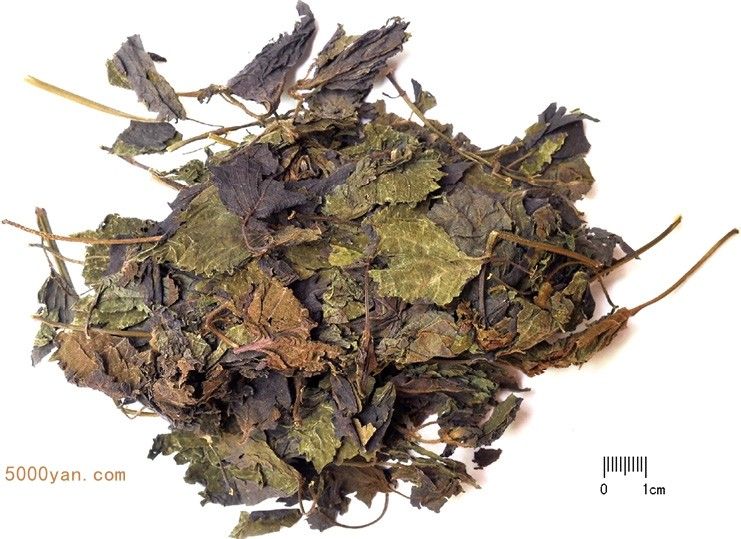
The leaves are mostly wrinkled, curled, and broken; when flattened, intact leaves are ovate, 4-11 cm long and 2.5-9 cm wide. The apex is long-acuminate or acute, the base is rounded or broadly cuneate, and the margin has rounded serrations. Both surfaces are purple, or the upper surface is green and the lower surface is purple, sparsely covered with gray-white hairs, and the lower surface has numerous punctate glandular scales. The petiole is 2-7 cm long, purple or purple-green. The texture is brittle. For those with young branches, the branch diameter is 2-5 mm, purple-green, and the cross-section shows a pith in the center. The odor is fragrant, and the taste is slightly pungent.
Chemical Constituents
This product contains perillaldehyde, limonene, linalool, perillaketone, and other components.
Pharmacology
It has antipyretic and sedative effects; exhibits excitatory membrane inhibitory effects; can promote the secretion of digestive juices, enhance gastrointestinal motility, and stimulate the circular muscles of the small intestine to facilitate the passage of intestinal contents. It has antitussive, expectorant, and antiasthmatic effects; hemostatic effects; anticoagulant and hyperglycemic effects; enhances immune function; demonstrates significant antimutagenic effects; antimicrobial activity; perilla has a mild inhibitory effect on adenylate cyclase; it also protects the skin from radiation damage and has anti-inflammatory effects.
Properties and Channel Entry
Acrid, warm. Enters the Lung and Spleen channels.
Functions and Indications
Releases the exterior and disperses Cold, moves Qi and harmonizes the Stomach
Dosage and Administration
Oral: decoct in water, 5-10 g. External: apply an appropriate amount, mash for poultice, grind into powder for application, or decoct for washing.
Precautions and Contraindications
Caution should be exercised in patients with Yin deficiency, Qi deficiency, and febrile diseases.
Prescriptions
1. For fever due to wind-cold: Zisuye (Perilla leaf), Fangfeng (Saposhnikovia root), and Chuanxiong (Szechuan lovage root) 4.5 g each, Chenpi (Tangerine peel) 3 g, Gancao (Licorice root) 1.8 g. Add a few slices of ginger, decoct and take. (Su Ye Tang from *Bu Zhi Yi Bi Yao*) 2. For cough, expelling phlegm and drool, and moistening the Lungs: Zisuye (Perilla leaf), Beimu (Fritillaria), Kuandonghua (Coltsfoot flower), and Hanfangji (Fourleaf ladybell root), equal parts. Grind the four ingredients into a fine powder, take 3 g per dose, add one tea bowl of water, decoct until 70% remains, and take warm. (Zi Su Yin from *Bo Ji Fang*) 3. For breast abscess with swelling and pain: Decoct Zisuye (Perilla leaf) in water and take frequently, and also pound the leaves and apply externally. (From *Hai Shang Ming Fang*) 4. For bleeding from incised wounds: Pound tender Zisuye (Perilla leaf) and Sangye (Mulberry leaf) together and apply as a plaster. (From *Yong Lei Qian Fang*) 5. For snake bites: Pound Zisuye (Perilla leaf), extract the juice, and drink it. (From *Qian Jin Yao Fang*) 6. For malignant sores, scabies, and tinea: Grind large Zisuye (Perilla leaf) into a fine powder and apply topically. (From *Pu Ji Fang*)