Pinyin: Mujingye
Aliases
Jingye
Source
Plant of the Verbenaceae family, Vitex negundo L. var. cannabifolia (Siebold & Zucc.) Hand.-Mazz.VitexnegundoL.var.cannabifoliaFresh leaves of (Sieb. et Zucc.) Hand.-Mazz.
Botanical Description
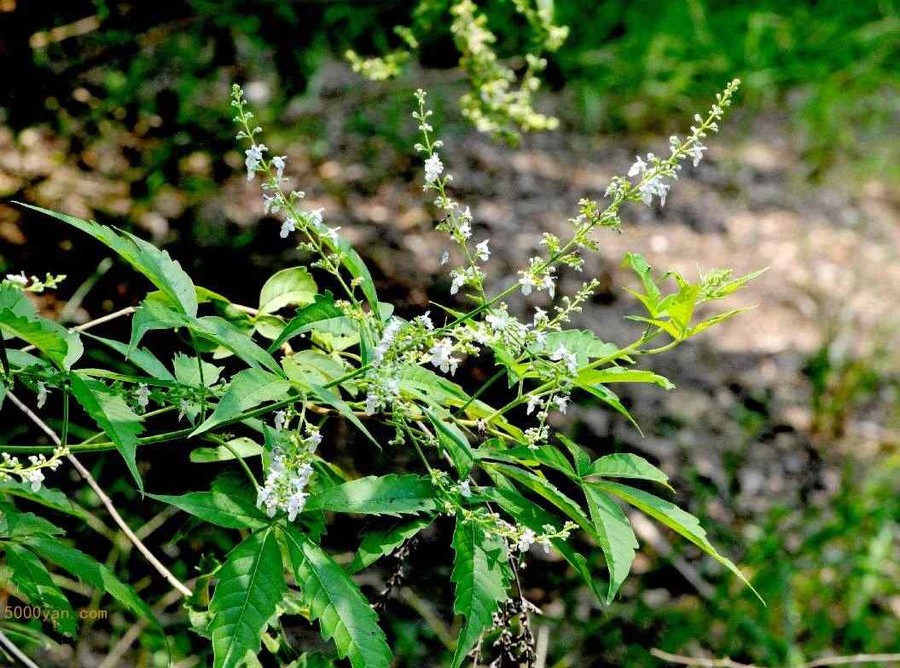
Deciduous shrub or small tree, 1-5 m tall. Much branched, aromatic. Branchlets quadrangular, green, coarsely hairy; older branches terete, brown. Leaves palmately compound, opposite; leaflets 5, rarely 3, the middle one largest; leaf blade lanceolate or elliptic-lanceolate, base cuneate, margin coarsely serrate, apex slightly acute, adaxially green, abaxially pale green, usually pubescent. Panicles terminal, 10-20 cm long; calyx campanulate, 5-toothed at apex; corolla pale purple, 5-lobed at apex, bilabiate. Fruit globose, black. Flowering and fruiting period: July to October.
Habitat and Distribution
Grows on sunny slopes, roadsides, or in shrublands at low elevations. Distributed in East China as well as Hebei, Hunan, Hubei, Guangdong, Guangxi, Sichuan, and Guizhou.
Harvesting and Processing
Harvested in summer and autumn when the leaves are lush, removed from stems and branches.
Medicinal Properties
This herb has palmately compound leaves with 5 or 3 leaflets, lanceolate or elliptic-lanceolate in shape. The central leaflet is 5-10 cm long and 2-4 cm wide, with the lateral leaflets gradually diminishing in size; the apex is acuminate, the base is cuneate, and the margin has coarse serrations. The upper surface is green, the lower surface is pale green, with short trichomes along the veins on both sides; the lower surface of young leaves has denser trichomes. The petiole is 2-6 cm long, with a shallow groove and densely covered with gray-white trichomes. Odor: aromatic; Taste: pungent and slightly bitter.
Chemical Constituents
This product containsβ- Dingxiangxi (caryophyllene), Xiangguixi (sabinene).β- Bisabolene, bornyl acetate, aciphyllene.α- cebrene and other constituents.
Pharmacology
Has expectorant, antitussive, and antiasthmatic effects; lowers blood pressure; regulates serum proteins; sedative and hypnotic. In vitro, it shows significant antibacterial activity against Staphylococcus aureus and Bacillus anthracis, and also exhibits some antibacterial activity against Escherichia coli, type B streptococcus, Corynebacterium diphtheriae, Salmonella typhi, Pseudomonas aeruginosa, and Shigella. It also has marked antihistamine effects.
Properties and Channel Entry
Slightly bitter and pungent, neutral in nature. Enters the Lung channel.
Functions and Indications
Expectorant, antitussive, and antiasthmatic. Used for cough with excessive phlegm.
Dosage and Administration
Oral: decoct in water for decoction, 9-15 g; fresh product can be used at 30-60 g; or crush to extract juice for drinking. External use: apply appropriate amount, crush and apply on the affected area; or decoct in water for fumigation and washing.
Prescriptions
1. For wind-cold common cold: fresh *Vitex negundo* leaves 24 g, or add fresh *Perilla frutescens* leaves 12 g, decoct in water for oral administration. (Fujian Chinese Herbal Medicine) 2. For preventing heat stroke: dried *Vitex negundo* tender leaves 6-9 g, decoct in water and drink as tea. (Fujian Chinese Herbal Medicine) 3. For hematuria: crush fresh *Vitex negundo* leaves to extract juice, take 2 ge (approx. 60 mL) with wine. (Thousand Golden Prescriptions) 4. For acute gastroenteritis: fresh *Vitex negundo* stems and leaves 30-60 g, decoct in water for oral administration. (Fujian Chinese Herbal Medicine) 5. For chronic dysentery unhealed: fresh *Vitex negundo* stems and leaves 15-24 g, add rock sugar, steep in boiling water and stew for 3 hours, take before meals, twice daily. (Fujian Folk Herbal Medicine) 6. For tinea pedis: fresh *Vitex negundo* leaves, fresh *Pinus massoniana* leaves, and *Camellia oleifera* seed cake, equal amounts. Decoct in water and fumigate-wash the affected area. (Fujian Chinese Herbal Medicine) 7. For urticaria: *Vitex negundo* leaves 9-15 g, decoct in water for oral administration; or alternatively use the leaves to prepare a decoction for fumigation-washing. (Fujian Chinese Herbal Medicine) 8. For tinea capitis: a. Take fresh *Vitex negundo* leaves 500 g, add boiling water 1000 mL, soak for 15 min then filter, use the filtrate to wash the head for 5-8 min, once daily. b. Fresh leaves 250 g, mash into a paste, apply to the affected area, twice daily. After washing and applying, wrap the head with a cloth. Generally, after 4 days of washing and applying, scalp itching disappears, pustules and bran-like scales reduce, and hair regrows after 2 months. [Zhejiang Medical Journal, 1962, 3(6):260]