Pinyin: Pipaye
Aliases
Baye, Lujuye.
Source
Rosaceae family plant *Eriobotrya japonica* (Loquat).Erio-botrya japonicaDried leaf of (Thunb.) Lindl.
Botanical Description
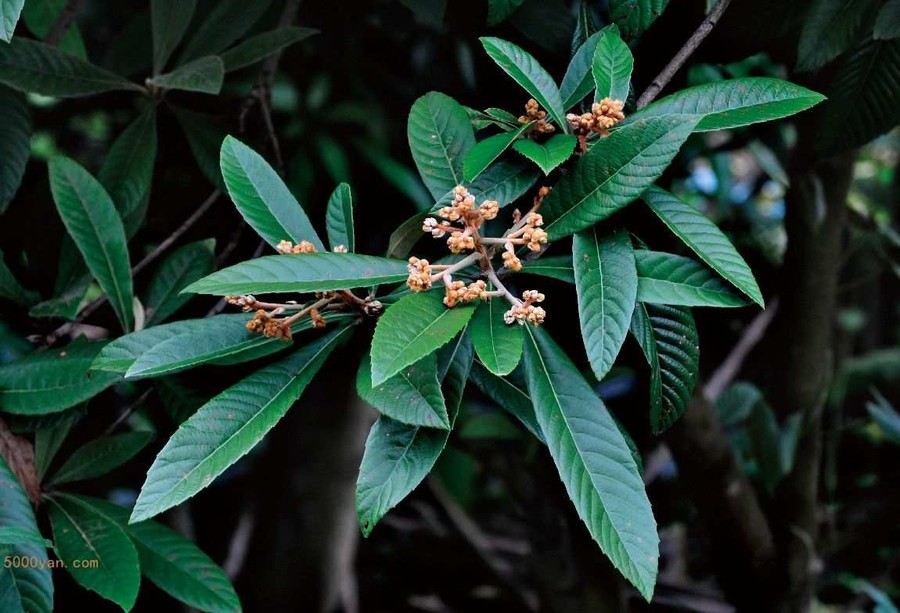
Evergreen small tree, approximately 10 m tall. Branches stout, yellow-brown, densely covered with rusty or gray-brown tomentum. Leaves leathery; petioles short or nearly absent, 6-10 mm long, with gray-brown tomentum; stipules subulate, hairy; leaf blades lanceolate, oblanceolate, obovate, or oblong-elliptic, upper margins with sparse serrations, upper surface glossy and wrinkled, lower surface and petioles densely covered with gray-brown tomentum, lateral veins 11-21 pairs. Panicles terminal, rachis and pedicels densely covered with rusty tomentum; flowers 1.2-2 cm in diameter; calyx tube shallowly cup-shaped, calyx lobes triangular-ovate, rusty tomentose externally; petals white, oblong or ovate, clawed at base, rusty tomentose; stamens 20, styles 5, free, stigma capitate, glabrous. Fruit globose or oblong, 3-5 cm in diameter, yellow or orange-red; seeds 1-5, globose or oblate, 1-1.5 cm in diameter, brown, glossy, seed coat papery. Flowering period October to December, fruiting period May to June.
Habitat and Distribution
Commonly cultivated near villages, on flatlands or slopes. Distributed in Central and Southern China, as well as Shaanxi, Gansu, Jiangsu, Anhui, Zhejiang, Jiangxi, Fujian, Taiwan, Sichuan, Guizhou, and Yunnan.
Harvesting and Processing
Harvest year-round, sun-dry to 70-80% dry, bundle into small handfuls, then continue sun-drying until completely dry.
Medicinal Properties
Leaves oblong or obovate, 12-30 cm long, 4-9 cm wide. Apex acute, base cuneate, margin with sparse serrations, entire near the base. Upper surface grayish-green, yellowish-brown, or reddish-brown, relatively smooth; lower surface densely covered with yellow tomentum, midrib prominently raised on the lower surface, lateral veins pinnate; petiole very short, covered with brownish-yellow tomentum. Leathery and brittle, easily broken. Odor: faint; Taste: slightly bitter.
Chemical Constituents
This product contains nerolidol, farnesol, and amygdalin.β- beta-sitosterol, maslinic acid, citric acid and other constituents.
Pharmacology
Has a sedative, antiasthmatic, and antitussive effect on the respiratory center. Topical application exhibits a strong inhibitory effect on carrageenan-induced edema and can significantly reduce urinary glucose in genetically diabetic mice and normal mice.
Properties and Channel Entry
Bitter, slightly cold. Enters the Lung and Stomach channels.
Functions and Indications
Clears Lung Heat, stops cough, directs rebellious Qi downward, and stops vomiting
Dosage and Administration
Internal administration: decocted in water, 9-15 g, up to 30 g in large doses; fresh product 15-30 g; or prepared as a paste, or made into pills or powder. For moistening the Lungs, descending Qi, and stopping cough, it is suitable to stir-fry with honey juice; for harmonizing the Stomach, descending Qi, and stopping nausea and vomiting, it is suitable to stir-fry with ginger juice.
Precautions and Contraindications
When used in decoctions, it should be wrapped and decocted. Contraindicated in cases of stomach-cold vomiting and wind-cold cough.
Prescriptions
1. For cough with phlegm sound in the throat: Loquat leaf 15 g, Sichuan fritillary bulb 1.5 g, apricot kernel 6 g, tangerine peel 6 g. Grind into powder, take 3-6 g each time with boiled water. (Diannan Materia Medica) 2. For lung heat cough: Loquat leaf 9 g, mulberry root bark 12 g, Scutellaria root 6 g, decoct in water for oral administration. Or honey-fried loquat leaf 12 g, honey-fried mulberry root bark 15 g, decoct in water for oral administration. (Shaanxi Chinese Herbal Medicine) 3. For wind-heat cough: Loquat leaf, bitter apricot kernel, mulberry root bark, chrysanthemum, burdock fruit each 9 g, decoct and take. (Anhui Chinese Herbal Medicine) 4. For lung wind with rebellious cough: Dried loquat leaf 30 g, coriander herb and hogfennel root each 15-18 g, mugwort leaf 5 pieces. Decoct in water, add brown sugar, take in the morning and evening on an empty stomach. (Tianmu Mountain Medicinal Plants) 5. For lung dryness cough: Dried loquat leaf (remove fuzz) 9 g, dried mulberry leaf 9 g, cogongrass rhizome 15 g, decoct in water for oral administration. (Guangxi Folk Commonly Used Chinese Herbal Medicine Manual) 6. For whooping cough: Loquat leaf 15 g, mulberry root bark 15 g, wolfberry root bark 9 g, licorice 3 g. Decoct in water for oral administration. (Jiangxi Herbal Medicine Manual) 7. For chronic bronchitis with cough, wheezing, and copious phlegm: Loquat leaf, winter mulberry leaf, plantain herb, milkweed pod, trichosanthes root in equal parts. Decoct and take. (Shanghai Commonly Used Chinese Herbal Medicine) 8. For facial sores: Loquat leaf, wipe off fuzz with cloth, roast dry, grind into powder, take 6 g with tea after meals. (Emergency Good Prescriptions)