Pinyin: Chouwutong
Aliases
Qiuye Changshan, Aitongzi, Qiuye Cha
Source
1. Verbenaceae plant Haizhouchangshan.Clerodendrum trichotomumDried young branches and leaves of Thunb.
Botanical Description
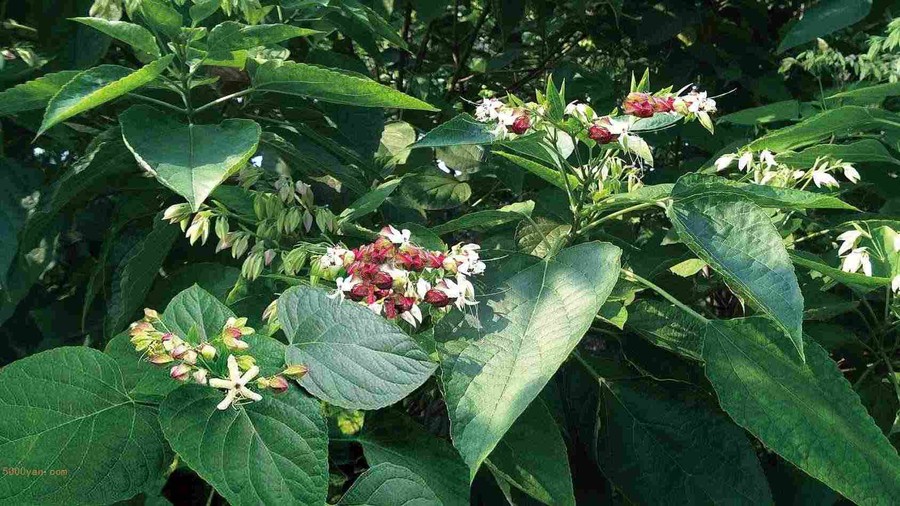
Shrub or small tree, 1.5-10 m tall. Young branches, petioles, and inflorescences sparsely to moderately covered with yellowish-brown pubescence or nearly glabrous; old branches gray-white, with lenticels, pith white, with pale yellow thin transverse septa. Leaves simple, opposite; petiole 2-8 cm long; leaf blade papery, broadly ovate, ovate, ovate-elliptic, or triangular-ovate, 5-17 cm long, 5-14 cm wide, apex acute to acuminate, base broadly cuneate to cuneate, occasionally cordate, margin entire or undulate-dentate, both surfaces sparsely pubescent or nearly glabrous; lateral veins 3-5 pairs. Corymbose cymes terminal or axillary, lax, usually dichotomously branched, inflorescence 8-18 cm long, peduncle 3-6 cm long, with elliptic leaf-like bracts, early deciduous; calyx greenish-white when young, later purple-red, fused at base, slightly swollen in the middle, 5-ribbed, apex 5-lobed, lobes triangular-lanceolate or ovate; corolla white or pinkish, corolla tube slender, apex 5-lobed, lobes oblong; stamens 4, exserted together with the style. Drupe subglobose, 6-8 mm in diameter, enclosed by the enlarged persistent calyx, blue-purple when ripe. Flowering and fruiting period: June-November.
Habitat and Distribution
Grows in thickets on mountain slopes. Distributed in North China, East China, Central South, Southwest, and other regions.
Harvesting and Processing
Harvested from June to October, bundled into sheaves, and dried in the sun.
Medicinal Properties
Branchlets suborbicular or slightly quadrangular, approximately 3 mm in diameter, yellow-green, with fine longitudinal wrinkles, yellow punctate lenticels, densely covered with short pubescence, which falls off in older specimens; texture brittle, easily broken, with the broken surface showing a pale yellow xylem and white pith. Leaves opposite, mostly wrinkled and curled, or broken; when fully expanded, the intact leaves are broadly ovate or elliptical, 7-15 cm long, 5-9 cm wide, apex acuminate, base broadly cuneate or truncate, margin entire or with undulate teeth. Upper surface gray-green, lower surface yellow-green, both surfaces with short pubescence; petiole 2-8 cm long, densely covered with short pubescence. Flowers mostly withered, yellow-brown, with long pedicels, stamens protruding beyond the corolla; in fruiting specimens, the calyx is persistent, withered yellow, containing a fruit, trigonous-ovoid, gray-brown, with wrinkled texture. Odor: characteristic, unpleasant; Taste: bitter and astringent. The best quality is characterized by dry flowering branches and green leaves.
Chemical Constituents
This product contains clerodendroside, meso-inositol, and alkaloids. It also contains acacetin-7-diglucuronide, plant lectin, clerodendronin A, clerodendronin B, clerodendrin A, and clerodendrin B, among others.
Pharmacology
Has antihypertensive, anti-inflammatory, analgesic, and sedative effects, and also has anthelmintic (expelling intestinal worms) effects.
Properties and Channel Entry
Bitter, slightly acrid, and neutral in nature.
Functions and Indications
Dispels Wind and eliminates Dampness, calms the Liver and lowers Blood pressure, resolves toxicity and kills parasites. Main indications: Wind-Damp Bi pain (rheumatic pain), hemiplegia, hypertension, migraine, malaria, dysentery, abscesses and sores, eczema and scabies.
Dosage and Administration
Oral: decoct in water, 10-15 g, fresh product 30-60 g; or steep in wine; or made into pills or powder. External use: appropriate amount, decoct in water for washing; or mash for application; or grind into powder for dusting or mixing for application.
Precautions and Contraindications
After high-temperature decoction, the antihypertensive effect of Chouwutong is diminished.
Prescriptions
1. For hypertension: a. 15 g each of *Clerodendrum trichotomum* leaf and *Capsella bursa-pastoris*, with 9 g of *Prunella vulgaris*. Decoct in water for oral administration. (*Hunan Materia Medica*) b. Equal amounts of *Clerodendrum trichotomum* leaf and *Chrysanthemum indicum*. Grind into fine powder, make into honey pills, take 9 g per dose. (*Wanxian Chinese Herbal Medicine*) 2. For hemiplegia: Dry *Clerodendrum trichotomum* leaves and stems in the sun, grind into powder, total 2 jin, mix with 1 jin of white honey to make pills. Take 9 g per dose, with boiling water in the morning and with wine in the evening. (*Compendium of Materia Medica* Supplement) 3. For rheumatic pain, bone and joint soreness, and hypertension: 9-30 g of *Clerodendrum trichotomum*, decoct and take; or grind into powder, take 3 g per dose, 3 times daily. It can also be used in combination with *Siegesbeckia orientalis*. (*Shanghai Commonly Used Chinese Herbal Medicines*) 4. For unilateral headache: 15 g of *Zanthoxylum bungeanum* and 60 g of *Clerodendrum trichotomum* leaf. First stir-fry the *Clerodendrum* leaves until yellow, then add the *Zanthoxylum* and stir-fry again. Sprinkle strong liquor into the pot, mix well, and remove. Wrap in silk fabric and apply to the painful area. Drink a bowl of hot wine, cover the neck with a quilt and sleep; sweating leads to recovery. (*Compendium of Materia Medica* Supplement) 5. For all types of internal and external hemorrhoids: Seven pieces of *Clerodendrum trichotomum* leaf, seven pieces of *Orostachys fimbriata*, and 9 g of sodium sulfate. Decoct in water for fumigation and washing. (*Compendium of Materia Medica* Supplement) 6. For eczema or itchy miliaria: Appropriate amount of *Clerodendrum trichotomum*, decoct in water for bathing. (*Shanghai Commonly Used Chinese Herbal Medicines*) 7. For tinea manuum: 30 g each of *Clerodendrum trichotomum* leaf, *Dictamnus dasycarpus* root bark, and *Cnidium monnieri* fruit. Decoct in water and apply hot to the affected area. (*Qingdao Chinese Herbal Medicine Manual*) 8. For carbuncle, furuncle, and ulcerative sores: Grind *Clerodendrum trichotomum* leaves into powder for external application, or mix with honey for external application. (*Wanxian Chinese Materia Medica*)